
Palm Sunday marks one of the most dramatic moments in Jesus’ life, yet most Christians are only familiar with the Sunday school version.
You know the basics: Jesus rode a donkey into Jerusalem while people waved palm branches and shouted “Hosanna.”
It’s the beginning of Holy Week, the Sunday before Easter.
Churches hand out palm fronds, kids wave them around, and everyone sings songs about Jesus entering the city.
But there’s so much more happening beneath the surface of this story.
Political rebellion disguised as religious celebration.
Fulfilled prophecy that Jewish leaders should have recognized.
A king claiming His throne while knowing it would cost Him His life.
And a crowd whose worship would turn to murder in less than a week.
When you understand what Palm Sunday actually meant in its historical context, the entire week leading to the crucifixion and resurrection makes more sense.
This wasn’t just a nice parade.
It was Jesus’s deliberate, strategic declaration of who He was, knowing exactly what would happen next.
The Biblical Account: Where Palm Sunday Appears in Scripture
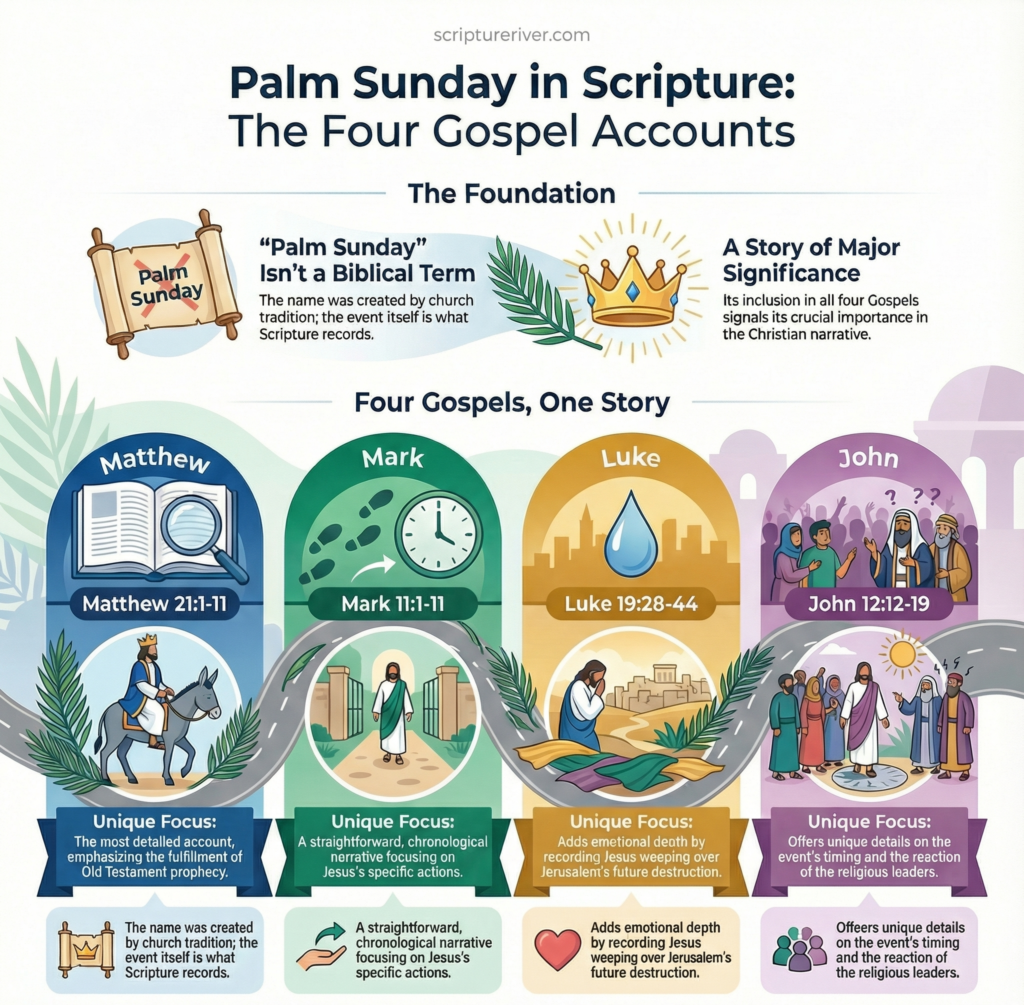
Palm Sunday isn’t called “Palm Sunday” anywhere in the Bible.
That name came later from church tradition.
But the event itself is recorded in all four Gospels, which tells you how significant it was.
When all four Gospel writers include the same story, pay attention.
Matthew 21:1-11 provides the most detailed narrative, including the fulfillment of Old Testament prophecy.
Mark 11:1-11 provides a straightforward chronological account focusing on Jesus’s actions.
Luke 19:28-44 adds emotional depth, recording Jesus’s grief over Jerusalem’s coming destruction.
John 12:12-19 offers unique details about the timing and the Jewish leaders’ response.
Each Gospel emphasizes different aspects of the same event, and when you read them together, a complete picture emerges.
This wasn’t a spontaneous celebration. Everything Jesus did was intentional, prophetically significant, and politically explosive.
Let’s look at the full story as Scripture records it.
The Journey to Jerusalem: What Led to Palm Sunday
Palm Sunday didn’t happen in isolation.
Jesus had been traveling toward Jerusalem deliberately for months. Luke 9:51 says He “resolutely set out for Jerusalem,” which means He made a determined decision to go there knowing what awaited Him.
He’d told His disciples repeatedly what would happen in Jerusalem.
He would be betrayed. Arrested. Mocked. Beaten. Crucified. And on the third day, He would rise again.
The disciples heard these predictions but didn’t understand them.
They were still expecting Jesus to establish an earthly kingdom and overthrow Roman occupation.
By the time they reached the outskirts of Jerusalem, massive crowds were gathering for Passover.
Jewish people from all over the Roman Empire were flooding into Jerusalem for the feast.
The city’s population would swell from about 40,000 to over 200,000 during Passover week.
Political tensions were always high during this festival because it celebrated Israel’s liberation from slavery in Egypt.
Rome stationed extra troops in Jerusalem during Passover specifically because rebellion was likely when hundreds of thousands of Jews gathered to remember freedom from oppression.
Into this powder keg of religious fervor and political tension, Jesus made His entrance.
The Donkey: Why Jesus’s Choice of Transportation Mattered
Jesus didn’t just happen to find a donkey.
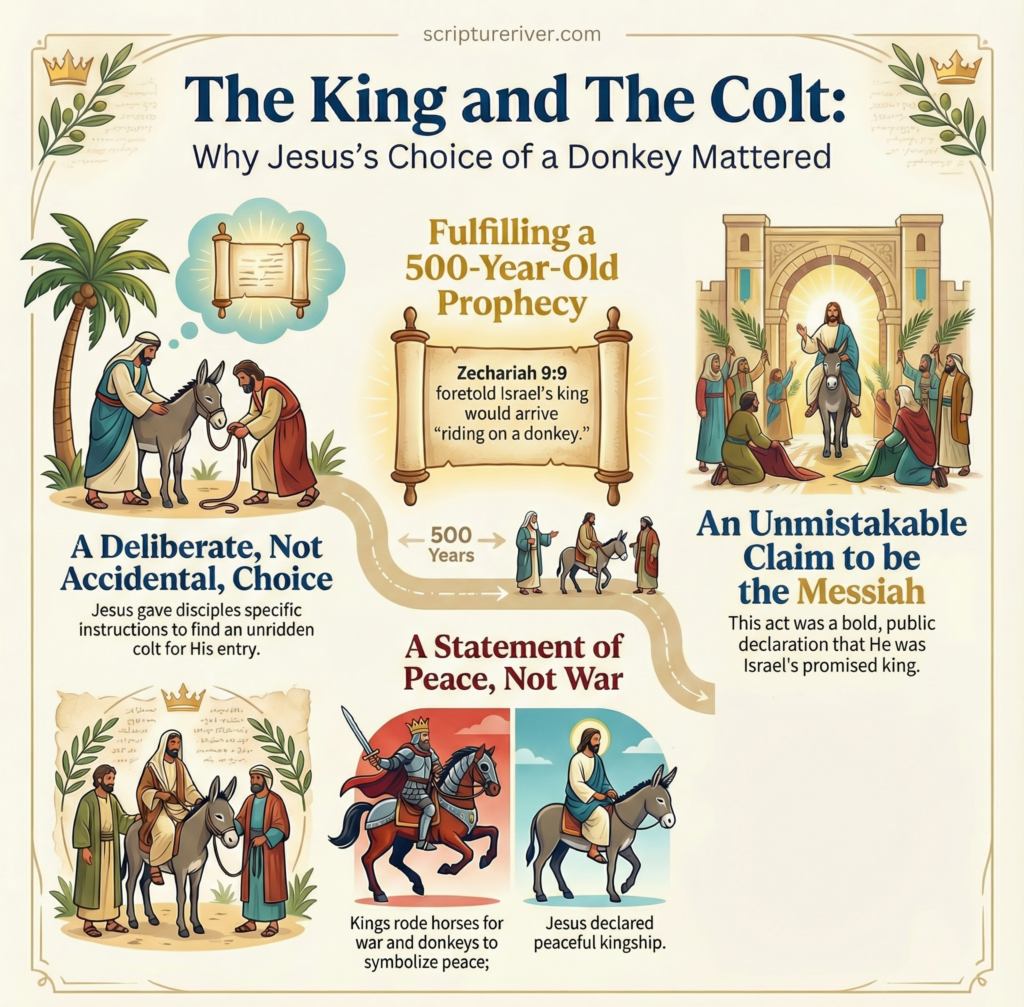
He sent two disciples ahead with specific instructions to retrieve a colt that had never been ridden, telling them exactly where they’d find it and what to say when asked why they were taking it.
Here’s the account from Mark 11:2-3, New International Version (NIV):
“Go to the village ahead of you, and just as you enter it, you will find a colt tied there, which no one has ever ridden. Untie it and bring it here. If anyone asks you, ‘Why are you doing this?’ say, ‘The Lord needs it and will send it back here shortly.'”
Everything happened exactly as Jesus said it would.
But why a donkey? Why not walk like He’d been doing for three years? Why not a horse, which would have been more impressive?
The donkey was a deliberate prophetic statement.
Zechariah 9:9 had prophesied 500 years earlier:
“Rejoice greatly, Daughter Zion! Shout, Daughter Jerusalem! See, your king comes to you, righteous and victorious, lowering himself and riding on a donkey, on a colt, the foal of a donkey.” (New International Version)
Every educated Jew knew this prophecy.
When Jesus rode that donkey into Jerusalem, He was publicly claiming to be Israel’s promised king.
Not subtly. Not ambiguously. Boldly and unmistakably.
But here’s what most people miss: kings rode horses when going to war and donkeys when coming in peace.
Jesus was declaring kingship while simultaneously declaring He came in peace, not in military conquest.
He was fulfilling messianic prophecy while subverting expectations about what kind of Messiah He would be.
The religious leaders would have understood this immediately. Jesus wasn’t being humble or random.
He was making the most politically explosive claim possible during the most volatile week of the year.
The Crowd’s Response: What “Hosanna” Actually Meant
As Jesus rode into Jerusalem, the crowd went wild.
Matthew 21:8-9, English Standard Version (ESV) describes the scene:
“Most of the crowd spread their cloaks on the road, and others cut branches from the trees and spread them on the road. And the crowds that went before him and that followed him were shouting, ‘Hosanna to the Son of David! Blessed is he who comes in the name of the Lord! Hosanna in the highest!'”
Let’s break down what was actually happening here.
Spreading cloaks on the road was how people honored kings.
When Jehu was anointed king of Israel in 2 Kings 9:13, the people immediately spread their garments under him.
The crowd was treating Jesus like royalty.
The palm branches carried a specific political meaning.
Palms had become symbols of Jewish nationalism and resistance against foreign occupation.
When the Maccabees liberated Jerusalem from Greek oppression 200 years earlier, the people celebrated by waving palm branches.
Using palms to greet Jesus was a political statement about liberation and kingship.
But the real explosive element was what they were shouting.
“Hosanna” is a Hebrew word meaning “save now” or “save, we pray.”
It comes from Psalm 118:25-26, a messianic psalm sung during Passover that looked forward to God’s deliverance.
When the crowd shouted “Hosanna to the Son of David,” they were explicitly calling Jesus the Messiah, the descendant of David who would restore Israel’s kingdom.
“Blessed is he who comes in the name of the Lord” was the next line from the same psalm, recognizing Jesus as God’s anointed one.
This wasn’t just religious enthusiasm. It was a political revolution dressed in biblical language.
The crowd was publicly proclaiming Jesus as the Messiah-King who would overthrow Roman occupation and restore Israel’s glory.
They expected Him to ride into Jerusalem, gather an army, and start the rebellion.
They had no idea He was riding toward a cross, not a throne.
The Religious Leaders’ Reaction: Why They Wanted Jesus Dead
The Pharisees and religious leaders were terrified by what they were witnessing.
Luke 19:39-40, New Living Translation (NLT) records their response:
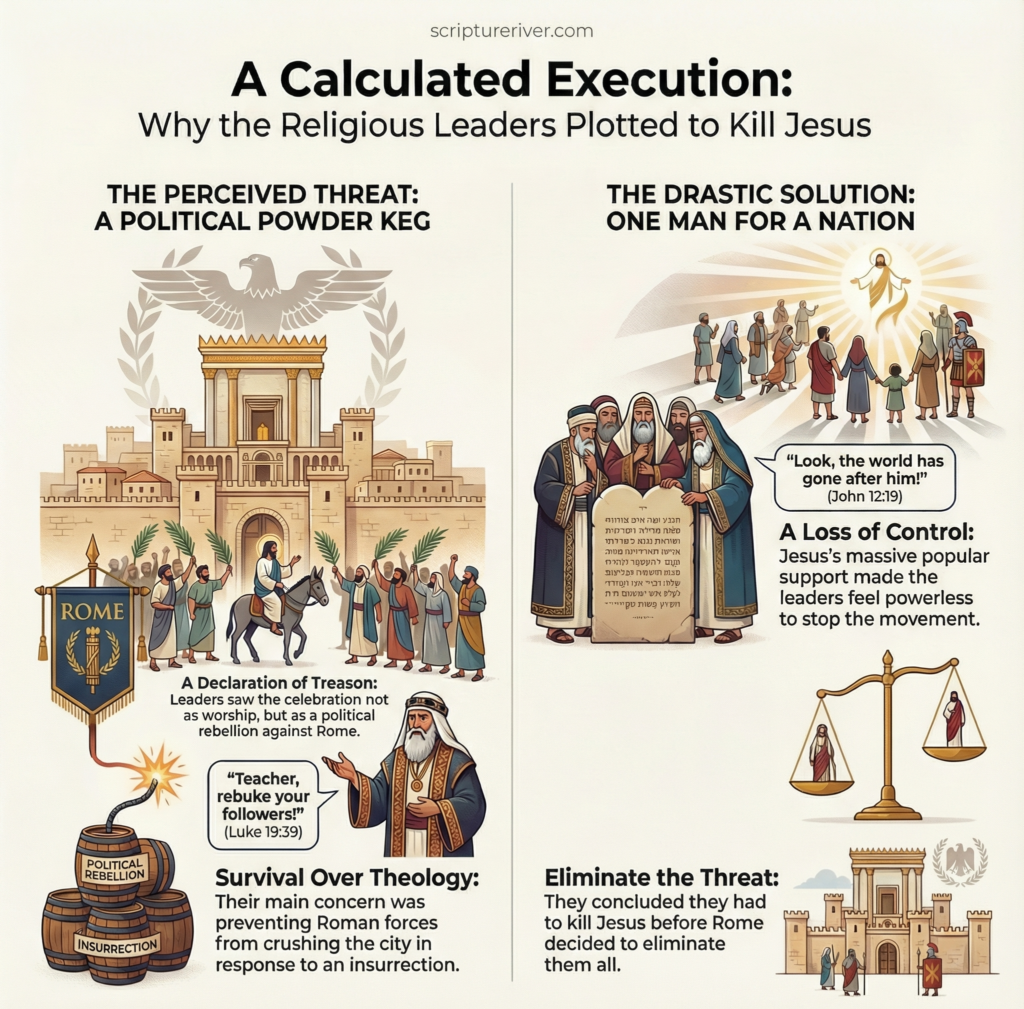
“But some of the Pharisees among the crowd said, ‘Teacher, rebuke your followers for saying things like that!’ He replied, ‘If they kept quiet, the stones along the road would burst into applause!'”
The Pharisees demanded that Jesus silence the crowd.
They understood exactly what was happening.
This was a messianic proclamation. Political rebellion.
Treason against Rome, which could bring violent retribution on the entire Jewish nation.
If Rome saw this demonstration and interpreted it as an attempted insurrection, they would crush it brutally and punish the whole city.
The religious leaders weren’t concerned about theological accuracy. They were concerned about survival.
Jesus refused to silence the crowd, essentially confirming everything they were saying about Him.
He was the Messiah. He was the promised King. Creation itself would declare it if humans didn’t.
John 12:19, Christian Standard Bible (CSB) captures the Pharisees’ frustrated response:
“Then the Pharisees said to one another, ‘You see? You’ve accomplished nothing. Look, the world has gone after him!'”
From their perspective, they’d lost control.
Jesus had massive popular support. The crowd was treating Him like the Messiah-King.
If this continued, Rome would respond with military force, destroying the temple and scattering the Jewish people.
Their solution?
Eliminate Jesus before Rome eliminates them all.
The very demonstration that looked like Jesus’s greatest triumph set in motion the events leading to His crucifixion five days later.
Jesus’s Emotional Response: The Moment Most People Miss
While the crowd celebrated and the Pharisees fumed, Jesus wept.
Luke 19:41-44, New International Version (NIV) records this heartbreaking moment:
“As he approached Jerusalem and saw the city, he wept over it and said, ‘If you, even you, had only known on this day what would bring you peace—but now it is hidden from your eyes. The days will come upon you when your enemies will build an embankment against you and encircle you and hem you in on every side. They will dash you to the ground, you and the children within your walls. They will not leave one stone on another, because you did not recognize the time of God’s coming to you.'”
This is the part that breaks my heart every time I read it.
Jesus was being celebrated as the conquering king, yet He was weeping because He knew what was coming.
Not just His own suffering and death, but Jerusalem’s destruction forty years later, when Rome would indeed destroy the city exactly as He predicted.
The people shouting “Hosanna” didn’t recognize their moment of visitation.
They wanted a political messiah who would defeat Rome militarily.
Jesus came as a suffering servant who would defeat sin and death spiritually.
They were celebrating Him for the wrong reasons, and it would lead to their rejection of Him when He didn’t meet their expectations.
Within days, some of these same people shouting “Hosanna” would be shouting “Crucify Him.”
Jesus knew this.
He knew He was riding toward betrayal, abandonment, torture, and execution. Yet He kept going because this was why He came.
What Happened Next: From Palm Sunday to Good Friday
Palm Sunday was Sunday. Jesus was crucified on Friday.
In five days, everything changed.
Monday: Jesus cleansed the temple, driving out money changers and merchants, declaring His authority over the temple itself. This enraged religious leaders even more.
Tuesday: Jesus taught in the temple courts, engaged in confrontations with religious leaders, and delivered His final public teachings, including prophecies about the end times.
Wednesday: Judas Iscariot agreed to betray Jesus to the religious leaders for thirty pieces of silver. The countdown to crucifixion began.
Thursday: Jesus shared the Last Supper with His disciples, instituted communion, washed their feet, and prayed in Gethsemane before being arrested.
Friday: Jesus was tried, convicted, tortured, and crucified. The king whom the crowd celebrated on Sunday was executed as a criminal on Friday.
The same crowds? Largely silent or actively hostile.
The messianic expectations from Palm Sunday? Shattered.
The political revolution that people anticipated? Replaced with what looked like a catastrophic failure.
But Sunday was coming.
Resurrection would prove that Jesus knew exactly what He was doing all along.
The Theological Significance: Why Palm Sunday Matters for Christians Today
Palm Sunday isn’t just a historical event to commemorate.
It reveals essential truths about who Jesus is and what He came to do.
It Confirms Jesus as the Promised Messiah
Jesus deliberately fulfilled Zechariah 9:9 by riding a donkey into Jerusalem.
This wasn’t accidental. He was publicly identifying himself as the prophesied Messiah-King.
For us today, Palm Sunday is evidence that Jesus is exactly who He claimed to be.
A prophecy written 500 years earlier came true in precise detail.
It Demonstrates Jesus’s Intentional Path to the Cross
Jesus didn’t stumble into crucifixion. He walked toward it deliberately.
Palm Sunday shows He was in complete control even while appearing vulnerable.
He orchestrated His entrance to force the confrontation that would lead to His death, because His death was the whole point.
We serve a Savior who chose the cross for us, not a victim who got caught.
It Reveals Human Fickleness and Failed Expectations
The crowd’s shift from “Hosanna” to “Crucify Him” in five days exposes how quickly human enthusiasm evaporates when expectations aren’t met.
We do the same thing.
We celebrate Jesus when we think He’ll give us what we want, then turn away when He doesn’t perform according to our timeline or preferences.
Palm Sunday challenges us to worship Jesus for who He actually is, not who we want Him to be.
It Shows Jesus’s Heart for the Lost
While being celebrated, Jesus wept over the city that would reject Him.
His compassion for people who were about to kill Him reveals the heart of God toward sinners. He doesn’t celebrate our destruction. He grieves it, even while knowing it’s the consequence of rejecting Him.
How Christians Observe Palm Sunday Today
Palm Sunday has been commemorated by the church for over 1,500 years.
Different traditions observe it in various ways, but common practices include:
Palm Processions: Many churches distribute palm branches and hold processions recreating Jesus’s entry into Jerusalem. Children often lead these processions, waving palms and singing.
Scripture Reading: All four Gospel accounts of the triumphal entry are read, sometimes dramatically, with different people reading different parts.
Special Music: Hymns and songs focusing on Jesus as King are sung, including “All Glory, Laud, and Honor” and “Hosanna, Loud Hosanna.”
Communion Services: Some traditions celebrate the Lord’s Supper on Palm Sunday, connecting Jesus’s entry into Jerusalem with His ultimate sacrifice.
Palm Crosses: Palms are often folded into crosses and given to congregants as reminders of the week ahead and where Jesus’s kingship leads.
The point isn’t the traditions themselves but what they point to: Jesus is the Messiah-King who willingly went to His death to save us.
Common Misconceptions About Palm Sunday Corrected
Let me clear up several misunderstandings people have about this event.
Misconception 1: It Was a Spontaneous Celebration
No. Jesus planned every detail. He sent disciples to get a specific donkey. He chose the route. He timed it for maximum impact during Passover when Jerusalem was packed with pilgrims.
This was a calculated prophetic demonstration, not a spontaneous parade.
Misconception 2: Everyone in Jerusalem Celebrated Jesus
The Gospels specify “crowds” and “disciples,” not the entire city. Many Jerusalem residents were probably unaware or indifferent.
The religious establishment actively opposed what was happening. The celebration wasn’t universal.
Misconception 3: The Same Exact People Who Shouted “Hosanna” Shouted “Crucify Him”
Possibly some overlap, but likely different groups.
The Palm Sunday crowd included pilgrims visiting for Passover. The crucifixion crowd five days later may have included more Jerusalem residents influenced by religious leaders’ propaganda.
We don’t know for certain it was the same people, though human nature suggests some who celebrated Sunday probably turned on Jesus by Friday.
Misconception 4: Jesus Rode Into Jerusalem to Be Crowned King Immediately
The crowd expected this, but Jesus never intended it.
He came to die, not reign. His kingdom wasn’t political or earthly at that time. The crown He’d wear within the week would be thorns, not gold.
Applying Palm Sunday to Your Life Today
So what does a 2,000-year-old parade mean for your life right now?
More than you might think.
Recognize Jesus’s True Identity
The crowds got excited about Jesus for the wrong reasons. They wanted a political deliverer, not a suffering savior.
Do you accept Jesus for who He actually is, or only for what you want Him to do for you?
Palm Sunday challenges you to examine whether you’re worshiping the real Jesus or a version you’ve created to meet your preferences.
Understand the Cost of Discipleship
Jesus rode toward His death intentionally. Following Him means embracing the same path of sacrificial obedience.
If you’re only interested in Christianity when it makes your life easier or more comfortable, you’ve missed the message of Palm Sunday entirely.
Check Your Expectations of God
When God doesn’t perform according to your timeline or preferences, do you turn away as the crowd did?
Faith that’s conditional on getting what you want isn’t real faith. It’s manipulation disguised as religion.
Remember That Jesus Knows What’s Coming
Just as Jesus knew Palm Sunday would lead to Good Friday and Easter Sunday, He knows what’s ahead in your life.
When circumstances don’t make sense, when suffering seems random, when God seems absent, remember He sees the whole story.
He’s working toward resurrection even when all you can see is the cross.
The Week That Changed Everything
Palm Sunday wasn’t just the beginning of Holy Week.
It was the beginning of the end of sin’s power, death’s reign, and Satan’s authority over humanity.
Jesus rode into Jerusalem knowing exactly what awaited Him. Betrayal. Torture. Crucifixion. Death.
But he also knew what came after. Resurrection. Victory. Eternal salvation for everyone who believes.
The crowd celebrated Jesus as an earthly king who would give them political freedom.
They got something infinitely better: a suffering servant who would give them spiritual freedom, eternal life, and reconciliation with God.
Palm Sunday reminds us that Jesus is a king, but not the kind of king we naturally want.
He’s better than our expectations, wiser than our preferences, and more committed to our ultimate good than our temporary comfort.
The question Palm Sunday asks each of us is the same question it asked the crowds in Jerusalem: Who do you say Jesus is?
Not who you want Him to be. Not who culture says He is. Not who religion has made Him out to be.
Who is He actually, according to Scripture?
Your answer to that question determines everything.
Prayer for Understanding Palm Sunday’s Significance
Father, thank You for the gift of Your Son who rode into Jerusalem knowing what awaited Him. Thank You that He didn’t turn away from the cross but embraced it willingly for our salvation. Forgive us when we celebrate Jesus for the wrong reasons, wanting Him to serve our agendas instead of submitting to His lordship. Help us see Him clearly as He actually is, not as we wish He would be. Give us faith to follow Him even when the path leads through suffering toward resurrection. May we never shout “Hosanna” with our lips while rejecting Him with our lives. Teach us what it means to worship the true King who wore a crown of thorns before wearing a crown of glory. In Jesus’s Name, Amen.
References
Bloomberg, C. L. (1992). Matthew: An Exegetical and Theological Exposition of Holy Scripture. B&H Publishing Group.
Carson, D. A. (2010). The Gospel According to John. Eerdmans Publishing.
Evans, C. A. (2001). Mark 8:27-16:20: Word Biblical Commentary. Thomas Nelson.
France, R. T. (2007). The Gospel of Matthew. Eerdmans Publishing.
Green, J. B. (1997). The Gospel of Luke. Eerdmans Publishing.
Keener, C. S. (2009). The Gospel of Matthew: A Socio-Rhetorical Commentary. Eerdmans Publishing.
Morris, L. (1992). The Gospel According to Matthew. Eerdmans Publishing.
Peterson, E. H. (2005). The Message: The Bible in Contemporary Language. NavPress.
Strong, J. (2010). Strong’s Exhaustive Concordance of the Bible. Hendrickson Publishers.
Wright, N. T. (1996). Jesus and the Victory of God. Fortress Press.