

Christianity makes a promise most other religions don’t: if you follow God, your life will include suffering.
Not might include. Will include. Guaranteed.
Psalm 34:19 doesn’t say “some righteous people face occasional difficulties.”
It says many afflictions will come to the righteous.
Plural. Frequent. Expected.
This contradicts everything prosperity gospel preachers teach and everything our comfort-seeking hearts want to believe.
We want faith to function as protection from hardship.
God offers something different: not exemption from affliction, but deliverance through it.
Psalm 34:19, New International Version (NIV)
“The righteous person may have many troubles, but the Lord delivers him from them all.”
That second half matters as much as the first. Yes, troubles will come. And yes, God will deliver you from all of them.
Not necessarily by preventing them, but by bringing you through them intact.
Understanding what David meant when he wrote this psalm changes how you interpret every hard season you face.
The Context Behind Psalm 34:19
David didn’t write this psalm from a place of comfortable theological speculation.
He wrote it from experience that nearly killed him.
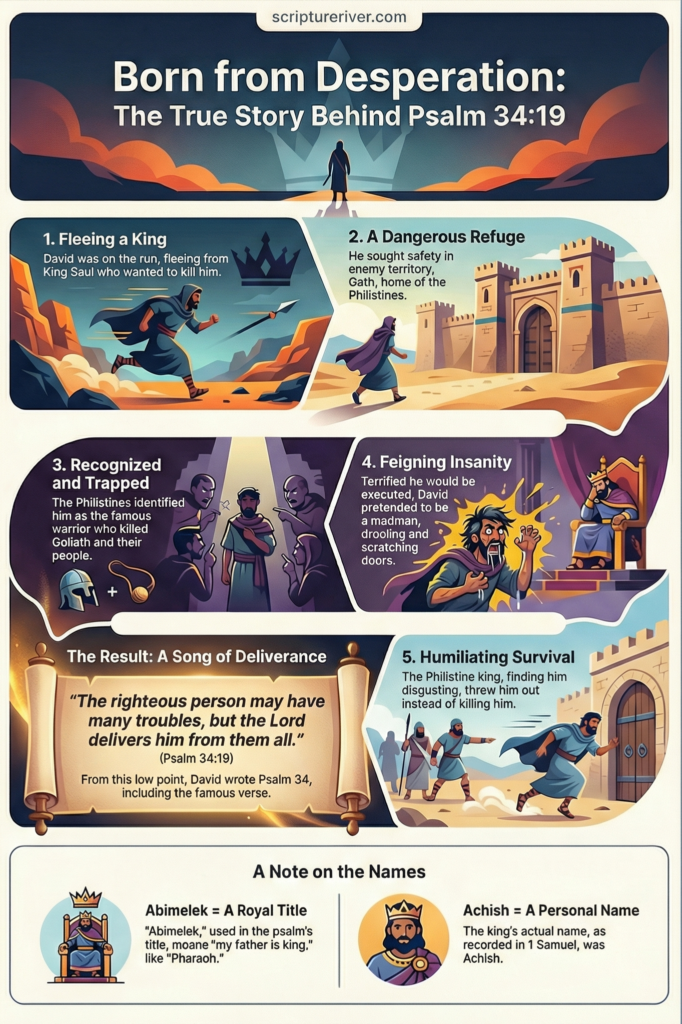
The superscript above Psalm 34 tells us David wrote this “when he pretended to be insane before Abimelek, who drove him away, and he left.”
Here’s something most readers miss: “Abimelek” isn’t a personal name.
It’s a royal title meaning “my father is king,” similar to how “Pharaoh” was used for Egyptian rulers regardless of their actual names.
The king’s personal name was Achish, as recorded in 1 Samuel 21:10-15.
Ancient Near Eastern cultures often used royal titles alongside personal names, which is why the Psalm uses “Abimelek” while 1 Samuel uses “Achish.”
Anyways, back to what happened: David was running from King Saul who wanted him dead.
He fled to Gath, enemy Philistine territory, hoping for refuge.
The Philistines recognized him as the warrior who’d killed Goliath and tens of thousands of their people.
They weren’t interested in giving him sanctuary.
David, terrified they’d execute him, pretended to be insane.
He drooled on himself, scratched marks on doors, acted like a madman.
King Achish (Abimelek) found him disgusting and useless, so he threw David out instead of killing him.
From that place of humiliation, fear, and utter dependence on God, David wrote Psalm 34. Including verse 19 about the righteous facing many afflictions.
David knew what he was talking about. He’d just lived it.
What “Righteous” Means in This Verse
Modern readers often misunderstand “righteous” as moral perfection or sinless behavior.
That’s not what the Hebrew word “tsaddiq” means.
It refers to people in right standing with God through faith, not people who never mess up.
David was righteous. He was also an adulterer and murderer.
His righteousness came from his relationship with God and his repentance when confronted with sin, not from flawless behavior.
When Psalm 34:19 talks about the righteous, it means people who belong to God through faith.
Believers. Followers of Yahweh. People trying to live according to His ways even when they fail.
If you’re a Christian, this verse applies to you.
You’re counted righteous through Christ’s righteousness credited to your account.
That means the promise about afflictions applies to you too.
What “Many Afflictions” Includes
The Hebrew word “ra’ah” translated afflictions means troubles, distress, evil things, adversity, hardship.
It’s comprehensive. Physical illness. Financial loss. Relational betrayal. Persecution for faith. Accidents. Disappointments. Chronic pain. Mental anguish. Grief.
All of it falls under “afflictions.”
David says these will be “many” for the righteous. Not occasional. Not rare. Many. Frequent. Expected parts of faithful Christian life.
Physical Afflictions
Paul had a chronic physical condition he called a “thorn in the flesh” that God refused to remove despite repeated prayers (2 Corinthians 12:7-9).
Timothy had frequent stomach problems (1 Timothy 5:23).
Epaphroditus almost died from illness (Philippians 2:27).
Righteous people get sick. Their bodies break down. Genetics don’t respect faith. Diseases don’t skip believers.
Relational Afflictions
David’s own son Absalom tried to overthrow and kill him.
Job’s friends tormented him with false accusations during his suffering.
Paul was abandoned by co-workers he’d invested in (2 Timothy 4:10).
Righteousness doesn’t protect you from betrayal, abandonment, or relational pain inflicted by people you trusted.
Circumstantial Afflictions
Joseph was sold into slavery by his brothers, falsely accused of rape, and imprisoned for years despite being righteous (Genesis 37-41).
Daniel was thrown into a lions’ den for praying to God (Daniel 6).
The early church faced systematic persecution, losing homes, possessions, and lives for following Christ (Hebrews 10:32-34).
Following God doesn’t create a protective bubble around your circumstances. Sometimes it makes circumstances harder.
Spiritual Afflictions
Spiritual warfare intensifies for people serious about following God.
The enemy targets those threatening his kingdom.
Doubt attacks. Temptation increases. Spiritual dryness comes. False teaching confuses.
These are afflictions as real as physical pain, though less visible.
Why God Allows Afflictions for the Righteous
This is the question everyone asks: if God loves me and I’m following Him, why doesn’t He protect me from suffering?
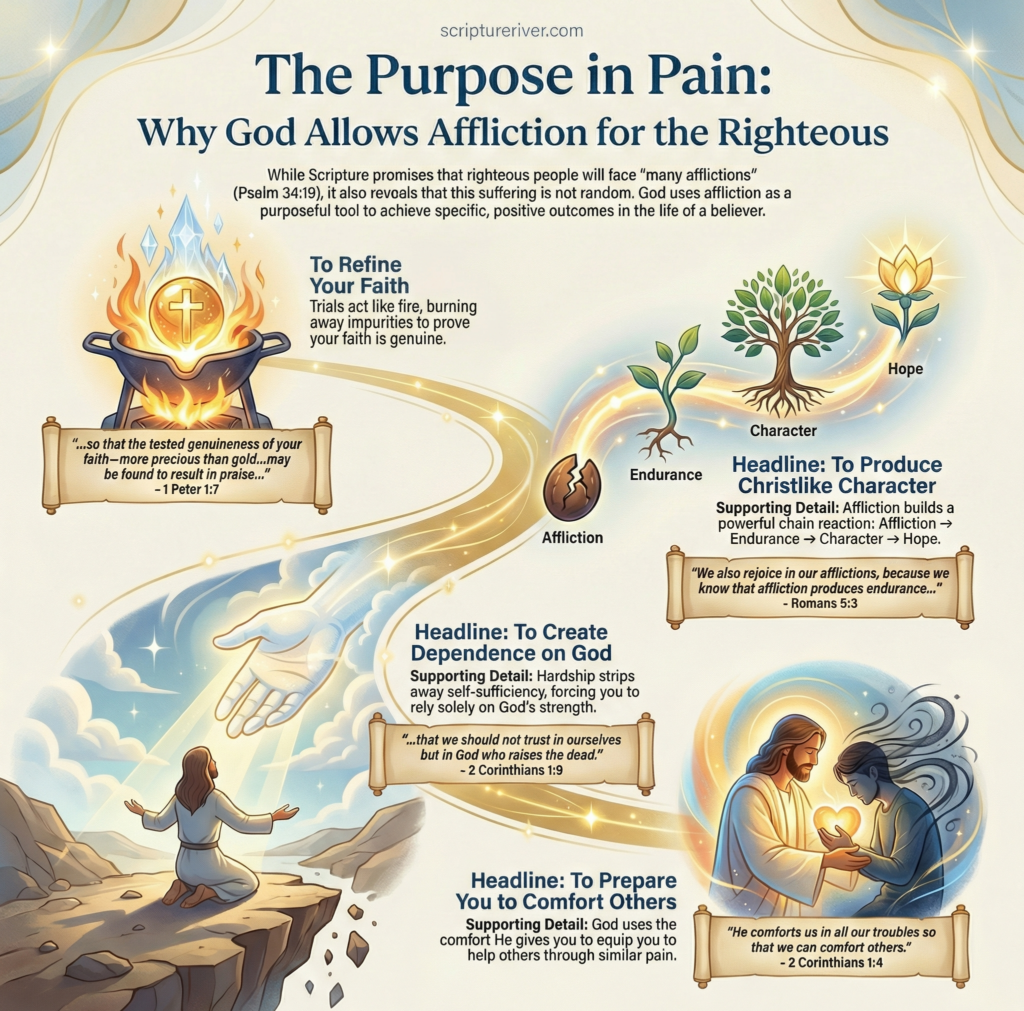
1. Afflictions Refine Faith
1 Peter 1:6-7, English Standard Version (ESV)
“In this you rejoice, though now for a little while, if necessary, you have been grieved by various trials, so that the tested genuineness of your faith—more precious than gold that perishes though it is tested by fire—may be found to result in praise and glory and honor at the revelation of Jesus Christ.”
Peter compares trials to fire that refines gold. Fire doesn’t destroy genuine gold. It purifies it by burning away impurities.
Your faith is tested through affliction. What survives the fire is proven genuine. What burns away was never real faith to begin with.
2. Afflictions Produce Christlike Character
Romans 5:3-4, Christian Standard Bible (CSB)
“And not only that, but we also rejoice in our afflictions, because we know that affliction produces endurance, endurance produces proven character, and proven character produces hope.”
The progression matters: affliction leads to endurance, which leads to character, which leads to hope.
You can’t develop endurance without something to endure.
You can’t build character without circumstances that require choosing right when wrong is easier.
Affliction is God’s primary tool for transforming you into Christ’s image.
3. Afflictions Create Dependence on God
When life is comfortable, we easily forget we need God. When affliction strips away our self-sufficiency, we’re forced to depend on Him completely.
2 Corinthians 1:8-9, New King James Version (NKJV)
“For we do not want you to be ignorant, brethren, of our trouble which came to us in Asia: that we were burdened beyond measure, above strength, so that we despaired even of life. Yes, we had the sentence of death in ourselves, that we should not trust in ourselves but in God who raises the dead.”
Paul says God allowed crushing affliction specifically so he’d stop trusting himself and learn to trust God alone.
That’s a gift, though it feels like punishment in the moment.
4. Afflictions Prepare You to Comfort Others
2 Corinthians 1:4, New Living Translation (NLT)
“He comforts us in all our troubles so that we can comfort others. When they are troubled, we will be able to give them the same comfort God has given us.”
God wastes nothing. The comfort He gives you through your afflictions equips you to comfort others through similar suffering later.
Your current pain is training for future ministry. That doesn’t make it hurt less, but it makes it purposeful rather than random.
The Promise in the Second Half of Psalm 34:19
David doesn’t leave us with only bad news about many afflictions.
He adds a promise that transforms how we understand suffering.
“The Lord delivers him from them all.”
All. Not some. Not most.
All afflictions the righteous face will ultimately result in God’s deliverance.
What Deliverance Means
Deliverance doesn’t always mean immediate removal of affliction.
Sometimes God delivers you from affliction by ending it miraculously.
Sometimes He delivers you through affliction by sustaining you until it passes naturally.
Sometimes He delivers you in affliction by giving you peace and strength to endure what doesn’t end.
All three are legitimate forms of deliverance. All three fulfill God’s promise.
When Deliverance Comes
God’s timing for deliverance rarely matches our preferences.
David waited years between God’s promise that he’d be king and actual coronation.
Joseph spent over a decade enslaved and imprisoned before deliverance came.
The Israelites wandered forty years in wilderness before entering the Promised Land.
Deliverance is guaranteed. The timeline is not.
Psalm 34:17, New International Version (NIV) adds this:
“The righteous cry out, and the Lord hears them; he delivers them from all their troubles.”
God hears immediately. He delivers in His timing. Learning to trust Him in the gap between hearing and deliverance is where faith matures.
Complete Deliverance
The ultimate deliverance comes at death for believers or Christ’s return, whichever happens first.
Every affliction ends eventually. Every pain stops. Every struggle concludes.
Either through healing, death, or resurrection into glorified bodies that can’t be afflicted.
Revelation 21:4, Christian Standard Bible (CSB) describes final deliverance:
“He will wipe away every tear from their eyes. Death will be no more; grief, crying, and pain will be no more, because the previous things have passed away.”
That’s the deliverance Psalm 34:19 ultimately points toward. Complete, permanent freedom from all affliction when we’re finally home with God.
How to Live as Righteous People Facing Afflictions
Knowing afflictions will come and deliverance is promised doesn’t automatically make walking through hard seasons easy.
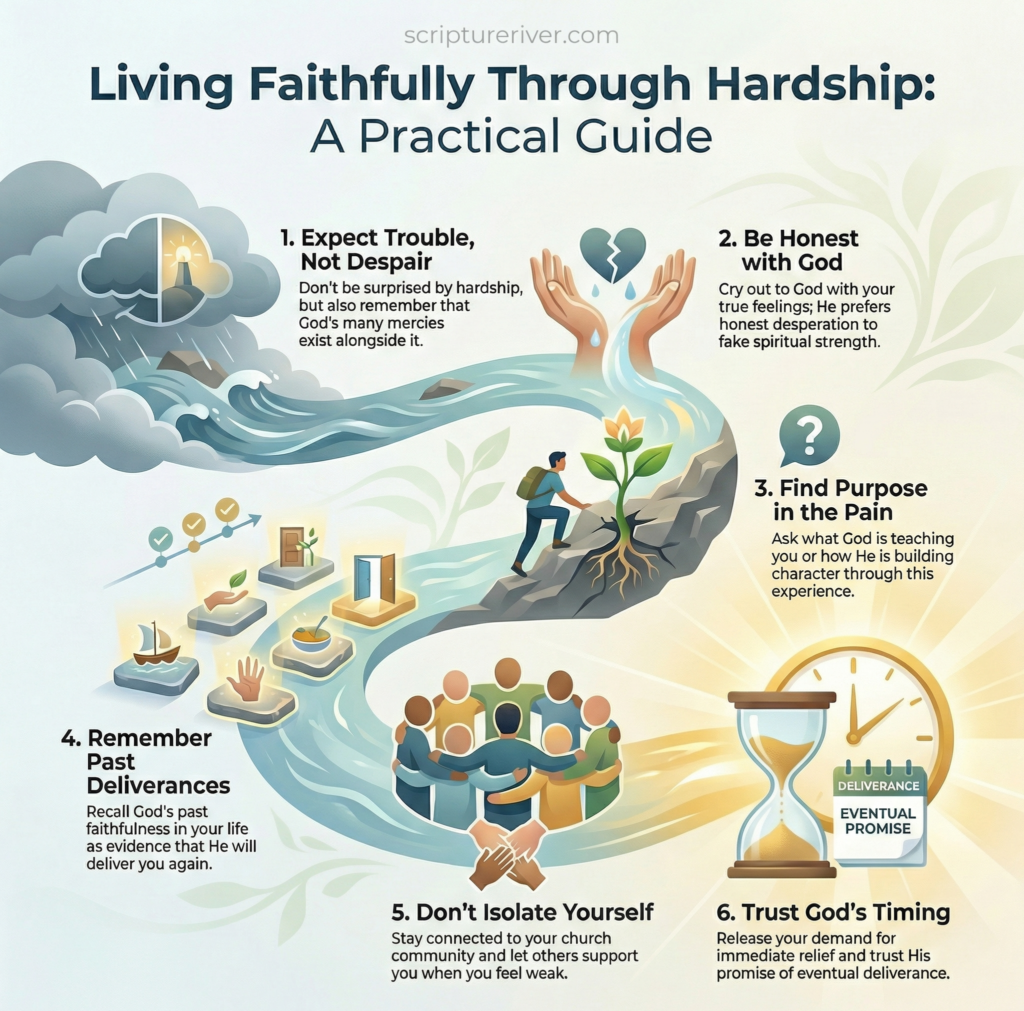
Here’s how to apply Psalm 34:19 practically.
1. Expect Afflictions Without Becoming Cynical
Don’t be surprised when troubles come. John 16:33 says in this world you will have trouble. Expect it.
At the same time, don’t become cynically resigned to suffering as if nothing good ever happens.
Afflictions are many, but so are God’s mercies. Both are true simultaneously.
2. Cry Out to God Honestly
David wrote Psalm 34 after humiliating himself to save his life. He didn’t hide his desperation or pretend to have it together.
When affliction hits, don’t perform spiritual strength you don’t feel.
Cry out to God honestly about how hard things are. He prefers honest desperation to fake maturity.
3. Look for How God Is Working
In every affliction, ask: What is God refining in me? What character is He building? What dependence is He teaching? How might this prepare me to help others later?
Those questions don’t eliminate pain, but they give it purpose.
4. Remember Past Deliverances
When current affliction feels overwhelming, remember how God delivered you from past troubles.
Make a list if necessary. His past faithfulness is evidence He’ll deliver you again.
5. Stay Connected to Other Believers
Isolation intensifies affliction. Stay connected to your church community even when you don’t feel like it. Let people carry you when you can’t carry yourself.
6. Hold Loosely to Timeline Expectations
You want deliverance now. God promises deliverance eventually. The gap between those two realities tests faith. Don’t demand God meet your timeline. Trust His.
The Tension We Must Hold
Psalm 34:19 creates tension every believer must learn to hold: life will be hard AND God will deliver.
Both are true. Neither cancels the other out.
You can’t embrace one while rejecting the other.
You can’t claim God’s deliverance promise while denying afflictions will come.
You can’t acknowledge coming afflictions while doubting God’s deliverance.
The mature Christian faith holds both truths simultaneously.
Many troubles will come. God will deliver from all of them. Not might. Will.
That’s not comfo
rtable theology. It’s honest theology that prepares you for reality while anchoring you to hope.
Prayer When Afflictions Come
Father, I’m in the middle of affliction right now and I don’t like it. I want deliverance immediately, but You haven’t delivered me yet. Help me trust You’re still good even when circumstances are bad.
Show me what You’re refining in me through this trial. Give me endurance to keep trusting You when deliverance delays. Remind me of past faithfulness when present affliction makes me doubt.
Keep me connected to other believers who can help carry this burden. And deliver me from this affliction in Your perfect timing, whether that means removing it, sustaining me through it, or giving me peace in the middle of it.
I trust You will deliver me from all my troubles eventually, even if not immediately.
In Jesus’s Name, Amen.
Sources Cited
Kidner, D. (2008). Psalms 1-72: An Introduction and Commentary. InterVarsity Press. [Book]
Lewis, C. S. (1940). The Problem of Pain. HarperCollins. [Book]
Peterson, E. H. (2005). The Message: The Bible in Contemporary Language. NavPress. [Bible Translation]
Piper, J. (2013). Don’t Waste Your Life. Crossway. [Book]
Strong, J. (2010). Strong’s Exhaustive Concordance of the Bible. Hendrickson Publishers. [Reference Book]
VanGemeren, W. A. (2008). Psalms. In T. Longman III & D. E. Garland (Eds.), The Expositor’s Bible Commentary: Psalms (Revised Edition). Zondervan. [Book]
Yancey, P. (1977). Where Is God When It Hurts? Zondervan. [Book]