

Nobody asks about the slave girl.
When people teach about Abraham and Sarah, Hagar appears as a footnote.
The Egyptian servant who carried Abraham’s child. The woman Sarah mistreated. The mother who ran away.
A supporting character in someone else’s story.
But God gave Hagar something He gave no one else in all of Scripture: she’s the only person who ever named God.
Not Moses. Not David. Not even Abraham.
A foreign slave woman fleeing abuse in the wilderness named the God of Israel.
She called Him “El Roi.” The God Who Sees Me.
That name reveals something profound about God’s character that women who feel overlooked, undervalued, and invisible desperately need to understand.
God sees you when everyone else looks past you.
He knows your name when others treat you like you don’t matter.
He intervenes in your story when you’re convinced no one cares what happens to you.
Hagar’s encounter with El Roi in Genesis 16 speaks directly to every woman who’s ever felt like she doesn’t count.
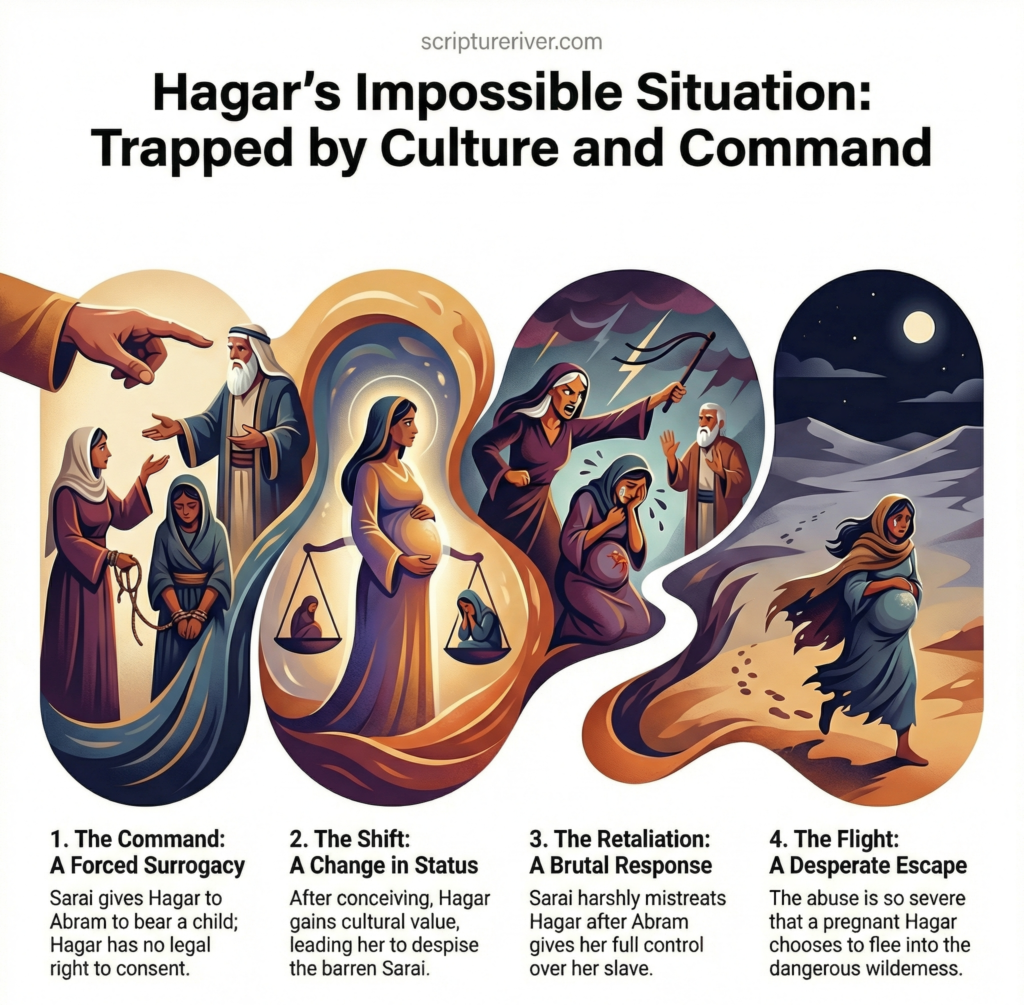
Hagar’s Impossible Situation
Genesis 16:1-6, New International Version (NIV)
“Now Sarai, Abram’s wife, had borne him no children. But she had an Egyptian slave named Hagar; so she said to Abram, ‘The Lord has kept me from having children.
Go, sleep with my slave; perhaps I can build a family through her.’ Abram agreed to what Sarai said. So after Abram had been living in Canaan ten years, Sarai, his wife, took her Egyptian slave Hagar and gave her to her husband to be his wife.
He slept with Hagar, and she conceived. When she knew she was pregnant, she began to despise her mistress.
Then Sarai said to Abram, ‘You are responsible for the wrong I am suffering. I put my slave in your arms, and now that she knows she is pregnant, she despises me. May the Lord judge between you and me.’
‘Your slave is in your hands,’ Abram said. ‘Do with her whatever you think best.’ Then Sarai mistreated Hagar; so she fled from her.”
Let’s be clear about what happened here. Hagar had no choice in any of this.
As an Egyptian slave in Abraham’s household, she had zero agency.
Sarah decided Hagar would bear Abraham’s child. Hagar didn’t consent. She was property, not a person with rights.
According to Old Testament scholar Phyllis Trible’s analysis in Texts of Terror, ancient Near Eastern law codes like the Code of Hammurabi allowed barren wives to give slave women to their husbands for childbearing purposes.
The child legally belonged to the wife, not the slave who birthed it.
Hagar was being used as what we’d now call a surrogate, except without choice or compensation.
The Complexity of Hagar’s Response
When Hagar got pregnant, she “began to despise her mistress.”
Some translations say she looked down on Sarah or treated her with contempt.
We need to understand the power dynamics here.
Hagar was still enslaved. She couldn’t actually do anything to Sarah.
But pregnancy gave her the one thing she’d never had: value in a culture that measured women’s worth by their ability to produce children, especially sons.
Sarah was barren and had lost status because of it. Hagar was fertile and had gained status because of it.
For the first time in her life, Hagar had something Sarah desperately wanted and couldn’t have.
The text doesn’t excuse Hagar’s attitude. But it explains it.
A woman who’d been powerless her entire life suddenly had the only currency that mattered in her world.
Sarah’s Retaliation
Sarah’s response was brutal.
She blamed Abraham, then when he gave her permission to do whatever she wanted with Hagar, she “mistreated” her.
The Hebrew word “anah” means to afflict, to oppress, to humiliate.
This wasn’t mild discipline.
It was abuse severe enough that a pregnant woman chose to run away into the wilderness alone rather than stay.
Think about what that means.
Hagar would rather risk death in the desert than remain under Sarah’s treatment.
In other words, the abuse was that bad.
The God Who Saw What Everyone Else Ignored
Genesis 16:7-9, English Standard Version (ESV)
“The angel of the Lord found her by a spring of water in the wilderness, the spring on the way to Shur. And he said, ‘Hagar, servant of Sarai, where have you come from and where are you going?’ She said, ‘I am fleeing from my mistress Sarai.’ The angel of the Lord said to her, ‘Return to your mistress and submit to her.'”
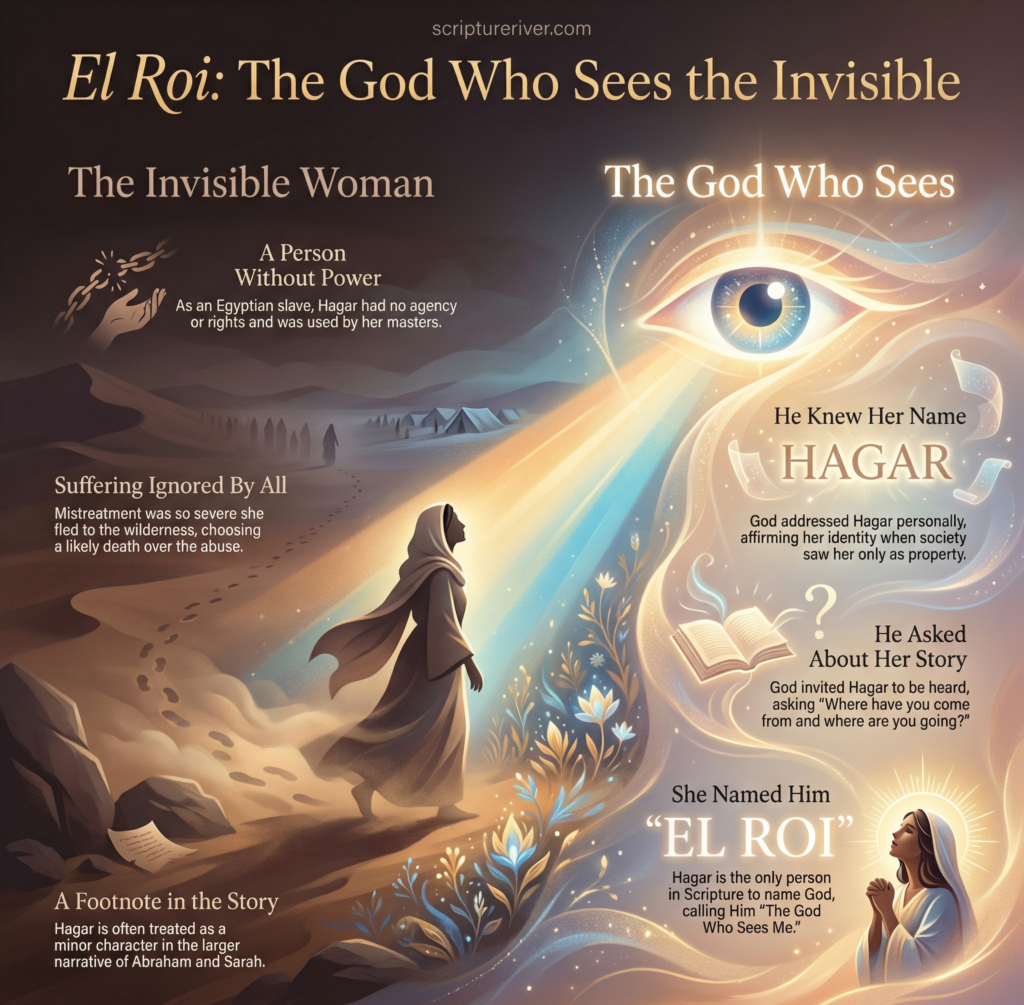
God didn’t ignore Hagar. He went looking for her.
The angel of the Lord, whom most theologians identify as a pre-incarnate appearance of Christ, found Hagar in the wilderness and spoke to her.
Not to Abraham. Not to Sarah. To the Egyptian slave girl, the girl nobody else cared about.
He Knew Her Name
“Hagar, servant of Sarai.” God called her by name.
In a culture where slaves were property without personhood, God addressed Hagar as an individual with identity.
He knew who she was.
Women who feel invisible need to grasp this. God knows your name.
Not just generically as “daughter” or “child.”
He knows YOU specifically, individually, personally.
He Asked About Her Story
“Where have you come from and where are you going?”
God wasn’t asking for information. He already knew.
He was inviting Hagar to tell her story, to be heard, to have someone care about what she was experiencing.
When was the last time someone asked about your story and actually listened to the answer? God did that for Hagar.
He Gave Her a Hard Command
God told Hagar to return to Sarah and submit to her. That sounds terrible until you read what comes next.
God wasn’t sending her back to be abused indefinitely.
He was sending her back with promises that would sustain her through the hardship and lead to eventual freedom.
The 3 Promises God Made to Hagar
Genesis 16:10-12, Christian Standard Bible (CSB)
“The angel of the Lord said to her, ‘I will greatly multiply your offspring, and they will be too many to count.’ The angel of the Lord said to her, ‘You have conceived and will have a son. You are to name him Ishmael, for the Lord has heard your cry of affliction. This man will be like a wild donkey. His hand will be against everyone, and everyone’s hand will be against him; he will settle near all his relatives.'”
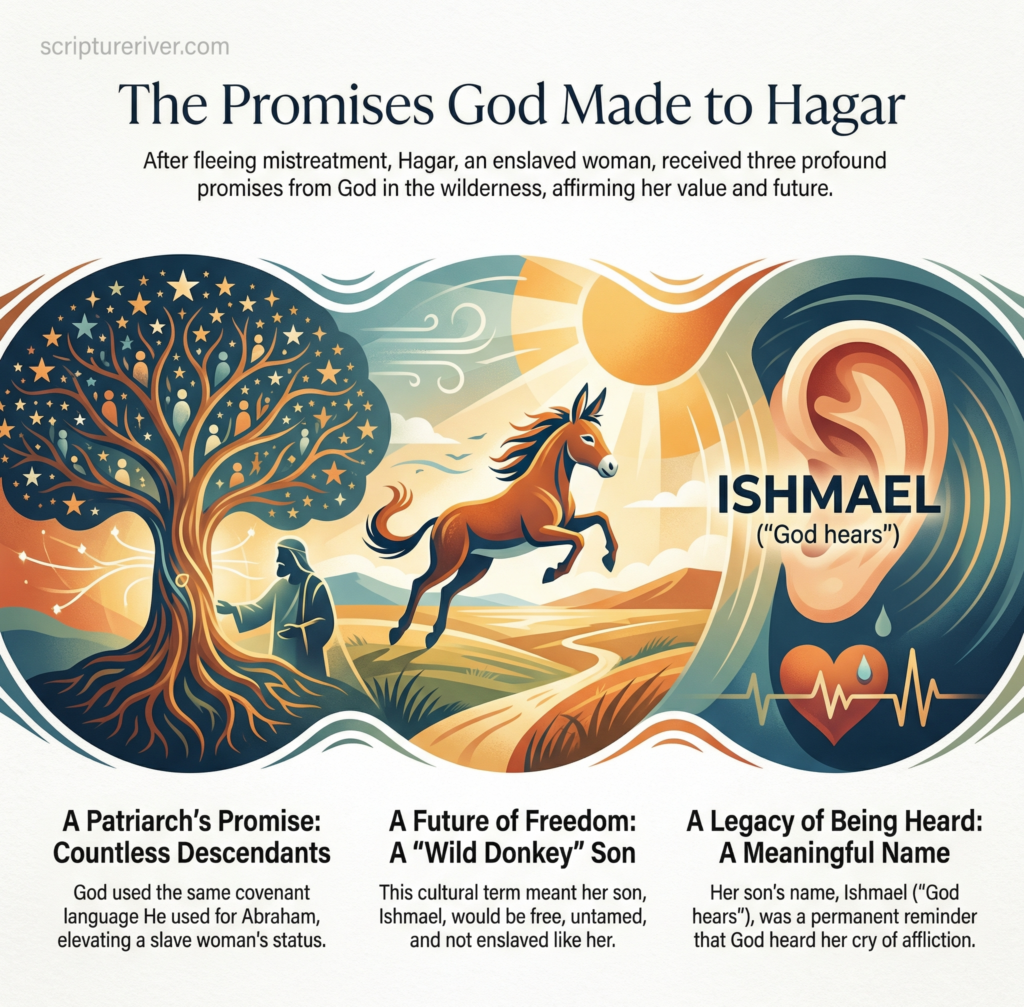
God gave Hagar three extraordinary promises.
First Promise: He Would Multiply Her Descendants
This is the same promise God made to Abraham. The exact same language.
God was treating Hagar, a foreign slave woman, with the same covenant language He used for the patriarch of Israel.
That’s staggering.
Hagar received a promise typically reserved for men, for patriarchs, for people who mattered in their culture.
God was declaring that Hagar mattered to Him.
Second Promise: Her Son Would Be Free
Ishmael’s description as “a wild donkey” sounds insulting in English.
In Hebrew culture, it meant he’d be free, untamed, not subject to anyone’s control.
Hagar was enslaved. Her son would be free.
That promise meant her suffering wouldn’t continue through her child. He’d live differently than she had.
Third Promise: God Had Heard Her Affliction
God specifically said He heard Hagar’s cry. The name Ishmael means “God hears.”
Every time Hagar spoke her son’s name, she’d remember: God heard me when I cried out.
God listened when I was suffering. God paid attention when everyone else ignored me.
Hagar’s Response: Naming God
Genesis 16:13, New King James Version (NKJV)
“Then she called the name of the Lord who spoke to her, You-Are-the-God-Who-Sees; for she said, ‘Have I also here seen Him who sees me?'”
Hagar called God “El Roi.” The God Who Sees.
Hebrew scholar Wenham notes in his Genesis commentary that this is the only place in Scripture where a human being gives God a name.
Even Abraham, who had multiple encounters with God, never named Him.
But Hagar did. The enslaved, Egyptian, foreign woman named the God of Israel based on her experience of Him.
What El Roi Means
The Hebrew “roi” comes from the verb “to see.”
But it’s not just visual observation. It carries the sense of seeing with concern, paying attention with the intent to act.
When God sees, He doesn’t just notice. He cares. He intervenes. He responds to what He sees.
Hagar encountered God who saw her suffering, heard her cry, knew her name, and gave her promises for a future she couldn’t see yet.
That’s El Roi. The God who sees you completely and responds to what He sees.
What El Roi Means for Modern Women
Hagar’s story isn’t ancient history with no modern application.
Women today experience the same dynamics that drove Hagar into the wilderness.
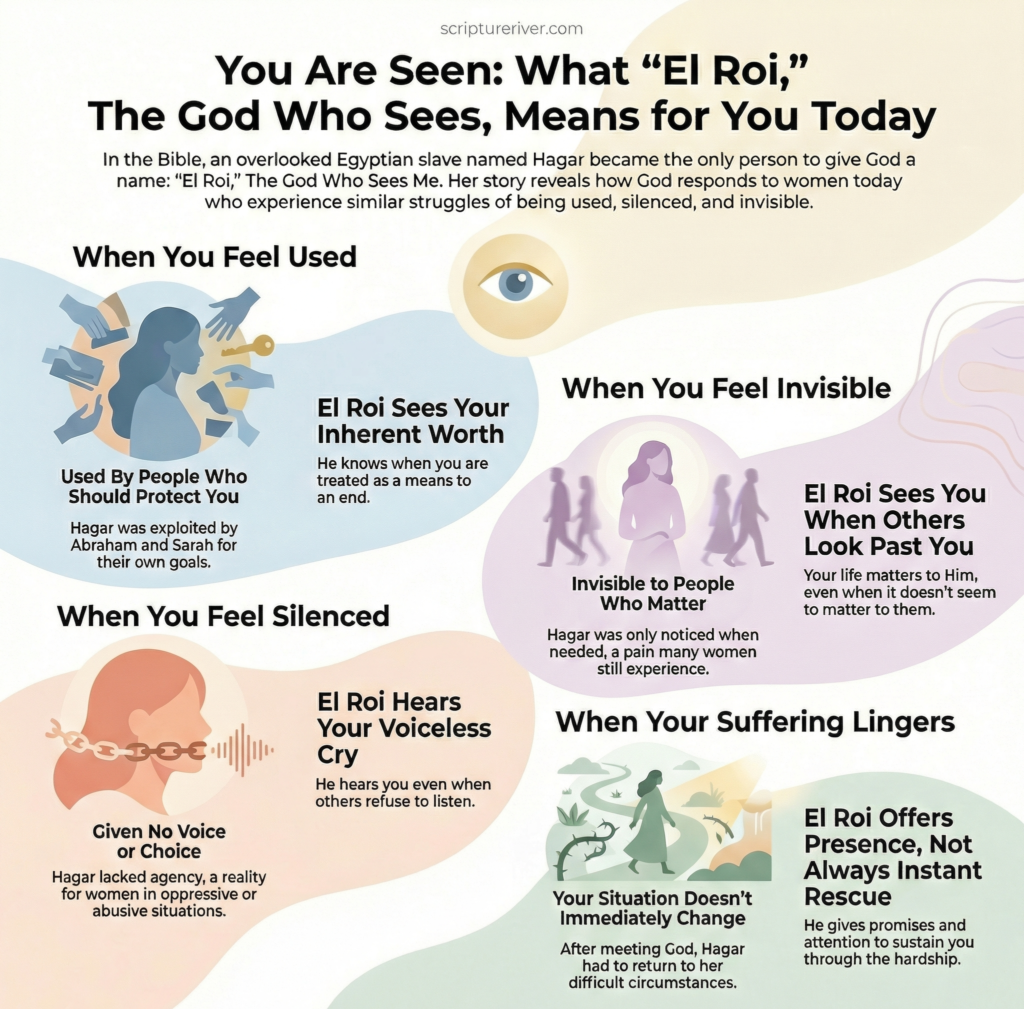
When You’re Used by People Who Should Protect You
Hagar was used by Abraham and Sarah for their purposes without regard for her wellbeing.
Women today are used by employers, church leaders, family members, and partners who view them as resources to exploit rather than people to value.
El Roi sees when you’re being used. ‘
He knows when people treat you as a means to their ends instead of a person with inherent worth.
When You Have No Voice or Choice
Hagar’s lack of agency is replicated whenever women face situations where their voices don’t matter and their choices are ignored.
In abusive relationships.
In oppressive work environments.
In families where daughters are valued less than sons.
In cultures where women’s testimony carries less weight than men’s.
El Roi sees when you’re powerless. He hears your voice even when others silence it.
When You’re Invisible to People Who Matter
Hagar was invisible to Abraham and Sarah except when they needed something from her.
Women experience this invisibility in countless settings.
The accomplished professional whose ideas are credited to male colleagues.
The stay-at-home mother whose work is dismissed as “not really working.”
The single women whose life is treated as less valuable than those of married women.
The older woman who becomes culturally invisible.
El Roi sees you when others look past you. Your life matters to Him even when it doesn’t matter to them.
When Suffering Seems Endless
Hagar’s immediate situation didn’t change after her encounter with El Roi.
She went back to Sarah’s household. She returned to difficulty.
But she returned with promises and with the knowledge that God saw her, heard her, and had plans for her future beyond her present suffering.
That’s what El Roi offers women in hard situations: not always immediate rescue, but always His presence, His promises, and His attention to your suffering.
The Limitations We Must Acknowledge
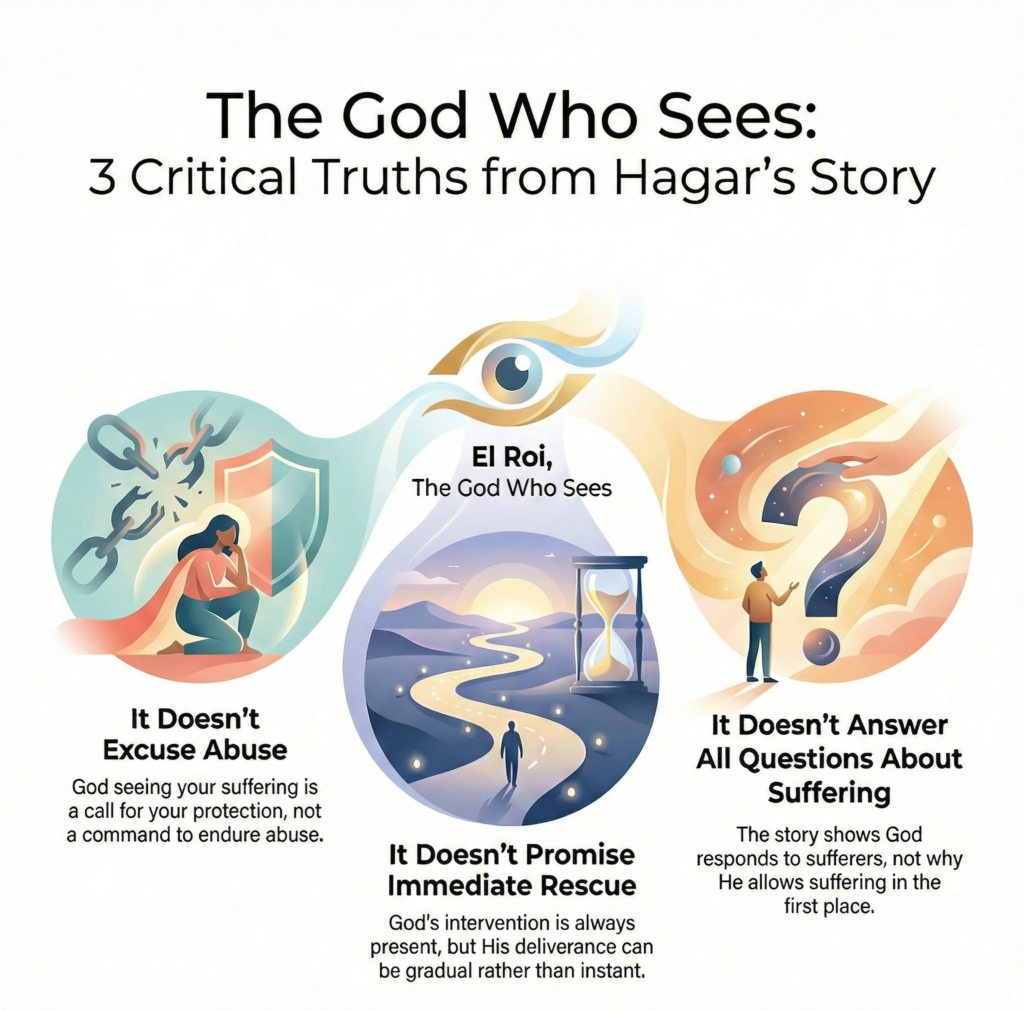
Hagar’s story is powerful, but we need to be honest about what it does and doesn’t say.
It Doesn’t Excuse Abuse
God saw Hagar’s suffering and sent her back into it temporarily. That doesn’t mean God endorses abuse or that women should stay in abusive situations because “God sees.”
Important clarification: If you’re experiencing abuse, El Roi seeing you doesn’t mean you shouldn’t seek safety. God, seeing you means He cares about your well-being and wants you protected.
It Doesn’t Promise Immediate Rescue
Hagar’s deliverance came gradually. Her son was born. Years later, Sarah had Isaac.
Eventually, Sarah demanded Abraham send Hagar and Ishmael away.
That expulsion, though painful, gave Hagar the freedom she’d never had as Sarah’s slave.
God’s seeing you doesn’t guarantee instant resolution to your hardship.
Sometimes His intervention is immediate. Sometimes it’s gradual. But understand that He’s always present.
It Doesn’t Answer All Questions About Suffering
Why did God allow Hagar to suffer in the first place?
Why didn’t He prevent Sarah’s abuse?
Why send her back instead of rescuing her immediately?
Hagar’s story doesn’t answer these questions.
It demonstrates that God sees suffering and responds to sufferers, even when He doesn’t eliminate suffering immediately.
How to Encounter El Roi in Your Invisibility
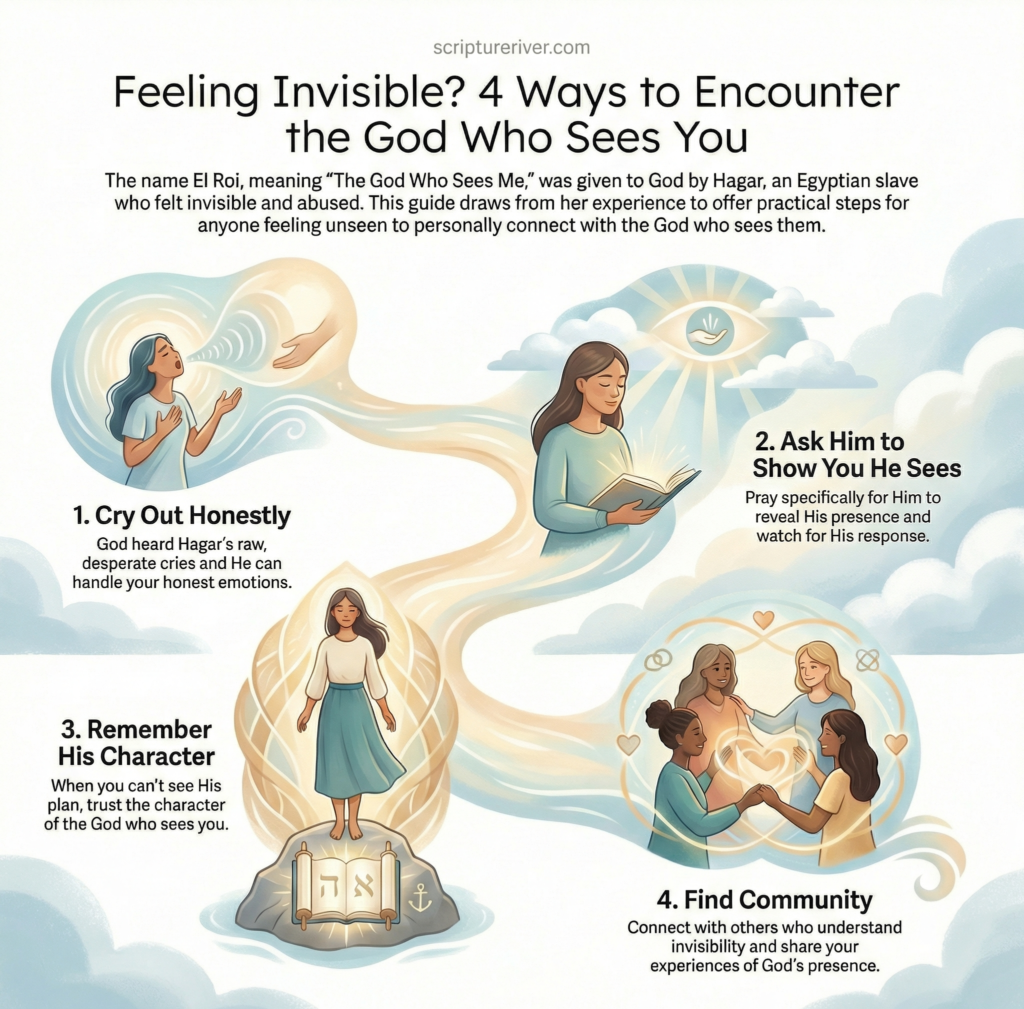
If you’re feeling unseen, unheard, and unvalued, here’s how to experience El Roi personally.
1. Cry Out Honestly to Him
Hagar didn’t use polite religious language. She fled into the wilderness crying. God heard her raw, desperate, honest emotion.
Tell God exactly how invisible you feel. How much it hurts to be overlooked. How exhausted you are from trying to matter to people who don’t see you.
He’s El Roi. He can handle your honesty.
2. Ask Him to Show You He Sees
Pray specifically: “God, show me that You see me. Make Your presence real to me. Let me know I matter to You even if I don’t matter to them.”
Then watch for His response.
It might come through Scripture that speaks directly to your situation.
Or through a person who sees you when you feel invisible.
Maybe even through circumstances that demonstrate His intervention.
3. Remember His Character When You Can’t See His Plan
Hagar couldn’t see God’s long-term plan when He sent her back to Sarah.
She had to trust His character based on one encounter in the wilderness.
You won’t always understand what God is doing in your circumstances.
But you can trust that El Roi sees you, knows your name, and is working on purposes you can’t see yet.
4. Find Community With Other Invisible Women
Hagar wasn’t the only woman in Scripture who felt invisible and encountered God’s seeing.
The woman at the well. The bleeding woman who touched Jesus’s garment. The widow with two mites. Mary Magdalene at the tomb.
God has a pattern of seeing women others overlook.
Find other women who understand invisibility and share how El Roi has revealed Himself to you.
The Promise El Roi Makes Today
Genesis 16 ends with Hagar naming the well where she encountered God: Beer-lahai-roi, meaning “the well of the Living One who sees me.”
That well still exists.
Archaeologists have identified its location in the Negev Desert. It’s a physical reminder that God sees women whom others ignore.
El Roi made promises to Hagar that He kept.
Her descendants multiplied. Her son lived free. God heard her affliction.
He makes the same promise to you today: I see you. I know your name. I hear your cry. I’m working on your story even when you feel invisible to everyone else.
You matter to El Roi. Not because of what you produce or who you serve or how useful you are. But simply because He sees you.
Prayer for Women Who Feel Invisible
El Roi, I feel invisible. People look past me, ignore my voice, treat me like I don’t matter. I’m exhausted from trying to be seen by people who won’t see me.
Thank You that You see me when everyone else looks away. Thank You that You know my name when others treat me like I’m nameless.
Thank You that my life matters to You even when it doesn’t matter to them. Show me that You see me. Make Your presence real to me in my invisibility.
Give me promises to hold onto when my situation feels hopeless. Help me trust Your character when I can’t see Your plan. And remind me that mattering to You is enough, even when I don’t matter to anyone else.
In Jesus’s Name, Amen.
Bibliography
Meyers, C. (2013). Rediscovering Eve: Ancient Israelite Women in Context. Oxford University Press. [Book]
Peterson, E. H. (2005). The Message: The Bible in Contemporary Language. NavPress. [Bible Translation]
Strong, J. (2010). Strong’s Exhaustive Concordance of the Bible. Hendrickson Publishers. [Reference Book]
Trible, P. (1984). Texts of Terror: Literary-Feminist Readings of Biblical Narratives. Fortress Press. [Book]
Wenham, G. J. (1994). Genesis 16-50. Thomas Nelson Publishers. [Book]
Wiersbe, W. W. (2007). The Bible Exposition Commentary: Old Testament. David C. Cook. [Book]
Williams, M. E. (2019). Sisters in Scripture: Exploring the Relationships Between Biblical Women. Kregel Publications. [Book]