
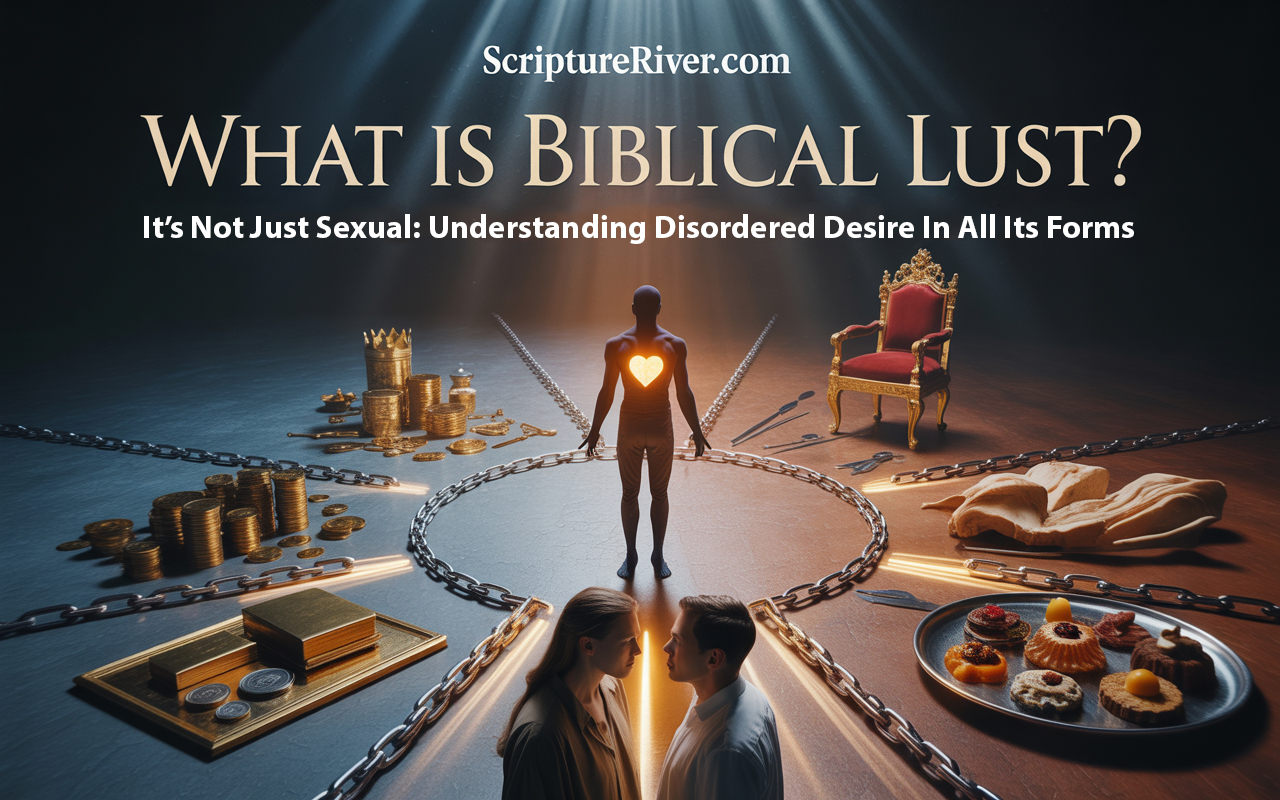
Most Christians think lust means one thing: sexual desire that crosses a line.
That’s not wrong, but it’s incomplete.
The Bible uses “lust” to describe something far broader than sexual temptation.
The Greek and Hebrew words translated “lust” in English Bibles refer to any intense craving that displaces God as the supreme object of your devotion.
You can lust for money. For power. For comfort. For food. For approval. For control. For material possessions. For success.
The object matters less than the intensity of desire that pushes everything else, including God, to the margins.
Understanding biblical lust requires looking beyond the sexual category where it’s usually confined and examining what Scripture actually teaches about disordered desire in all its forms.
Prefer Listening to Reading?
Here’s an 18-minute audio overview that breaks down this post, discussing points like what biblical lust actually means beyond just sexual temptation, what Jesus really said about lustful looking in its proper context, the Greek and Hebrew words Scripture uses for lust, and practical steps for fighting disordered desires that have displaced God in your life.
The Hebrew and Greek Words Behind “Lust”
English translations use “lust” to render several different biblical words, each with distinct meanings.
Old Testament: Ta’avah and Chamad
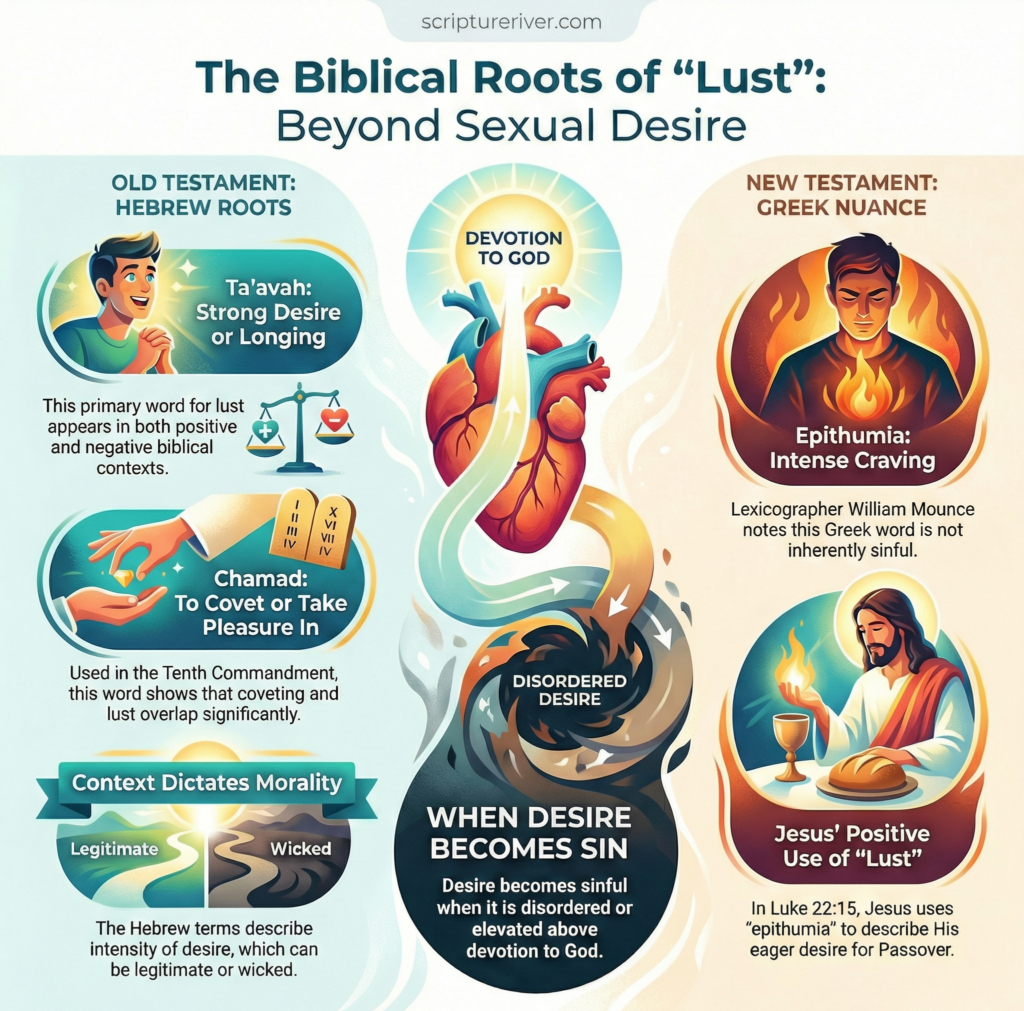
The primary Hebrew word translated “lust” is “ta’avah,” meaning strong desire, craving, or longing.
It appears in both positive and negative contexts.
Psalm 10:3 describes the wicked who “boasts of the desires of his soul” (ESV), using ta’avah negatively.
But the same word appears positively when describing legitimate desires.
“Chamad” is another Hebrew word meaning to desire, covet, or take pleasure in.
The tenth commandment uses this word: “You shall not covet” (Exodus 20:17). Covet and lust overlap significantly in biblical thinking.
New Testament: Epithumia
The Greek word “epithumia” means strong desire, craving, or longing. Like the Hebrew ta’avah, it can be neutral, positive, or negative depending on context.
According to Greek lexicographer William Mounce, epithumia itself isn’t inherently sinful.
Jesus used it positively in Luke 22:15 when He said, “I have eagerly desired to eat this Passover with you.” The Greek is “epithumia epethumēsa,” literally “with desire I have desired.”
What makes epithumia sinful is when the desire becomes disordered by being directed toward wrong objects or pursued in wrong ways or elevated above devotion to God.
What Jesus Actually Said About Lustful Looking
Matthew 5:27-28, New International Version (NIV)
“You have heard that it was said, ‘You shall not commit adultery.’ But I tell you that anyone who looks at a woman lustfully has already committed adultery with her in his heart.”
This verse is frequently misunderstood, creating unnecessary guilt and confusion about normal human attraction.
The Context: The Sermon on the Mount
Jesus was teaching about the heart behind God’s law, not just external compliance.
The Pharisees focused on avoiding physical adultery while ignoring heart attitudes that violated the spirit of the commandment.
Jesus exposed that righteousness God requires goes deeper than behavior. It involves heart transformation.
What “Looking Lustfully” Actually Means
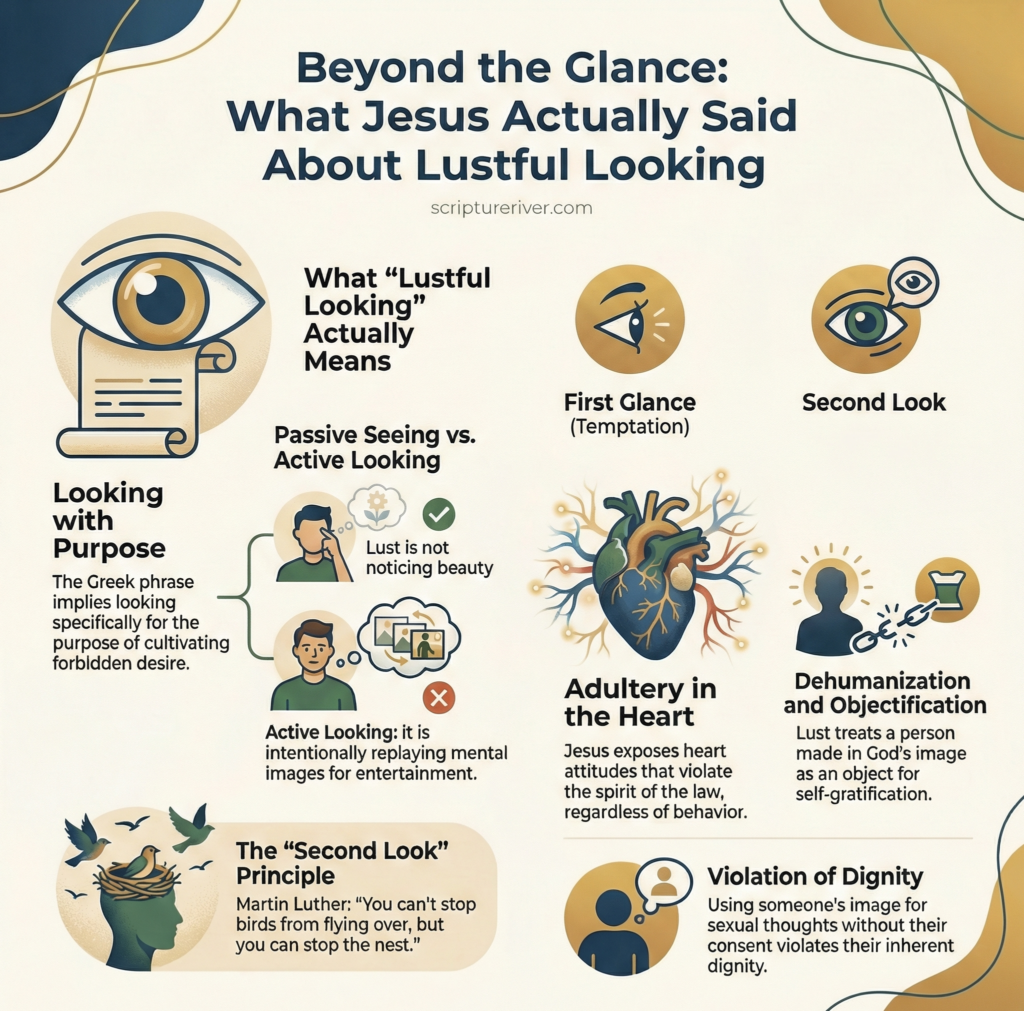
The Greek phrase is “blepōn autēn pros to epithumēsai,” literally “looking at her for the purpose of desiring her.”
New Testament scholar D.A. Carson explains in his Matthew commentary that this isn’t describing momentary attraction or noticing someone is beautiful.
It describes intentional, sustained looking with the purpose of feeding sexual desire.
The Greek construction indicates purpose and intention.
You’re not passively seeing someone. You’re actively looking in order to cultivate desire for what you can’t or shouldn’t have.
The Difference Between Temptation and Sin
Being tempted isn’t sin. Jesus was tempted in all ways yet without sin (Hebrews 4:15). Noticing someone attractive isn’t lustful looking.
Lustful looking is when you see someone attractive and then deliberately continue looking, replaying mental images, imagining scenarios, cultivating desire that you’re treating as entertainment rather than resisting as temptation.
Martin Luther reportedly said, “You cannot keep birds from flying over your head but you can keep them from building a nest in your hair.”
The first glance that notices attraction isn’t sin. The second look that feeds desire crosses into lust.
Why Jesus Called It Adultery in the Heart
Adultery requires another person participating in the sin. How can looking alone be adultery?
Jesus’s point is that the heart attitude that leads to physical adultery is itself a violation of God’s design for sexuality.
You’re treating another person as an object for your gratification rather than as a person made in God’s image.
The person you’re looking at lustfully hasn’t consented to participating in your sexual thoughts.
You’re using them without their knowledge or permission.
That violates their dignity and God’s design for sexuality to exist within a committed covenant relationship.
Biblical Lust Beyond Sexual Desire
Scripture addresses many forms of lust that have nothing to do with sex.
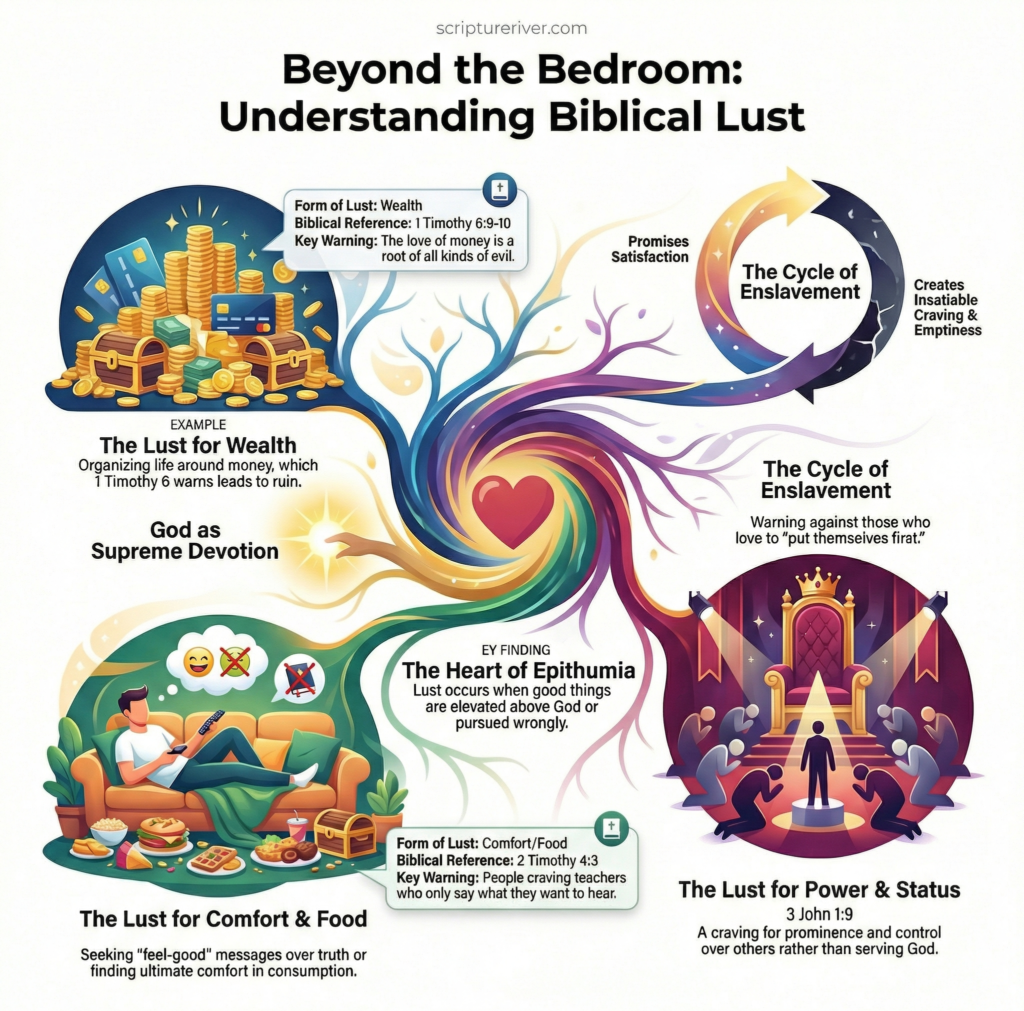
The Lust for Wealth
1 Timothy 6:9-10, Christian Standard Bible (CSB)
“But those who want to be rich fall into temptation, a trap, and many foolish and harmful desires that plunge people into ruin and destruction. For the love of money is a root of all kinds of evil, and by craving it, some have wandered away from the faith and pierced themselves with many griefs.”
The “desires” here translate epithumia. Craving wealth is lust. When money becomes the object you organize your life around pursuing, you’re lusting after it.
The Lust for Power and Status
3 John 1:9, English Standard Version (ESV)
“I have written something to the church, but Diotrephes, who likes to put himself first, does not acknowledge our authority.”
Diotrephes lusted for prominence. He wanted first place. His craving for status drove his behavior and opposition to apostolic authority.
Christians lust for power when they manipulate to gain leadership positions, when they need to control others, when they measure their worth by their influence or status.
The Lust for Comfort
2 Timothy 4:3, New King James Version (NKJV)
“For the time will come when they will not endure sound doctrine, but according to their own desires they will heap up for themselves teachers; and they will turn their ears away from the truth.”
“Their own desires” translates epithumia. People lust for comfortable teaching that doesn’t challenge or convict. They crave messages that make them feel good rather than truth that transforms.
The Lust for Food
Philippians 3:19, English Standard Version (ESV)
“Their end is destruction, their god is their belly, and they glory in their shame, with minds set on earthly things.”
When appetite controls you, you’re lusting. Food becomes the object you serve rather than fuel for serving God.
This doesn’t mean enjoying food is sinful. It means being ruled by cravings for food, organizing life around eating, and finding ultimate comfort in consumption rather than in God.
The Root Problem With All Lust
What makes lust sinful isn’t the specific object desired. It’s the disordered relationship between you, the object, and God.
Lust Makes Created Things Ultimate
Romans 1:25, Christian Standard Bible (CSB)
“They exchanged the truth of God for a lie, and worshiped and served what has been created instead of the Creator, who is praised forever. Amen.”
God designed us to enjoy created things while worshiping only Him. Lust reverses that order. We make created things ultimate and treat God as secondary.
Sex, money, food, comfort, and power are all good things God created.
They become destructive when they displace God as the center of devotion.
Lust Is Never Satisfied
Proverbs repeatedly address insatiable desire.
Proverbs 27:20 says, “Death and Destruction are never satisfied, and neither are human eyes.”
Lust promises satisfaction but never delivers.
The person who lusts for money never has enough. The person who lusts for sexual gratification finds temporary relief followed by renewed craving. The person who lusts for food experiences pleasure followed by emptiness.
Lust creates a cycle of craving, temporary satisfaction, and renewed craving that intensifies over time.
Lust Enslaves
2 Peter 2:19, New International Version (NIV)
“They promise them freedom, while they themselves are slaves of depravity—for ‘people are slaves to whatever has mastered them.'”
Whatever you lust for controls you. You become enslaved to the object of your desire. Your decisions, priorities, time, energy, and resources get organized around feeding that craving.
Freedom comes from being mastered by God alone rather than enslaved to created things.
How to Fight Lust Biblically
Scripture provides specific strategies for combating lust in all its forms.
Recognize What You’re Actually Craving
Lust often masks deeper needs that only God can satisfy.
Sexual lust may mask loneliness or need for intimacy.
Lust for success may mask insecurity or need for significance.
Lust for control may mask fear or need for security.
Ask yourself what you’re really craving beneath the surface desire.
Then bring that deeper need to God rather than trying to satisfy it through lesser things.
Starve Lustful Desires Through Avoidance
1 Thessalonians 5:22, New King James Version (NKJV)
“Abstain from every form of evil.”
You can’t always control what temptations cross your path. You can control how much you expose yourself to them.
If you struggle with sexual lust, avoid media that feeds it.
If you struggle with material lust, limit exposure to advertising and shopping environments.
If you struggle with food lust, don’t keep triggering foods readily accessible.
This isn’t legalism. It’s wisdom. Don’t feed desires you’re trying to kill.
Replace Lustful Desires With Godly Ones
Galatians 5:16, English Standard Version (ESV)
“But I say, walk by the Spirit, and you will not gratify the desires of the flesh.”
You don’t eliminate desire. You redirect it. Cultivate desire for God, for righteousness, for knowing Christ, for serving others.
When you’re filled with the Spirit and pursuing godly desires actively, lustful desires lose their power.
Confess Lustful Patterns to Trusted Believers
James 5:16, Christian Standard Bible (CSB)
“Therefore, confess your sins to one another and pray for each other, so that you may be healed. The prayer of a righteous person is very powerful in its effect.”
Lust thrives in secrecy. Confession breaks its power by bringing it into light and enlisting others’ prayers and accountability.
Find one or two trusted believers of the same gender who will hear your confession without judgment and hold you accountable lovingly.
Remember Your Identity in Christ
Colossians 3:3, English Standard Version (ESV)
“For you have died, and your life is hidden with Christ in God.”
You’re not someone trying to resist temptation through willpower alone. You died with Christ. You were raised with Him. Your life is hidden in Him.
That identity means lust doesn’t define you. You’re not “a lustful person trying to be better.” You’re a new creation in Christ learning to live according to your true identity.
Frequently Asked Questions About Lust
Is all sexual desire lust?
No. Sexual desire within marriage is good and God-designed (1 Corinthians 7:3-5). Sexual attraction to your spouse isn’t lust. Lust is sexual desire directed toward someone you’re not married to or cultivated in ways that violate God’s design for sexuality.
How do I know if I’ve crossed from attraction to lust?
Attraction notices someone is attractive and moves on. Lust intentionally dwells on that attraction, replays mental images, imagines scenarios, or seeks additional stimulation. The key difference is intention and cultivation versus fleeting notice.
Is it lust if I fantasize about my future spouse?
This is complex. Anticipating marriage with someone you’re engaged to isn’t inherently sinful. But detailed sexual fantasizing, even about your future spouse, can train your mind toward self-centered gratification rather than other-centered intimacy that marriage requires. Wisdom suggests maintaining sexual purity in thought as well as action before marriage.
Can married people lust for their spouses?
This question confuses categories. Married couples are commanded to desire each other sexually (1 Corinthians 7:3-5). Within marriage, strong sexual desire for your spouse honors God’s design. The issue is when married people lust for others or when they treat their spouse as an object for selfish gratification rather than pursuing mutual intimacy.
Is craving chocolate the same as sexual lust?
The biblical category of epithumia applies to any disordered desire. If you’re enslaved to cravings for chocolate, organizing life around satisfying that desire, and it’s displacing God as your ultimate satisfaction, then yes, it’s functioning as lust. Most people’s enjoyment of chocolate doesn’t reach that level of disordered desire.
How can I stop lustful thoughts immediately?
You can’t always control what thought enters your mind. You can control what you do with it. When a lustful thought appears, immediately redirect your attention. Pray. Quote Scripture. Physically leave the situation if possible. Call a friend. Do something requiring mental engagement. The faster you redirect, the less the thought gains power.
Prayer for Freedom from Lust
Father, I confess I struggle with disordered desires. I’ve elevated created things above You. I’ve organized my life around satisfying cravings rather than serving You. Forgive me for the ways I’ve lusted for things that can’t ultimately satisfy. Show me what deeper needs I’m trying to meet through lust. Help me bring those needs to You. Give me strength to avoid situations that feed lustful desires. Replace my cravings for lesser things with deeper desire for You. Surround me with believers who will hold me accountable. Remind me of my identity as a new creation in Christ who has died to sin and been raised to new life. Free me from enslavement to desire. Make You alone the Master I serve. In Jesus’s Name, Amen.
Works Cited
Carson, D. A. (1984). Matthew. In F. E. Gaebelein (Ed.), The Expositor’s Bible Commentary. Zondervan. [Book]
Fee, G. D. (2009). The First Epistle to the Corinthians. Eerdmans Publishing Company. [Book]
Mounce, W. D. (2006). Mounce’s Complete Expository Dictionary of Old and New Testament Words. Zondervan. [Reference Book]
Peterson, E. H. (2005). The Message: The Bible in Contemporary Language. NavPress. [Bible Translation]
Piper, J. (2015). Finally Alive: What Happens When We Are Born Again. Christian Focus Publications. [Book]
Strong, J. (2010). Strong’s Exhaustive Concordance of the Bible. Hendrickson Publishers. [Reference Book]
Tripp, P. D. (2002). Sex in a Broken World: How Christ Redeems What Sin Distorts. Crossway. [Book]