
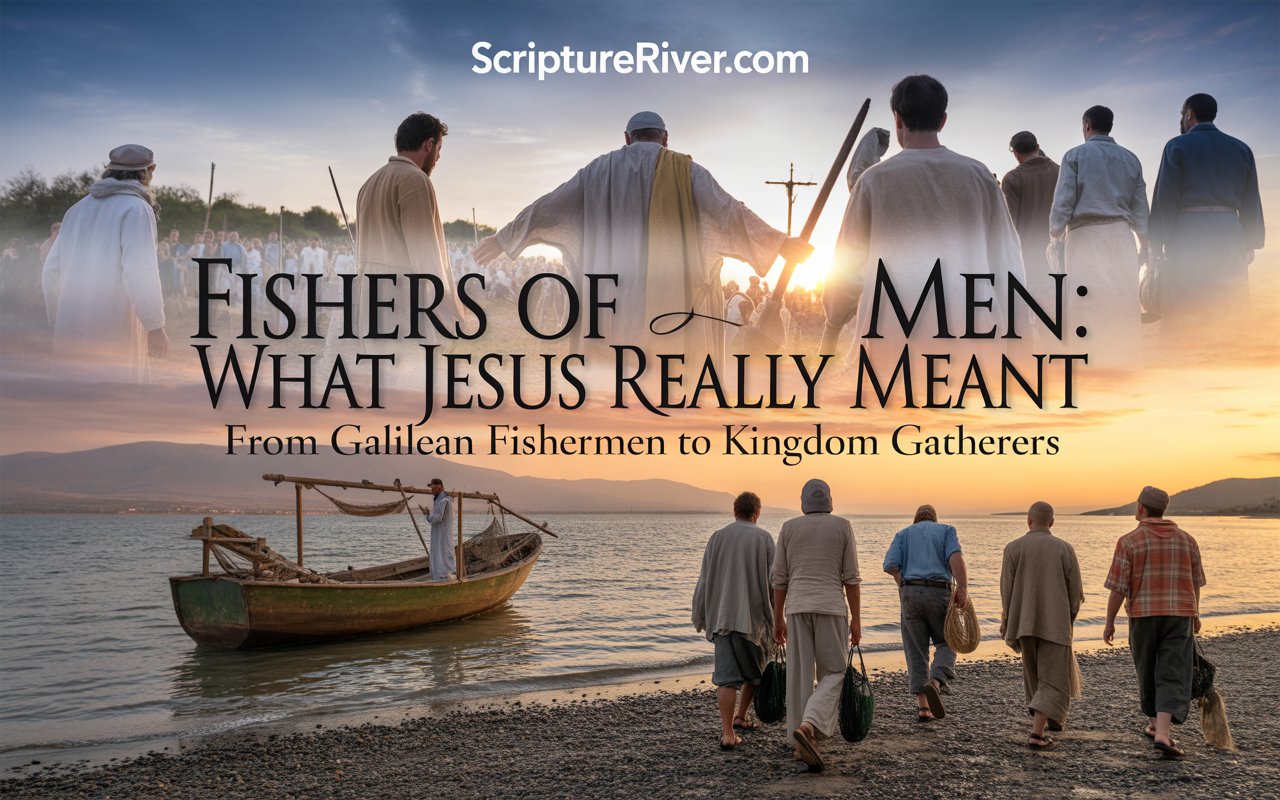
Jesus recruited His first disciples with a job offer, not a theology lecture.
Four fishermen were working their nets on the Sea of Galilee when Jesus walked up and said something that would become one of Christianity’s most recognizable phrases: “Follow me, and I will make you fishers of men.”
No explanation. No application process. No detailed job description.
Just a metaphor drawn from their daily work and a promise about their future calling.
Two thousand years later, “fishers of men” appears on church signs, evangelism training materials, and Christian bumper stickers.
But what did Jesus actually mean when He used this fishing metaphor?
Was He talking about evangelism techniques?
Soul-winning strategies?
Something else entirely?
Understanding what Jesus meant requires examining the original context, the fishing practices His audience knew, and how this metaphor connects to broader biblical themes about God’s mission in the world.
The Biblical Text in Context

Matthew 4:18-20, English Standard Version (ESV)
“While walking by the Sea of Galilee, he saw two brothers, Simon (who is called Peter) and Andrew his brother, casting a net into the sea, for they were fishermen. And he said to them, ‘Follow me, and I will make you fishers of men.’ Immediately they left their nets and followed him.”
Mark 1:16-17, Christian Standard Bible (CSB)
“As he passed alongside the Sea of Galilee, he saw Simon and Andrew, Simon’s brother, casting a net into the sea—for they were fishermen. ‘Follow me,’ Jesus told them, ‘and I will make you fish for people.'”
When This Happened
This wasn’t Jesus’s first interaction with these fishermen.
John 1:35-42 records an earlier encounter where Andrew and another disciple (likely John) met Jesus through John the Baptist’s testimony. Andrew then brought his brother Simon to Jesus.
So when Jesus called them at the Sea of Galilee, they already knew who He was.
The call to follow Him wasn’t coming from a complete stranger.
What They Were Doing
Peter and Andrew were “casting a net into the sea.” The Greek word “amphiballō” describes throwing a circular casting net, a common fishing method on the Sea of Galilee.
According to archaeological research on first-century Galilean fishing practices documented by Mendel Nun, fishermen used several net types: casting nets thrown from shore or boat, seine nets dragged between boats, and trammel nets set as barriers.
Each method required skill, timing, and knowledge of fish behavior.
Their Immediate Response
Matthew and Mark both emphasize the disciples left “immediately.”
They didn’t negotiate terms, ask for time to think it over, or finish their workday. They walked away from nets, boats, and their fishing business to follow Jesus.
That radical response suggests Jesus’s call carried authority they recognized and couldn’t ignore.
What First-Century Fishing Involved
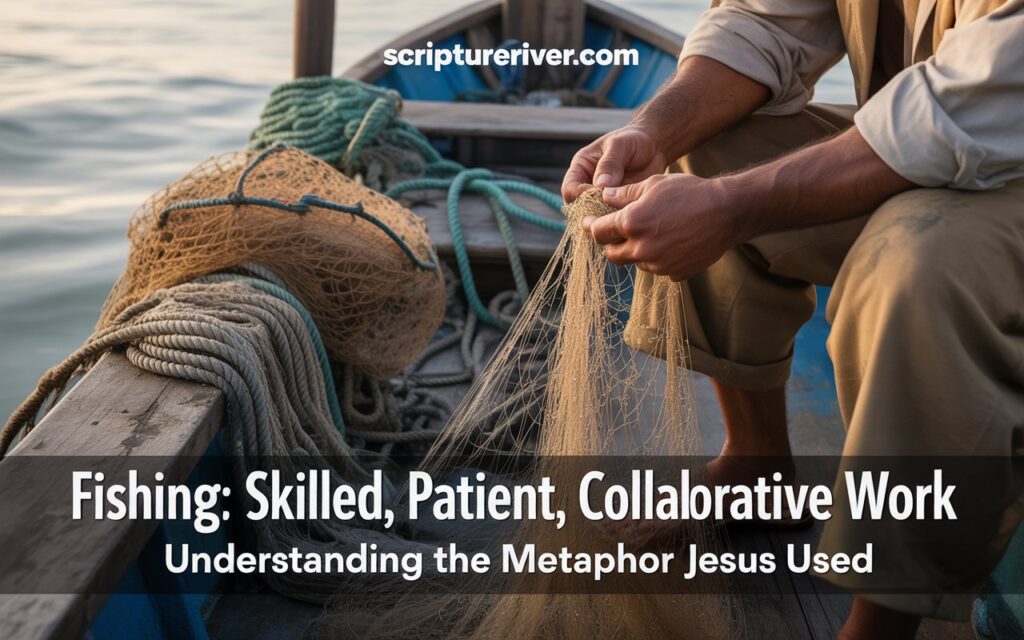
Jesus’s metaphor resonated because His audience understood fishing intimately. It wasn’t a recreational sport. It was demanding work requiring expertise.
Fishing Was Skilled Labor
Successful fishing required knowing where fish gathered, what times they fed, how weather affected their behavior, which nets worked for which species, and how to repair damaged equipment.
Fishermen on the Sea of Galilee weren’t casual hobbyists.
They were professionals running family businesses, often working in partnerships to share labor and equipment costs.
Fishing Required Patience and Persistence
Fish don’t cooperate with human schedules. Fishermen spent hours, sometimes all night, casting nets repeatedly.
Luke 5:5 records Peter saying, “Master, we toiled all night and took nothing.” Empty nets after exhausting work were a normal occurrence.
Fishing taught waiting, perseverance, and accepting that results don’t always match effort.
Fishing Was Collaborative Work
Most fishing methods required teams.
Seine nets needed multiple boats. Large catches required several men to haul nets. Processing and selling fish involved whole families.
The fishing industry Peter and Andrew left was community-based, not individualistic.
Fishing Provided Essential Food
Fish was a staple protein source in first-century Palestine.
Successful fishermen provided food security for their communities. Their work mattered economically and nutritionally.
What “Fishers of Men” Meant to Jesus’s Audience
When Jesus said “I will make you fishers of men,” His audience heard layers of meaning we miss reading it in modern contexts.
The Old Testament Background
The metaphor of catching people with nets appears in the Old Testament, usually in judgment contexts.
Jeremiah 16:16, New International Version (NIV)
“‘But now I will send for many fishermen,’ declares the Lord, ‘and they will catch them. After that I will send for many hunters, and they will hunt them down on every mountain and hill and from the crevices of the rocks.'”
This describes God sending agents to gather Israel for judgment. The fishing metaphor carried connotations of God’s sovereign action in gathering people.
Ezekiel 29:4-5 uses fishing imagery for judgment against Egypt. Prophets employed fishing metaphors to describe God catching people for accountability.
Jesus redeemed this judgment imagery by making it about rescue and inclusion in God’s kingdom rather than condemnation.
The Transformation Jesus Promised
“I will make you fishers of men” is a promise of transformation.
Jesus wasn’t recruiting them because they already possessed the skills needed. He was promising to equip them for a new kind of work.
According to New Testament scholar R.T. France’s commentary on Matthew, the emphasis falls on “I will make you.”
Jesus would do the transforming. Their part was following Him.
The Work Jesus Was Inviting Them Into
Jesus was beginning His public ministry of announcing God’s kingdom.
He needed collaborators who would participate in that mission. “Fishers of men” described their future role in gathering people into the kingdom.
Just as fishermen gathered fish from the sea, these disciples would gather people from the world into God’s redemptive purposes.
What “Fishers of Men” Means for Christians Today
This metaphor applies to all Christians, not just evangelists or pastors. Understanding how requires looking beyond simplistic evangelism formulas.
It’s About Participating in God’s Mission
God is gathering people from every nation, tribe, and language into His kingdom. Christians participate in that mission by pointing people toward Jesus through words and lives.
Being fishers of men means joining what God is already doing in the world. You’re not creating the mission. You’re collaborating with God’s work.
It Requires Following Jesus First
Jesus said “Follow me, and I will make you fishers of men.” The order matters. Following comes before fishing for people.
You can’t effectively point others toward Jesus if you’re not actively following Him yourself. Proximity to Jesus is the prerequisite for participating in His mission.
It’s Learned Through Practice, Not Classroom Study
Jesus didn’t send the disciples to seminary before involving them in ministry.
He made them fishers of men by having them walk with Him, watch Him interact with people, and gradually participate in the work.
You learn to be a fisher of men by doing it under Jesus’s direction, making mistakes, experiencing both success and failure, and growing through the process.
It Values People as Worth Pursuing
Fishermen pursued fish because they were valuable. Jesus values people infinitely more than fish.
Being fishers of men means treating people as treasured by God, worth the effort of pursuing a relationship and sharing truth.
This contradicts consumerist evangelism that treats people as statistics or projects. Biblical fishing for men involves genuine care for individuals.
It Requires Patience and Persistence
Fish don’t jump into nets. People don’t typically respond to the gospel on first hearing.
Fishing for men requires the same patience and persistence as fishing does.
You plant seeds. You water. You wait. Then you trust God for growth.
Some days the nets are full. Other days they’re empty. You keep fishing anyway.
It Works Best Collaboratively
The disciples fished in teams. Christians participate in God’s mission most effectively in community, not isolation.
You might have spiritual conversations that your friend can’t initiate.
Your friend might answer questions you can’t address.
Someone else might provide the relationship that opens doors to gospel conversations. Fishing for men is teamwork.
What “Fishers of Men” Doesn’t Mean
Misunderstanding this metaphor creates problematic approaches to sharing faith.
It Doesn’t Mean Using Manipulative Techniques
Some evangelism training treats “fishing for men” as mastering persuasion techniques to hook people and reel them in against their will.
That distorts the metaphor. You’re not manipulating people.
You’re participating in God’s work of drawing people to Himself through the Holy Spirit’s conviction and the gospel’s power.
It Doesn’t Mean Everyone Evangelizes the Same Way
Fishermen used different methods for different contexts. Casting nets. Seine nets. Trammel nets. The goal was catching fish. The methods varied.
Christians participate in God’s mission through different gifts, personalities, and approaches. There’s no one-size-fits-all evangelism formula.
It Doesn’t Make Evangelism Your Only Calling
Being fishers of men is one dimension of following Jesus. It’s not your entire Christian identity or sole purpose.
You’re also called to worship, serve, grow in holiness, love others, pursue justice, and steward creation. Fishing for men fits within comprehensive discipleship, not replacing it.
It Doesn’t Measure Success by Numbers
Fishermen’s success was measured by full nets. But Jesus’s parable of the Sower in Matthew 13:3-9 shows that faithful gospel proclamation produces varied responses. Some soil is hard. Some is shallow. Some is thorny. Some is good.
You’re responsible for faithful fishing, not controlling how many respond.
Frequently Asked Questions About Fishers of Men
Did Jesus only call fishermen to be fishers of men?
No. While Jesus used fishing language with Peter, Andrew, James, and John, He called people from various backgrounds. Matthew was a tax collector. Simon was a Zealot. Paul was a Pharisee and tentmaker. The metaphor applied specifically to these fishermen but the mission applies to all Christians.
Is being a fisher of men only about verbal evangelism?
No. While verbal gospel proclamation is essential, fishing for men includes living in ways that attract people to Jesus, serving others tangibly, answering questions when asked, demonstrating kingdom values, and creating environments where spiritual conversations happen naturally. Your entire life participates in God’s mission.
How can introverts be fishers of men?
Fishing for men doesn’t require extroverted personality. Introverts often excel at deep one-on-one conversations, thoughtful written communication, hospitality in small settings, and creating safe spaces for honest questions. Different fishing methods suit different personalities.
What if I’ve tried sharing my faith and people rejected the message?
Fishermen experienced empty nets regularly. Rejection doesn’t mean you failed. Some people will reject the gospel no matter how clearly you present it. Your calling is faithful fishing, not guaranteeing results. Keep fishing. Some nets will be empty. Others will be surprisingly full.
Does “fishers of men” imply aggressive evangelism tactics?
No. The metaphor describes participating in God’s work of gathering people into His kingdom. How you do that should reflect Jesus’s character: loving, truthful, patient, respectful of free will. Aggressive manipulation contradicts Jesus’s approach to people throughout the Gospels.
How do I become a fisher of men if I don’t know what to say?
Start by following Jesus closely. Learn from how He interacted with people in the Gospels. Ask the Holy Spirit for opportunities and words. Begin with people you already know. Share your story honestly. Answer questions as they arise. You don’t need all the answers to participate in God’s mission.
Sources Referenced
France, R. T. (2007). The Gospel of Matthew. Eerdmans Publishing Company. [Book]
Nun, M. (1989). The Sea of Galilee and Its Fishermen in the New Testament. Kibbutz Ein Gev. [Book]
Peterson, E. H. (2005). The Message: The Bible in Contemporary Language. NavPress. [Bible Translation]
Strong, J. (2010). Strong’s Exhaustive Concordance of the Bible. Hendrickson Publishers. [Reference Book]
Witherington, B. (2001). The Gospel of Mark: A Socio-Rhetorical Commentary. Eerdmans Publishing Company. [Book]
Wright, N. T. (2004). Matthew for Everyone, Part 1. Westminster John Knox Press. [Book]