
God hates six things, detests a seventh, and chances are you committed at least one of them this week.
That sentence should make you uncomfortable. It’s designed to.
We’ve sanitized God into a cosmic grandfather who overlooks everything with an indulgent smile.
The Bible presents Someone who loves intensely and hates specifically, whose holiness means certain behaviors provoke His active opposition.
Proverbs 6:16-19, English Standard Version (ESV)
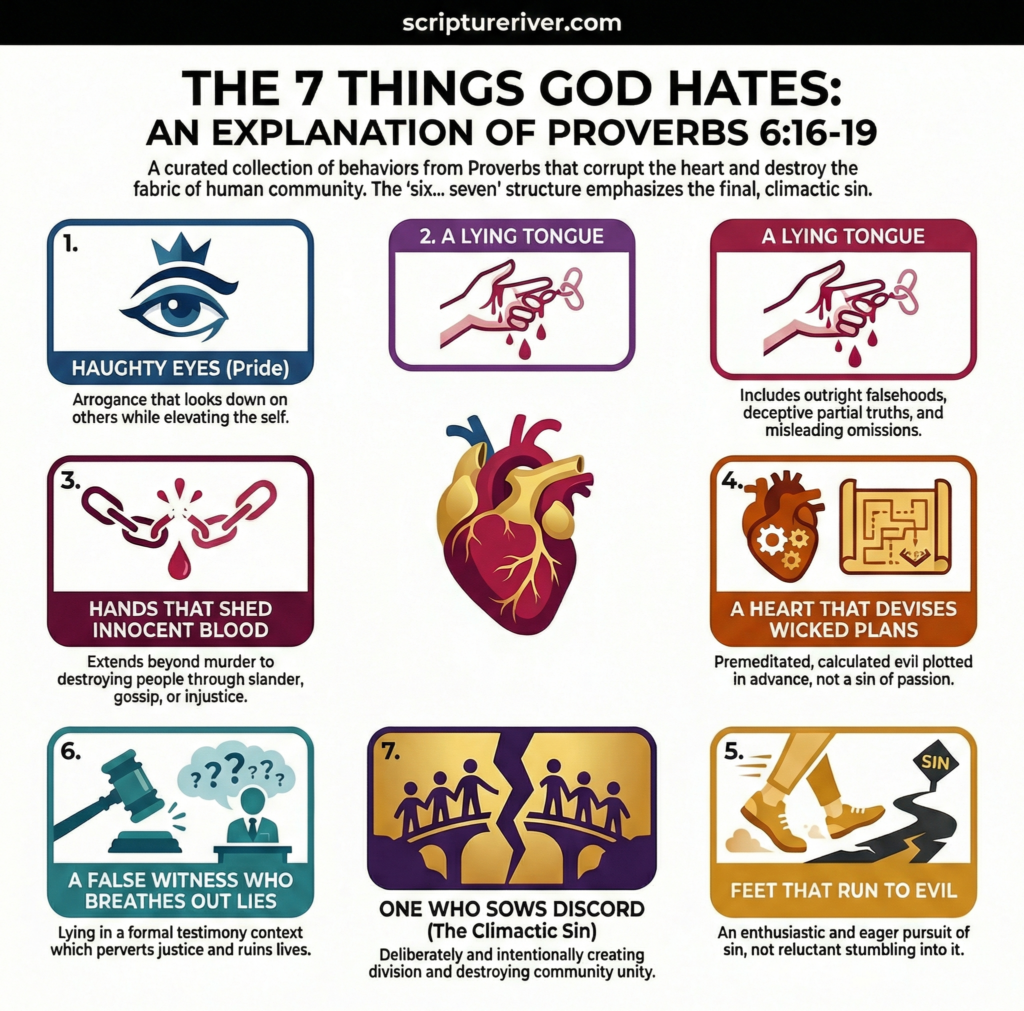
“There are six things that the Lord hates, seven that are an abomination to him: haughty eyes, a lying tongue, and hands that shed innocent blood, a heart that devises wicked plans, feet that make haste to run to evil, a false witness who breathes out lies, and one who sows discord among brothers.”
This isn’t comprehensive list of everything God dislikes.
It’s a curated collection of behaviors that destroy community and reveal heart corruption.
Each item targets something that tears apart the fabric of human relationships God designed to reflect His glory.
The structure itself matters.
Starting with six and adding a seventh creates emphasis in Hebrew poetry. The seventh item receives special attention as a climactic conclusion.
Understanding why God hates these specific things and how they manifest in contemporary life reveals whether you’re living in ways that provoke God’s opposition or pursuing holiness that pleases Him.
Unpacking Each Abomination
1. Haughty Eyes
The Hebrew word for haughty (rum) means lifted up, elevated, exalted. Haughty eyes look down on others while elevating self.
This isn’t healthy confidence or recognizing your gifts.
It’s arrogance that considers others inferior, dismisses their perspectives, and treats them as less valuable than yourself.
You see haughty eyes when someone refuses to learn from anyone they consider beneath them.
When they interrupt constantly because their thoughts matter more than yours. When they take credit for collaborative work. When they can’t admit being wrong.
Proverbs 16:18, Christian Standard Bible (CSB)
“Pride comes before destruction, and an arrogant spirit before a fall.”
Pride tops this list deliberately. It’s foundational sin from which others flow.
Satan’s fall began with pride. Adam and Eve’s sin involved wanting to be like God.
Pride makes you your own god, dismissing the actual God’s authority.
2. A Lying Tongue
Lying tongue doesn’t just mean outright falsehoods.
It includes exaggeration, deceptive partial truths, misleading implications, and convenient omissions that create false impressions.
You lie when you embellish stories to make yourself look better. When you shade facts in your favor during conflicts. When you let people believe something you know isn’t true because correcting them would be inconvenient. When your words technically contain truth while intentionally deceiving.
John 8:44, New International Version (NIV)
“You belong to your father, the devil, and you want to carry out your father’s desires. He was a murderer from the beginning, not holding to the truth, for there is no truth in him. When he lies, he speaks his native language, for he is a liar and the father of lies.”
Lying aligns you with Satan’s character. God’s nature is truth. Christ declared “I am the truth” (John 14:6). Lying violates God’s essential nature.
3. Hands That Shed Innocent Blood
This obviously includes murder. But innocent blood extends beyond literal killing to destroying innocent people through slander, false accusations, or systemic injustice that crushes the vulnerable.
You shed innocent blood through gossip that destroys someone’s reputation. Through false testimony in courts or workplaces. Through supporting systems that exploit the poor while benefiting yourself. Through abortion that ends innocent human life. Through criminal justice that punishes innocent while protecting guilty with wealth and connections.
Exodus 23:7, New King James Version (NKJV)
“Keep yourself far from a false matter; do not kill the innocent and righteous. For I will not justify the wicked.”
God specifically defends the innocent. Attacking them invites His fierce opposition.
4. A Heart That Devises Wicked Plans
This addresses premeditated evil. Not sins of passion or weakness but calculated wickedness plotted in advance.
You devise wicked plans when you scheme how to cheat on taxes. When you strategize how to manipulate someone into relationship or business deal that benefits you at their expense. When you plot revenge. When you calculate how to get away with sin.
The Hebrew word translated “devises” (charash) means to plow or engrave.
These aren’t passing temptations resisted. They’re wickedness carved into your thinking through repeated meditation.
Psalm 36:4, English Standard Version (ESV)
“He plots trouble while on his bed; he sets himself in a way that is not good; he does not reject evil.”
Lying in bed plotting wickedness reveals hearts thoroughly given over to sin.
5. Feet That Make Haste to Run to Evil
This describes eagerness for sin. Not reluctant stumbling but enthusiastic pursuit. Running toward wickedness rather than fleeing it.
You run to evil when you can’t wait to share juicy gossip. When you eagerly engage in sins you’ve struggled with before. When you seek out situations where you know temptation awaits. When you’re first to join conversations tearing others down.
The imagery of feet running emphasizes wholehearted commitment. This isn’t casual sin. It’s determined pursuit.
Proverbs 4:14-15, Christian Standard Bible (CSB)
“Don’t set foot on the path of the wicked; don’t proceed in the way of evil ones. Avoid it; don’t travel on it. Turn away from it, and pass it by.”
Wisdom runs away from evil. Folly runs toward it.
6. A False Witness Who Breathes Out Lies
This repeats lying from item two with specific focus on testimony context. False witness destroys justice and ruins innocent lives.
Ancient Israel’s legal system depended on witness testimony. False witnesses could cause innocent people’s execution.
Modern equivalents include perjury, false police reports, lying in depositions, fabricating evidence, and character assassination disguised as honest testimony.
Proverbs 19:5, New International Version (NIV)
“A false witness will not go unpunished, and whoever pours out lies will not go free.”
The phrase “breathes out” suggests lying is this person’s natural speech, as automatic as breathing.
7. One Who Sows Discord Among Brothers
The climactic seventh abomination. Someone who deliberately creates division, turns people against each other, and destroys community unity.
You sow discord when you gossip to create factions. When you manipulate conflicts to your advantage. When you pit people against each other. When you refuse to reconcile after offenses are addressed. When you divide churches over preferences rather than theology. When you turn family members against each other.
The word “sows” indicates intentional planting. This isn’t accidental discord from honest disagreement. It’s calculated destruction of unity.
Romans 16:17, English Standard Version (ESV)
“I appeal to you, brothers, to watch out for those who cause divisions and create obstacles contrary to the doctrine that you have been taught; avoid them.”
Church unity matters so much that Paul commands avoiding those who deliberately destroy it.
Why These Seven Specifically
These aren’t random selections. Each one directly attacks either God’s character (pride, lying) or human relationships God designed (murder, discord, false witness, plotting evil, running to evil).
Pride elevates self above God. Lying contradicts God’s truth. Shedding innocent blood destroys God’s image-bearers. Wicked plans pervert the minds God gave for wisdom. Running to evil perverts the freedom God gave for righteousness. False witness destroys justice God commands. Discord destroys unity God values.
Together they paint portrait of person completely corrupted internally (pride, wicked heart, running to evil) expressing that corruption externally through lying, violence, false testimony, and division.
The Gospel Response
Reading this list should produce two responses: conviction and gratitude.
Conviction because honest self-examination reveals you’ve committed these abominations. You’ve been proud. You’ve lied. You’ve torn others down. You’ve plotted selfish schemes. You’ve eagerly pursued what God calls evil.
Gratitude because Christ died for these sins. God’s hatred of these abominations was poured out on Jesus at the cross. 2 Corinthians 5:21 declares “For our sake he made him to be sin who knew no sin, so that in him we might become the righteousness of God.”
The same God who hates these sins offers complete forgiveness through Christ’s atoning death. You’re not condemned to guilt. You’re invited to repentance and cleansing.
Practical Application
Examine yourself honestly. Which of these seven do you commit regularly? Where do you see these patterns in your life?
Confess specifically. Don’t pray vague “forgive my sins” prayers. Name the specific pride, lies, discord, or wicked plans. 1 John 1:9 promises “If we confess our sins, he is faithful and just to forgive us our sins and to cleanse us from all unrighteousness.”
Pursue opposite virtues. Replace pride with humility. Replace lying with truth-telling. Replace discord-sowing with peacemaking. Replacement, not just elimination, creates lasting change.
Watch for subtle manifestations. These sins often hide behind acceptable facades. Pride disguises itself as confidence. Lying becomes “protecting people’s feelings.” Discord-sowing masquerades as “honest sharing.”
Help others avoid these. When you see friends heading toward these sins, lovingly intervene. Galatians 6:1 commands “Brothers, if anyone is caught in any transgression, you who are spiritual should restore him in a spirit of gentleness.”
Frequently Asked Questions
Does God really hate people or just sin?
God hates sin and also exercises wrath toward people who practice sin unrepentantly. Psalm 5:5 states “The boastful shall not stand before your eyes; you hate all evildoers.” However, God’s hatred is just response to evil, and He offers mercy through Christ to all who repent.
Which of the seven is worst?
Scripture doesn’t rank them, though placing discord last suggests special emphasis. All are abominations. Asking which is worst might deflect from examining which ones you personally commit.
Can Christians commit these sins?
Yes. Christians sin. The difference is Christians confess, repent, and pursue change through the Spirit’s power. Unbelievers practice these sins without conviction or desire to change.
How is this list different from the Ten Commandments?
The Ten Commandments are comprehensive moral law. Proverbs 6:16-19 highlights specific sins God particularly hates. There’s overlap (lying, murder) but this passage emphasizes community-destroying behaviors the Commandments address less directly.
What if I’ve committed all seven?
Confess them, receive God’s forgiveness through Christ, and pursue holiness going forward. The gospel exists precisely for people who’ve committed abominable sins. Christ died for all of these.
Why isn’t sexual sin on this list?
Proverbs addresses sexual sin extensively elsewhere (Proverbs 6:20-35 immediately follows this passage). This list focuses on pride and community destruction specifically. Sexual sin’s absence here doesn’t minimize its seriousness.
Prayer of Repentance
Holy God, I’ve committed abominations You hate. I’ve been proud, considering myself above others. I’ve lied to protect my image and advance my interests. I’ve destroyed others’ reputations through words. I’ve plotted selfish schemes. I’ve run eagerly toward sins I should flee. I’ve given false testimony. I’ve sown discord among people You want united. I deserve Your opposition. Yet You offer mercy through Christ who bore Your hatred of these sins on the cross. Forgive me. Cleanse me. Transform me. Replace my pride with humility. Replace my lies with truth. Replace my discord with peacemaking. Make me hate what You hate and love what You love. In Jesus’s Name, Amen.
Works Cited
Garrett, D. A. (1993). Proverbs, Ecclesiastes, Song of Songs. B&H Publishing Group. [Biblical Commentary]
Longman, T. (2006). Proverbs. Baker Academic. [Biblical Commentary]
Peterson, E. H. (2005). The Message: The Bible in Contemporary Language. NavPress. [Bible Translation]
Strong, J. (2010). Strong’s Exhaustive Concordance of the Bible. Hendrickson Publishers. [Reference Book]
Waltke, B. K. (2004). The Book of Proverbs: Chapters 1-15. Eerdmans Publishing Company. [Biblical Commentary]

