
My contractor promised the deck would be finished by Friday.
Friday came. No deck. “I’ll definitely have it done by Monday,” he said.
Monday passed. Still nothing.
Wednesday, he texted: “I swear on my mother’s grave, it’ll be ready this weekend.”
It wasn’t.
Three broken promises.
Each one reinforced with increasingly dramatic oaths.
Each one worthless.
That’s exactly the pattern James addresses in James 5:12.
In first-century culture, people constantly swore elaborate oaths to make their words sound credible.
The bigger the oath, the less trustworthy the person making it.
James cuts through that nonsense with one radical command: let your yes be yes and your no be no.
No oaths. No embellishment. Just integrity.
This verse isn’t about avoiding profanity. No.
It’s about becoming the kind of person whose word doesn’t need reinforcement because everyone knows you mean what you say.
Audio Overview: Why Your Word Should Be Enough
Listen to this 4-minute explanation of why James commanded Christians to stop swearing oaths and start building character so trustworthy that your simple yes carries more weight than someone else’s elaborate promises.
You’ll discover what this verse actually prohibits, what it allows, and how to become someone whose word is genuinely reliable without needing oaths to back it up.
What James 5:12 Actually Says
Here’s the full verse that confuses Christians about oaths, honesty, and integrity:
James 5:12, English Standard Version (ESV)
“But above all, my brothers, do not swear, either by heaven or by earth or by any other oath, but let your ‘yes’ be yes and your ‘no’ be no, so that you may not fall under condemnation.”
James opens with “above all,” which signals that this is critically important.
More important than patience in suffering, which he just discussed.
More important than prayer for the sick, which he’s about to discuss.
The character that makes oaths unnecessary ranks as one of James’s highest priorities for believers.
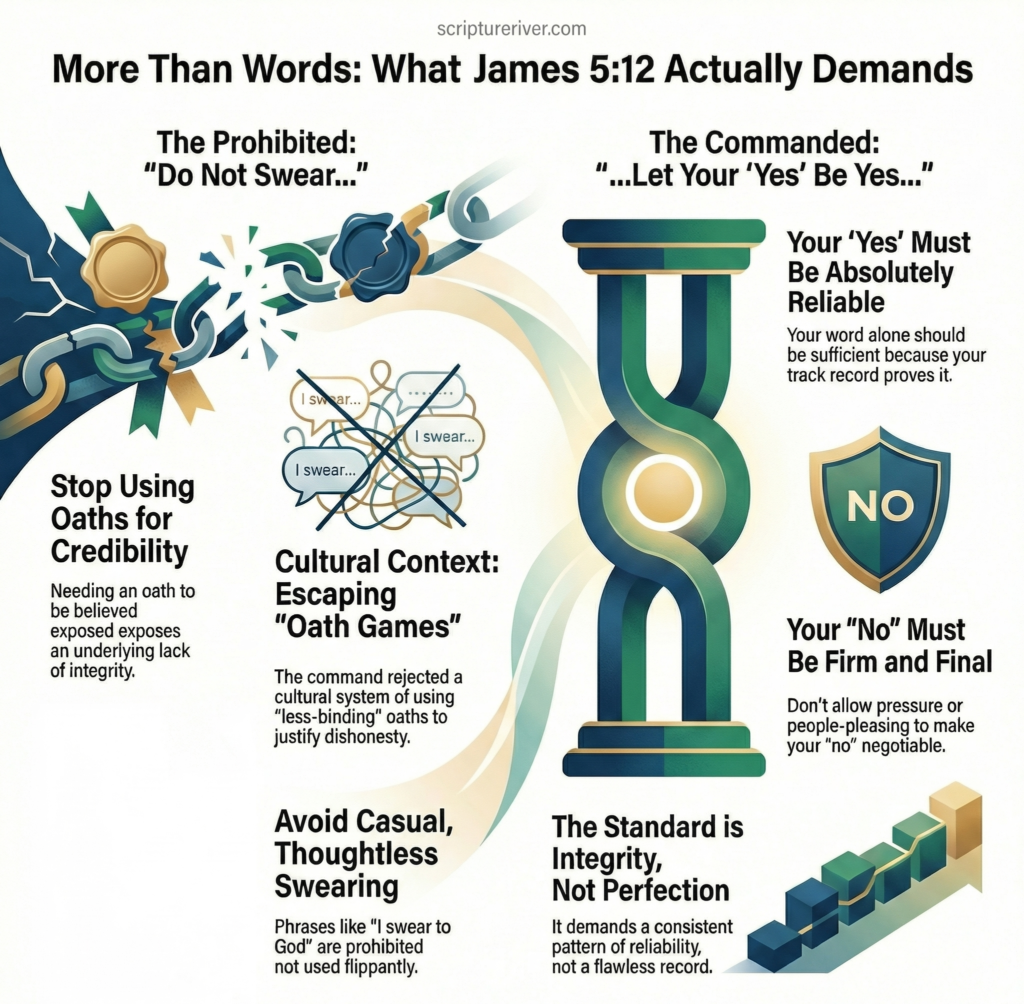
The command breaks into two parts: what to stop doing (swearing oaths) and what to do instead (speak with integrity that needs no reinforcement).
The Cultural Context That Makes This Make Sense
First-century Jewish culture had complex oath-taking systems that sound bizarre to modern readers.
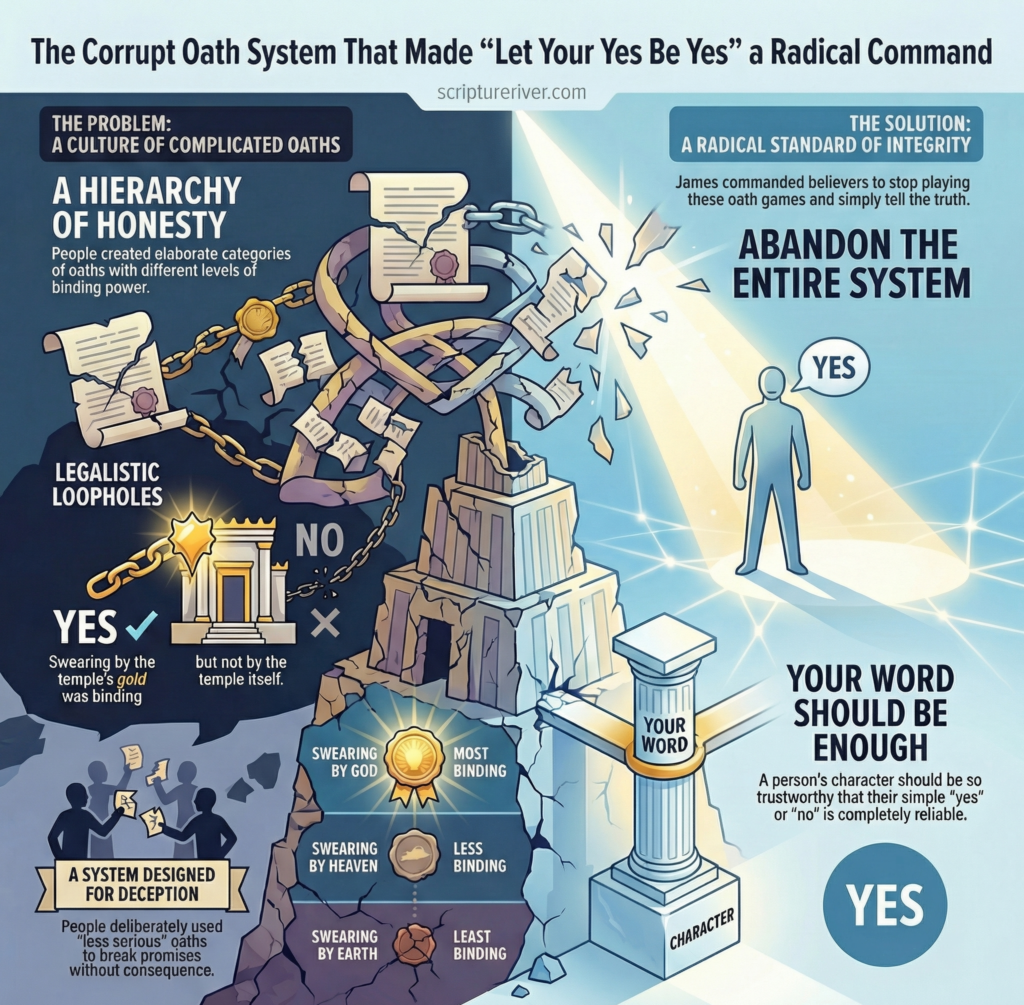
According to biblical scholar Douglas Moo in his commentary on James, Jews developed elaborate categories of oaths with different binding levels.
Swearing by heaven was considered less binding than swearing by God directly.
Swearing by earth was less binding than swearing by heaven.
Swearing by Jerusalem was somewhere in between.
People manipulated this system constantly.
They’d make promises using less binding oaths, then claim they weren’t really obligated when they broke them because the oath wasn’t serious enough.
Jesus addressed this exact problem in Matthew 5:33-37 and Matthew 23:16-22.
The Pharisees taught that swearing by the temple didn’t bind you, but swearing by the temple’s gold did.
Swearing by the altar didn’t bind you, but swearing by the gift on the altar did.
It was legalistic hair-splitting that let people lie while technically keeping elaborate oath rules.
James, writing to Jewish Christians scattered throughout the Roman Empire, commanded them to abandon this entire corrupt system.
Stop playing oath games. Just tell the truth and keep your word.
What James Is Actually Prohibiting
Let’s get specific about what James forbids and what he doesn’t.
What James Prohibits
1. Using Oaths to Make Your Word Sound More Trustworthy
When you need an oath to convince people you’re telling the truth, it reveals you’re known for not telling the truth.
Trustworthy people don’t need elaborate promises. Their track record speaks for itself.
James prohibits the habit of reinforcing your words with oaths because needing reinforcement exposes a lack of integrity.
2. Casual, Flippant Swearing
“I swear to God.” “I promise on my life.” “Cross my heart and hope to die.”
These phrases roll off Christian tongues constantly, usually with zero thought about whether we’ll actually follow through.
James prohibits treating serious commitments casually by attaching religious language to promises you might not keep.
3. Using God’s Name to Validate Your Promises
Swearing by heaven, earth, Jerusalem, or any religious symbol is dragging God into your personal credibility problem.
You’re essentially saying, “I know you don’t trust me, so I’m invoking God to make you believe me.”
That’s taking God’s name in vain. Using his reputation to shore up yours when your word alone isn’t trusted.
What James Doesn’t Prohibit
1. Legal Oaths in Court
The Apostle Paul took oaths in his letters. In Romans 1:9, he says, “God is my witness.” In 2 Corinthians 1:23, he calls God a witness to his motives.
Legal contexts where formal testimony requires an oath aren’t what James is addressing.
As New Testament scholar Craig Blomberg notes in his Matthew commentary, Jesus Himself answered under oath when the high priest charged Him during His trial.
The issue isn’t formal legal procedures. It’s the corruption of daily speech through casual oath-taking.
2. Promises Made to God
Making vows to God (like wedding vows or dedication promises) isn’t prohibited here.
Ecclesiastes 5:4-5 encourages keeping vows made to God.
James isn’t contradicting that. He’s addressing horizontal promises between people, not vertical commitments to God.
3. Strong Affirmations
Saying “I promise” or “I give you my word” isn’t wrong if you genuinely intend to follow through.
The problem is needing increasingly dramatic oaths because your previous promises were broken.
That pattern reveals character issues, not vocabulary choices.
What “Let Your Yes Be Yes” Actually Means
The positive command is more important than the prohibition.
Your Yes Should Mean Yes
When you say yes, people should be able to count on it without requiring additional confirmation.
According to a 2019 Gallup poll on honesty and ethics in professions, only 18% of Americans rate business executives as having high honesty and ethical standards.
The prevailing cultural assumption is that people’s words can’t be trusted without contracts, guarantees, and legal reinforcement.
James calls Christians to live differently.
Your yes should be so reliable that people don’t need your signature, your oath, or your elaborate promises.
Your word alone should be sufficient because your track record proves it.
Your No Should Mean No
This is equally important and equally difficult.
When you say no, stick with it. Don’t let guilt, pressure, or people-pleasing make you reverse commitments you’ve already declined.
Many Christians struggle more with unreliable nos than unreliable yesses.
We say no to protect our boundaries or capacity, then cave when pushed. Our no becomes negotiable.
James says stop. Let your no be firm. Say it with integrity and maintain it with integrity.
The Standard Is Integrity, Not Perfection
James isn’t demanding that you never make mistakes or that unforeseen circumstances never prevent you from keeping commitments.
He’s demanding you build character where:
- You think carefully before committing
- You commit only to what you genuinely intend to do
- You follow through unless genuinely prevented
- You communicate honestly when circumstances change
- Your pattern over time is reliable
That’s different from perfectionism. It’s integrity, which biblical scholars like Scot McKnight note in his James commentary, is the core virtue James emphasizes throughout his entire letter.
Why This Matters More Than You Think
Let your yes be yes and no be no sounds like simple advice about honesty.
It’s actually revolutionary teaching about the kind of character God demands from His people.
It Reveals Who You Actually Worship
Jesus said in Matthew 6:24 you can’t serve two masters. Your words reveal your master.
If your yes changes based on what’s convenient, comfortable, or advantageous, you’re serving yourself, not God.
If your yes remains yes regardless of cost, you’re serving God, not circumstances.
Your word is a window into your worship. James is diagnosing spiritual allegiance through verbal integrity.
It Distinguishes Christians in a Corrupt Culture
In the ancient Roman world and in our world, people assume everyone lies.
Contracts exist because words aren’t trusted.
Lawyers review agreements because promises aren’t reliable.
Business deals require escrow because commitments are suspect.
When Christians develop reputations for keeping their word so consistently that oaths become unnecessary, that’s distinctive witness.
People notice when someone’s yes actually means yes every single time. It’s rare enough to stand out dramatically.
It Protects Your Testimony
I’ve watched believers destroy their Christian witness through broken promises.
The coworker you promised to pray for but forgot. The friend you committed to help but bailed on. The ministry volunteer position you signed up for, then abandoned.
Each broken promise tells unbelievers: Christians’ words are just as unreliable as everyone else’s. Jesus makes no practical difference in their lives.
That’s not a testimony problem. That’s a discipleship problem. And James 5:12 directly addresses it.
How to Actually Live This Out
Knowing what James means and actually doing it are different challenges.
Here’s how to develop the integrity this verse requires.
1. Pause Before Committing to Anything
Don’t say yes immediately when asked to do something.
“Let me check my calendar and get back to you.” “I need to pray about that before committing.” “Give me 24 hours to think it through.”
According to research by organizational psychologist Adam Grant, people who immediately agree to requests are less likely to follow through than those who take time to consider before committing.
Slow down your yesses. Think them through. Commit only when you genuinely intend to follow through.
2. Track Your Commitments
You can’t keep promises you forget you made.
Write down what you’ve committed to. Review it regularly. If your list gets overwhelming, that’s feedback that you’re overcommitting.
Better to say no upfront than yes initially and no eventually through failure to follow through.
3. Communicate Changes Immediately
Circumstances change. Emergencies happen. Sometimes keeping one commitment requires breaking another.
When you realize you can’t keep a commitment, communicate immediately. Don’t wait until the last minute, hoping something changes.
Integrity includes honest communication about changed circumstances as soon as you recognize them.
4. Make Fewer, Higher-Quality Commitments
Research from behavioral economist Dan Ariely suggests people overestimate their future availability by about 40%.
You think you’ll have more time next month than you do. You assume future-you will be more energetic than present-you. So you overcommit.
Make fewer commitments. Let your track record of keeping them speak louder than the quantity of promises made.
5. Build a Reputation Slowly
Trustworthiness develops through a consistent pattern over time.
Each kept promise builds trust. Each broken promise destroys the trust built over months.
You can’t build a reputation for integrity through dramatic gestures. Only through boring consistency of keeping your word year after year.
When Keeping Your Word Costs You
Sometimes integrity is expensive.
You committed to helping someone move, then got invited to something more appealing. Keep your word anyway.
You promised to volunteer, but you’re exhausted and don’t feel like it. Keep your word anyway.
You said you’d be there, but staying home sounds better. Keep your word anyway.
This is where letting your yes be yes gets tested. When keeping commitments costs something.
Jesus kept His commitment to die for sinners even when it cost Him everything. That’s the standard for Christian integrity.
Your word should be valuable enough that you’ll sacrifice comfort, convenience, and preference to keep it.
The Warning James Gives
James ends James 5:12 with: “so that you may not fall under condemnation.”
That’s serious language. Unreliable speech leads to judgment.
Why would God judge verbal unreliability so harshly?
Because your words reveal your heart. Matthew 12:34 says out of the overflow of the heart the mouth speaks.
If your words are unreliable, your heart is unreliable. If your commitments are negotiable based on convenience, your commitment to God is negotiable too.
James isn’t being harsh. He’s being realistic. The character that makes oaths necessary reveals a character that can’t be trusted in deeper spiritual matters.
God takes your words seriously because they reveal whether you take Him seriously.
What This Means for Your Life Today
James 5:12 should convict every believer in specific, practical ways.
In your marriage: When you say, “I’ll be home by 6,” are you home by 6? Or are your spouse and kids learning not to count on your word?
In your work: When you commit to a deadline, do you meet it? Or do coworkers know your promises need large margins for reality?
In your friendships: When you say “Let’s get together soon,” do you follow through? Or is it just a nice-sounding exit from conversations?
In your church: When you sign up to volunteer, do you show up consistently? Or do ministry leaders know not to depend on you?
Your answers to these questions reveal whether you’re living James 5:12 or just knowing it.
Knowing is easy. Living costs something. But it produces a character that looks like Jesus and a testimony that draws people to Him.
Let your yes be yes. Let your no be no. Build integrity so unshakeable that your word alone carries more weight than someone else’s oath.
That’s what James demands. And it’s what a watching world desperately needs to see in Christians.
Prayer for Verbal Integrity
Father, I confess my words haven’t been reliable. I’ve made commitments I didn’t keep, promises I didn’t fulfill, and said yes when I should have said no.
Forgive me for the times my unreliability has damaged my testimony and hurt people who trusted me. Give me wisdom to think carefully before committing to anything. Give me courage to say no when I should.
Give me integrity to keep my word even when it costs me. Make me someone whose yes is genuinely yes and whose no is genuinely no, so that my life reflects Your character and my words build trust instead of destroying it.
In Jesus’s Name, Amen.
References
Blomberg, C. L. (1992). Matthew. B&H Publishing Group. [Book]
Davids, P. H. (1982). The Epistle of James: A Commentary on the Greek Text. Eerdmans Publishing Company. [Book]
Gallup, Inc. (2019). “Honesty/Ethics in Professions.” Gallup News. [Research Report]
Grant, A. (2013). Give and Take: Why Helping Others Drives Our Success. Penguin Books. [Book]
McKnight, S. (2011). The Letter of James. Eerdmans Publishing Company. [Book]
Moo, D. J. (2000). The Letter of James. Eerdmans Publishing Company. [Book]
Morris, L. (1992). The Gospel According to Matthew. Eerdmans Publishing Company. [Book]
Peterson, E. H. (2005). The Message: The Bible in Contemporary Language. NavPress. [Bible Translation]
Strong, J. (2010). Strong’s Exhaustive Concordance of the Bible. Hendrickson Publishers. [Reference Book]
Wiersbe, W. W. (2007). The Bible Exposition Commentary: New Testament (Vol. 2). David C. Cook. [Book]