
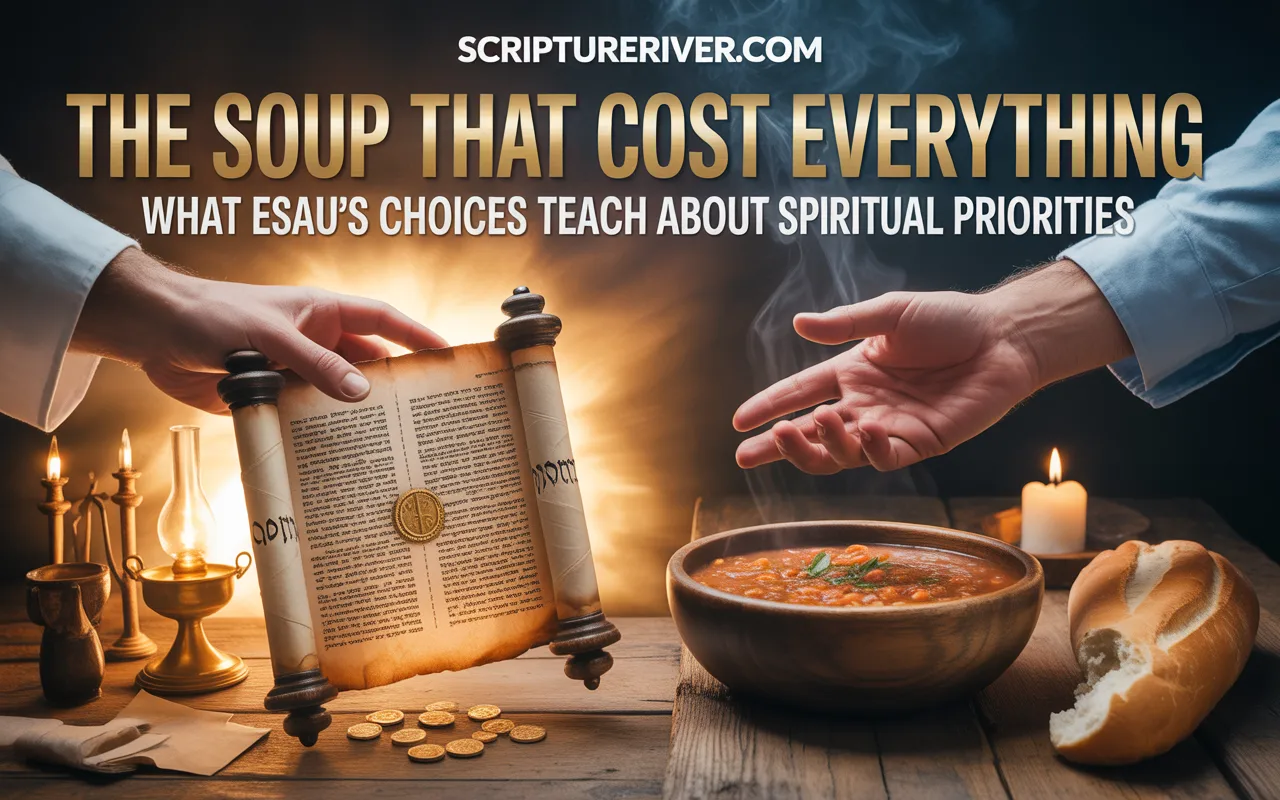
Esau traded his birthright for a bowl of soup and spent the rest of his life regretting it.
“Once when Jacob was cooking stew, Esau came in from the field, and he was exhausted. And Esau said to Jacob, ‘Let me eat some of that red stew, for I am exhausted!’ (Therefore his name was called Edom.) Jacob said, ‘Sell me your birthright now.’ Esau said, ‘I am about to die; of what use is a birthright to me?’ Jacob said, ‘Swear to me now.’ So he swore to him and sold his birthright to Jacob. Then Jacob gave Esau bread and lentil stew, and he ate and drank and rose and went his way. Thus Esau despised his birthright.”
Genesis 25:29-34, English Standard Version (ESV)
This isn’t ancient history with no modern relevance.
It’s mirror reflecting decisions you make constantly about what matters and what doesn’t.
Every day you choose between immediate gratification and eternal value, between what feels urgent and what’s actually important, between temporary comfort and lasting blessing.
Esau’s life documents what happens when those choices consistently prioritize the wrong things.
His story isn’t just about one bowl of soup.
It’s a pattern of valuing physical appetite over spiritual inheritance, immediate satisfaction over future blessing, and momentary relief over covenant promises.
Understanding Esau requires examining his entire life, not just the infamous transaction.
His choices before and after that meal reveal consistent pattern: spiritual things mattered less than physical things, long-term promises mattered less than short-term comfort, and God’s plans mattered less than personal preferences.
Esau’s Character Before the Fatal Choice
1. Born Grasping
Genesis 25:24-26, Christian Standard Bible (CSB)
“When her time to give birth was completed, there were indeed twins in her womb. The first one came out red-looking, covered with hair like a fur coat, and they named him Esau. After this, his brother came out grasping Esau’s heel with his hand. So he was named Jacob. Isaac was sixty years old when they were born.”
Jacob emerged grabbing Esau’s heel, foreshadowing the struggle between them.
But notice Esau’s description: red and hairy, physical characteristics emphasized from birth. His name means “hairy,” grounding his identity in physical traits.
2. Preferred by Isaac for Wrong Reasons
Genesis 25:27-28, New International Version (NIV)
“The boys grew up, and Esau became a skillful hunter, a man of the open country, while Jacob was content to stay at home among the tents. Isaac, who had a taste for wild game, loved Esau, but Rebekah loved Jacob.”
Isaac loved Esau for food he provided. Their relationship centered on appetite and physical pleasure.
This favoritism based on what Esau could provide rather than who he was, shaped his understanding of value and worth.
3. Skilled but Spiritually Unaware
Esau was skilled hunter, physically strong, capable outdoorsman.
His abilities were impressive by worldly standards. But skill in the physical realm doesn’t translate to wisdom in the spiritual realm.
Esau excelled at hunting animals while remaining completely inept at guarding what mattered eternally.
The Critical Transaction Deconstructed
What the Birthright Actually Meant
The birthright carried three primary privileges: double inheritance portion, family leadership after father’s death, and spiritual headship including priesthood role and covenant blessings promised to Abraham’s line.
Selling the birthright meant forfeiting double inheritance, family authority, and most critically, the spiritual leadership and covenant promises God made to Abraham and Isaac.
Esau’s Stated Reasoning
“I am about to die; of what use is a birthright to me?” Esau’s logic seems reasonable on surface.
He was exhausted, hungry, and reasoned that birthright benefits matter nothing if you starve to death.
But this is classic short-term thinking drowning out long-term reality.
He wasn’t actually dying. He was tired and hungry from hunting. His “I’m about to die” was a dramatic exaggeration justifying trading eternal blessing for immediate satisfaction.
What Scripture Says About His Heart
“And Jacob gave Esau bread and stew of lentils; then he ate and drank, arose, and went his way. THUS, Esau despised his birthright.”
Genesis 25:34, New King James Version (NKJV)
That word “despised” (Hebrew: bazah) means to hold in contempt, to consider worthless, to treat as trivial.
Esau didn’t accidentally lose his birthright. He despised it. He considered spiritual inheritance worthless compared to physical appetite.
The Pattern Continues: Esau’s Marriage Choices
“When Esau was forty years old, he took Judith the daughter of Beeri the Hittite to be his wife, and Basemath the daughter of Elon the Hittite, and they made life bitter for Isaac and Rebekah.”
Genesis 26:34-35, English Standard Version (ESV)
Esau married Canaanite women who worshiped false gods.
God had specifically commanded Abraham’s line to avoid marrying Canaanites to preserve covenant faithfulness.
Esau ignored this completely, choosing wives based on what pleased him rather than what honored God or the family covenant.
Later, when he realized this grieved his parents, he married an Ishmaelite woman, still avoiding covenant people.
His response wasn’t genuine repentance but a superficial adjustment that missed the deeper spiritual issue.
The Moment of Realization and Irreversible Loss
Genesis 27:30-38, Christian Standard Bible (CSB)
“As soon as Isaac had finished blessing Jacob and Jacob had left the presence of his father Isaac, his brother Esau arrived from his hunting. He had also made some delicious food and brought it to his father. He said to his father, ‘Let my father get up and eat some of his son’s game, so that you may bless me.’ But his father Isaac said to him, ‘Who are you?’ He answered, ‘I am Esau your firstborn son!’ Isaac began to tremble uncontrollably and said, ‘Who was it then who hunted game and brought it to me? I ate it all before you came in, and I blessed him. Indeed, he will be blessed!’ When Esau heard his father’s words, he cried out with a loud and bitter cry and said to his father, ‘Bless me too, my father!’ But he replied, ‘Your brother came deceitfully and took your blessing.’ So he said, ‘Isn’t he rightly named Jacob? For he has cheated me twice now. He took my birthright, and look, now he has taken my blessing.’ Then he asked, ‘Haven’t you saved a blessing for me?’ … Esau said to his father, ‘Do you have only one blessing, my father? Bless me too, my father!’ And Esau wept loudly.”
The moment Esau realized what he’d lost is heartbreaking.
But notice: he wasn’t grieving the spiritual loss. He was grieving the material and social loss. He wanted the blessing’s benefits, not the covenant relationship it represented.
“See that no one is sexually immoral, or is godless like Esau, who for a single meal sold his inheritance rights as the oldest son. Afterward, as you know, when he wanted to inherit this blessing, he was rejected. Even though he sought the blessing with tears, he could not change what he had done.”
Hebrews 12:16-17, New International Version (NIV)
The New Testament commentary on Esau is harsh: he’s called “godless” (Greek: bebelos, meaning profane, treating sacred things as common).
He sought the blessing with tears but couldn’t undo the transaction. Some choices have permanent consequences.
What Esau’s Life Teaches About Spiritual Priorities
Appetite Can Become Your God
Esau’s stomach governed his decisions. When hungry, he traded eternity for soup. When attracted to Canaanite women, he married them despite covenant commands.
Physical desires consistently trumped spiritual values.
Present Comfort Blinds You to Future Consequences
“I am about to die” thinking paralyzes long-term perspective. When present discomfort feels unbearable, you rationalize choices that destroy your future.
You Can Regret Loss Without True Repentance
Esau wept over losing the blessing but never showed genuine repentance for despising it.
He wanted benefits without valuing what they represented. Regret over consequences isn’t the same as repentance over sin.
Small Choices Reveal Deep Values
The soup transaction seemed minor but revealed Esau’s core values.
Your small daily choices about what you watch, what you eat, how you spend money, and what you prioritize reveal whether you value spiritual or physical things more.
Not Everything Lost Can Be Recovered
Some opportunities close permanently. Esau couldn’t undo selling his birthright. You can’t reclaim time wasted, years lived carnally, or relationships destroyed through selfishness.
Grace forgives, but consequences often remain.
Spiritual Inheritance Matters More Than Physical Blessing
Esau lost both, but the spiritual loss was infinitely worse. He forfeited his place in the covenant line.
The Messiah would come through Jacob’s descendants, not Esau’s. Physical blessing is temporary. Spiritual blessing is eternal.
Modern Applications: Are You Esau?
Exchanging Eternal for Temporal
Do you trade spiritual growth for entertainment? Prayer time for sleep? Church involvement for career advancement? Scripture reading for social media scrolling? These are modern versions of trading birthright for soup.
Prioritizing Physical Comfort Over Spiritual Discipline
Do you skip spiritual disciplines when they’re inconvenient? Avoid fasting because it’s uncomfortable? Neglect prayer when you’re tired? Choose leisure over service?
Marrying Outside God’s Will
Do you pursue relationships that pull you from God rather than toward Him? Date non-believers rationalizing you’ll evangelize them? Compromise conviction for romantic relationship?
Living for Present Satisfaction
Do you make decisions based on what feels good now rather than what’s wise eternally? Accumulate debt for present pleasure? Sacrifice long-term health for immediate gratification?
Treating Sacred Things as Common
Do you treat church casually, showing up when convenient? Handle Scripture carelessly? Approach worship flippantly? Treat covenant commitments lightly?
How to Avoid Esau’s Mistakes
1. Cultivate Eternal Perspective
“Do not lay up for yourselves treasures on earth, where moth and rust destroy and where thieves break in and steal; but lay up for yourselves treasures in heaven, where neither moth nor rust destroys and where thieves do not break in and steal. For where your treasure is, there your heart will be also.”
Matthew 6:19-21, New King James Version (NKJV)
Train yourself to evaluate choices through eternity’s lens. Will this matter in 100 years? In eternity?
2. Master Your Appetites
Don’t let hunger, tiredness, lust, or any physical desire make decisions. Pause when physical urges demand immediate satisfaction. Fast regularly to remind yourself you can survive delayed gratification.
3. Value Spiritual Inheritance
Your identity in Christ, spiritual gifts, calling, and eternal inheritance matter infinitely more than physical comfort, social status, or material wealth. Protect them fiercely.
4. Choose Wisely in Relationships
Marry someone who strengthens your faith, not weakens it. Build friendships with people who challenge you spiritually, not accommodate your carnality.
5. Count Costs Before Deciding
Ask: What am I actually trading? What are long-term consequences? Does this align with God’s purposes for my life? Am I being governed by appetite or wisdom?
Frequently Asked Questions
Was Jacob right to trick Esau?
No. Jacob’s deception was wrong. However, Esau had already sold his birthright. Jacob’s sin in acquiring the blessing through deception doesn’t excuse Esau’s sin in despising the birthright originally.
Could Esau have been saved spiritually?
Scripture doesn’t tell us Esau’s final spiritual state. We know he was excluded from covenant line and called “godless” but whether he ever turned to God genuinely isn’t revealed. The warnings about him focus on his life choices, not his eternal destination.
Why did God choose Jacob over Esau before they were born?
Romans 9:11-13 addresses this. God’s choice wasn’t based on their works but on His sovereign purposes. This demonstrates salvation is by grace, not merit. The point isn’t fairness by human standards but God’s sovereign right to choose.
Is this story saying physical needs don’t matter?
No. Physical needs matter, but they shouldn’t govern spiritual decisions. Esau wasn’t wrong to be hungry. He was wrong to trade eternal blessing for temporary satisfaction of hunger.
What if I’ve already made Esau-like choices?
Confess them, repent genuinely, and start prioritizing correctly now. While some consequences may remain, God’s grace forgives and can redeem even wasted years. Unlike Esau who sought blessing without repentance, genuine repentance finds mercy.
How do I teach my children not to be like Esau?
Model valuing spiritual things over physical comfort. Let them see you sacrifice immediate pleasure for long-term spiritual good. Teach delayed gratification. Help them understand that not every desire should be immediately satisfied.
Say This Prayer
Father, Esau’s story terrifies me because I see myself in his choices. I too easily trade spiritual blessing for immediate comfort. I despise my spiritual inheritance by treating it casually. I let appetite govern decisions that should be governed by wisdom. Forgive me for Esau-like thinking that prioritizes present over future, physical over spiritual, temporary over eternal. Give me Jacob’s hunger for blessing even though his methods were flawed. Help me value what You value. Teach me to master my appetites rather than be mastered by them. Show me where I’m trading birthright for soup in modern forms. Give me eternal perspective that makes temporary sacrifices worth enduring. Don’t let me wake up decades from now weeping over blessing I despised. In Jesus’s Name, Amen.
Reference List
Hamilton, V. P. (1990). The Book of Genesis: Chapters 18-50. Eerdmans Publishing Company. [Biblical Commentary]
Peterson, E. H. (2005). The Message: The Bible in Contemporary Language. NavPress. [Bible Translation]
Sarna, N. M. (1989). Genesis. Jewish Publication Society. [Biblical Commentary]
Strong, J. (2010). Strong’s Exhaustive Concordance of the Bible. Hendrickson Publishers. [Reference Book]
Wenham, G. J. (1994). Genesis 16-50. Thomas Nelson Publishers. [Biblical Commentary]