

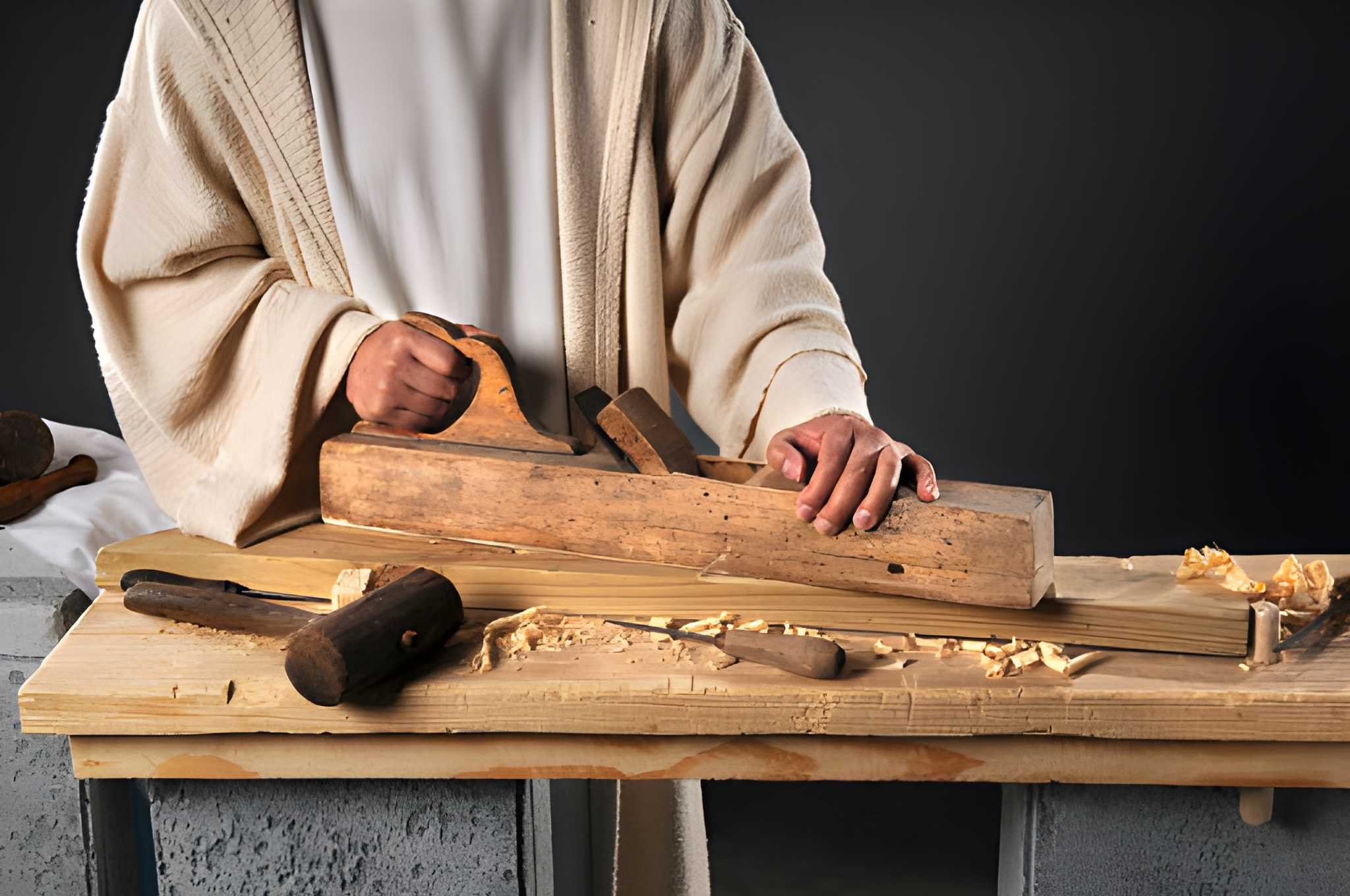
You’ve seen the paintings. Jesus in a workshop, sawdust on His tunic, planing wood with Joseph.
Sunday school taught you Jesus was a carpenter.
Most Christmas pageants reinforced it.
But here’s the truth: Jesus probably wasn’t a carpenter in the way you imagine.
The Greek word tekton translated as “carpenter” actually means “builder” or “craftsman.”
Archaeological evidence from first-century Nazareth reveals stone, not wood, was the primary building material.
Jesus likely worked as a stonemason or general builder, shaping Galilee’s abundant limestone rather than scarce timber.
This matters because when Jesus spoke about foundations, cornerstones, and building on rock, He was speaking from decades of hands-on experience.
Let’s explore what Scripture says, what archaeology reveals, and why this changes how we understand Jesus’ teachings.
What The Bible Actually Says About Jesus’ Trade
“Is not this the carpenter, the son of Mary and brother of James and Joses and Judas and Simon?” Mark 6:3, ESV
Only Two Verses Mention It
The entire biblical evidence for Jesus’ occupation consists of exactly two verses.
Mark 6:3 calls Jesus “the carpenter.” Matthew 13:55 calls Him “the carpenter’s son.”
That’s everything.
Luke doesn’t mention it. John doesn’t mention it. Paul never references it.
These two brief statements have shaped centuries of Christian imagination. But the original Greek tells a more complex story.
The Critical Greek Word: Tekton
The word translated “carpenter” is tekton (τέκτων).
This is where everything changes. Tekton doesn’t specifically mean “carpenter” as we understand it today.
The word comes from a root meaning “to shape” or “to build.” It referred to any skilled craftsman or builder.
In ancient Greek, tekton was a broad occupational term. The specific material depended on context.
How The Septuagint Uses Tekton
The Septuagint (the Greek Old Testament Jesus would have known) uses tekton for various craftsmen.
It describes workers who built David’s house (2 Samuel 5:11). It refers to those who repaired the temple (2 Kings 12:11).
But it also describes artisans working with iron (1 Samuel 13:19) and bronze (1 Kings 7:14).
The Septuagint translators understood tekton as flexible. The material wasn’t inherent in the word.
What Does Architect Mean?
Consider the English word “architect.”
It comes from archi-tekton, literally “chief builder.” Not “chief carpenter.” Not “chief woodworker.” Chief builder.
This linguistic connection reveals the word’s true meaning. Jesus was called a tekton, a builder and craftsman.
The question is: what materials did He build with?
Archaeological Evidence From Jesus’ Hometown
“Therefore everyone who hears these words of mine and does them will be like a wise man who built his house on the rock.” Matthew 7:24, ESV
What Nazareth Was Really Like
Nazareth was a small Jewish village of 400-500 people in Jesus’ day.
It was so insignificant that it doesn’t appear in Jewish sources until the 3rd century AD.
But recent archaeological excavations have transformed our understanding of this village.
Professor Ken Dark’s research shows Nazareth was strictly observant Jewish community. Residents carefully maintained purity laws.
The evidence is clear: no pig bones found (pork being forbidden).
Limestone vessels carved locally (unable to become ritually impure). Multiple mikvahs (ritual baths) discovered.
Stone Was Everywhere. Wood Was Scarce.
Here’s the archaeological game-changer: Nazareth was surrounded by limestone quarries.
The local limestone is easy to quarry and shape. It’s also durable enough for construction.
Excavations reveal that quarrying was a major part of Nazareth’s economy. Multiple quarries existed around the village and in the valley toward Sepphoris.
Stone was the building material. Not wood. Houses were built with stone walls and foundations.
Wood was expensive and rare in first-century Galilee. Trees were scarce. Quality timber had to be imported.
Using wood for major construction would have been economically impractical.
What Would A Tekton Actually Do?
Scholar James W. Fleming notes that “Jesus and Joseph would have formed and made nine out of ten projects from stone.”
This included building foundations, constructing walls, carving features, making limestone vessels, and shaping stone blocks.
Yes, some wood was used for door frames, beams, furniture, and tools.
But the primary work of a builder in stone-rich, wood-poor Galilee? Stone construction.
The Sepphoris Factor
Just three miles from Nazareth stood Sepphoris, a major Roman city.
Under Herod Antipas, Sepphoris underwent massive expansion during Jesus’ childhood.
This boom required every skilled worker. For Joseph, it meant steady employment.
The walk took about an hour. Halfway between lay an enormous stone quarry.
If Joseph and Jesus worked construction, Sepphoris provided opportunities involving stone.
Jesus’ Childhood Home
Archaeologist Ken Dark studied a house beneath the Sisters of Nazareth convent, traditionally identified as Jesus’ childhood home.
This first-century dwelling shows sophisticated stonework.
Builders cut into the limestone hillside to create a platform, modified a cave with rock-cut walls, and carved a stone staircase.
Dark’s conclusion? “Whoever built the house had a very good understanding of stone-working. That would be consistent with someone who might be called a tekton.”
How This Changes Everything About Jesus’ Teachings
“The stone that the builders rejected has become the cornerstone.” Psalm 118:22, ESV
Stone Metaphors Dominate Jesus’ Teaching
If Jesus worked primarily with stone, His words take on new depth.
Consider how often He used stone and building imagery:
Building on rock versus sand (Matthew 7:24-27).
The cornerstone that builders rejected (Matthew 21:42, quoting Psalm 118:22).
“On this rock I will build my church” (Matthew 16:18).
The temple stones that would be destroyed (Mark 13:2).
Being living stones built into a spiritual house (1 Peter 2:5).
These aren’t random metaphors. They’re the language of a man who spent thirty years working with stone.
What About Wood Imagery?
Here’s what’s striking: Jesus rarely used woodworking imagery.
No parables about carpentry. No references to planing boards or cutting joints.
The closest might be the yoke being “easy” (Matthew 11:30), but even that could refer to any craftsman making yokes.
For someone supposedly working with wood for decades, the absence of woodworking metaphors is remarkable.
The stone imagery, by contrast, is overwhelming.
The Builder’s Eye
When Jesus looked at the Jerusalem temple, He saw it differently than tourists.
His disciples marveled at the massive stones (Mark 13:1). Some temple stones weighed over 100 tons.
Jesus prophesied: “Not one stone will be left on another” (Mark 13:2).
He spoke with the authority of someone who understood exactly how much labor went into placing each stone.
What This Means For Understanding Jesus
“For we are his workmanship, created in Christ Jesus for good works.” Ephesians 2:10, ESV
His Humanity Becomes More Real
Jesus wasn’t a distant deity pretending to be human.
He worked a real trade for thirty years. He developed real skills. He earned real wages.
He knew tired muscles after a long day. He understood difficult clients and tight deadlines.
For thirty years, before any miracle or sermon, Jesus lived an ordinary life.
The Permanence of His Work
Stone speaks to permanence in ways wood never could.
Wood rots. Wood burns. Wood warps and splits with time.
Stone endures. Stone lasts for centuries. A stone foundation withstands storms.
When Jesus said He would build His church, He wasn’t building with temporary materials.
He builds on rock. He is the rock. His work lasts forever.
We Are Living Stones
Peter wrote: “You yourselves like living stones are being built up as a spiritual house” (1 Peter 2:5).
This isn’t accidental imagery. Peter learned from Jesus the builder.
Stone doesn’t easily bend. It must be carefully shaped. Each strike must be precise.
God works with hard hearts the way Jesus worked with hard stone. Patiently. Skillfully.
The Master Stonemason is shaping you into something beautiful and eternal.
Dignity of Work
Jesus worked for thirty years before three years of public ministry.
That ratio matters. He spent most of His earthly life in “ordinary” work.
There’s profound dignity in this. Your work, whatever it is, reflects God’s image.
Jesus sanctified work by doing it. Not just blessing others who did it. Actually doing it Himself.
Frequently Asked Questions
Does it really matter if Jesus was a carpenter or stonemason?
For salvation? No. Jesus’ occupation doesn’t affect His deity, sinless life, atoning death, or resurrection.
But for understanding His teachings? Absolutely. Knowing Jesus likely worked with stone illuminates dozens of passages.
It also deepens our appreciation for His humanity. He truly entered our world and knew physical labor.
Why do all the Bibles say “carpenter” then?
Translation requires interpretation. When the King James Version was produced in 1611, translators chose “carpenter” as the most familiar English equivalent.
Later translations followed this precedent. The choice wasn’t necessarily wrong, just narrow.
Modern archaeology and better understanding of first-century Galilee give us more context.
A more accurate translation would be “builder” or “craftsman,” leaving the specific materials open.
Didn’t Jesus work in Nazareth, not Sepphoris?
Jesus likely lived in Nazareth but may have worked in Sepphoris.
The cities were only three miles apart, an hour’s walk. Many craftsmen in small villages would commute for work in larger cities.
There’s no biblical evidence placing Jesus at Sepphoris. But it’s plausible given proximity and economic reality.
Could Jesus have worked with both stone and wood?
Absolutely. A tekton was a general builder, versatile with different materials.
Jesus probably worked primarily with stone for major construction, but also with wood for frames, beams, and furniture.
The key is understanding that stone was the dominant building material in His region.
What about all the Christian art showing Jesus as a carpenter?
Art reflects the artist’s culture, not necessarily historical accuracy.
Medieval European artists depicted Jesus as a carpenter because that’s what they knew. Wood was abundant in Europe.
These artistic traditions are beautiful and meaningful. But they don’t necessarily reflect first-century Galilee.
Does this change Jesus’ identity as the Son of God?
Not even slightly.
Jesus is fully God and fully man regardless of whether He worked with wood or stone.
His divine nature, sinlessness, substitutionary atonement, and bodily resurrection don’t depend on His earthly trade.
Understanding Jesus as a stonemason enriches our understanding of His humanity and teachings.
Works Cited
Aleteia. (2019). Were Jesus and Joseph really carpenters? [Historical religious analysis]
Biblical Archaeology Society. (2015). Has the childhood home of Jesus been found? [Archaeological research]
Christianity.com. (2025). Was Jesus actually a carpenter? [Christian educational article]
Dark, K. (2023). Archaeology of Jesus’ Nazareth. [Academic monograph]
Ehrman, B. (2025). Was Jesus really a carpenter? Maybe not! [Biblical scholarship]
Got Questions. (2015). Was Jesus a carpenter? [Apologetics resource]
Jenkins, P. (2022). Jesus the carpenter and the search for biblical words. [Linguistic analysis]
Lifeway Leadership. (2018). Was Jesus a carpenter or a stonemason? [Ministry article]
Medium. (2025). Jesus the carpenter or Jesus the stonemason? [Theological essay]
Wikipedia. (2025). Tekton. [Reference encyclopedia]

