
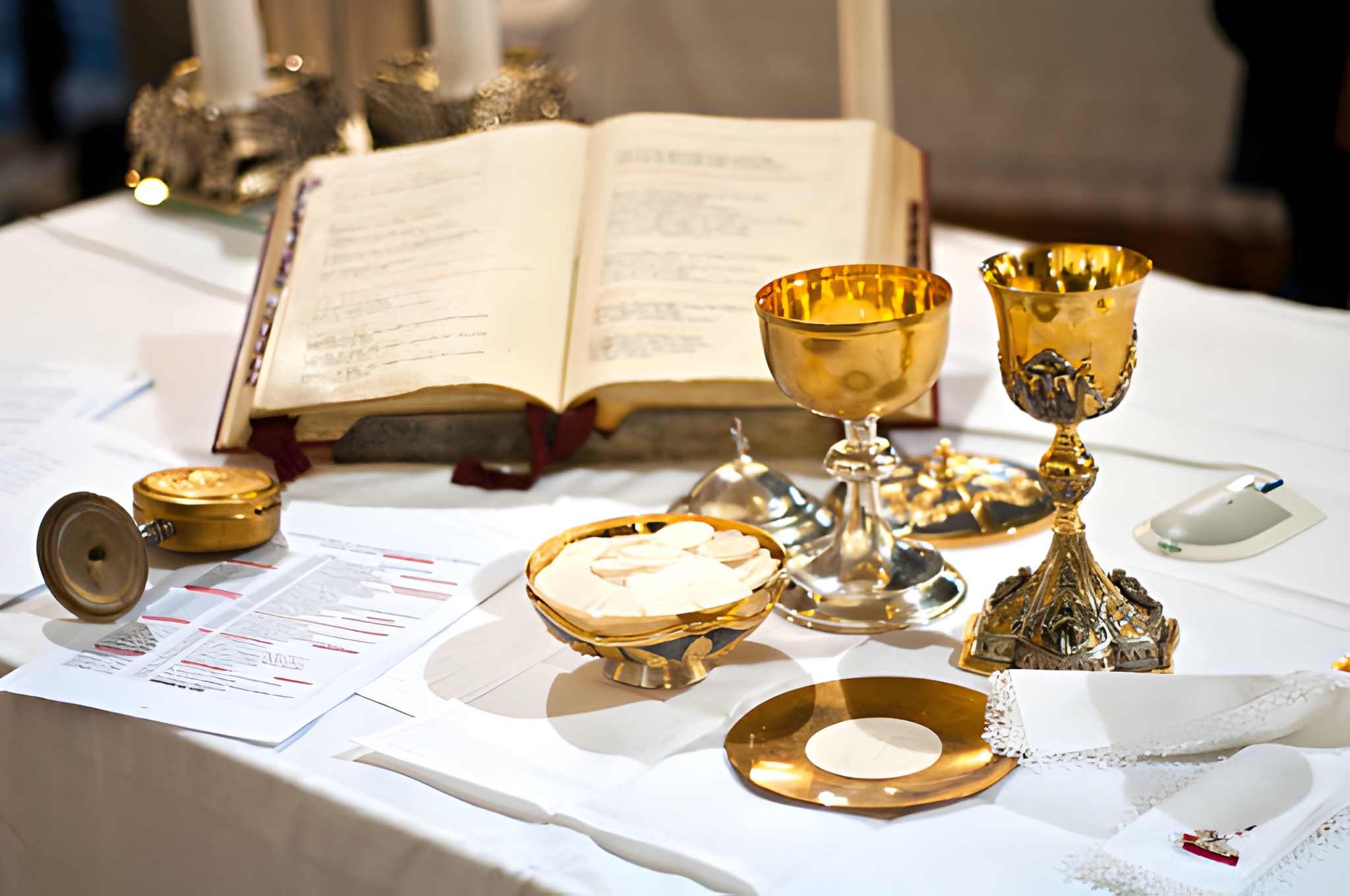
The bread breaks in your hand. The cup passes between believers.
And in that simple moment, you’re participating in something that connects you to every Christian who has ever lived.
Communion, also called the Lord’s Supper or the Eucharist, is far more than a religious ritual.
It’s a proclamation, a remembrance, a covenant renewal, and a fellowship all wrapped into one sacred act.
Yet most Christians don’t know the deeper meanings embedded in this practice.
The symbolism runs far deeper than bread representing body and wine representing blood.
The Greek words, the Passover connections, the covenant implications—all reveal truths that transform how we approach the Lord’s Table.
The Meaning Behind the Greek Word Koinonia
Before we examine specific verses, we need to understand a crucial Greek word that appears throughout Scripture’s teaching on communion: koinonia (κοινωνία).
This word appears 19 times in the Greek New Testament and is translated variously as “fellowship,” “communion,” “participation,” “sharing,” and “contribution.” But its essential meaning embraces far more than our English translations capture.
Koinonia means joint participation, intimate sharing, partnership, and community. It conveys the idea of having something in common, of entering into deep relationship through shared experience.
When 1 Corinthians 10:16 speaks of the “communion of the blood of Christ” and the “communion of the body of Christ,” it’s using koinonia to describe our participation in—our intimate sharing in—Christ’s sacrifice. We’re not merely remembering an event; we’re entering into fellowship with Christ Himself and with all believers through this sacred meal.
The English word “communion” actually derives from Latin communio (“sharing in common”), which itself translates the Greek koinonia. This rich theological term reminds us that when we take communion, we’re declaring our union with Christ and our unity with His body, the church.
Understanding koinonia transforms communion from individual observance into corporate participation in Christ’s finished work.
Bible Verses About Communion and Their Symbolism
1. Matthew 26:26-28 (NIV)
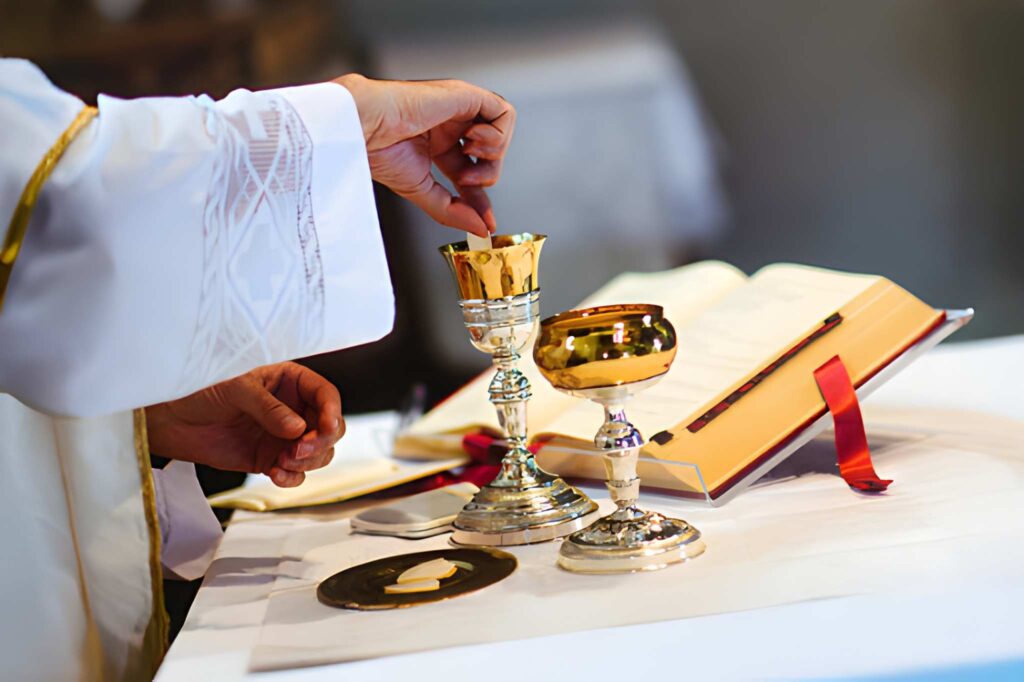
“While they were eating, Jesus took bread, and when he had given thanks, he broke it and gave it to his disciples, saying, ‘Take and eat; this is my body.’ Then he took a cup, and when he had given thanks he gave it to them, saying, ‘Drink from it, all of you. This is my blood of the covenant, which is poured out for many for the forgiveness of sins.'”
This is the institution of communion—the moment Jesus transformed the Passover meal into the Lord’s Supper.
The Symbolism:
- Bread = Christ’s body: The broken bread symbolizes Jesus’ body that would be broken, beaten, and crucified for our sins
- Cup/Wine = Christ’s blood: The poured wine symbolizes Jesus’ blood that would be shed on the cross
- Breaking the bread = Christ’s suffering: The physical act of breaking represents the violence done to His body
- Pouring the cup = Christ’s death: Wine poured out represents His life poured out unto death
- “Blood of the covenant” = New Covenant sealed: Just as the Old Covenant was sealed with animal blood (Exodus 24:8), the New Covenant is sealed with Christ’s blood
Matthew adds “for the forgiveness of sins”—explicitly stating the purpose of this sacrifice: our sins are forgiven through Christ’s shed blood.
2. 1 Corinthians 11:23-26 (ESV)
“For I received from the Lord what I also delivered to you, that the Lord Jesus on the night when he was betrayed took bread, and when he had given thanks, he broke it, and said, ‘This is my body, which is for you. Do this in remembrance of me.’ In the same way also he took the cup, after supper, saying, ‘This cup is the new covenant in my blood. Do this, as often as you drink it, in remembrance of me.’ For as often as you eat this bread and drink the cup, you proclaim the Lord’s death until he comes.”
Paul’s account is the earliest written record of the Lord’s Supper, predating the Gospels (written around AD 55).
The Symbolism:
- “This is my body, which is for you” = Substitutionary sacrifice: Jesus’ body given for us, taking our place
- “Do this in remembrance of me” = Memorial act: Each communion service brings His sacrifice into present memory
- “New covenant in my blood” = Eternal promise sealed: God’s new agreement with humanity, guaranteed by Christ’s death
- “You proclaim the Lord’s death” = Gospel testimony: The act itself preaches Christ’s sacrifice visually
- “Until he comes” = Anticipation of return: Points forward to Christ’s second coming
This passage emphasizes three purposes: Remembrance (looking back), Proclamation (looking around), and Anticipation (looking forward).
3. 1 Corinthians 10:16-17 (NIV)
“Is not the cup of thanksgiving for which we give thanks a participation in the blood of Christ? And is not the bread that we break a participation in the body of Christ? Because there is one loaf, we who are many are one body, for we all share the one loaf.”
Here’s where Paul uses koinonia (participation/communion) to describe our relationship with Christ through the elements.
The Symbolism:
- Cup of thanksgiving = Gratitude for Christ’s sacrifice: We give thanks for the blood shed for us
- Participation in the blood = Sharing in Christ’s death: We become partakers in the benefits of His sacrifice
- Participation in the body = Union with Christ: We’re spiritually joined to Him through faith
- One loaf = Unity of believers: The single bread shared by all symbolizes we are one body in Christ
- Many are one body = Corporate identity: Individual believers form one unified church
The single loaf passed among believers powerfully symbolized that all who partake become one body in Christ. Division contradicts communion’s very meaning.
4. John 6:53-56 (ESV)
“So Jesus said to them, ‘Truly, truly, I say to you, unless you eat the flesh of the Son of Man and drink his blood, you have no life in you. Whoever feeds on my flesh and drinks my blood has eternal life, and I will raise him up on the last day. For my flesh is true food, and my blood is true drink. Whoever feeds on my flesh and drinks my blood abides in me, and I in him.'”
Though John’s Gospel doesn’t describe the Last Supper institution, this “Bread of Life Discourse” clearly has Eucharistic significance.
The Symbolism:
- “Eat the flesh of the Son of Man” = Receiving Christ by faith: Not literal cannibalism, but spiritual appropriation
- “Drink his blood” = Believing in His sacrifice: Accepting the benefits of His death
- “Flesh is true food” = Jesus satisfies spiritual hunger: He alone provides eternal sustenance
- “Blood is true drink” = Jesus quenches spiritual thirst: He alone gives eternal life
- “Abides in me, and I in him” = Mutual indwelling: Ongoing intimate relationship with Christ
Jesus spoke these words after feeding the 5,000. Many disciples left because they took His words literally (John 6:66). Verse 63 clarifies: “The Spirit gives life; the flesh counts for nothing.” Communion embodies this spiritual truth.
5. 1 Corinthians 11:27-29 (NIV)
“So then, whoever eats the bread or drinks the cup of the Lord in an unworthy manner will be guilty of sinning against the body and blood of the Lord. Everyone ought to examine themselves before they eat of the bread and drink from the cup. For those who eat and drink without discerning the body of Christ eat and drink judgment on themselves.”
This sobering warning addresses the specific Corinthian problem: wealthy believers gorging themselves while poor believers went hungry (1 Corinthians 11:21-22).
The Symbolism:
- “Unworthy manner” = Irreverence or division: Taking communion without honoring its sacred meaning
- “Guilty of sinning against the body and blood” = Desecrating Christ’s sacrifice: Treating His death casually
- Self-examination = Heart preparation: Checking our spiritual condition before partaking
- “Discerning the body” = Recognizing Christ AND His church: Understanding both Christ’s sacrificed body and the church as His body
- Judgment = Divine discipline: God corrects His children who abuse this sacred act
Self-examination isn’t about perfection but about checking: Do we understand Christ’s sacrifice? Are we at peace with other believers? Are we approaching with reverence?
6. Luke 22:19-20 (NIV)
“And he took bread, gave thanks and broke it, and gave it to them, saying, ‘This is my body given for you; do this in remembrance of me.’ In the same way, after the supper he took the cup, saying, ‘This cup is the new covenant in my blood, which is poured out for you.'”
The Symbolism:
- “Body given for you” = Personal sacrifice: Christ died specifically for each believer
- “Do this in remembrance” = Commanded memorial: Ongoing practice to keep His sacrifice fresh in mind
- “New covenant in my blood” = New relationship with God: Replaces the Old Covenant that Israel broke
- “Poured out for you” = Violent death: His blood violently shed on the cross
- Bread and cup together = Complete sacrifice: Body and blood represent His whole person given
The “new covenant” connects to Jeremiah 31:31-34, where God promised forgiveness and hearts transformed by His law—made possible through Christ’s blood.
7. Mark 14:22-25 (ESV)
“And as they were eating, he took bread, and after blessing it broke it and gave it to them, and said, ‘Take; this is my body.’ And he took a cup, and when he had given thanks he gave it to them, and they all drank of it. And he said to them, ‘This is my blood of the covenant, which is poured out for many. Truly, I say to you, I will not drink again of the fruit of the vine until that day when I drink it new in the kingdom of God.'”
The Symbolism:
- Giving thanks = Eucharistos: Greek word meaning thanksgiving, source of “Eucharist”
- “Poured out for many” = Universal scope: Christ’s death sufficient for all who believe
- “Until that day” = Future fulfillment: Points to the Marriage Supper of the Lamb (Revelation 19:9)
- “Drink it new in the kingdom” = Restored fellowship: Perfect communion in God’s kingdom
- Blessing the bread = Consecration: Setting apart common elements for sacred purpose
Every communion service anticipates the glorious reunion when Christ returns.
8. Acts 2:42 (NIV)
“They devoted themselves to the apostles’ teaching and to fellowship, to the breaking of bread and to prayer.”
The Symbolism:
- “Breaking of bread” = Regular communion practice: Central act of early church worship
- “Devoted themselves” = Steadfast commitment: Not occasional but continual practice
- Listed with teaching, fellowship, prayer = Core spiritual discipline: Essential practice alongside other fundamentals
- Community meal = Unity and love: Shared meal expressing their unity in Christ
The early believers treated communion as central to their common life, not an occasional add-on.
9. Acts 20:7 (ESV)
“On the first day of the week, when we were gathered together to break bread, Paul talked with them, intending to depart on the next day, and he prolonged his speech until midnight.”
The Symbolism:
- “First day of the week” = Sunday resurrection celebration: Christians met on Sunday, not Jewish Sabbath
- “Gathered together to break bread” = Communion as worship focus: Primary purpose of gathering
- Regular practice = Weekly observance: Suggests early church took communion frequently
- Corporate gathering = Community essential: Not individual practice but church body together
Communion became the focal point of Sunday worship in the early church.
10. 1 Corinthians 11:26 (NIV)
“For whenever you eat this bread and drink this cup, you proclaim the Lord’s death until he comes.”
The Symbolism:
- Eating and drinking = Active participation: Not passive observation but intentional involvement
- “Proclaim the Lord’s death” = Visual gospel: Actions preach Christ’s sacrifice without words
- “Until he comes” = Temporary practice with eternal purpose: Communion continues until Christ returns
- Past + Present + Future = Complete timeline:
- Past: Remembering Christ’s death
- Present: Proclaiming the gospel now
- Future: Anticipating His return
This verse captures communion’s full scope: a memorial (looking back), a testimony (looking around), and a promise (looking forward). It’s the most comprehensive act of worship the church performs.
Closing Reflection: Why Communion Matters
Communion isn’t optional Christianity. Jesus commanded it: “Do this in remembrance of me.”
When you take communion, you’re connecting with:
Christ’s sacrifice: The broken bread and poured cup point to His body broken and blood shed. You’re remembering His death purchased your forgiveness.
The New Covenant: You’re affirming you’re under grace, not law. God’s promises are yours through Christ’s blood.
The global church: Every Christian who takes communion anywhere joins you in declaring Christ’s death. You’re part of one body.
Future glory: You’re anticipating Christ’s return when we feast with Him in the Father’s kingdom.
Whether your tradition observes communion weekly, monthly, or quarterly, approach it with understanding, reverence, and gratitude. Examine your heart, confess known sin, reconcile with believers when possible, and partake with faith.
The bread and cup are simple elements. But the realities they represent are profound beyond measure.
Frequently Asked Questions
How often should churches observe communion?
Scripture doesn’t mandate specific frequency. Paul’s phrase “as often as you drink it” (1 Corinthians 11:25) suggests flexibility. The early church appears to have celebrated weekly (Acts 20:7). Some churches follow this pattern; others observe monthly or quarterly. What matters most is meaningful participation with proper understanding.
Can children take communion?
This varies by tradition. Some churches allow young children who’ve professed faith. Others wait until children can “examine themselves” (1 Corinthians 11:28) and understand communion’s meaning. Most agree communion is for believers with some level of comprehension.
What if I’ve sinned before taking communion?
The warning against taking communion “in an unworthy manner” doesn’t mean sinless perfection. It means approaching with reverence, examining your heart, confessing known sin, and being at peace with other believers. Communion reminds us we’re forgiven sinners, not perfect saints.
What’s the difference between communion, the Lord’s Supper, and Eucharist?
These terms refer to the same practice but emphasize different aspects. “Communion” (from koinonia) emphasizes fellowship. “Lord’s Supper” emphasizes it’s Jesus’ meal. “Eucharist” (from eucharistos, “thanksgiving”) emphasizes gratitude for Christ’s sacrifice.
Why do some churches use wine and others grape juice?
Jesus used wine at Passover. Some churches maintain this; others use grape juice to avoid causing recovering alcoholics to stumble. Since Scripture doesn’t specify the type of “fruit of the vine,” both are acceptable. What matters is the spiritual significance.
References
Bible.org. (2006). Lesson 11: How to come to the Lord’s Supper (1 Corinthians 11:17-34). [Biblical exposition]
Blue Letter Bible. (2022). The Lord’s Supper (1 Corinthians 11:17-34) by H.B. Charles, Jr. [Sermon resource]
Christianity.com. (2022). Why is Jesus called the bread of life? Meaning of John 6:35. [Biblical analysis]
Christian Trends Magazine. (2023). In presence of Jesus and fellowship with others. [Communion theology]
Got Questions. (2020). What did Jesus mean when He said, “This is my body, broken for you”? [Theological explanation]
Harvest Community Church. (n.d.). The Lord’s Supper (1 Corinthians 11:23-26). [Sermon exposition]
Living Church of God. (n.d.). Are Passover, Communion, and the Lord’s Supper the same thing? [Historical analysis]
The Wartburg Project. (n.d.). Why is “koinonia” translated “communion” in 1 Corinthians 10:16-17? [Greek word study]
Wikipedia. (2025). Eucharist. [Historical overview]
Wikipedia. (2025). Koinonia. [Greek word study]