
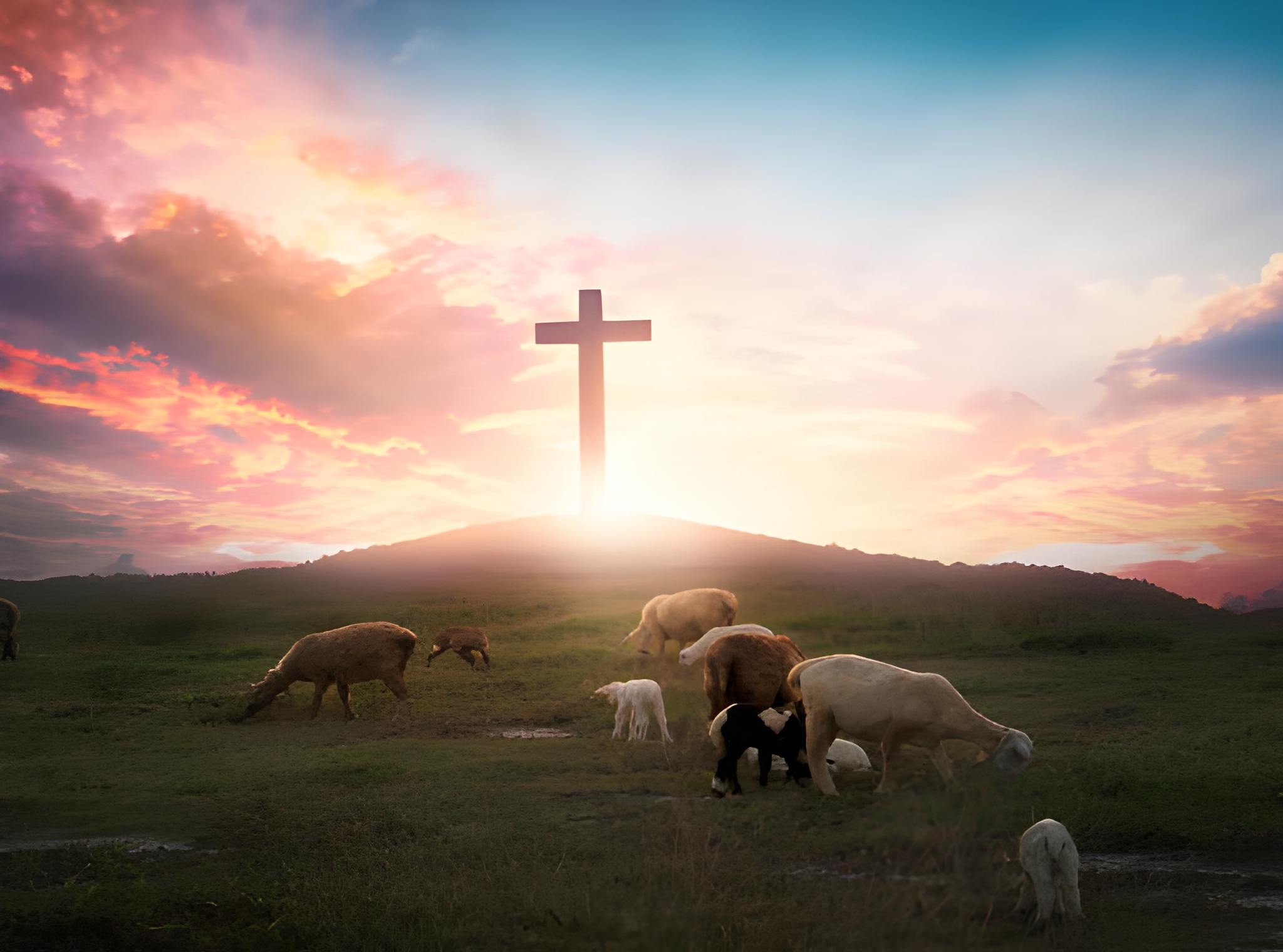
When Jesus told Peter, “Feed my sheep,” He was commissioning Peter to spiritually care for believers.
This means teaching them God’s Word, protecting them from false teaching, guiding them in faith, and providing for their spiritual needs.
Jesus was restoring Peter after his denial and appointing him to shepherd the Church.
This wasn’t just for Peter; it’s the calling of every Christian leader and, in a broader sense, every believer who helps others grow in Christ.
When they had finished breakfast, Jesus said to Simon Peter, “Simon, son of John, do you love me more than these?” He said to him, “Yes, Lord; you know that I love you.” He said to him, “Feed my lambs.” He said to him a second time, “Simon, son of John, do you love me?” He said to him, “Yes, Lord; you know that I love you.” He said to him, “Tend my sheep.” He said to him the third time, “Simon, son of John, do you love me?” Peter was grieved because he said to him the third time, “Do you love me?” and he said to him, “Lord, you know everything; you know that I love you.” Jesus said to him, “Feed my sheep.”
(John 21:15-17, ESV)
The Context: Peter’s Restoration
This conversation happened on the shores of the Sea of Galilee after Jesus’ resurrection.
Peter and some disciples had been fishing all night. Jesus appeared, caused their nets to fill miraculously, then cooked them breakfast.
This intimate breakfast meeting was about to become one of the most significant moments in Peter’s life.
Just days earlier, Peter had denied Jesus three times.
While Jesus faced trial and crucifixion, Peter sat by a fire and swore he didn’t even know Jesus.
The rooster crowed. Jesus looked at him. Peter went out and wept bitterly (Luke 22:54-62).
Now, beside another charcoal fire, Jesus asked Peter three times if he loved Him.
Three denials. Three questions. Three opportunities for restoration.
Jesus wasn’t holding Peter’s failure against him. He was healing him and recommissioning him for ministry.
Breaking Down the Three Commands
Each of Jesus’ three commands uses slightly different language, showing the full scope of pastoral care:
“Feed my lambs” (verse 15) – The word “feed” here (bosko) means to nourish or provide food. “Lambs” refers to young, vulnerable believers who need careful tending and constant care. New Christians are like baby sheep: helpless, easily frightened, prone to wander. They need gentle feeding with the basic truths of Scripture.
“Tend my sheep” (verse 16) – The word “tend” (poimaino) means to shepherd in a supervisory capacity. This includes feeding but adds ruling, guiding, and protecting. It’s the full scope of pastoral oversight. Peter later used this same word when writing to church elders: “Be shepherds of God’s flock that is under your care, serving as overseers” (1 Peter 5:2).
“Feed my sheep” (verse 17) – This returns to the word “feed” (bosko) but now applies it to mature sheep, not just lambs. Even experienced believers need continual feeding from God’s Word. No Christian ever graduates from needing spiritual nourishment.
Together, these commands paint a complete picture: care for new believers tenderly, lead mature believers wisely, and keep everyone fed with Scripture constantly.
Why Jesus Repeated Himself Three Times
Jesus’ threefold question wasn’t random.
Peter had denied Jesus three times.
Now Jesus gave him three chances to affirm his love.
Each denial was being undone. Each wound was being healed.
Three betrayals met with three opportunities for restoration.
Peter was grieved when Jesus asked the third time. He understood what was happening. Jesus was driving the point home, making sure Peter knew he was fully forgiven and fully restored.
The repetition emphasized how crucial this commission was. If Peter truly loved Jesus, he would care for Jesus’ flock.
This pattern teaches us something vital: love for Jesus must translate into care for His people.
Jesus didn’t say, “If you love me, worship enthusiastically” or “If you love me, have profound theological insights.”
He said, “If you love me, feed my sheep.” Love for Christ proves itself through service to His Church.
What “Feed” Really Means
The word “feed” involves more than just giving food.
In the shepherd metaphor, it means providing everything sheep need to thrive:
Spiritual nourishment – Shepherds feed sheep with God’s Word. Peter later wrote, “Like newborn infants, long for the pure spiritual milk, that by it you may grow up into salvation” (1 Peter 2:2). Believers need steady diet of Scripture, not stories, entertainment, or philosophy disguised as preaching.
Protection from predators – False teachers are like wolves. Shepherds must recognize and warn against doctrinal error. Paul told the Ephesian elders, “I know that after my departure fierce wolves will come in among you, not sparing the flock” (Acts 20:29).
Guidance and direction – Sheep wander easily. They need guidance to green pastures and still waters (Psalm 23:2). Spiritual shepherds help believers navigate life’s decisions according to Scripture.
Care for the wounded – Sheep get hurt, sick, and stuck. Good shepherds bind up wounds, heal the sick, and rescue the straying (Ezekiel 34:4). This means counseling the troubled, comforting the grieving, and pursuing those who wander from faith.
Leading by example – Shepherds don’t drive sheep from behind; they lead from the front. Jesus said the sheep “follow him because they know his voice” (John 10:4). Christian leaders must model the faith they teach.
Who Are “My Sheep”?
Jesus said “my sheep,” not “your sheep, Peter.” This is crucial. The flock belongs to Jesus. Peter was an undershepherd caring for Jesus’ flock, not building his own empire. Every pastor, teacher, and Christian leader serves under the Chief Shepherd (1 Peter 5:4).
The sheep are believers, the Church. Throughout Scripture, God’s people are called His flock:
- “We are his people, the sheep of his pasture” (Psalm 100:3)
- “I am the good shepherd. I know my own and my own know me” (John 10:14)
- “He is our God, and we are the people of his pasture, and the sheep of his hand” (Psalm 95:7)
The flock includes both lambs (new believers) and mature sheep (experienced Christians). All need feeding. All need shepherding. None are expendable.
This Applies Beyond Peter
While Jesus spoke directly to Peter, this command extends to all Christian leaders.
The word we translate “pastor” comes from the same root word for shepherd.
Every pastor, elder, teacher, and ministry leader carries this commission: feed Jesus’ sheep.
But it doesn’t stop with paid clergy.
Every mature believer has younger believers they can feed. Every Christian who knows Scripture can teach someone who doesn’t.
Mothers and fathers feed their children spiritually. Sunday school teachers feed their classes. Small group leaders feed their groups.
Anyone who helps another Christian grow in faith is fulfilling this command.
Hebrews 5:12 assumes this is normal: “By this time you ought to be teachers.”
Mature believers should naturally begin feeding others. If you’ve been a Christian for years but have never helped another believer grow, you’re missing part of your calling.
What This Looks Like Practically
How do you “feed sheep” in daily life?
For pastors and teachers: Preach Scripture faithfully. Don’t water down God’s Word. Give people solid biblical truth. Protect the flock from false teaching. Visit the sick. Counsel the troubled. Pursue the wandering.
For parents: You are the primary shepherds of your children. Feed them God’s Word at home. Teach them to pray. Model authentic faith. Disciple them intentionally.
For small group leaders: Create environments where believers can be vulnerable, ask questions, and grow. Study Scripture together deeply. Pray for one another.
For mentors: Come alongside newer believers. Share what you’ve learned. Answer their questions. Walk with them through struggles.
For all believers: Share what you know. When you learn from Scripture, teach someone else. When God works in your life, testify about it. Point people to Jesus constantly.
The Connection Between Love and Service
Notice the structure of Jesus’ conversation with Peter.
Each time Peter affirmed his love, Jesus commanded him to feed the sheep. The connection is deliberate: if you love Jesus, you’ll serve His people.
This flips our natural thinking.
We imagine love for Jesus means mystical feelings, emotional worship, or personal spiritual experiences.
Jesus says love for Him means getting your hands dirty caring for His Church. It means sacrifice, service, hard work.
John reinforces this in his first epistle: “If anyone has the world’s goods and sees his brother in need, yet closes his heart against him, how does God’s love abide in him? Little children, let us not love in word or talk but in deed and in truth” (1 John 3:17-18).
You don’t truly love Jesus if you neglect His Church. You can’t claim devotion to the Shepherd while abandoning the sheep.
Frequently Asked Questions
Was this command only for Peter or for all believers?
Jesus spoke directly to Peter, commissioning him specifically for pastoral leadership. Peter later became a key leader in the early Church (Acts 2-5). However, the principle extends to all Christian leaders. The commission to feed sheep applies to anyone in spiritual leadership: pastors, elders, teachers, disciplers, and parents.
In a broader sense, every believer should help others grow. We’re commanded to “encourage one another and build one another up” (1 Thessalonians 5:11). If you know more than someone else, teach them. If you’re stronger, help the weaker. Every Christian feeds sheep in some capacity.
What’s the difference between feeding lambs and feeding sheep?
Lambs are young, vulnerable, immature believers. They need basic teaching, gentle care, and constant attention. You don’t feed them complex theology; you feed them “milk” (1 Corinthians 3:2). They need foundational truths taught patiently.
Sheep are mature believers who can handle “solid food” (Hebrews 5:14). They need deeper teaching, more challenging application, and guidance in ministry. But notice: even sheep still need feeding. Maturity doesn’t mean you stop needing God’s Word.
How do I know if I’m called to feed sheep?
If you’re a Christian, you’re called to help others grow in some capacity. Not everyone is called to be a pastor, but everyone should disciple someone. Ask yourself: Who is God putting in my path? Who is younger in the faith than me? Who can I teach, encourage, or help?
Start where you are. If you’re a parent, feed your children. If you’re in a small group, encourage others. If someone asks you spiritual questions, answer them from Scripture. Feeding sheep starts with simple obedience to opportunities God provides.
What if I don’t feel qualified to teach others?
Peter didn’t feel qualified either. He’d just denied Jesus three times. He was a fisherman, not a trained rabbi. Yet Jesus commissioned him anyway.
God qualifies the called; He doesn’t just call the qualified. If you know Jesus and His Word, you know enough to help someone who knows less. Start with what you know. Share your testimony. Teach what you’ve learned. God will grow your capacity as you obey.
Does “feeding sheep” mean I should become a pastor?
Not necessarily. Pastoral ministry is a specific calling (1 Timothy 3:1-7), but feeding sheep happens in many contexts. Teachers feed sheep in classrooms. Parents feed sheep at home. Mentors feed sheep in coffee shops. Small group leaders feed sheep in living rooms.
Don’t wait for official ministry positions. Feed the sheep God puts in your path right now. If God calls you to vocational ministry later, He’ll make that clear. For now, be faithful with the opportunities He’s already given you.
Say This Prayer
Jesus, thank You for feeding me with Your Word. Help me love You by serving Your people. Show me who needs feeding in my life. Give me courage to teach what I know and wisdom to teach it well. Make me a faithful shepherd under Your authority. Let my love for You overflow into care for Your flock. In Your name, Amen.
Sources Consulted
GotQuestions.org. (2011). Why did Jesus tell Peter to “feed my sheep”? [Biblical exposition]
Bible Hub. (n.d.). John 21:17. [Verse text]
Simply Bible. (n.d.). Feed my sheep – John 21:15-17. [Pastoral application]
Living as Apprentices. (2018). Going deeper with God – “Feed my sheep.” [Devotional reflection]
Christianity.com. (2022). Take care of my sheep – Meaning of Jesus’ words. [Shepherd imagery]
Crosswalk.com. (2020). Feed my sheep – Meaning of Jesus’ words to Peter. [Practical application]
Patheos. (2025). John 21:15-17 – Jesus tells Peter to tend my sheep. [Theological study]
Church of the Eternal God. (n.d.). Christ tells Peter three times to feed my sheep. [Greek analysis]
Bible.com. (n.d.). John 21:15-17 ESV. [Translation text]
BibleRef.com. (n.d.). What does John 21:17 mean? [Context explanation]