
I guess you know that feeling.
I’m talking about that sick weight in your stomach when you think about what you’ve done.
The way you carefully edit your stories around certain people.
The mental gymnastics you perform to avoid thinking about it.
The private browser tabs. The deleted text messages. The half-truths that technically aren’t lies.
The careful compartmentalization of your life so no one sees the whole picture.
You’re hiding sin. And it’s destroying you.
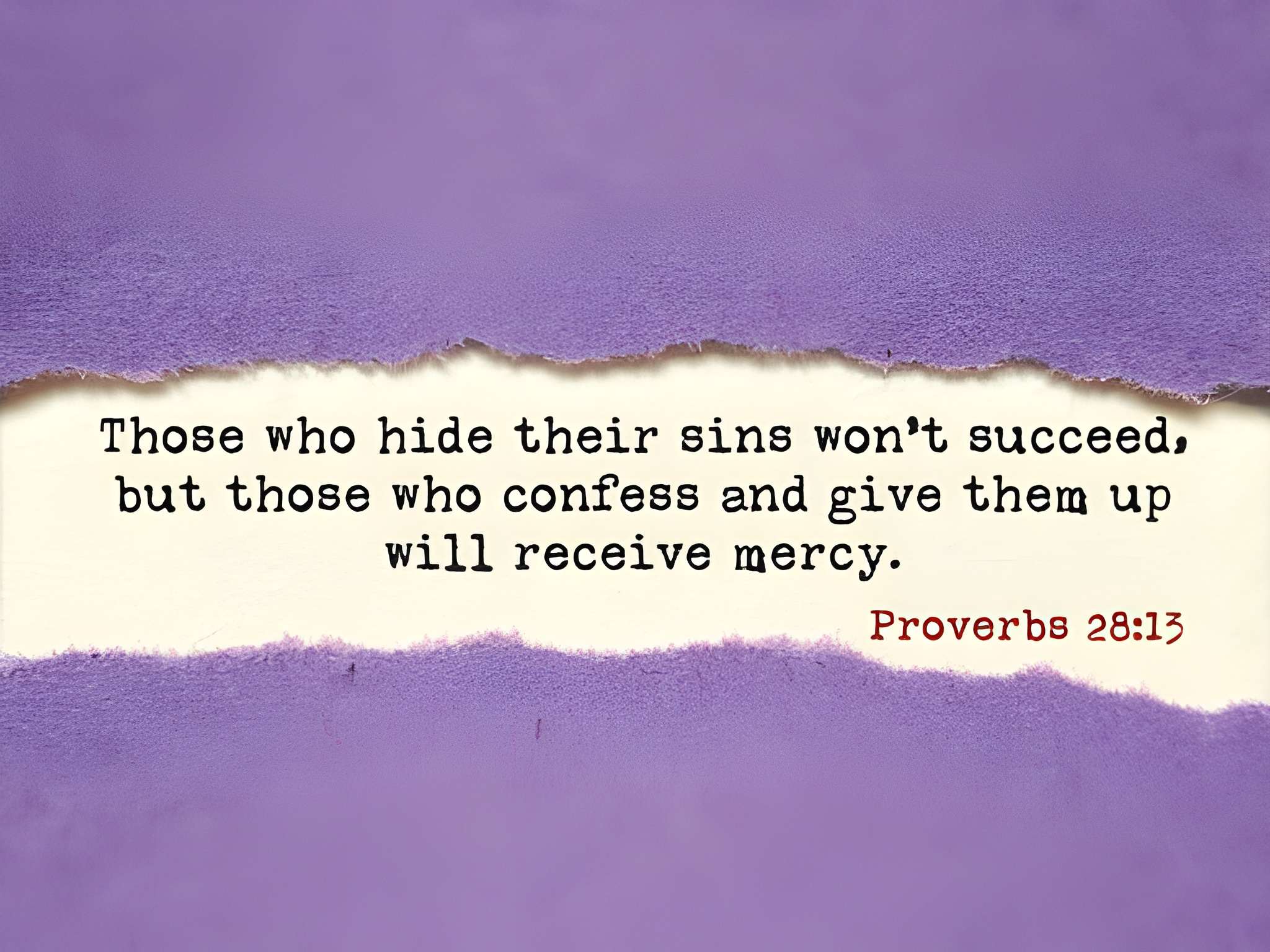
“Whoever conceals their sins does not prosper, but the one who confesses and renounces them finds mercy.”
Proverbs 28:13 (NIV)
This single verse captures one of Scripture’s most important spiritual truths: hiding sin never works, and confession always leads to mercy.
When you understand this principle, you can transform your relationship with God, restore your peace, and free you from the exhausting burden of maintaining a false image.
The Futility of Concealing Sin
The Message translation puts it bluntly: “You can’t whitewash your sins and get by with it.”
The Hebrew word for “conceal” is kacah, which means to cover, hide, or obscure from view.
It’s the same word used when Adam and Eve tried to hide from God after eating the forbidden fruit.
The proverb promises that whoever conceals sin “will not prosper.” The NASB says they “will not prosper.” The CSB reads, “will not prosper.” The Amplified Bible expands: “will not prosper.” Different translations, same devastating conclusion: covering sin blocks prosperity.
But what does “prosper” mean here?
The Hebrew tsalach means to advance, succeed, make progress, or be profitable.
This isn’t primarily about financial wealth.
It’s about flourishing in life, experiencing God’s blessing, advancing spiritually, having healthy relationships, and living with inner peace and joy.
The Good News Translation makes the consequence explicit: “You will never succeed in life if you try to hide your sins.”
The Contemporary English Version adds clarity: “If you don’t confess your sins, you will be a failure.”
Think about the logic here.
We try to hide sin because we fear the consequences of exposure.
We imagine that keeping it secret will protect us from shame, judgment, or punishment.
But the verse promises the opposite: the very act of concealing guarantees failure.
We trade temporary relief for permanent dysfunction.
Biblical Examples of Hidden Sin
Scripture provides vivid case studies of people who tried to cover their sins.
Achan’s Hidden Treasure: After the victory at Jericho, God commanded Israel not to take any plunder. Achan violated this command, stealing a beautiful robe, silver, and gold, which he buried under his tent. He thought no one would know. But Joshua 7 records that Achan’s hidden sin caused Israel’s defeat at Ai and cost him his life along with his entire family. He didn’t prosper. He lost everything.
David’s Covered Adultery: King David committed adultery with Bathsheba, then tried to cover it by bringing her husband Uriah home from battle. When that failed, David arranged Uriah’s death and married Bathsheba. He thought his secret was safe. But Psalm 32 reveals the physical and emotional toll his concealment took. David wrote that when he kept silent about his sin, his “bones wasted away” through groaning all day long. God’s hand was “heavy” upon him. His strength “evaporated like water in the summer heat.” The cover-up caused more suffering than the original sin.
Ananias and Sapphira’s Deception: In Acts 5, this couple sold property and claimed to give the full proceeds to the church while secretly keeping part of the money. They wanted the reputation of generosity without the cost. Peter confronted them for lying to the Holy Spirit. Both dropped dead on the spot. Their attempt to hide their greed literally killed them.
The pattern is consistent: hidden sin produces exponentially more damage than confessed sin.
The Physical and Emotional Toll of Concealment
David’s testimony in Psalm 32:3-4 reveals that hiding sin affects us physically and emotionally, not just spiritually.
Modern psychology confirms what Scripture has always taught: unresolved guilt takes a measurable toll on health.
Research shows that people experiencing guilt have lower levels of immunoglobulin A, a key immune system marker. Lower levels correlate with increased susceptibility to illness.
Studies also link guilt to insomnia, fatigue, weakened immunity, chronic pain, digestive problems, and cardiovascular stress.
But the spiritual consequences are even worse.
Hidden sin creates distance from God.
We avoid prayer because we can’t face Him. We skip church because we feel like frauds. We withdraw from Christian fellowship because we fear exposure. We stop reading Scripture because every verse feels like an indictment.
Slowly, we isolate ourselves from every source of spiritual strength.
Hidden sin also isolates us from people.
We can’t be fully known if we’re hiding parts of ourselves. We maintain exhausting facades. We carefully control information. We live in constant fear that someone will discover the truth.
This prevents genuine intimacy and authentic community.
James 5:16 says, “Therefore confess your sins to each other and pray for each other so that you may be healed.”
Notice that confession to others leads to healing.
Sin thrives in secrecy. It withers in the light.
The Two-Part Path to Mercy
Proverbs 28:13 doesn’t just warn against concealment.
It provides the solution: “whoever confesses and renounces them finds mercy.” The NLT says, “if they confess and turn from them, they will receive mercy.” The Amplified Bible reads, “whoever confesses and turns away from his sins will find compassion and mercy.”
Notice the verse requires two actions, not just one.
First: Confession. The Hebrew yadah literally means “to throw” or “to cast.” By extension, it means to confess or even to praise. Confession means casting your sin out into the open before God. It’s the opposite of concealing. No more hiding, denying, minimizing, or rationalizing. Full acknowledgment of what you’ve done and its seriousness.
True confession involves several elements. It names the specific sin rather than using vague generalities. It takes full responsibility without blaming circumstances or other people. It acknowledges the sin’s offensiveness to God, not just its negative consequences. It expresses genuine sorrow and repentance. It seeks forgiveness without demanding it or presuming upon it.
Second: Forsaking. The Hebrew azab means to leave, abandon, let go, or forsake. The ESV says “forsakes them.” The NRSV says “forsakes them.” The CSB reads “renounces them.” Confession without change is manipulation. We don’t receive mercy simply by saying “I’m sorry.” We receive mercy when we turn completely away from sin, leaving it behind.
Forsaking sin means you stop committing the sin, not just stop getting caught. You remove access and opportunity, cutting off paths to temptation. You establish accountability with people who will ask hard questions. You pursue holiness actively, not just avoid sin passively. You replace sinful patterns with righteous ones.
The Grace Church commentary notes: “We don’t receive God’s mercy and blessing simply by saying ‘I’m sorry.’ We receive his blessing and mercy when we turn completely away from it, leaving it behind.”
The Promise of Mercy
Here’s the beautiful promise: “will find mercy.” The NASB says “will find compassion.” The AMP reads “will find compassion and mercy.” The Passion Translation declares, “you will be kissed by mercy.”
God’s mercy means He doesn’t give us what we deserve.
Despite our sin, despite our attempts to hide, despite the damage we’ve caused, God offers compassion to those who confess and forsake.
This mercy isn’t earned. We can’t manipulate God into mercy through perfect confession. Mercy is God’s character responding to genuine repentance.
First John 1:9 provides the New Testament parallel: “If we confess our sins, he is faithful and just to forgive us our sins and to cleanse us from all unrighteousness.”
Notice God is “faithful and just” to forgive. His mercy isn’t capricious or uncertain.
When we meet His conditions for confession and repentance, He promises forgiveness.
The verse also promises we “will find” mercy. The NASB says “will find compassion.” The Hebrew structure guarantees this outcome. It’s not “might find” or “could possibly receive.”
Confession plus forsaking equals mercy. Always. Without exception.
This means no sin is beyond God’s mercy if you’ll confess and forsake it.
The pornography addiction you’ve hidden for years. The financial fraud no one knows about. The abortion you’ve never told anyone. The affair you ended but never confessed. The abuse you perpetrated. The addiction you’re maintaining.
Whatever it is, God’s mercy is greater.
Practical Steps for Confession and Repentance
If you’re ready to stop hiding and start experiencing mercy, here’s how to begin.
Confess to God first. Go before Him in prayer and lay it all out. Don’t minimize. Don’t rationalize. Don’t blame others. Name the sin specifically. Acknowledge its seriousness. Express genuine sorrow. Ask for forgiveness. Thank Him for His mercy.
Confess to others when appropriate. James 5:16 instructs us to confess sins to each other. Find a mature Christian you trust and tell them. This breaks sin’s power over you. If your sin harmed someone specifically, confess to them and seek reconciliation. If your sin was public, your confession may need to be public too.
Make restitution where possible. If you stole, return what you took with interest. If you damaged property, repair or replace it. If you harmed someone’s reputation, work to restore it. Genuine repentance includes making things right wherever possible.
Establish accountability. Don’t just confess and walk away unchanged. Give someone permission to ask you hard questions regularly. Install software that monitors your internet usage if needed. Change your phone number if certain people tempt you. Take whatever practical steps are necessary to forsake the sin completely.
Replace sin with righteousness. Ephesians 4:28 demonstrates this principle: “Anyone who has been stealing must steal no longer, but must work, doing something useful with their own hands, that they may have something to share with those in need.” Don’t just stop the sin. Actively pursue the opposite virtue.
Frequently Asked Questions
What if my confession causes serious consequences?
Sometimes confession leads to loss of reputation, relationships, or positions. Joseph’s brothers faced this when they finally confessed their sin to their father. But the consequences of continued concealment are always worse. David’s cover-up cost him far more than confession would have. Trust that God’s mercy will sustain you through whatever consequences come.
Do I need to confess sins to everyone?
No. Confess to God always. Confess to those you’ve directly harmed. Confess to a mature Christian for accountability. The circle of confession should generally match the circle affected by the sin. Private sins require private confession. Public sins may require public confession.
What if I’ve confessed but don’t feel forgiven?
Feelings follow truth; they don’t determine it. First John 1:9 promises God forgives when we confess. Trust His word over your emotions. Continue confessing until your feelings align with truth. Sometimes lingering guilt indicates you haven’t truly forsaken the sin yet.
What if I keep falling back into the same sin?
Repeated failure doesn’t disqualify you from mercy. Keep confessing. Keep forsaking. Keep pursuing righteousness. God’s mercy is new every morning. But also examine whether you’re genuinely forsaking or just confessing while maintaining access to temptation.
Can I confess anonymously?
While God knows who you are, confessing to a person anonymously can still break sin’s power. Many churches offer anonymous confession opportunities. Online confession to a pastor or counselor you’ll never meet in person can provide accountability without exposure. But eventually, having at least one person who knows you personally and holds you accountable produces the deepest freedom.
Prayer for Courage in Confession
Father God, I confess that I’ve been hiding sin from You and from others. I’ve tried to manage my image while neglecting my soul. Forgive me for believing the lie that concealment would protect me when it’s actually destroying me. Give me courage to bring my sin into the light. Give me humility to confess fully without minimizing or excusing. Give me strength to forsake completely, cutting off every path back to sin. Thank You that Your mercy is greater than my sin. Thank You that confession leads to compassion, not condemnation. I trust Your promise that those who confess and forsake will find mercy. Help me walk in the freedom that comes from living in truth rather than hiding in darkness. In Jesus’ name, Amen.
Sources and Further Reading
BibleRef.com. (n.d.). What does Proverbs 28:13 mean? [Biblical commentary]
Bible Study Tools. (n.d.). Proverbs 28:13 – Whoever conceals their sins does not prosper. [Verse exposition]
Brown, F., Driver, S. R., & Briggs, C. A. (n.d.). Hebrew lexicon. [Lexical study]
Faith and Health Connection. (n.d.). Unconfessed sin and your health – Psalm 32. [Health devotional]
Grace Church Kalispell. (2021). Flourishing through repentance – Proverbs 28:13. [Sermon exposition]
Platt, D. (2024). Confessing sin (Proverbs 28:13). Radical: Pray the Word. [Devotional series]
Precept Austin. (n.d.). Proverbs 28:13 commentary. [Biblical commentary]
Rooted Ministry. (2024). Psalm 32: The importance of confession and the Christ who forgives. [Youth ministry resource]
Scott LaPierre Ministries. (2025). When I kept silent about my sin – Psalm 32:3-5. [Biblical teaching]
The Berean. (n.d.). Proverbs 28:13 – Uncover sin, confess, forsake, and prosper in God’s favor. [Biblical study]