

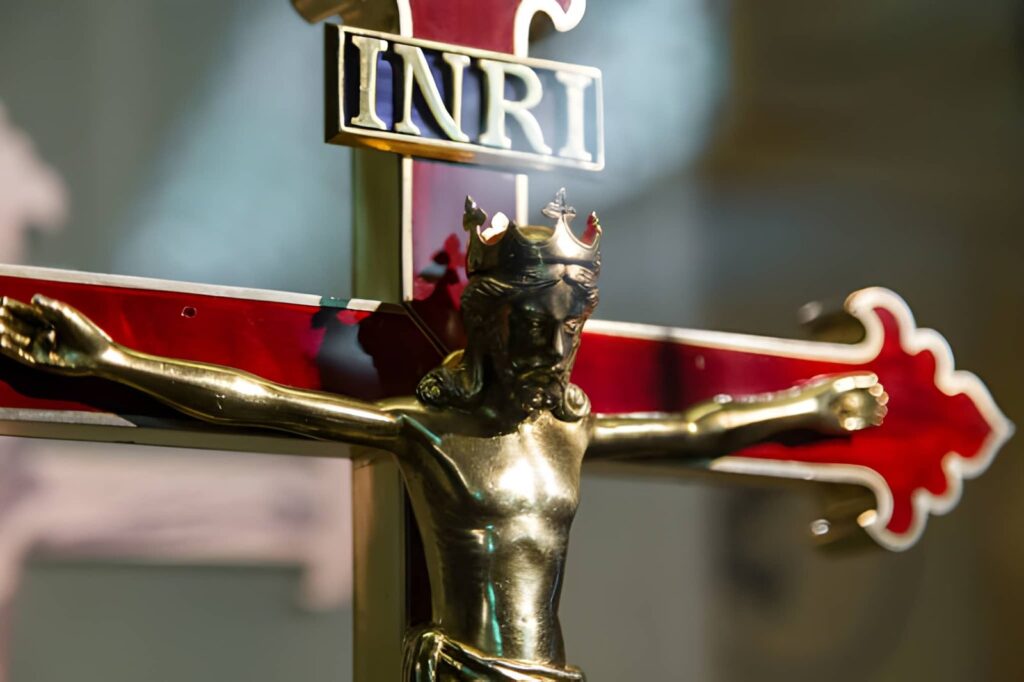
Look closely at crucifixes and paintings of the crucifixion.
You’ll notice four letters above Jesus’s head: INRI.
These letters appear consistently across centuries of Christian art.
But what do they mean?
INRI is the Latin acronym for “Iesus Nazarenus, Rex Iudaeorum,” which translates to “Jesus of Nazareth, the King of the Jews.”
Pilate ordered this inscription placed on Jesus’s cross as the official charge explaining His execution.
Roman law required posting the crime for which condemned criminals died.
Ironically, what Pilate intended as mockery became the greatest proclamation of truth: Jesus truly is the King of the Jews and King of all creation.
Pilate had a notice prepared and fastened to the cross. It read: JESUS OF NAZARETH, THE KING OF THE JEWS.
John 19:19, NIV
The inscription appeared in three languages.
Hebrew, Latin, and Greek.
Each language served a specific purpose.
Everyone passing by could read the charge.
This wasn’t accidental.
God ensured His Son’s identity was proclaimed in the world’s major languages.
Decoding the Latin Acronym Letter by Letter
I for Iesus (Jesus)
Latin used “I” where English uses “J.” The Romans had no letter J in their alphabet. “Iesus” is the Latin form of the Hebrew name Yeshua or Joshua, meaning “Yahweh saves.”
This name itself testified to Jesus’s mission. The angel told Joseph, “You are to give him the name Jesus, because he will save his people from their sins” (Matthew 1:21). Even in the accusation meant to mock, Jesus’s saving purpose was declared.
N for Nazarenus (of Nazareth)
Nazareth was a small, insignificant village in Galilee. Jewish leaders mocked Jesus’s origins: “Nazareth! Can anything good come from there?” (John 1:46). Including “Nazarenus” emphasized His humble background.
Yet this fulfilled prophecy. “He will be called a Nazarene” (Matthew 2:23). What humans intended as an insult, God ordained as identification. The King came from lowly origins, not royal palaces.
R for Rex (King)
“Rex” is Latin for king. This word carried the real accusation. Jesus claimed to be a king. In Roman territory, only Caesar was king. Claiming kingship challenged Roman authority, constituting treason punishable by crucifixion.
The irony runs deep. Jesus is King, but not the political revolutionary Rome feared. His kingdom isn’t of this world (John 18:36). Yet the title “King” appeared above His head as He died.
I for Iudaeorum (of the Jews)
“Iudaeorum” is the genitive plural form meaning “of the Jews.” Combined with “Rex,” it creates “King of the Jews.” This title carried political and religious significance.
Politically, it accused Jesus of sedition against Rome. Religiously, it identified Him as claiming Jewish Messianic authority. Both interpretations threatened existing power structures.
Explaining Pilate’s Motives for the Inscription
A Statement of the Charge
Roman practice required posting the crime above crucifixion victims. For Jesus, Pilate wrote “King of the Jews.” This was the official charge.
A Mockery of Jesus’s Claims
Pilate found no fault in Jesus, but political pressure forced him to condemn an innocent man. The inscription mocked Jesus. Here hung the supposed “King” in the most shameful death the Romans devised.
A Jab at Jewish Leaders
The inscription also jabbed at Jewish authorities. They wanted Jesus dead for blasphemy. Pilate gave them their execution but mocked their Messianic hopes.
The chief priests of the Jews protested to Pilate, “Do not write ‘The King of the Jews,’ but that this man claimed to be king of the Jews.”
John 19:21, NIV
The Jewish leaders demanded changes. Pilate refused. “What I have written, I have written” (John 19:22).
Recognizing God’s Providence in the Inscription
The Truth Proclaimed Despite Human Intentions
Humans intended mockery. God orchestrated the proclamation. The title placed above Jesus declared absolute truth: Jesus is the King of the Jews and all humanity.
Pilate thought he was being clever. He was being prophetic. Every word rang true despite his sarcastic intent.
Three Languages Reaching All People
The inscription appeared in Hebrew (or Aramaic), Latin, and Greek.
Many of the Jews read this sign, for the place where Jesus was crucified was near the city, and the sign was written in Aramaic, Latin and Greek.
John 19:20, NIV
Hebrew was the religious language. Latin was the governmental language. Greek was the cultural language. Together, these languages reached every segment of society.
The Permanent Record
Pilate’s refusal to change the inscription ensured a permanent record. What God declares stands regardless of human objection. Jesus’s kingship remains eternally established.
Connecting the Inscription to Jesus’s True Identity
King of the Jews in Lineage
Jesus descended from David through both genealogies. The prophesied Messiah would come from David’s line and restore Israel’s throne forever.
The angel announced, “The Lord God will give him the throne of his father David” (Luke 1:32-33). Jesus is the King of the Jews by birth, prophecy, and divine right.
King of All Creation
Yet Jesus’s kingship extends beyond ethnic Israel. He is King of kings and Lord of lords.
On his robe and on his thigh he has this name written: KING OF KINGS AND LORD OF LORDS.
Revelation 19:16, NIV
The inscription “King of the Jews” pointed to Jesus’s universal kingship.
The Crucifixion as Coronation
Paradoxically, the cross became Jesus’s throne. His crucifixion was His coronation. Jesus ascended to kingship not through military conquest but through sacrificial death.
Applying This Truth to Christian Faith Today
Jesus’s Kingship Demands Response
The inscription forces a decision. If Jesus is King, He deserves obedience, worship, and allegiance. Acknowledging His kingship requires submitting to His rule.
Many want Jesus as Savior without accepting Him as King. They desire forgiveness without surrender. But you can’t separate the two. The King who died to save also lives to rule.
The Cross Reveals God’s Wisdom
What seemed like defeat was actually victory. What appeared as weakness demonstrated power. What looked like the end was really the beginning.
God’s wisdom differs from human wisdom. We see strength in dominance. God shows strength in sacrifice. We see power in conquest. God demonstrates power in surrender.
Every Language Declares His Lordship
The trilingual inscription foreshadows the gospel going to all nations. Jesus’s kingship isn’t limited to one ethnicity, language, or culture. His rule extends globally.
This calls believers to proclaim Christ’s kingship across linguistic and cultural boundaries. The message that appeared in three languages 2,000 years ago must reach every language today.
Prayer for Hearts That Submit to Christ the King
Lord Jesus, You are truly King. The inscription Pilate wrote in mockery declared truth. You rule over all creation. Forgive me when I resist Your kingship. Help me submit every area of my life to Your authority. Thank You for becoming King through the cross. Reign in my heart completely. In Your name, Amen.
Frequently Asked Questions
Why did Pilate refuse to change the inscription?
Pilate’s refusal likely stemmed from stubborn pride and continued mockery of the Jewish leaders. Having been manipulated into crucifying an innocent man, he asserted his authority in this small matter. Unwittingly, God used Pilate’s stubbornness to ensure that the truth about Jesus remained permanently on display, demonstrating divine sovereignty over human decisions.
Was the inscription historically accurate?
Yes. All four Gospels mention the inscription, though with slight wording variations reflecting different emphasis. Roman crucifixion practice consistently included posted charges. Archaeological evidence confirms this custom. The inscription’s presence is historically certain, though the exact wording may have varied across the three languages used.
Why do different Gospels record slightly different wordings?
The Gospels emphasize different aspects of the same inscription. Matthew focuses on “This is Jesus, the King of the Jews.” Mark shortens it to “The King of the Jews.” Luke includes “This is the King of the Jews.” John provides the fullest detail. These reflect the trilingual inscription and different Gospel purposes.
Do all Christian traditions use INRI?
Primarily Catholic and some Protestant traditions include INRI on crucifixes. Orthodox Christianity typically uses Greek or Slavonic equivalents (INBI or ІНЦІ). Protestant crosses often omit inscriptions entirely, though artwork depicting the crucifixion usually includes the title. The underlying truth of Jesus’s kingship unites all genuine Christian traditions.
What does INRI teach about Jesus’s mission?
INRI encapsulates Jesus’s identity and mission. “Jesus” (Savior) declares His purpose. “Nazareth” shows His humanity. “King” reveals His authority. “Jews” indicates His covenant role. Together, they proclaim that Jesus, the humble human Savior, reigns as covenant King. His mission was to accomplish salvation through crucifixion that led to coronation.
Bibliographic References and Study Resources
The Bible (NIV, ESV, KJV, NKJV). (2011). Various publishers. [Primary Scripture]
Bock, D. L. (1996). Luke (Baker Exegetical Commentary). Baker Academic. [Scholarly Study]
Brown, R. E. (1994). The death of the Messiah (Vols. 1-2). Doubleday. [Academic Work]
GotQuestions.org. (2024). What does INRI stand for? What was written on the cross?. Got Questions. [Christian Blog]
Keener, C. S. (2003). The Gospel of John: A commentary. Hendrickson Publishers. [Exegetical Analysis]
Learn Religions. (2024). INRI: The meaning of the inscription on Jesus’s cross. Learn Religions. [Christian Blog]
Morris, L. (1995). The Gospel according to John (Revised edition). Eerdmans. [Theological Commentary]
Catholic Answers. (2023). Why do crucifixes have INRI on them?. Catholic Answers. [Christian Blog]
Wright, N. T. (2003). The resurrection of the Son of God. Fortress Press. [Historical Theology]
BibleStudyTools.com. (2024). The significance of INRI on the cross of Christ. Bible Study Tools. [Christian Blog]
Carson, D. A. (1991). The Gospel according to John (Pillar Commentary). Eerdmans. [Interpretive Study]