
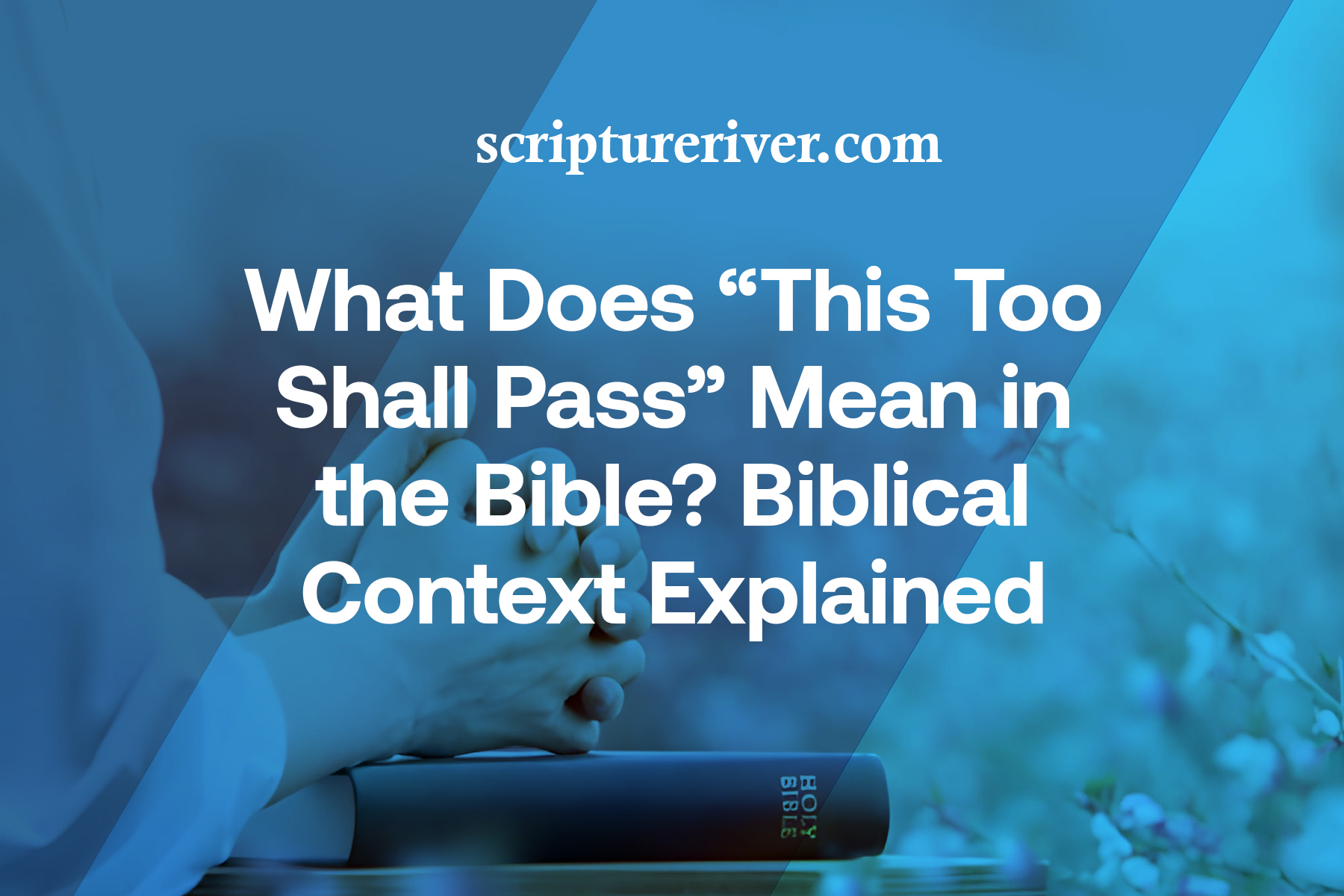
“This too shall pass” is one of the most quoted phrases in Christian circles.
It appears on greeting cards, in sermons, and on social media posts attributed to Scripture.
The problem is that it is not in the Bible.
Not a single translation. Not a paraphrase. Not a loose rendering of any original Hebrew or Greek text.
The phrase does not exist in the canonical Scriptures, and the confusion surrounding it matters because it shapes how millions of people understand suffering, endurance, and hope.
What the Bible does teach on this subject is far more specific, far more grounded, and far more useful than the phrase most people believe it contains.
Is “This Too Shall Pass” Actually in the Bible?
No. As GotQuestions.org confirms, the phrase does not appear anywhere in Scripture.
The confusion has a few sources.
One is the King James Version’s frequent use of the phrase, “and it came to pass,” which appears 477 times in the KJV and 177 times in the NKJV.
That phrase means something happened, not that something temporary faded.
The two sentences sound similar but mean completely different things.
Another source of confusion is Ecclesiastes 3, which addresses seasons of life in language that resonates with the sentiment of the phrase.
But Ecclesiastes 3 does not say “this too shall pass.” It says something more theologically rich and more demanding of the reader.
A third source is the phrase’s cultural ubiquity.
The older an expression becomes and the more broadly it circulates, the more easily it gets attached to authoritative sources it never came from.
Where the Phrase Actually Comes From
The true origin of “this too shall pass” traces to medieval Persian Sufi poetry, not to the Bible.
Scholars trace it to 12th-century Persian poets Sanai and Attar of Nishapur.
Attar records the story of a powerful king who asked his wise men to create a ring that would make him happy when sad and sad when happy.
The sages gave him a ring inscribed: “This too shall pass.”
A parallel version appears in Jewish folklore connected to King Solomon.
According to Rabbi Lisa Rubin, Solomon wanted to humble his wisest servant by assigning an impossible task.
When the servant failed, Solomon had a ring made with the Hebrew inscription “Gam ze ya’avor,” meaning, “This too shall pass.”
The phrase appears in the Israel Folklore Archive but has no biblical source text.
In the Western world, the phrase gained wide circulation through a 19th-century retelling of these fables by English poet Edward FitzGerald.
Abraham Lincoln then made it famous, quoting it in an 1859 speech as a phrase of an “Eastern monarch” that was true in both adversity and prosperity.
None of these sources are Scripture. The phrase is genuinely wise as human proverbs go. It simply is not biblical.
What Ecclesiastes 3 Actually Says
The passage most closely aligned with “this too shall pass” is Ecclesiastes 3:1-8, traditionally attributed to King Solomon.
“There is a time for everything, and a season for every activity under the heavens: a time to be born and a time to die, a time to plant and a time to uproot, a time to kill and a time to heal, a time to tear down and a time to build, a time to weep and a time to laugh, a time to mourn and a time to dance, a time to scatter stones and a time to gather them, a time to embrace and a time to refrain from embracing, a time to search and a time to give up, a time to keep and a time to throw away, a time to tear and a time to mend, a time to be silent and a time to speak, a time to love and a time to hate, a time for war and a time for peace.”
(Ecclesiastes 3:1-8, NIV)
Solomon is not simply saying that hard times will end. He is saying that every season of human existence, including the painful ones, exists within the sovereign ordering of God.
As GotQuestions.org explains, Solomon illustrates through fourteen juxtaposing pairs that God controls the timing of everything. The key verse that follows anchors the entire passage:
“He has made everything beautiful in its time. He has also set eternity in the human heart; yet no one can fathom what God has done from beginning to end.”
(Ecclesiastes 3:11, NIV)
The phrase “He has made everything beautiful in its time” is a statement about God’s sovereign authorship over all seasons, not a promise that every difficult season simply evaporates.
Take it further: Read Ecclesiastes 3:1-15 in one sitting. As you read, identify which specific season described in verses 1-8 most closely matches where you are right now.
Then read verse 11 again. Let the connection between your current season and God’s sovereign timing be the thing you sit with, not just the comfort that it will end.
What the Bible Teaches About Temporary Suffering
While “this too shall pass” is not in Scripture, the Bible does have substantial, grounded things to say about the temporary nature of earthly suffering. These verses do not simply reassure you that hard things will stop. They place temporary suffering inside an eternal framework.
“For our light and momentary troubles are achieving for us an eternal glory that far outweighs them all. So we fix our eyes not on what is seen, but on what is unseen, since what is seen is temporary, but what is unseen is eternal.”
(2 Corinthians 4:17-18, NIV)
Paul wrote this while being beaten, imprisoned, and rejected. He does not describe suffering as light and momentary because it felt that way. He describes it that way because he is measuring it against eternity.
Take it further: Write down your most pressing difficulty right now. Then write the phrase “achieving for me an eternal glory that far outweighs it.” Paul’s equation is intentional and specific. What would it look like for you to approach this difficulty as something producing something rather than simply something to be survived?
“Consider it pure joy, my brothers and sisters, whenever you face trials of many kinds, because you know that the testing of your faith produces perseverance. Let perseverance finish its work so that you may be mature and complete, not lacking anything.”
(James 1:2-4, NIV)
James does not say trials pass. He says trials produce. The goal is not relief. It is maturity.
Take it further: Name the specific quality that this current trial might be developing in you. Not in the abstract. Name it concretely: patience, trust, dependence on God, compassion for others in similar pain. Knowing what a season is producing changes how you endure it.
“Why, you do not even know what will happen tomorrow. What is your life? You are a mist that appears for a little while and then vanishes.”
(James 4:14, NIV)
James uses the image of morning mist to describe human life. It is not a bleak statement. It is a clarifying one. The brevity of life is an argument for urgency, not despair.
Take it further: The mist image is meant to reorder priorities. Ask yourself: if this life is brief and passing, what am I holding onto too tightly right now? What would I invest in differently if I genuinely believed the permanent was worth more than the temporary?
“Let us not become weary in doing good, for at the proper time we will reap a harvest if we do not give up.”
(Galatians 6:9, NIV)
This verse is as close as Scripture comes to the sentiment of “this too shall pass,” and it is worth noting the difference. Paul does not simply say things will improve. He says hold on, keep doing good, and at the proper time there will be a harvest. The endurance is purposeful.
Take it further: Identify one area where you are tempted to stop doing good because it is not yet producing visible results. This verse is written for exactly that moment. Stay in it one more season. The harvest has a proper time that is not yours to determine.
“Heaven and earth will pass away, but my words will never pass away.”
(Matthew 24:35, NIV)
Jesus says everything passes, including creation itself. But His Word does not. This is the theological inversion of “this too shall pass.” Not suffering alone passes. Everything temporal passes. What does not pass is the Word of God.
Take it further: What truth from Scripture have you been relying on most during this difficult season? Write it down. Speak it aloud. The impermanence of suffering is real, but it is anchored in something that will not pass: the promises of a God whose words outlast the universe.
The Difference Between “This Too Shall Pass” and Biblical Hope
The phrase “this too shall pass” is not false. It is incomplete.
Used as a human proverb, it offers comfort by pointing toward the end of a difficult season. That is genuinely helpful as far as it goes.
But the Bible does not simply tell you that suffering ends. It tells you that suffering produces something, that it is happening within God’s sovereign time, that it is light when compared to eternal glory, and that what you are building toward does not pass away.
The biblical version of this idea is stronger than the proverb because it gives suffering a purpose rather than just an expiration date.
A Prayer for Anyone In A Difficult Season
Father, I do not know how long this season will last. I am choosing to trust that You have appointed its length and that it is producing something I cannot yet see. Keep me from simply waiting for it to end. Teach me what it is meant to build in me. Let me fix my eyes not on what is temporary but on what is eternal. I choose to trust You with this. In Jesus’ name, amen.
Frequently Asked Questions
Is “this too shall pass” in the Bible?
No. As GotQuestions.org confirms, the exact phrase does not appear in any Bible translation or original manuscript. The idea that it is biblical likely comes from the phrase’s cultural ubiquity, the KJV expression “and it came to pass,” and the resonance with Ecclesiastes 3’s language about seasons.
Where did “this too shall pass” come from?
Scholars trace it to 12th-century Persian Sufi poets Sanai and Attar of Nishapur. A parallel version appears in Jewish folklore attributed to King Solomon. The phrase entered wide Western use through a 19th-century English retelling of these fables and was famously quoted by Abraham Lincoln in an 1859 speech.
What does Ecclesiastes 3 say about seasons of life?
GotQuestions.org explains that Solomon uses fourteen pairs of contrasting activities to show that God controls the timing of every human season. The passage’s governing statement is verse 11: God has made everything beautiful in its time. This is about divine sovereignty over seasons, not just the natural passage of time.
Is it okay for Christians to use the phrase “this too shall pass”?
The phrase is not unbiblical in sentiment, but should never be presented as Scripture. As human wisdom acknowledging impermanence, it is acceptable. Used as a substitute for Scripture or to avoid the biblical theology of suffering, it falls short of what God’s Word actually offers.
What Bible verses speak to the temporary nature of suffering?
Key verses include 2 Corinthians 4:17-18, which frames suffering as momentary compared to eternal glory; James 1:2-4, which shows suffering producing maturity; Galatians 6:9, which anchors endurance in a coming harvest; and Matthew 24:35, where Jesus declares that while everything temporal passes, His Word does not.
Cited Works and Sources
Bartholomew, C. G. (2009). Ecclesiastes: Baker commentary on the Old Testament wisdom and psalms. Baker Academic.
Keyes, R. (2006). The quote verifier. St. Martin’s Press.
GotQuestions.org. (2019). Is “this too shall pass” found in the Bible? Got Questions Ministries.
GotQuestions.org. (2015). What does it mean that there is a proper time for everything (Ecclesiastes 3:1-8)? Got Questions Ministries.
Christianity.com. (2024). “This too shall pass”: Origin, history and Bible teaching. Christianity.com.
Crosswalk.com. (2020). “This too shall pass”: Is it in the Bible? Crosswalk.com.
Bible Study Tools. (2022). Does the Bible say “this too shall pass”? BibleStudyTools.com.
St. Paul Center. (n.d.). Is “this too shall pass” in the Bible? StPaulCenter.com.
The Preacher’s Word. (2018). This, too, shall pass. ThePreachersWord.com.
BibleReasons.com. (2025). “This too shall pass” Bible verse. BibleReasons.com.

