

Easter morning in our house used to be chaos. Egg hunts, chocolate bunnies, new clothes, and a mad rush to church.
By the time we collapsed that evening, we’d celebrated everything except the actual reason for the day.
That changed five years ago when I started a simple tradition with my family: reading the Easter story together from Scripture before anything else happened.
No distractions, no agenda, just the Word of God telling us why we celebrate.
The transformation has been remarkable.
My kids now understand that Easter isn’t about what we get but about what Jesus did.
They can tell you the resurrection story in their own words. And honestly, it’s changed Easter for me too.
In this post, I’m sharing 13 essential Easter verses perfect for family reading.
These aren’t random springtime scriptures. They’re the backbone of the resurrection narrative, carefully selected to walk your family through Jesus’s death, burial, and triumphant rising.
Whether your children are toddlers or teenagers, these verses will anchor your Easter celebration in biblical truth.
Listen: Why These Verses Matter
Press play to hear a 13-minute explanation of why reading Scripture together as a family on Easter morning transforms how your children understand the gospel.
This brief overview sets the stage for the verses and family discussion questions that follow.
Why Reading Easter Scripture as a Family Actually Matters
Let me tell you what happens when you don’t ground Easter in Scripture.
Your kids grow up thinking Easter is about baskets and candy. They know the secular traditions but not the sacred story.
They can recite “The Night Before Christmas” but stumble through the resurrection account.
I’ve watched this happen in countless Christian families.
Parents assume kids are learning the Easter story at church, so they don’t teach it at home.
Meanwhile, kids absorb hours of egg hunt content and zero hours of empty tomb theology.
Research shows that children whose families read Scripture together develop stronger biblical literacy, deeper faith foundations, and clearer understanding of core Christian doctrines.
Easter provides the perfect opportunity because the story is dramatic, visual, and deeply meaningful.
But there’s a deeper reason I’m passionate about this.
The resurrection isn’t just a nice story. It’s the foundation of everything we believe as Christians.
Paul says in 1 Corinthians 15:17 that if Christ hasn’t been raised, our faith is worthless.
Your kids need to know this story like they know their own names. They need to hear it repeatedly until it becomes part of their spiritual DNA.
Reading these verses together on Easter creates a family tradition that reinforces the most important truth in human history: Jesus died and rose again.
How to Use These Verses With Your Family
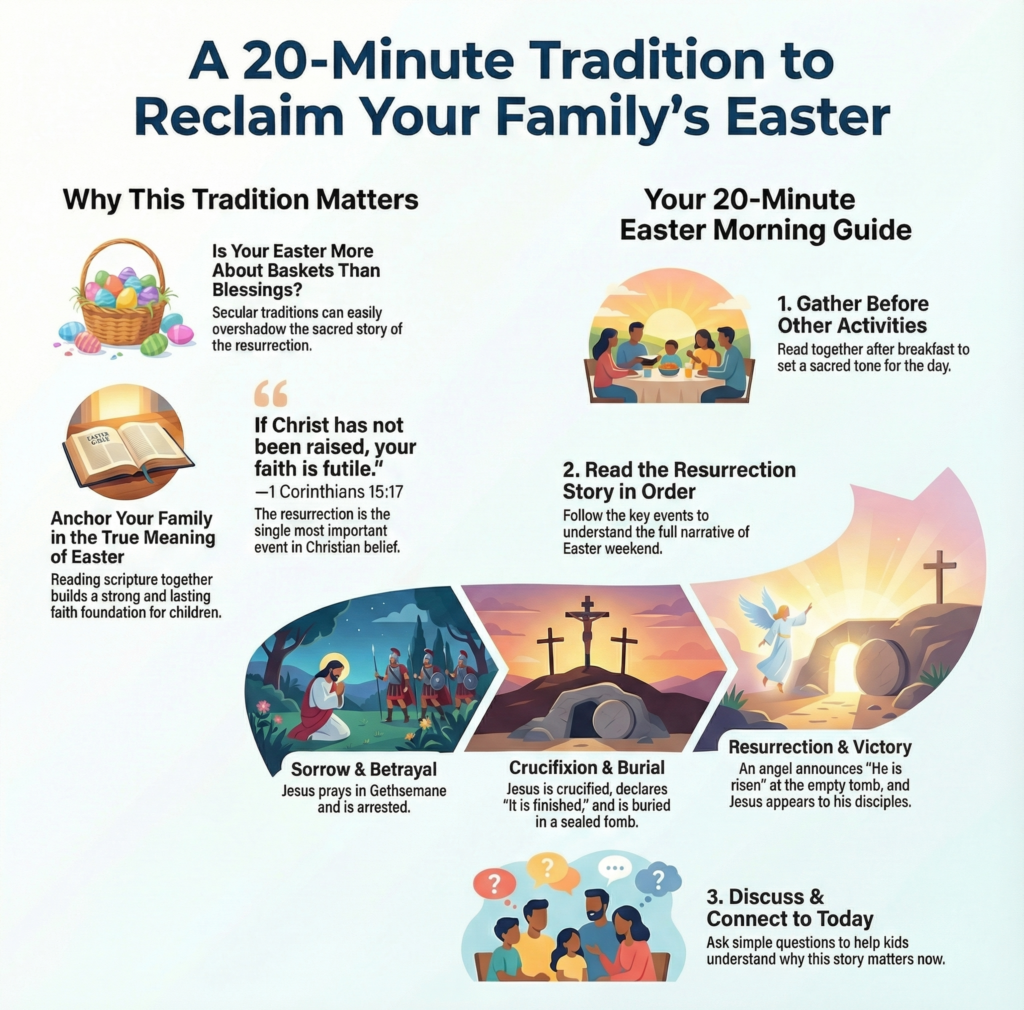
Before we get to the specific scriptures, let me give you a framework that’s worked beautifully in my own family and with dozens of families in my congregation.
Gather everyone before other Easter activities. This sets the tone that Scripture comes first, and celebrations follow. We do this right after breakfast, before anyone gets dressed for church.
Read the verses in order. They follow the chronological progression of Easter weekend, from Jesus’s arrest through His resurrection appearances. This helps children grasp the narrative flow.
Let different family members read. Even young children can read a verse or two. It creates ownership and engagement.
Pause for brief discussion. I’ve included simple questions after each verse. Don’t turn this into a lengthy Bible study. Keep it conversational and age-appropriate.
Connect it to today. Help kids understand why this ancient event matters for their lives right now.
The entire reading takes maybe 15 to 20 minutes, depending on how much discussion you allow. It’s not a massive time commitment, but the spiritual impact is profound.
The 13 Essential Easter Verses for Families

1. Matthew 26:36-38 – Jesus Prays in Gethsemane
New International Version (NIV)
“Then Jesus went with his disciples to a place called Gethsemane, and he said to them, ‘Sit here while I go over there and pray.’ He took Peter and the two sons of Zebedee along with him, and he began to be sorrowful and troubled. Then he said to them, ‘My soul is overwhelmed with sorrow to the point of death. Stay here and keep watch with me.'”
Why This Matters: Easter didn’t start with victory. It started with Jesus experiencing deep emotional pain. He knew what was coming, and He was troubled by it.
Family Discussion: Ask your kids, “Have you ever been scared about something you knew was going to happen? How did you feel?” Help them see that Jesus understands fear and sorrow because He experienced them.
This verse is crucial because it shows Jesus’s humanity. Kids sometimes think Jesus floated through crucifixion without really suffering. This verse corrects that misunderstanding immediately.
2. Mark 14:43-46 – Jesus Is Arrested
English Standard Version (ESV)
“And immediately, while he was still speaking, Judas came, one of the twelve, and with him a crowd with swords and clubs, from the chief priests and the scribes and the elders. Now the betrayer had given them a sign, saying, ‘The one I will kiss is the man. Seize him and lead him away under guard.’ And when he came, he went up to him at once and said, ‘Rabbi!’ And he kissed him. And they laid hands on him and seized him.”
Why This Matters: Jesus was betrayed by someone close to Him. This wasn’t strangers attacking Him, but His own disciple selling Him out.
Family Discussion: Talk about how Judas pretended to love Jesus while actually betraying Him. Ask, “How do you think Jesus felt when His friend did this?”
Kids understand betrayal. They’ve experienced friends turning on them at school. Connecting Jesus’s experience to theirs makes the story personal.
3. Luke 23:20-23 – The Crowd Chooses Barabbas
New Living Translation (NLT)
“Pilate argued with them, because he wanted to release Jesus. But the mob shouted, ‘Crucify him! Crucify him!’ For the third time he demanded, ‘Why? What crime has he committed? I have found no reason to sentence him to death. So I will have him flogged, and then I will release him.’ But the mob shouted louder and louder, demanding that Jesus be crucified, and their voices prevailed.”
Why This Matters: Jesus was innocent, but the crowd demanded His death anyway. Even the Roman governor knew Jesus had done nothing wrong.
Family Discussion: Ask, “Have you ever been blamed for something you didn’t do? How did that feel?” Then explain, “Jesus experienced that on the biggest scale possible, and He chose to go through with it to save us.”
This introduces the concept of substitution. Jesus took punishment He didn’t deserve so we could receive forgiveness we don’t deserve.
4. John 19:16-18 – The Crucifixion
Christian Standard Bible (CSB)
“Then he handed him over to be crucified. Then they took Jesus away. Carrying the cross by himself, he went out to what is called Place of the Skull, which in Aramaic is called Golgotha. There they crucified him and two others with him, one on either side, with Jesus in the middle.”
Why This Matters: This is the central event of Good Friday. Jesus physically died on a Roman cross, bearing the weight of human sin.
Family Discussion: Depending on your children’s ages, explain crucifixion as gently or as graphically as appropriate. The key point is that Jesus suffered physically so we could be forgiven spiritually.
Don’t sanitize this too much. Kids need to understand that Jesus’s sacrifice was costly, painful, and real.
5. Matthew 27:45-46 – Darkness Covers the Land
New King James Version (NKJV)
“Now from the sixth hour until the ninth hour there was darkness over all the land. And about the ninth hour Jesus cried out with a loud voice, saying, ‘Eli, Eli, lama sabachthani?’ that is, ‘My God, My God, why have You forsaken Me?'”
Why This Matters: Even nature responded to Jesus’s death. Darkness covered the earth, and Jesus experienced separation from the Father as He bore our sin.
Family Discussion: Explain that Jesus felt abandoned by God so that we would never have to be. Ask, “What’s the scariest feeling you’ve ever had?” Then tell them Jesus experienced something far worse so they could always know God’s presence.
This is heavy theology, but even young children can grasp that Jesus went through something terrible on our behalf.
6. John 19:30 – It Is Finished
The Message (MSG)
“After he took the wine, Jesus said, ‘It’s done… complete.’ Bowing his head, he offered up his spirit.”
Why This Matters: Jesus’s final words weren’t defeat. They were declaration of victory. The work of salvation was complete.
Family Discussion: Ask, “What do you think Jesus meant by ‘It is finished’?” Help them understand He wasn’t saying His life was over. He was saying the mission was accomplished.
The Greek word “tetelestai” meant “paid in full.” It’s what someone would write across a debt when it was completely satisfied. Our sin debt was paid.
7. Matthew 27:57-60 – Jesus Is Buried
New American Standard Bible (NASB)
“Now when it was evening, a rich man from Arimathea came, named Joseph, who himself had also become a disciple of Jesus. This man went to Pilate and asked for the body of Jesus. Then Pilate ordered it to be given to him. And Joseph took the body and wrapped it in a clean linen cloth, and laid it in his own new tomb, which he had cut out in the rock; and he rolled a large stone against the entrance of the tomb and went away.”
Why This Matters: Jesus was genuinely dead and buried. This wasn’t a near-death experience or a swoon. He was placed in a sealed tomb.
Family Discussion: Explain that some people say Jesus didn’t really die, just fainted. But the Bible is clear. He was dead, wrapped in burial cloths, and sealed in a tomb. This makes the resurrection even more amazing.
8. Matthew 27:62-66 – The Tomb Is Sealed and Guarded
New International Version (NIV)
“The next day, the one after Preparation Day, the chief priests and the Pharisees went to Pilate. ‘Sir,’ they said, ‘we remember that while he was still alive that deceiver said, “After three days I will rise again.” So give the order for the tomb to be made secure until the third day. Otherwise, his disciples may come and steal the body and tell the people that he has been raised from the dead. This last deception will be worse than the first.’ ‘Take a guard,’ Pilate answered. ‘Go, make the tomb as secure as you know how.’ So they went and made the tomb secure by putting a seal on the stone and posting the guard.”
Why This Matters: The religious leaders tried to prevent resurrection claims by securing the tomb. This backfired spectacularly because it proved the disciples couldn’t have stolen the body.
Family Discussion: Ask, “If you wanted to make sure something stayed locked, what would you do?” Then explain that’s exactly what Jesus’s enemies did, but it didn’t matter because God’s power is greater than human security.
9. Matthew 28:1-6 – The Empty Tomb
English Standard Version (ESV)
“Now after the Sabbath, toward the dawn of the first day of the week, Mary Magdalene and the other Mary went to see the tomb. And behold, there was a great earthquake, for an angel of the Lord descended from heaven and came and rolled back the stone and sat on it. His appearance was like lightning, and his clothing white as snow. And for fear of him the guards trembled and became like dead men. But the angel said to the women, ‘Do not be afraid, for I know that you seek Jesus who was crucified. He is not here, for he has risen, as he said. Come, see the place where he lay.'”
Why This Matters: This is it. The moment everything changed. The tomb was empty because Jesus had risen from the dead.
Family Discussion: Ask your kids to imagine being those women. “How would you feel seeing an angel? How would you feel hearing ‘He is risen’?” Build excitement here. This is the victory moment.
The phrase “as he said” is critical. Jesus predicted His resurrection multiple times. He did exactly what He promised.
10. Luke 24:36-39 – Jesus Appears to His Disciples
New Living Translation (NLT)
“And just as they were telling about it, Jesus himself was suddenly standing there among them. ‘Peace be with you,’ he said. But the whole group was startled and frightened, thinking they were seeing a ghost! ‘Why are you frightened?’ he asked. ‘Why are your hearts filled with doubt? Look at my hands. Look at my feet. You can see that it’s really me. Touch me and make sure that I am not a ghost, because ghosts don’t have bodies, as you see that I do.'”
Why This Matters: Jesus wasn’t a spirit or a vision. He had a physical, resurrected body. He invited them to touch Him to prove it.
Family Discussion: Explain that Jesus’s resurrection wasn’t just His soul going to heaven. His actual body came back to life in a new, glorified form. Ask, “Why do you think it was important that Jesus had a real body?”
This matters because our future resurrection will also be physical, not just spiritual.
11. John 20:24-28 – Doubting Thomas Believes
Christian Standard Bible (CSB)
“But Thomas (called ‘Twin’), one of the Twelve, was not with them when Jesus came. So the other disciples were telling him, ‘We’ve seen the Lord!’ But he said to them, ‘If I don’t see the mark of the nails in his hands, put my finger into the mark of the nails, and put my hand into his side, I will never believe.’ A week later his disciples were indoors again, and Thomas was with them. Even though the doors were locked, Jesus came and stood among them and said, ‘Peace be with you.’ Then he said to Thomas, ‘Put your finger here and look at my hands. Reach out your hand and put it into my side. Don’t be faithless, but believe.’ Thomas responded to him, ‘My Lord and my God!'”
Why This Matters: Even Jesus’s disciples struggled to believe at first. But Jesus provided evidence, and Thomas’s doubt turned to worship.
Family Discussion: Ask if anyone has ever doubted something they were told. Explain that having questions is okay, but we should bring those questions to Jesus as Thomas did.
Thomas gets criticized, but Jesus didn’t reject him for doubting. He provided what Thomas needed to believe.
12. 1 Corinthians 15:3-5 – The Gospel Summary
New King James Version (NKJV)
“For I delivered to you first of all that which I also received: that Christ died for our sins according to the Scriptures, and that He was buried, and that He rose again the third day according to the Scriptures, and that He was seen by Cephas, then by the twelve.”
Why This Matters: Paul summarizes the gospel in three historical facts: Christ died, was buried, and rose again. Everything we believe depends on these events being true.
Family Discussion: Help your kids memorize this short summary. “Christ died for our sins, was buried, and rose again.” That’s the Easter message in one sentence.
13. Romans 6:4 – We Share in His Resurrection
Amplified Bible (AMP)
“We have therefore been buried with Him through baptism into death, so that just as Christ was raised from the dead through the glory and power of the Father, we too might walk habitually in newness of life [abandoning our old ways].”
Why This Matters: Easter isn’t just about what happened to Jesus 2,000 years ago. It’s about what happens to us now when we trust Him.
Family Discussion: Explain that when we believe in Jesus, we get to share in His resurrection. We get new life, not someday but starting right now. Ask, “What does ‘new life’ mean for how we live today?”
This connects the historical resurrection to the present transformation. Easter changes everything about how we live.
Making These Verses Come Alive for Different Ages

I’ve read Easter scriptures with families where the children ranged from three to seventeen.
Here’s what I’ve learned about adapting to different developmental stages.
For Preschoolers (Ages 3-5): Focus on the narrative flow rather than theological depth. Use simple language and emphasize that Jesus loves them so much that He died and came back to life. Let them color pictures of the empty tomb while you read.
For Elementary Kids (Ages 6-10): They can grasp the substitutionary aspect. Jesus took their punishment. Use the discussion questions and let them ask anything. Their questions reveal what they’re processing.
For Preteens and Teens (Ages 11+): Don’t dumb it down. Engage the apologetic aspects. Why do we believe the resurrection actually happened? What’s the evidence? Teenagers respect intellectual honesty.
The beauty of reading the actual biblical text is that it works at every level. The Holy Spirit applies truth appropriate to each person’s understanding.
Our Thoughts on Easter as a Family Milestone
I’ll be honest with you about something that breaks my heart every Easter season.
I watch Christian families invest massive energy into egg hunts, special meals, and new outfits while giving maybe five minutes to the actual resurrection story.
The secular overwhelms the sacred, and our kids learn that Easter is really about chocolate and springtime.
Then we wonder why they walk away from faith as teenagers. We never grounded them in the foundational truth that Christ is risen.
Reading these 13 verses as a family won’t solve every spiritual challenge your children will face.
But it will give them something precious: a clear understanding of the gospel and a family memory tied to Scripture rather than just traditions.
Five years into this practice, my kids still talk about our Easter morning readings. They quote the verses. They reference the discussions.
It’s become the anchor that holds all our other Easter celebrations in proper perspective.
Your family needs this too.
Not because I said so, but because the resurrection is too important to relegate to a brief mention at church while you spend hours on everything else.
Start this year. Gather your family on Easter morning, read these verses together, and watch what God does through His Word spoken in your home.
Prayer for Easter Understanding
Father, thank You for the greatest miracle in human history. Thank You that Jesus didn’t stay dead but rose in victory over sin and death.
As we gather as families to celebrate Easter, help us keep the main thing the main thing. Don’t let us get so distracted by traditions that we miss the truth.
Open our children’s hearts to understand what Jesus did for them. Help even the youngest grasp that Easter is about sacrifice and resurrection, death defeated and life restored.
Give us wisdom as parents to teach this story year after year without it becoming rote or boring. Keep it fresh, keep it real, keep it central.
May our Easter celebrations honor You by exalting the risen Christ above everything else we do that day.
He is risen. He is risen indeed.
In Jesus’s Name, Amen.
References
Arnold, C. E. (2010). Zondervan Illustrated Bible Backgrounds Commentary: Matthew, Mark, Luke. Zondervan.
Keener, C. S. (2003). The Gospel of John: A Commentary. Baker Academic.
Longman, T., & Garland, D. E. (Eds.). (2010). The Expositor’s Bible Commentary: Luke-Acts. Zondervan.
Morris, L. (1992). The Gospel According to Matthew. Eerdmans Publishing.
Peterson, E. H. (2005). The Message: The Bible in Contemporary Language. NavPress.
Strobel, L. (2016). The Case for Easter: A Journalist Investigates the Evidence for the Resurrection. Zondervan.
Strong, J. (2010). Strong’s Exhaustive Concordance of the Bible. Hendrickson Publishers.
Witherington, B. (2006). Matthew. Smyth & Helwys Bible Commentary.
Wright, N. T. (2003). The Resurrection of the Son of God. Fortress Press.