

“Taste and see that the Lord is good.”
I must have read that verse a hundred times before it actually hit me.
It was always just pretty religious language, the kind of poetic phrase you find in Psalms that sounds nice but doesn’t really mean anything concrete.
Then I went through the darkest season of my life.
The Ministry was falling apart. My marriage was strained to the breaking point.
My faith felt like it was held together with duct tape and desperation.
I was going through the motions of believing while secretly wondering if any of it was actually real.
That’s when Psalm 34:8 stopped being religious poetry and became a lifeline.
Because David wasn’t writing theoretical theology when he penned those words.
He was writing from personal, hard-won experience of God’s goodness in the middle of absolute chaos.
What we are going to do in this post is unpack what it actually means to taste and see that the Lord is good.
Not the sanitized Sunday school version, but the raw, practical, life-changing reality of experiencing God’s goodness for yourself.
Because this verse isn’t an invitation to appreciate God from a distance.
It’s a dare to get close enough to know Him intimately.
Audio Teaching: Beyond Theoretical Faith
Listen to this teaching on why “taste and see” language matters for your spiritual life.
You’ll discover why God invites us to experience His goodness rather than just believe in it intellectually, and how this verse challenges comfortable, theoretical Christianity that never gets close enough to actually know God personally.
The Context Behind “Taste And See That the Lord Is Good”
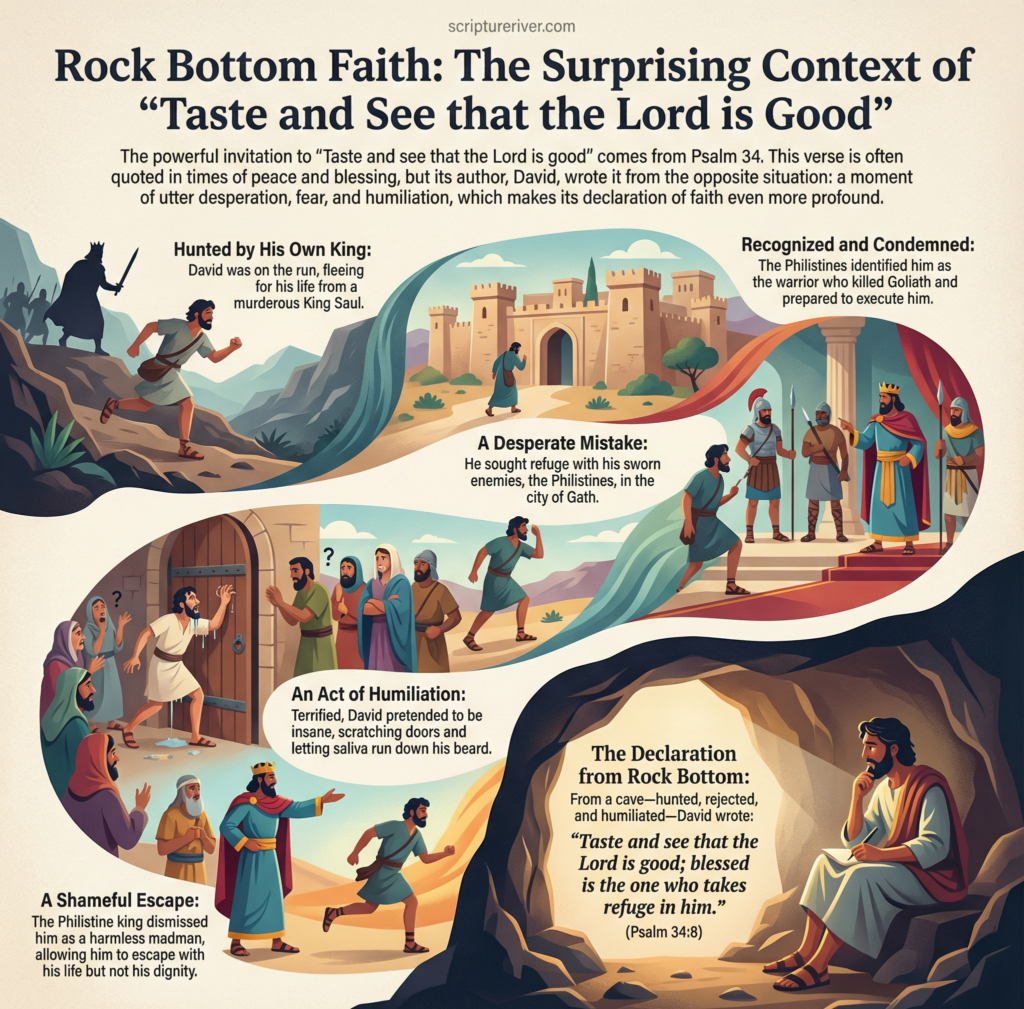
Before we can understand what this verse means, we need to know where it came from.
David wrote Psalm 34 after one of the most humiliating episodes of his life.
He’d fled from King Saul, who was trying to kill him.
In desperation, David sought refuge with Israel’s enemies, the Philistines.
Specifically, he went to King Achish of Gath.
Big mistake.
The Philistines recognized David as the warrior who’d killed their champion Goliath and slaughtered thousands of their soldiers.
They were ready to execute him on the spot.
David, terrified for his life, pretended to be insane.
The Bible says he scratched on doors and let saliva run down his beard.
It worked.
King Achish threw him out as a crazy person rather than killing him as an enemy.
David escaped with his life but not his dignity.
And that’s the context for this psalm.
David had just drooled on himself and acted like a madman to avoid execution.
He was hiding in a cave, hunted by his own king, rejected by his enemies, and utterly humiliated.
Yet from that cave, he wrote one of the most triumphant psalms in Scripture, declaring God’s goodness and inviting others to taste and see it for themselves.
Here’s the full verse in context:
“Taste and see that the Lord is good; blessed is the one who takes refuge in him.” (Psalm 34:8, New International Version)
David wasn’t writing from a palace throne or after a great victory. He was writing from rock bottom, and that’s precisely what makes his invitation so compelling.
What “Taste” Actually Means in Biblical Language
The Hebrew word David uses for “taste” is “ta’am.”
It means exactly what you think it means: to taste, to perceive by the mouth, to experience directly.
But in Hebrew thought, tasting wasn’t just about food.
It was about an intimate, personal experience.
When the Bible talks about tasting, it’s talking about direct encounter, not secondhand knowledge.
You can’t taste something from a distance. You have to get close enough to put it in your mouth.
Think about how you learn about food.
Someone can describe chocolate cake to you in exquisite detail.
They can show you pictures.
They can explain the ingredients and the baking process.
But until you actually taste chocolate cake for yourself, you don’t really know it.
That’s David’s point about God’s goodness.
You can hear sermons about it. You can read books about it. You can study theology that explains it.
But until you personally experience God’s goodness in your own life, you’re operating on borrowed knowledge, not personal conviction.
I spent years knowing about God’s goodness theoretically without tasting it personally.
I could quote verses. I could preach sermons.
But I was spiritually malnourished because I was living on descriptions of food rather than eating it myself.
The invitation to “taste and see that the Lord is good” is an invitation to stop living on secondhand religion and start experiencing God directly.
What “See” Adds to Our Understanding
David could have stopped with “taste.” But he adds “see,” and that second word transforms the verse.
The Hebrew word “ra’ah” means to see, to perceive, to understand.
But it’s more than just visual observation.
It’s seeing with comprehension, with understanding, with insight.
When you combine “taste” and “see,” David is inviting a complete experience of God’s goodness that engages every sense and faculty you have.
Taste speaks to an intimate, personal encounter. See speaks to verified understanding.
Together, they create a picture of knowing God so thoroughly that His goodness becomes undeniable in your own experience.
You taste God’s goodness through direct experience.
You see God’s goodness when you look back and recognize His faithfulness.
The tasting is immediate and sensory. The seeing is reflective and cognitive.
I tasted God’s goodness when He sustained me through that dark season I mentioned earlier.
I didn’t understand what was happening at the time. I just knew that somehow I was surviving what should have destroyed me.
I saw God’s goodness later, when I could look back and recognize how He’d been working even when I couldn’t feel it.
The perspective of time revealed patterns of faithfulness I couldn’t see in the moment.
Both are necessary.
Tasting without seeing might be an emotional experience without understanding.
Seeing without tasting might be intellectual knowledge without relationship.
David invites us to both.
Five Ways to Actually Taste and See God’s Goodness
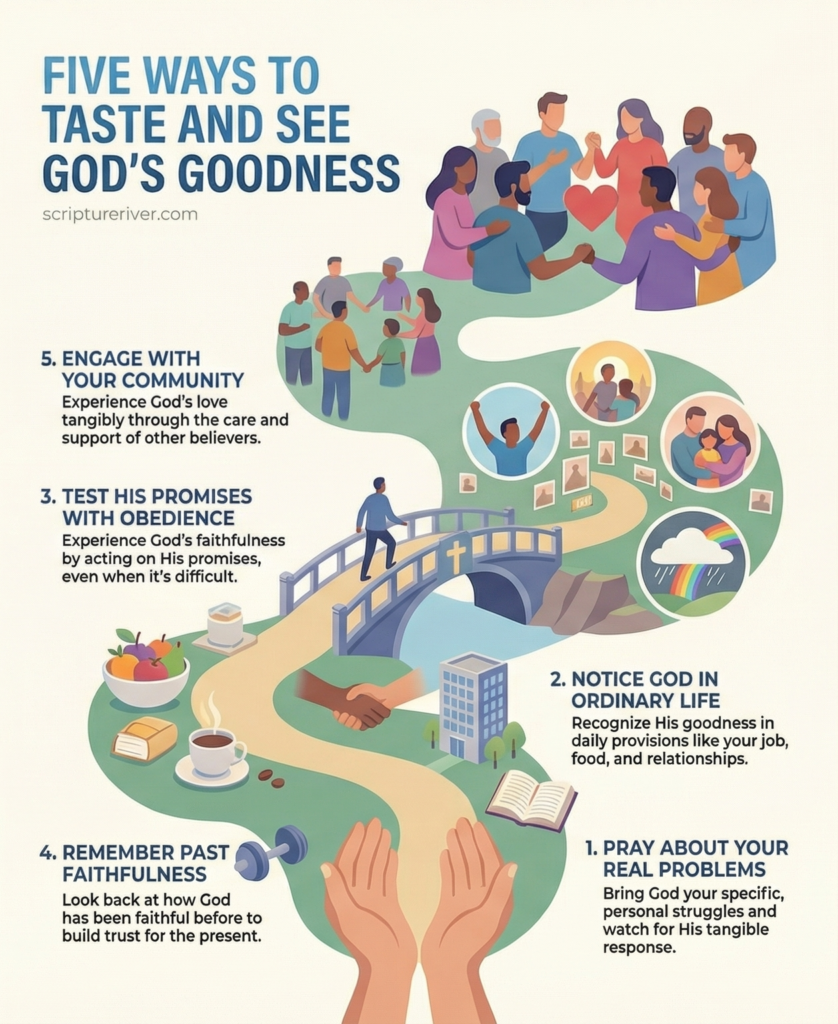
Knowing what the verse means theologically is one thing. Actually experiencing God’s goodness is another.
Let me share five practical ways to move from concept to experience.
1. Bring Your Actual Problems to God in Prayer
You can’t taste God’s goodness in hypothetical situations. You taste it when you bring Him your real struggles and watch Him respond.
Stop praying generic prayers about generic issues. Bring God the specific problems keeping you awake at night.
The relationship that’s broken. The financial pressure that is crushing you. The health crisis terrifying you. The decision you don’t know how to make.
When you bring God your actual mess, and He shows up in tangible ways, that’s when you taste His goodness personally.
I didn’t taste God’s goodness through theological study.
I tasted it when I brought Him my failing marriage and desperate prayers, and He began healing what I thought was beyond repair.
That’s tasting, not just knowing.
2. Look for God’s Provision in Ordinary Life
We often miss God’s goodness because we’re looking for dramatic miracles while overlooking daily mercies.
God’s goodness shows up in the job you have, the food on your table, the bed you sleep in, and the relationships sustaining you.
Every good thing in your life is evidence of God’s goodness if you have eyes to see it.
Start keeping a daily list of God’s provision. Not huge answered prayers necessarily, but simple gifts.
Health today. Enough money to pay this bill. A kind word from a friend. Your children’s laughter.
When you train yourself to recognize God’s goodness in ordinary places, you start seeing it everywhere.
And seeing it everywhere strengthens your faith that He’ll be good in the hard places too.
3. Test God’s Promises Through Obedience
This is where “taste and see” gets challenging.
You can’t taste food you refuse to put in your mouth.
You can’t experience God’s faithfulness to promises you never test through obedience.
God promises to provide for those who seek first His kingdom.
Test that promise by tithing when it feels financially impossible.
God promises peace to those who bring Him their anxieties. Test that promise by actually praying instead of just worrying.
Every act of obedience is an opportunity to taste God’s goodness.
When you step out in faith, and God proves faithful, you’re not just learning doctrine. You’re experiencing reality.
I tested God’s promise about provision when we decided to adopt despite having no idea how we’d afford it.
Watching God provide in unexpected ways wasn’t just encouraging. It was tasting His goodness in a way that changed my faith permanently.
4. Remember Past Faithfulness During Present Struggles
The “see” part of this verse often happens in retrospect.
You taste God’s goodness in the moment. You see it when you look back and recognize the pattern.
When you’re in a current crisis, deliberately remember past crises where God proved faithful.
Write them down if you need to. Revisit journal entries. Talk to people who walked through previous hard seasons with you.
Seeing God’s faithfulness in past situations gives you the courage to trust Him in present ones.
It’s evidence that His goodness isn’t theoretical or occasional. It’s consistent and reliable.
David kept returning to his testimony of killing Goliath when he faced new threats.
That experience of God’s goodness gave him confidence that God would be good again.
Do the same with your own history.
5. Engage Christian Community Honestly
You taste God’s goodness through direct experience with Him, but you also taste it through His people when they embody His love tangibly.
Stop hiding behind fake smiles at church.
Share your real struggles with trusted believers and let them minister to you.
When someone brings you a meal during a crisis, that’s tasting God’s goodness.
When someone prays with you in desperation, that’s tasting it.
When the community rallies around you in suffering, that’s tasting it.
God often dispenses His goodness through human hands.
If you isolate yourself, you miss that dimension of experiencing Him.
I tasted God’s goodness profoundly when my church community supported us through adoption expenses, brought us meals, and prayed for us through the waiting.
God’s goodness had faces, names, and hands that served. That’s tasting, not just believing.
What God’s Goodness Actually Looks Like

Here’s where we need to get brutally honest about what “the Lord is good” actually means.
God’s goodness doesn’t mean everything in your life will be pleasant.
David wrote this psalm from a cave while being hunted. His circumstances were terrible, but God’s goodness was still real.
God’s goodness means He’s working for your ultimate welfare even when immediate circumstances are painful.
It means His character is consistently loving, faithful, and trustworthy, even when His actions confuse you.
I’ve tasted God’s goodness in answered prayers that exceeded my hopes.
But I’ve also tasted it in unanswered prayers that forced me to depend on Him rather than His gifts.
Both are good, though one feels better than the other.
God’s goodness showed up when He healed my father after a stroke.
It also showed up when He didn’t heal my friend’s father and instead gave that family supernatural grace to endure loss.
Different outcomes, same goodness.
The invitation to taste and see God’s goodness isn’t a promise of comfort in Christianity.
It’s an invitation to discover that God’s character remains good even when circumstances aren’t, and that His presence is the ultimate good we’re seeking anyway.
The Difference Between Tasting Once and Continual Feasting
David’s invitation is in the present tense, which matters.
He’s not saying “taste once and you’re done.” He’s inviting ongoing, repeated experience of God’s goodness.
One taste isn’t enough to sustain you spiritually any more than one meal is enough to sustain you physically.
You need regular, repeated encounters with God’s goodness.
This is why daily spiritual disciplines matter.
Prayer, Scripture reading, worship, and community aren’t religious obligations.
They’re the means by which you repeatedly taste God’s goodness so you don’t spiritually starve.
I can’t survive on the God-encounter I had five years ago. I need a fresh experience of His goodness today.
Yesterday’s manna doesn’t feed today’s hunger. That’s why David uses present-tense language, inviting continual tasting.
The Christian life isn’t about one powerful conversion experience followed by decades of coasting on that memory.
It’s about daily tasting, continual seeing, repeated encounters with God’s goodness that keep your faith alive and growing.
When You Can’t Taste God’s Goodness
Let me address the painful reality that sometimes you read “taste and see that the Lord is good” and think, “I can’t taste anything.
God feels absent, and goodness feels like a cruel joke.”
I’ve been there.
So have countless believers throughout history.
Even David, who wrote this psalm, had other psalms where he cried out, feeling abandoned by God.
When you can’t taste God’s goodness presently, here’s what you do.
First, acknowledge the struggle honestly to God.
Don’t pretend you’re experiencing something you’re not.
Tell Him, “I’m supposed to taste Your goodness, but I feel nothing. Help me.”
Second, lean on past tastes when present ones aren’t available.
Remember times when God’s goodness was undeniable.
Those memories aren’t manufacturing fake experience. They’re evidence that helps sustain you through drought seasons.
Third, keep showing up even when you feel nothing.
Keep praying. Keep reading Scripture. Keep gathering with believers.
Faith isn’t always feeling. Sometimes it’s simply continuing the practices that connect you to God, even when the connection feels one-sided.
Fourth, let others taste for you temporarily.
When your faith is too weak to taste God’s goodness yourself, borrow the faith of believers around you who are tasting it.
That’s what community is for.
Seasons of not tasting God’s goodness are real and painful.
They’re not necessarily signs you’re doing something wrong.
Sometimes they’re just wilderness seasons every believer walks through.
Keep moving forward. The tasting will return.
Our Final Thoughts on Experiencing God’s Goodness
Here’s what I know about tasting and seeing that the Lord is good.
It’s the most important invitation in all of Scripture because it moves faith from theory to experience, from secondhand religion to firsthand relationship.
You can study theology your entire life without tasting God’s goodness.
You can attend church for decades without seeing His faithfulness personally.
But until you accept David’s invitation to taste and see for yourself, you’re missing the whole point of a relationship with God.
God doesn’t want you to know about Him.
He wants you to know Him.
That requires getting close enough to taste, staying attentive enough to see, and being vulnerable enough to let experience trump theory.
Your invitation stands.
Come taste and see the goodness of God
Not because I said so or because theology demands it, but because God Himself is inviting you into a direct, personal, transformative encounter with His goodness.
Take Him up on it.
Bring Him your real life, not your religious performance.
Test His promises through actual obedience.
Watch for His provision in ordinary moments.
Remember His past faithfulness during present struggles.
And discover for yourself what David discovered in that cave: God’s goodness is real, it’s available, and it’s worth risking everything to experience.
Prayer for Those Seeking to Taste God’s Goodness
Father, we want to taste and see that You’re good, but sometimes that feels impossible. We’re going through hard things, and goodness feels abstract and distant. Help us experience You personally, not just know about You theoretically. Open our eyes to see Your goodness in places we’ve been missing it. Give us courage to bring You our real problems so we can taste Your real faithfulness. Remind us of past times when Your goodness was undeniable so we can trust You in present uncertainty. We’re accepting David’s invitation right now. We’re choosing to taste and see instead of remaining at a safe distance. Meet us in that vulnerability. Show us Your goodness in ways that change us forever. In Jesus’s Name, Amen.
References
Brueggemann, W. (1984). The Message of the Psalms: A Theological Commentary. Augsburg Publishing House.
Kidner, D. (2008). Psalms 1-72: An Introduction and Commentary. InterVarsity Press.
Longman, T. (2014). Psalms: An Introduction and Commentary. InterVarsity Press.
Peterson, E. H. (2005). The Message: The Bible in Contemporary Language. NavPress.
Piper, J. (2011). Desiring God: Meditations of a Christian Hedonist. Multnomah.
Spurgeon, C. H. (1976). The Treasury of David (Vol. 1). Hendrickson Publishers.
Strong, J. (2010). Strong’s Exhaustive Concordance of the Bible. Hendrickson Publishers.
VanGemeren, W. A. (2008). Psalms. In T. Longman & D. Garland (Eds.), The Expositor’s Bible Commentary: Psalms (Rev. ed.). Zondervan.
Wiersbe, W. W. (2007). The Bible Exposition Commentary: Old Testament. David C. Cook.
Wright, C. J. (2001). Knowing God the Father Through the Old Testament. InterVarsity Press.