


You’ve been working on the same problem for six months.
Every angle covered. Every option explored. Every conversation replayed.
Plans A through Z mapped out in detail.
You’re doing everything right, trying everything possible, and still nothing’s changing.
And someone quotes Psalm 46:10 at you: “Be still and know that I am God.”
It sounds like spiritual gaslighting.
Like you’re supposed to just stop caring, stop trying, and passively watch your life fall apart while trusting God’s doing something invisible.
Well…
That’s not what the verse means. At all.
“Be still” isn’t about giving up or becoming passive.
It’s about recognizing when your frantic striving has become an attempt to do God’s job for Him.
And sometimes the most spiritual thing you can do is stop.
Understanding Psalm 46:10
Here’s the verse that gets stitched on pillows and painted on walls:
Psalm 46:10, New International Version (NIV)
“Be still, and know that I am God; I will be exalted among the nations, I will be exalted in the earth.”
Most people stop reading after “be still and know that I am God.”
That’s a mistake because the rest of the verse reveals what God means.
He’s not inviting you to meditate quietly.
He’s declaring His sovereignty over situations that make you feel like you need to take control.
The Context That Changes Everything
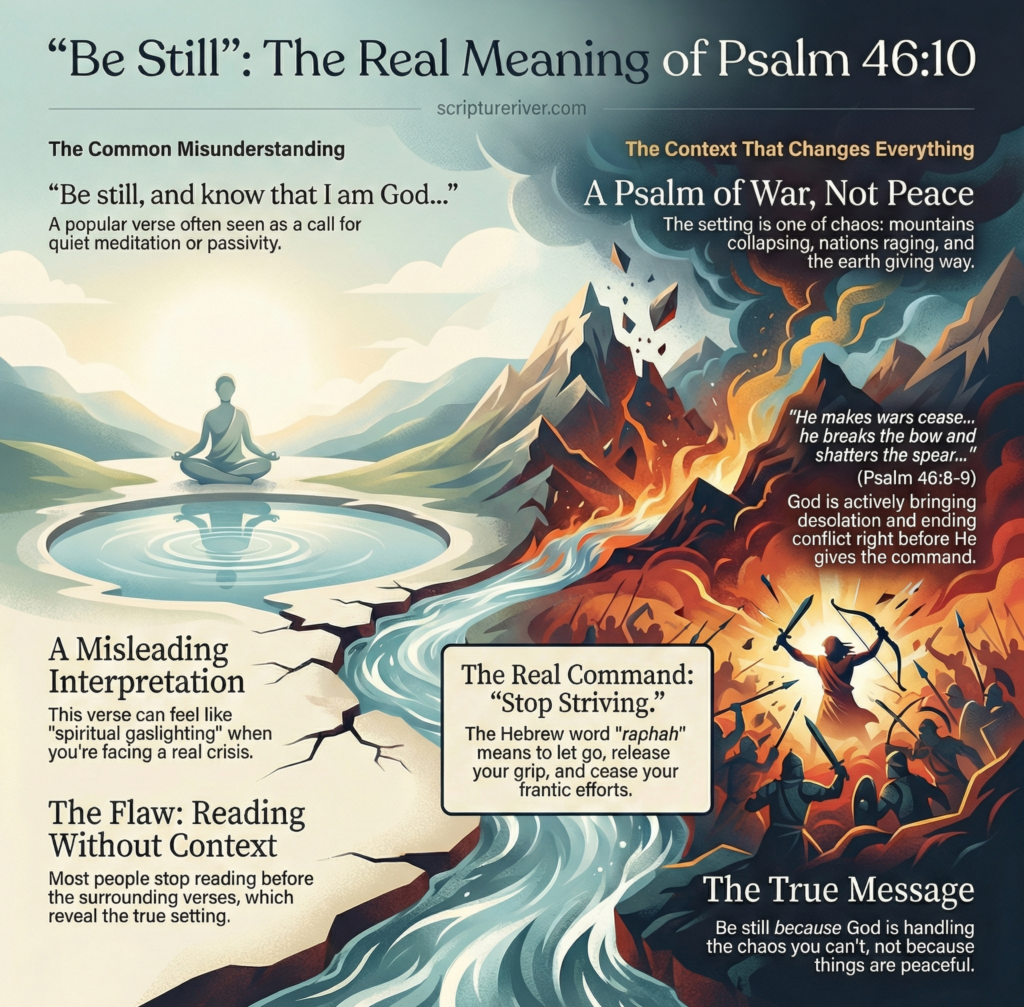
Psalm 46 isn’t a peaceful devotional about quiet time with God.
It’s a psalm about war, destruction, and chaos. Mountains collapsing. Waters roaring. Nations raging. Earth giving way.
Look at the verses immediately before verse 10:
Psalm 46:8-9, English Standard Version (ESV)
“Come, behold the works of the Lord, how he has brought desolations on the earth. He makes wars cease to the end of the earth; he breaks the bow and shatters the spear; he burns the chariots with fire.”
God is making wars cease. He’s breaking weapons. He’s bringing desolations.
Into this context of catastrophic conflict, God commands: “Be still.”
Not because everything’s peaceful. Because He’s handling what you can’t.
What “Be Still” Actually Means in Hebrew
The Hebrew phrase “raphah” translated “be still” doesn’t mean sit quietly and meditate.
According to Old Testament Hebrew scholar Willem VanGemeren’s research in the Psalms commentary, “raphah” means to let go, to release, to stop striving, to cease your efforts.
It’s the same word used in Exodus 4:26 when God “let Moses alone” after Zipporah circumcised their son.
God ceased His action against Moses.
In Judges 8:3, the word describes how Gideon’s words calmed the anger of the Ephraimites.
Their rage ceased.
In 2 Chronicles 15:7, the word means “do not let your hands be weak.”
The opposite of raphah is continuing to work.
Raphah means stop working, release your grip, cease your efforts.
So when God commands “Be still” in Psalm 46:10, He’s not saying “be quiet and meditate.”
He’s saying “Stop. Let go. Quit trying to fix this. Cease your frantic striving.”
What “Know That I Am God” Actually Requires

The second half of the command matters just as much.
“Know that I am God.”
The Hebrew word “yada” for know means intimate, experiential knowledge.
Not just intellectual agreement that God exists, but deep, personal understanding of who He is.
This isn’t abstract theology. It’s recognizing God’s character in the specific situation making you want to take control.
He’s God when your finances are collapsing.
He’s God when your relationships are falling apart.
He’s God when your health is failing.
He’s God when nations rage and mountains shake.
Knowing He’s God means trusting His character enough to stop trying to be God yourself.
The Personal Crisis That Taught Me This
Let me tell you about the situation that forced me to understand what “be still” actually means.
A relationship I cared about deeply was unraveling.
Every conversation made things worse.
I tried fixing it through better communication, changed behavior, giving space, not giving space. Nothing worked.
I obsessed. Replayed conversations endlessly. Drafted texts I never sent. Made plans for what I’d say next time. Lost sleep strategizing how to repair what was breaking.
One morning during prayer, exhausted from trying to control the situation, I sensed God saying: “Be still.”
I argued. “But I have to do something. I can’t just sit here while this falls apart.”
God repeated: “Be still. Know that I am God.”
It finally hit me.
All my striving wasn’t helping. It was making things worse.
I was trying to be God over this situation, to control outcomes I had no power to control.
So I stopped. Not because I figured it out spiritually. Because I physically couldn’t keep trying anymore.
I released the relationship into God’s hands. I stopped texting, stopped planning conversations, stopped strategizing how to fix it.
And something shifted. Not the situation immediately. But me. The obsession loosened. The anxiety decreased. I could breathe again.
God didn’t fix the relationship the way I wanted. But He met me in the surrender. And that was enough.
What Being Still Actually Looks Like Practically
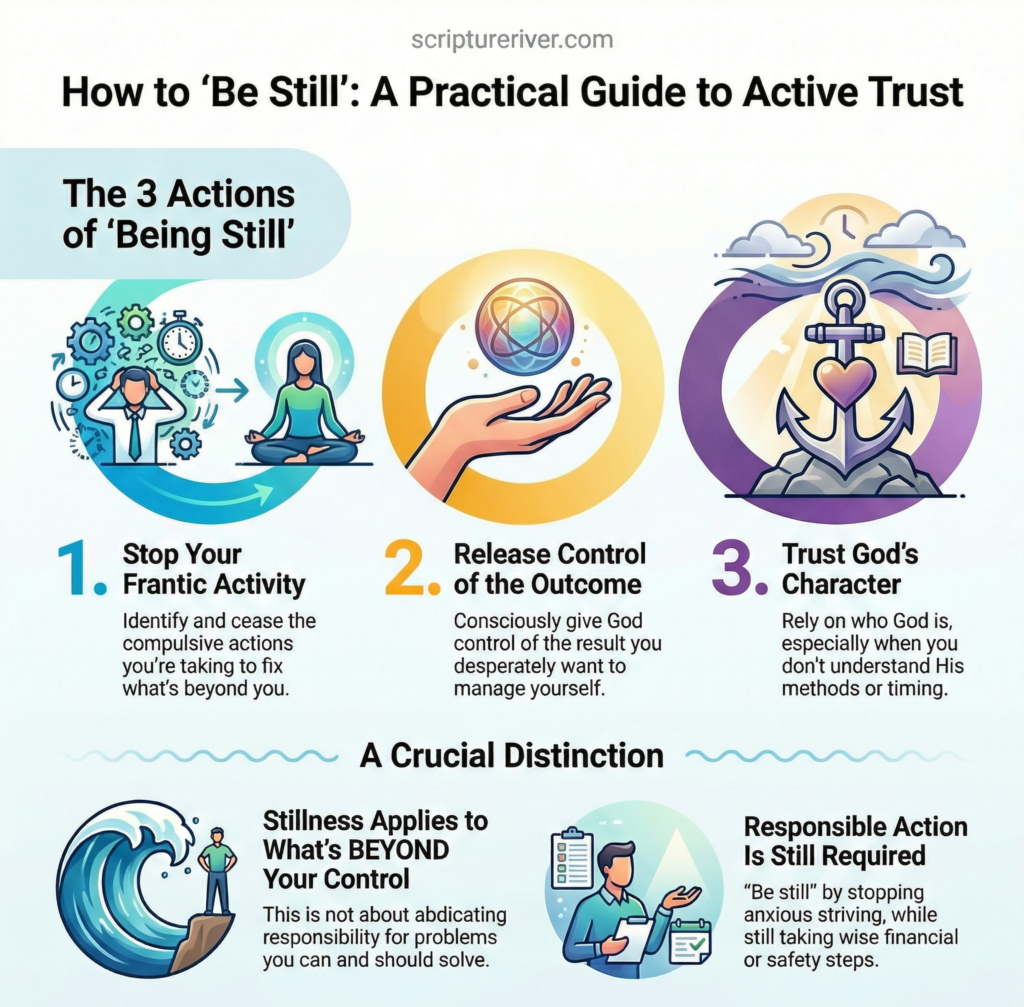
“Be still” isn’t passive resignation. It’s active trust that looks like specific behaviors.
Stop Your Frantic Activity
Being still means identifying the frantic, compulsive actions you’re taking to try to control outcomes.
For me, that was constant texting, obsessive planning, and mentally rehearsing conversations. For you, it might be different.
What are you doing frantically trying to fix what only God can fix? Stop doing that.
Release Control of the Outcome
This is the hardest part. You have to consciously give God control of the outcome you desperately want to control yourself.
Not just pray about it while still trying to manipulate the situation. Actually release it.
I physically opened my hands and said out loud: “God, I’m giving You control of this relationship. I can’t fix it. It’s Yours.”
Physical action helps your brain process spiritual surrender.
Trust God’s Character, Not Your Understanding
Proverbs 3:5-6 connects directly to Psalm 46:10: “Trust in the Lord with all your heart and lean not on your own understanding.”
Being still requires trusting God’s character when you don’t understand His methods or timing.
He’s good when outcomes aren’t what you want. He’s in control when everything feels out of control. He’s God when circumstances suggest He’s absent.
That’s what “know that I am God” requires.
Act Responsibly Within Your Control
Disclaimer: “Be still” doesn’t mean abdicating all responsibility or ignoring problems you can actually solve.
If you’re in an abusive relationship, being still doesn’t mean staying and doing nothing.
It means ceasing your attempts to change your abuser while taking responsible action to protect yourself.
If you have financial problems, being still doesn’t mean not working or budgeting.
It means stopping anxious striving while taking wise financial steps.
Being still addresses what’s beyond your control. Responsible stewardship addresses what’s within your control. Both are necessary.
What This Verse Doesn’t Mean
Let’s clear up common misinterpretations that make Psalm 46:10 harmful instead of helpful.
It doesn’t mean “be quiet and stop bothering God.” God invites honest prayer, including lament and complaint. Being still isn’t about silencing your voice to God.
It doesn’t mean “do nothing about real problems.” Being still addresses problems beyond your control. You’re still responsible for problems within your control.
It doesn’t mean “never take action.” Sometimes after being still and seeking God’s guidance, He directs you to act. Being still prepares you for right action, not permanent passivity.
It doesn’t guarantee the outcome you want. Being still doesn’t manipulate God into giving you what you demand. It surrenders to whatever outcome He determines is best.
Why This Is So Difficult for Us
Being still contradicts everything our culture teaches about problem-solving.
We’re taught to take charge. Make things happen. Never give up. Control your destiny.
All of that is antithetical to “be still and know that I am God.”
Being still requires admitting you’re not God. You can’t fix everything. Some situations are beyond your control. And that’s terrifying.
We’d rather keep striving, even when our striving makes things worse, than surrender control to God.
But that’s exactly what God commands. Stop striving. Let go. Trust Me.
When Being Still Becomes Worship
Here’s what I’ve learned through forced practice of being still.
When you stop trying to be God and let God actually be God, surrender becomes worship.
Every time you release control, you’re declaring God’s sovereignty.
Every time you stop striving, you’re trusting His sufficiency.
Every time you cease your frantic efforts, you’re acknowledging He’s God and you’re not.
That’s worship in its purest form.
Not singing songs. Not raising hands.
Surrendering control of situations you desperately want to control because you trust God’s character more than your understanding.
The Promise Hidden in the Command
Psalm 46:10 ends with God’s promise: “I will be exalted among the nations, I will be exalted in the earth.”
God will be exalted. His purposes will succeed. His glory will be revealed.
Your striving doesn’t accomplish God’s purposes.
Your frantic control attempts don’t establish His kingdom. Your anxious efforts don’t exalt Him.
He will be exalted whether you’re still or not.
But when you’re still, you get to experience His exaltation as peace instead of exhaustion.
Prayer for Surrendered Control
Father, I’m striving. Frantically trying to control what only You can control. I’m exhausted from trying to be God over my circumstances.
So right now, I’m choosing to be still. I’m releasing control of this situation I’ve been gripping so tightly. I know You are God even when I don’t understand what You’re doing.
I trust Your character more than my understanding. Help me stop my frantic efforts and rest in Your sovereignty. You will be exalted.
Your purposes will succeed. I don’t need to make it happen through anxious striving. Teach me what it means to be still and know that You are God.
In Jesus’s Name, Amen.
References
Peterson, E. H. (2005). The Message: The Bible in Contemporary Language. NavPress. [Bible Translation]
Strong, J. (2010). Strong’s Exhaustive Concordance of the Bible. Hendrickson Publishers. [Reference Book]
VanGemeren, W. A. (2008). Psalms. In T. Longman III & D. E. Garland (Eds.), The Expositor’s Bible Commentary: Psalms (Revised Edition). Zondervan. [Book]

