


Your heart’s racing. Your palms are sweating.
That presentation is in two hours, and you’ve rehearsed a hundred times, but the nervousness won’t stop.
Or maybe it’s not a presentation.
Maybe it’s a difficult conversation you need to have. A medical test result you’re waiting for. A decision that could change everything.
And the nervous energy coursing through your body feels impossible to control.
I’ve been there more times than I can count.
Despite years in ministry, I still get nervous before speaking to a large audience.
My stomach tightens, my thoughts scatter, and I wonder if I’ll even be able to speak coherently when I climb to that stage.
Here’s what I’ve learned: nervousness isn’t a sign of weak faith. It’s a sign you’re human.
But Scripture offers something more powerful than just white-knuckling your way through anxious moments.
It offers the actual truth that can reshape how your nervous system responds to stress.
Audio Overview
If you don’t have the time to read through this guide, I added an audio overview of this post that addresses nervousness and how believers can handle it.
You can listen while getting ready for that stressful event, during your anxious commute, or whenever sitting still feels impossible.
Understanding Nervousness Through a Biblical Lens
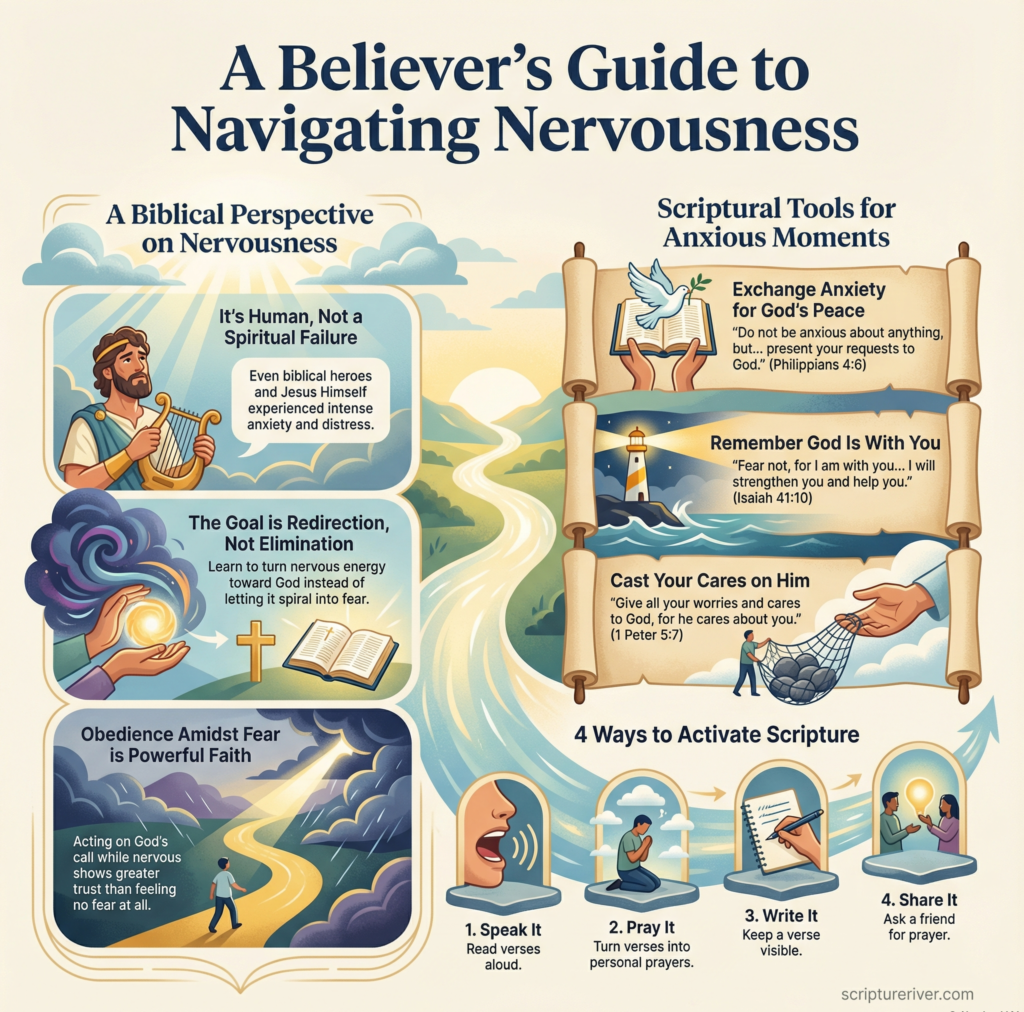
Many believers feel ashamed of their nervousness, as if anxiety is evidence of spiritual failure.
I’ve counseled hundreds of Christians who beat themselves up for feeling nervous, convinced that “perfect love casts out fear” means they should never experience anxious moments.
That’s not what Scripture teaches.
The Bible distinguishes between chronic, debilitating anxiety that reflects misplaced trust and normal human nervousness in response to genuine challenges.
Paul told the Philippians not to be anxious about anything, yet he also described his own deep concern for the churches and his nervousness about how they’d receive difficult messages.
Jesus told His disciples not to worry about what to say when brought before authorities, yet He Himself experienced such intense stress in Gethsemane that He sweat drops of blood.
That’s a medical condition called hematidrosis, caused by extreme anxiety.
The nervousness Scripture addresses isn’t the adrenaline response your body produces when facing real challenges.
It’s the spiral of worry that happens when we try to control outcomes only God can control or when we forget who’s actually in charge of our circumstances.
I learned this distinction during a season when I struggled with panic attacks before speaking engagements.
A wise mentor told me, “Your body’s nervous response isn’t sin.
What you do with that nervousness determines whether it drives you toward God or away from Him.”
That changed everything.
These verses aren’t about eliminating all nervous feelings. They’re about redirecting nervous energy toward trust instead of spiraling fear.
11 Bible Verses to Combat Nervousness

1. Philippians 4:6-7 – New International Version (NIV)
“Do not be anxious about anything, but in every situation, by prayer and petition, with thanksgiving, present your requests to God. And the peace of God, which transcends all understanding, will guard your hearts and your minds in Christ Jesus.”
Paul wrote this from prison, not from a comfortable study.
He was chained to Roman guards, uncertain whether he’d be executed or released. Yet he instructed believers not to be anxious about anything.
The Greek word “merimnao” for “be anxious” means to be drawn in different directions, to be distracted with cares.
It’s the mental fragmentation that happens when nervousness takes over.
Paul’s solution isn’t positive thinking.
It’s a specific action: pray about everything, thank God in everything, and present specific requests.
The result is peace that “guards” your heart and mind. The word “phroureo” means to protect by military guard.
God’s peace literally stations itself around your thoughts and emotions like a soldier protecting a fortress.
That’s not eliminating nervous feelings. That’s supernatural protection in the middle of them.
I’ve prayed this verse hundreds of times before nerve-wracking situations.
Sometimes the nervousness vanishes. More often, it stays but loses its power to control me. That’s the peace Paul promised.
2. Isaiah 41:10 – English Standard Version (ESV)
“Fear not, for I am with you; be not dismayed, for I am your God; I will strengthen you, I will help you, I will uphold you with my righteous right hand.”
God spoke this to Israel facing exile and terrifying uncertainty.
The command “fear not” appears over 300 times in Scripture.
God wouldn’t repeat it that often if nervousness wasn’t a normal human experience.
The Hebrew “chathath” for “dismayed” means to be shattered, broken down, or overwhelmed. It’s that feeling when nervousness becomes so intense that you feel like you’re falling apart.
Notice God doesn’t just command you to stop being nervous.
He gives you four specific reasons why you don’t have to be: His presence, His identity as your God, His strengthening power, and His upholding support.
The phrase “righteous right hand” emphasizes that God’s help is both powerful and perfectly good. He won’t fail you or lead you wrong.
When I’m nervous about a counseling session with someone in crisis, I repeat this verse. It reminds me I’m not walking into that room alone.
God is with me, and His strength is available even when I feel inadequate.
3. 1 Peter 5:7 – New Living Translation (NLT)
“Give all your worries and cares to God, for he cares about you.”
Peter wrote this to believers facing persecution. They had real reasons to be nervous.
Their faith could cost them jobs, relationships, even lives.
The Greek “epirripto” for “give” means to cast upon or throw upon. It’s an active, forceful movement.
You don’t politely hand your nervousness to God. You throw it on Him like you’re hurling a heavy burden off your back.
Why can you do this? Because He cares.
The word “melo” means it matters to Him, He’s concerned about you. Your nervousness isn’t an inconvenience to God. It genuinely matters to Him.
I had a woman in my congregation who was terrified of her upcoming surgery.
She kept apologizing for being nervous, as if God was annoyed by her fear.
When we studied this verse together, she wept. “He actually cares that I’m scared?” she asked. Yes. He does.
4. Matthew 6:34 – Christian Standard Bible (CSB)
“Therefore don’t worry about tomorrow, because tomorrow will worry about itself. Each day has enough trouble of its own.”
Jesus preached this during the Sermon on the Mount, addressing people with genuine survival concerns. They worried about food, clothing, and basic needs.
His instruction seems almost humorous: don’t worry about tomorrow because tomorrow will have its own worries.
He’s acknowledging that challenges will come. But He’s also pointing out the futility of experiencing tomorrow’s nervousness today.
Most nervousness is about future events.
The presentation next week. The conversation that hasn’t happened yet. The outcome you can’t predict.
Jesus says that’s borrowing trouble from the future, and it doesn’t help.
I struggle with this constantly.
I’ll get nervous about something happening on Friday, and it’s only Monday.
I’m essentially living Friday’s challenge four times instead of once. Jesus calls me back to today, this moment, this hour.
5. Psalm 56:3-4 – New American Standard Bible (NASB)
“When I am afraid, I will put my trust in You. In God, whose word I praise, In God I have put my trust; I will not be afraid. What can mere man do to me?”
David wrote this when the Philistines seized him in Gath.
He was literally captured by enemies who wanted him dead. His nervousness wasn’t irrational. It was completely justified.
But notice he doesn’t say, “I will never be afraid.” He says, “When I am afraid.” He acknowledges fear as real, then describes what he does with it: transfers it into trust.
The Hebrew “batach” for trust means to be confident, sure, secure.
It’s not a feeling. It’s a choice to place confidence in God’s character and promises even while nervous feelings persist.
David’s rhetorical question “What can mere man do to me?” isn’t bravado. It’s perspective.
The worst humans can do is temporary. God’s power and promises are eternal.
When I’m nervous about criticism or opposition, this verse grounds me. People’s opinions, even people’s actions, are limited in their power over me. God’s care is unlimited.
6. 2 Timothy 1:7 – King James Version (KJV)
“For God hath not given us the spirit of fear; but of power, and of love, and of a sound mind.”
Paul wrote this to Timothy, his younger protégé, who apparently struggled with timidity.
Timothy was nervous about the opposition he faced as a young leader.
The word “deilia” for fear means cowardice or timidity. It’s not the respectful fear of God but the paralyzing nervousness that stops you from doing what God calls you to do.
God gave you the opposite: power, love, and a sound mind. The Greek “sophronismos” for sound mind means self-control, discipline of thought. It’s the mental clarity that nervousness tries to steal.
This verse has become my battle cry before difficult ministry situations.
When nervousness makes me want to avoid hard conversations or shrink from necessary confrontations, I remember: God didn’t give me that spirit.
He gave me power, love, and clear thinking.
7. Proverbs 3:5-6 – The Message (MSG)
“Trust God from the bottom of your heart; don’t try to figure out everything on your own. Listen for God’s voice in everything you do, everywhere you go; he’s the one who will keep you on track.”
Solomon wrote this as wisdom for navigating life’s uncertainties.
The nervousness many of us feel comes from trying to figure everything out ourselves, needing to predict and control every outcome.
The Hebrew “sha’an” for lean means to support oneself, to rely upon.
It’s what you do when you’re too weak to stand alone. You lean your full weight on something stronger.
When you acknowledge God in all your ways, you’re inviting His guidance into every decision and situation that’s making you nervous.
The promise is that He’ll direct your paths, even when you can’t see where they’re leading.
I’ve had to learn this through repeated failure.
Every time I’ve tried to figure everything out myself, nervousness has consumed me.
Every time I’ve genuinely leaned on God’s wisdom instead of my own understanding, peace has followed.
8. Psalm 94:19 – New International Version (NIV)
“When anxiety was great within me, your consolation brought me joy.”
The psalmist is refreshingly honest here. Anxiety was great, not small or manageable. It was overwhelming.
The Hebrew “sar’aph” for anxiety means disquieting thoughts, worries that multiply.
But God’s consolation brought joy.
The word “ta’anuwg” for consolation means comfort, delight, pleasure. It’s not just the absence of anxiety but the presence of genuine joy alongside it or even through it.
This verse permits me to be honest about how nervous I feel.
I don’t have to minimize it or pretend it’s not happening.
I can say, “God, anxiety is great within me right now,” and then experience His comfort that brings unexpected joy.
9. John 14:27 – English Standard Version (ESV)
“Peace I leave with you; my peace I give to you. Not as the world gives do I give to you. Let not your hearts be troubled, neither let them be afraid.”
Jesus spoke this in the upper room the night before His crucifixion. His disciples were about to experience the most traumatic events of their lives, and Jesus knew it.
He didn’t promise to remove the traumatic circumstances.
He promised to give them His peace in the middle of those circumstances.
The peace the world gives is circumstantial, dependent on everything going well. Jesus’s peace transcends circumstances.
The word “tarasso” for troubled means to stir up, to agitate. It’s the churning, unsettled feeling nervousness produces.
Jesus commands it to stop, not through willpower but through receiving His supernatural peace.
10. Psalm 34:4 – New Living Translation (NLT)
“I prayed to the Lord, and he answered me. He freed me from all my fears.”
David testified to answered prayer. He prayed specifically about his fears, and God freed him. The Hebrew “natsal” for freed means to snatch away, to deliver, to rescue.
This isn’t a one-time prayer formula. It’s a pattern David discovered: pray about what’s making you nervous, and God responds.
Sometimes He removes the threat. Sometimes He removes the fear while the threat remains. Either way, He delivers.
I’ve experienced both. Sometimes God has changed circumstances that were making me nervous.
More often, He’s changed my internal response to those circumstances, which is actually more powerful.
11. Romans 8:15 – Amplified Bible (AMP)
“For you have not received a spirit of slavery leading again to fear [of God’s judgment], but you have received the Spirit of adoption as sons [the Spirit producing sonship] by which we [joyfully] cry, “Abba! Father!”
Paul contrasts two spirits: slavery that produces fear and adoption that produces confident intimacy with God. The Greek “phobos” for fear here means terror, dread, that which strikes fear.
As God’s adopted children, we don’t approach Him nervously, wondering if He’ll reject us.
We approach Him as beloved children calling Him “Abba,” the Aramaic equivalent of “Daddy.”
This verse addresses the nervousness many believers feel about God Himself.
Are you good enough? Is He pleased with you? Will He help you or reject you?
The Spirit of adoption answers: you’re His child, fully accepted, completely loved.
How to Actually Use These Verses When You’re Nervous Right Now
Knowing these verses intellectually doesn’t automatically calm your nervous system.
Let me share what I’ve learned about practically applying Scripture when nervousness hits.
1. Speak the Verses Out Loud
There’s neurological power in speaking truth audibly when you’re nervous. Your brain processes spoken words differently from thoughts.
When I’m nervous before preaching, I go somewhere private and read these verses out loud. Not quickly or mechanically, but slowly, letting each phrase penetrate.
Sometimes I’ll read the same verse five or six times, emphasizing different words each time. “God has not given us a spirit of fear.” “God has NOT given us a spirit of fear.” “God has not given US a spirit of fear.”
Your ears hearing biblical truth spoken in your own voice creates a feedback loop that begins reprogramming anxious thought patterns.
2. Pray the Verses Back to God
Turn these verses into personalized prayers. Instead of just reading Philippians 4:6-7, pray it:
“Father, You told me not to be anxious about anything. I’m anxious about this meeting this afternoon. I’m bringing it to You with thanksgiving that You’re in control. I’m asking specifically that You give me clarity and calm. Guard my heart and mind with Your peace.”
This transforms Scripture from information into conversation. You’re not just learning doctrine. You’re engaging with the God who gave the promise.
3. Write Out the Verse That Speaks Most to Your Situation
I keep index cards in my car, office, and home.
When nervousness hits about a specific situation, I write out the most relevant verse and put it where I’ll see it repeatedly.
Before a difficult counseling session, I’ll write Isaiah 41:10 and tape it to my desk. Before a challenging conversation, I’ll write 2 Timothy 1:7 and put it in my pocket.
Physical interaction with Scripture engages your brain differently than just reading digitally. Writing it out forces you to slow down and process each word.
4. Share the Verse with Someone You Trust
Nervousness often isolates us. We hide our anxiety, afraid people will judge us for not having stronger faith.
When I’m nervous about something, I text a trusted friend and say, “I’m really nervous about this situation. I’m holding onto Philippians 4:6-7. Would you pray that for me today?”
Speaking your nervousness out loud to someone safe and attaching it to Scripture does two things: it breaks isolation’s power, and it invites someone else to stand in faith with you when yours feels weak.
The Truth About Nervousness That Changed My Ministry
After fifteen years of pastoral work, here’s what I know about nervousness that I wish someone had told me earlier.
Nervousness isn’t the opposite of faith. Obedience in the face of nervousness is actually stronger faith than feeling no nervousness at all.
Think about it.
When you’re not nervous, doing hard things is easy.
But when you’re terrified and do it anyway because God called you to, that’s remarkable faith.
Abraham was probably nervous when God called him to leave everything familiar.
Moses was definitely nervous when God sent him to Pharaoh.
Esther was understandably nervous when she approached the king uninvited.
Their nervousness didn’t disqualify them. Their obedience despite nervousness revealed their faith.
I used to think mature Christians didn’t get nervous.
Now I realize mature Christians have simply learned what to do with their nervousness.
They’ve learned to redirect it toward God instead of letting it redirect them away from obedience.
The verses we’ve explored aren’t magical formulas that eliminate nervous feelings.
They’re tools that help you process those feelings through the lens of God’s character, promises, and presence.
Some days you’ll read these verses and feel immediate peace.
Other days, you’ll read them while still feeling nervous, but you’ll do what God called you to do anyway. Both are victories.
Our Thoughts on Navigating Nervousness Biblically
Nervousness is part of being human in a fallen world.
It’s not evidence of spiritual failure or weak faith. It’s your body and mind responding to genuine challenges and uncertainties.
What matters is what you do with that nervousness.
Do you let it spiral into paralyzing anxiety that keeps you from obeying God?
Or do you bring it to Him, filter it through Scripture, and move forward anyway?
I’ve been nervous about countless situations. Some turned out fine. Some turned out terribly. But I can testify that God’s presence and peace were available in all of them, not just the ones that ended well.
These eleven verses have sustained me through nervous breakdowns before speaking, anxious nights before difficult decisions, and terrifying moments when ministry felt impossible.
They didn’t always remove the nervousness, but they always provided something stronger: the truth about who God is, regardless of how I feel.
If you’re nervous about something right now, then you’re in good company.
Biblical heroes got nervous. Jesus Himself experienced anxiety.
The question isn’t whether you’ll feel nervous. The question is whether you’ll let God’s truth shape how you respond to those feelings.
Read these verses. Pray them. Speak them out loud.
Let them remind you that God is with you, He cares about you, and His peace is available even when your circumstances remain challenging.
You’re going to be okay. Not because everything will turn out perfectly, but because the God who holds you is perfectly trustworthy.
Prayer for Peace in Nervous Moments
Father, I come to You with all my nervousness laid bare. I’m not going to pretend I’m fine when I’m anxious. You already know how I feel anyway.
Thank You that my nervousness doesn’t disqualify me from Your presence or Your help. Thank You that You care about what’s making me anxious, even if it seems small to others.
I’m choosing right now to cast all my anxiety on You because You care for me. I’m taking the nervousness I feel about specific situations and throwing it onto Your shoulders because they’re strong enough to carry it.
Give me Your peace that transcends understanding. Guard my heart and mind in Christ Jesus. When nervous thoughts try to spiral, bring me back to Your truth. When my body responds with anxious symptoms, calm my nervous system with Your presence.
Help me trust You from the bottom of my heart instead of trying to figure everything out on my own. Remind me that You haven’t given me a spirit of fear but of power, love, and a sound mind.
I choose to do what You’ve called me to do, even while feeling nervous. Give me courage to obey despite anxious feelings. Let my obedience in the face of nervousness be evidence of faith, not its absence.
Thank You that You’re with me in this. I’m not facing anything alone.
In Jesus’s Name, Amen.
References
Allender, D. B., & Longman, T. (1994). The Cry of the Soul: How Our Emotions Reveal Our Deepest Questions About God. NavPress.
Barker, K. L. (Ed.). (2011). NIV Study Bible. Zondervan.
Fee, G. D., & Stuart, D. (2014). How to Read the Bible for All Its Worth (4th ed.). Zondervan Academic.
Hart, A. D. (1999). The Anxiety Cure: A Proven Method for Dealing with Worry, Stress, and Panic Attacks. Thomas Nelson.
Köstenberger, A. J. (2013). A Theology of John’s Gospel and Letters. Zonderdale Academic.
Peterson, E. H. (2005). The Message: The Bible in Contemporary Language. NavPress.
Piper, J. (2013). When I Don’t Desire God: How to Fight for Joy. Crossway.
Strong, J. (2010). Strong’s Exhaustive Concordance of the Bible. Hendrickson Publishers.
Welch, E. T. (2004). Running Scared: Fear, Worry, and the God of Rest. New Harvest.
Wiersbe, W. W. (2007). The Bible Exposition Commentary. David C. Cook.
Wright, N. T. (2010). After You Believe: Why Christian Character Matters. HarperOne.

