


Prayer shouldn’t feel like a religious obligation you’re failing at.
Yet for most Christians, that’s exactly what it feels like.
You know you should pray more.
You’ve tried morning devotions, prayer journals, accountability partners, and every method you’ve heard recommended.
But your prayer life still feels dry, mechanical, and honestly disappointing.
I can tell you the problem isn’t your discipline or spirituality.
The problem is that most of us have never actually learned what the Bible teaches about prayer.
We’ve absorbed cultural Christianity’s version of prayer, which is heavy on performance and light on relationship.
We pray the way we think we should instead of the way Scripture actually invites us to.
These thirteen verses have completely transformed how I pray and how I teach others to pray.
They’re not tips for better prayer performance. They’re foundational truths that make prayer what God intended it to be.
Why Most Prayer Teaching Misses the Point
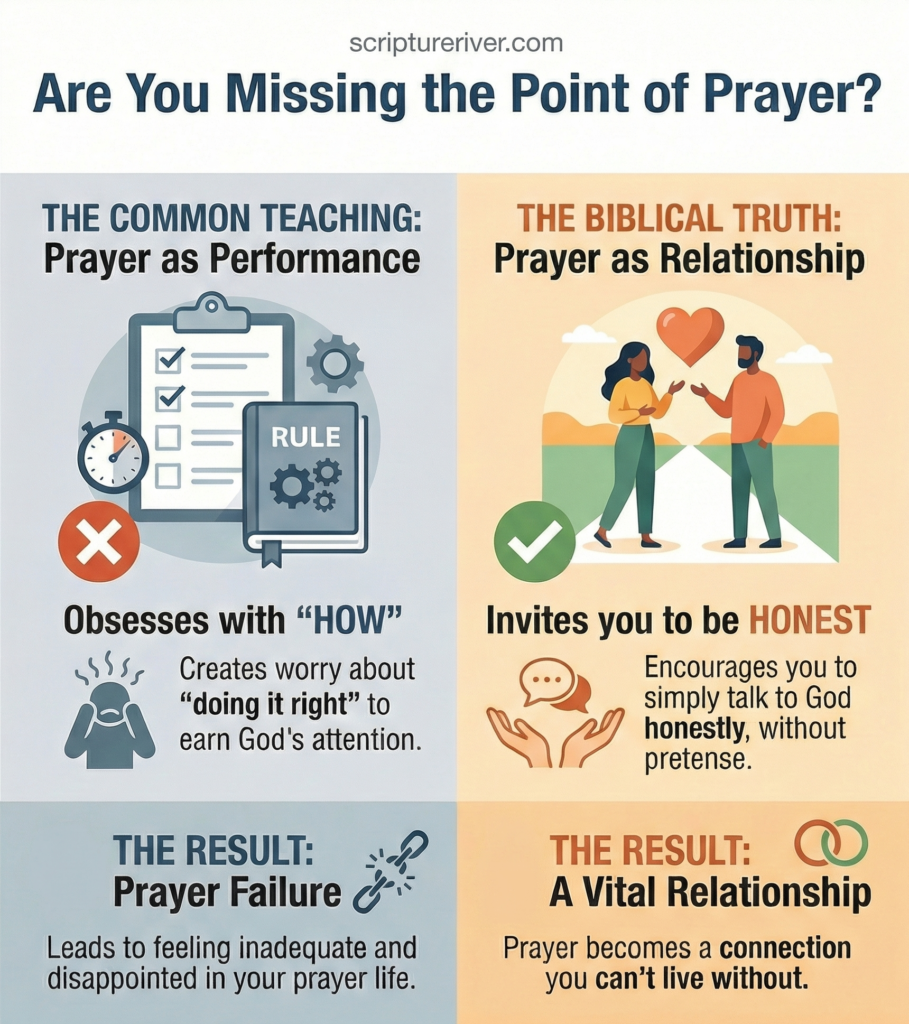
Let’s start with brutal honesty about why your prayer life probably feels inadequate.
You’ve been taught that effective prayer requires certain conditions.
The right posture. The right words. The right time of day. The right duration. The right level of faith. The right spiritual maturity.
And when your prayers don’t meet these supposed requirements, you feel like a prayer failure.
Here’s what I’ve discovered after years of studying Scripture and counseling believers about prayer.
Most prayer teaching focuses on technique when the Bible focuses on relationship.
We obsess over how to pray when Scripture emphasizes who we’re praying to.
We worry about doing it right when God invites us to simply talk to Him honestly.
The verses I’m sharing don’t offer formulas or techniques.
They reveal the heart of prayer as God designed it.
Intimate conversation with your father who loves you, hears you, and responds to you.
Not religious performance that earns His attention.
When you understand what these verses actually teach, prayer stops being a spiritual discipline you’re failing at and becomes a relationship you can’t live without.
The Foundational Bible Verses That Redefine Prayer

1. Matthew 6:6 – Where Real Prayer Happens
New International Version (NIV)
“But when you pray, go into your room, close the door and pray to your Father, who is unseen. Then your Father, who sees what is done in secret, will reward you.”
Jesus contrasts authentic prayer with religious performance.
The Pharisees prayed publicly to impress people. Jesus says effective prayer happens in private with the Father who sees what others don’t.
Notice He doesn’t say “if you pray” but “when you pray.” Prayer isn’t optional for believers. But it’s also not public showmanship.
Your prayer closet doesn’t have to be literal. It’s anywhere you get alone with God without audience or pretense.
I pray in my car before meetings. I pray walking through my neighborhood. I pray in the shower. The location matters less than the privacy and honesty.
What transformed my prayer life was realizing God rewards secret, sincere prayer more than impressive public prayers. That removed performance pressure entirely.
Application: Find your private place this week. It might be your bedroom, your car, a park bench. Go there daily and talk to God like He’s actually there and actually listening. Because He is.
2. Philippians 4:6-7 – What to Pray About
English Standard Version (ESV)
“Do not be anxious about anything, but in everything by prayer and supplication with thanksgiving let your requests be made known to God. And the peace of God, which surpasses all understanding, will guard your hearts and your minds in Christ Jesus.”
Paul gives clear instruction about prayer’s scope.
Don’t be anxious about anything. Pray about everything. Nothing is too small or too big for God’s attention.
The progression matters: prayer and supplication with thanksgiving. You bring requests, but you do it with grateful hearts remembering past faithfulness.
The promise is peace that guards your heart and mind. Not necessarily changed circumstances, but supernatural peace in unchanged circumstances.
I used to filter what I prayed about, thinking some concerns were too trivial for God. Philippians 4:6-7 destroyed that misconception.
Traffic stress. Kid tantrums. Work frustrations. Financial worries. Relationship tensions. God invites it all.
When I started praying about literally everything instead of just “spiritual” things, anxiety decreased and peace increased noticeably.
Application: For one week, pray about absolutely everything. Every worry, every decision, every frustration. Watch how anxiety transforms into peace as you practice bringing God into all of life, not just crisis moments.
3. 1 Thessalonians 5:16-18 – The Prayer Lifestyle
New Living Translation (NLT)
“Always be joyful. Never stop praying. Be thankful in all circumstances, for this is God’s will for you who belong to Christ Jesus.”
Paul describes prayer as continual, not occasional.
“Never stop praying” doesn’t mean never doing anything else. It means maintaining awareness of God’s presence throughout your day, talking to Him constantly.
Prayer becomes your default response to everything. Something good happens? Thank God. Something hard happens? Ask God for help. Facing a decision? Seek God’s wisdom.
This verse revolutionized prayer for me because it removed the pressure of scheduled prayer times.
I still have focused prayer times, but I also pray dozens of micro-prayers throughout the day. Brief conversations with God that keep me connected to His presence constantly.
Waiting in line? Pray. Stuck in traffic? Pray. Between meetings? Pray. Washing dishes? Pray.
Prayer stops being an isolated event and becomes ongoing relationship.
Application: Set hourly phone reminders that just say “Pray.” When they go off, wherever you are, acknowledge God’s presence and have a brief conversation. Watch how this builds continuous awareness of His presence.
4. James 5:16 – The Power of Honest Prayer
Christian Standard Bible (CSB)
“Therefore, confess your sins to one another and pray for one another, so that you may be healed. The prayer of a righteous person is very powerful in its effect.”
James reveals that powerful prayer flows from honest confession and communal intercession.
Notice the order: confess, then pray. Honesty precedes power.
When you hide sin and pretend you’re spiritually fine, your prayers lose effectiveness. When you confess struggles honestly and invite others to pray with you, power is released.
I’ve watched this work repeatedly in ministry.
Believers struggling alone see little breakthrough. Believers who confess struggles and invite prayer support experience dramatic transformation.
The phrase “prayer of a righteous person” doesn’t mean sinlessly perfect. It means someone in right relationship with God through honest confession and authentic faith.
Application: Identify one trusted believer this week. Share a struggle you’ve been hiding and ask them to pray with you about it. Experience the power of honest, communal prayer versus isolated secret-keeping.
5. John 15:7 – Prayer Aligned with God’s Word
New King James Version (NKJV)
“If you abide in Me, and My words abide in you, you will ask what you desire, and it shall be done for you.”
Jesus connects effective prayer to abiding relationship and Scripture saturation.
When you’re connected to Jesus and His words are shaping your thinking, your desires align with His will. Then asking for what you want becomes asking for what He wants.
This isn’t manipulating God through Scripture quotation. It’s transformation where your heart starts wanting what God wants because you’re saturated in His Word and connected to His heart.
Prayer becomes powerful when it flows from Scripture-shaped desires rather than self-centered wishes.
I started praying Scripture back to God years ago, and it transformed my prayer life. Reading a promise in the Bible and saying, “God, You said this. I’m asking for this in my life” grounds prayer in truth.
Application: Choose one biblical promise this week. Pray it back to God daily in your own words, asking Him to fulfill that promise in your specific situation. Watch how Scripture-saturated prayer focuses and strengthens your requests.
6. Matthew 7:7-8 – The Invitation to Ask Boldly
The Message (MSG)
“Don’t bargain with God. Be direct. Ask for what you need. This isn’t a cat-and-mouse, hide-and-seek game we’re in. If your child asks for bread, do you trick him with sawdust? If he asks for fish, do you scare him with a live snake on his plate? As bad as you are, you wouldn’t think of such a thing. You’re at least decent to your own children. So don’t you think the God who conceived you in love will be even better?”
Jesus invites bold, direct asking without religious games.
Ask. Seek. Knock. All active verbs requiring initiative and persistence.
God isn’t offended by bold requests. He’s your Father who loves giving good gifts to His children.
Many believers pray timidly, almost apologizing for bothering God. Jesus says the opposite: ask directly for what you need.
I used to hedge my prayers with qualifiers: “If it’s Your will…” or “If You think it’s best…” While those can be appropriate, they often masked lack of faith.
Jesus invites confident asking based on God’s character as a good Father.
Application: This week, pray one bold, specific request without hedging or apologizing. Ask directly for something you need, trusting that God is a good Father who loves giving good gifts to His children.
7. Romans 8:26-27 – When You Don’t Know How to Pray
New International Version (NIV)
“In the same way, the Spirit helps us in our weakness. We do not know what we ought to pray for, but the Spirit himself intercedes for us through wordless groans. And he who searches our hearts knows the mind of the Spirit, because the Spirit intercedes for God’s people in accordance with the will of God.”
Paul addresses what to do when you literally don’t know what to pray.
The Holy Spirit intercedes for you when words fail. Your inability to articulate prayer doesn’t stop God from hearing your heart.
Sometimes situations are too complex, emotions too overwhelming, or confusion too deep for coherent prayer. In those moments, the Spirit translates your groans into prayers God understands.
This verse brought tremendous relief during my darkest season when I couldn’t form prayers beyond “God, help.”
I thought my inability to pray eloquently meant God wasn’t hearing me. Romans 8:26-27 taught me the Spirit was interceding for me when I couldn’t intercede for myself.
Application: Next time you face a situation where you genuinely don’t know what to pray, simply be honest with God about that. Tell Him you don’t have words, then trust the Spirit to intercede on your behalf. Silent presence with God counts as prayer.
8. 1 John 5:14-15 – Confidence in God’s Hearing
English Standard Version (ESV)
“And this is the confidence that we have toward him, that if we ask anything according to his will he hears us. And if we know that he hears us in whatever we ask, we know that we have the requests that we have asked of him.”
John establishes the foundation for confident prayer: God hears and responds.
The condition is praying according to His will. But here’s what many miss: God’s will isn’t mysterious or unknowable. Scripture reveals it clearly in many areas.
God’s will is your sanctification. Your spiritual growth. Your conformity to Christ’s image. Your love for others. Your faith development.
When you pray for things aligned with Scripture’s clear teaching about God’s will, you can pray with absolute confidence He hears and will answer.
This changed how I pray by giving me categories of confident prayer versus uncertain prayer.
Healing? Uncertain outcome, but confident God hears. Character transformation? Certain outcome, absolutely confident God will answer.
Application: Make two prayer lists. First list: prayers aligned with clearly stated biblical will (spiritual growth, wisdom, love for others). Second list: prayers with uncertain outcomes (circumstances, people’s choices). Pray both, but notice the different confidence levels Scripture supports for each.
9. Ephesians 6:18 – Strategic Prayer in Spiritual Warfare
Christian Standard Bible (CSB)
“Pray at all times in the Spirit with every kind of prayer and petition. To this end, be alert with all perseverance and petition for all the saints.”
Paul connects prayer to spiritual warfare, revealing prayer’s strategic importance.
Prayer isn’t just personal devotion. It’s spiritual weaponry against forces opposing God’s kingdom.
“All times” means constant readiness. “Every kind of prayer” means varied approaches. “All perseverance” means not giving up. “All the saints” means communal focus, not just personal needs.
This verse expanded my prayer beyond my personal concerns to God’s broader kingdom purposes.
I started praying for other believers, for gospel advancement, for spiritual breakthrough in resistant areas. Prayer became strategic engagement in spiritual battle, not just personal maintenance.
Application: Add one element of spiritual warfare praying this week. Pray for one missionary, one church planter, one evangelist, or one believer facing spiritual opposition. Engage prayer as spiritual strategy, not just personal therapy.
10. Luke 18:1-8 – The Parable About Persistent Prayer
New Living Translation (NLT)
“One day Jesus told his disciples a story to show that they should always pray and never give up. ‘There was a judge in a certain city,’ he said, ‘who neither feared God nor cared about people. A widow of that city came to him repeatedly, saying, “Give me justice in this dispute with my enemy.” The judge ignored her for a while, but finally he said to himself, “I don’t fear God or care about people, but this woman is driving me crazy. I’m going to see that she gets justice, because she is wearing me out with her constant requests!”‘ Then the Lord said, ‘Learn a lesson from this unjust judge. Even he rendered a just decision in the end. So don’t you think God will surely give justice to his chosen people who cry out to him day and night? Will he keep putting them off?'”
Jesus teaches that persistence in prayer matters.
The judge was unjust and uncaring, yet responded to persistence. God is just and caring, so how much more will He respond to persistent prayer?
This doesn’t mean wearing God down until He relents. It means continued seeking demonstrates genuine faith and desire.
Many believers pray once about something and never mention it again. Jesus says keep praying, keep asking, keep seeking until you see breakthrough or clear answer.
I’ve practiced persistent prayer for specific concerns over months and years. Some prayers were answered dramatically. Others I’m still praying. But persistence itself has deepened my faith.
Application: Choose one long-term prayer concern. Commit to praying about it daily for the next month, not just once. Track your prayers in a journal and watch how persistence affects both the situation and your own faith.
11. Mark 11:24 – Prayer and Faith Connection
New American Standard Bible (NASB)
“Therefore I tell you, all things for which you pray and ask, believe that you have received them, and they will be granted to you.”
Jesus links prayer effectiveness to believing faith.
This isn’t positive thinking or mind-over-matter. It’s trusting God’s character enough to believe He hears and will respond according to His wisdom.
The faith isn’t in your prayer’s power but in God’s faithfulness. You believe you’ve received because you trust the Giver, not because you’ve mastered prayer technique.
This verse challenged my doubt-filled prayers where I asked but didn’t actually expect anything to happen.
True faith-filled prayer asks expecting God to respond, even if the response isn’t what you anticipated.
Application: Before praying this week, pause and ask yourself: “Do I actually believe God will respond to this prayer?” If not, pray first for faith to believe, then pray your request believing God hears and will answer according to His perfect will.
12. Hebrews 4:16 – Approaching God with Confidence
New International Version (NIV)
“Let us then approach God’s throne of grace with confidence, so that we may receive mercy and find grace to help us in our time of need.”
The writer of Hebrews invites bold approach to God’s throne.
Not timid, fearful, apologetic approach. Confident approach based on Jesus’s finished work, not your spiritual performance.
God’s throne is described as a throne of grace. You’re not approaching a judge waiting to condemn. You’re approaching a Father ready to extend mercy and grace.
This single verse demolished my timid, performance-based prayer.
I used to approach God like I was bothering Him, hoping He’d tolerate my presence. Hebrews 4:16 taught me I’m invited boldly to receive help in my time of need.
Application: Next time you pray, consciously remember you’re approaching a throne of grace, not judgment. Pray with the confidence of a beloved child approaching a loving father, not a servant hoping not to be punished.
13. Matthew 18:19-20 – The Power of Agreement in Prayer
The Passion Translation (TPT)
“Again, I give you an eternal truth: If two of you agree to ask God for something in a symphony of prayer, my heavenly Father will do it for you. For wherever two or three come together in honor of my name, I am right there with them!”
Jesus reveals special power when believers pray in agreement.
This isn’t just individual prayer multiplied by participants. There’s unique authority when believers unite their faith around common requests.
Corporate prayer taps into spiritual dynamics unavailable to solo prayer.
I’ve experienced breakthrough in ministry situations after gathering believers to pray in agreement that never came through individual prayer alone.
Agreement doesn’t mean identical words. It means unified hearts seeking the same thing from God.
Application: This week, invite one or two believers to pray with you about something specific. Experience the power of united, agreement-based prayer versus praying alone.
The Prayer Life These Verses Create
When you let these thirteen verses shape your prayer life instead of cultural Christianity’s version of prayer, everything changes.
Prayer stops being a religious duty you’re failing at.
It becomes honest conversation with your Father throughout the day.
Bold requests based on His character. Persistent seeking that demonstrates genuine faith. Scripture-saturated asking aligned with His will.
Corporate agreement that releases unique power.
You pray more because it’s relationship, not obligation.
You pray with confidence because you understand God’s invitation to approach His throne boldly.
You pray persistently because you trust His character even when answers delay.
This isn’t prayer perfection. It’s prayer transformation.
From performance to relationship. From technique to trust. From religious activity to intimate connection.
Practical Steps to Transform Your Prayer Life This Week
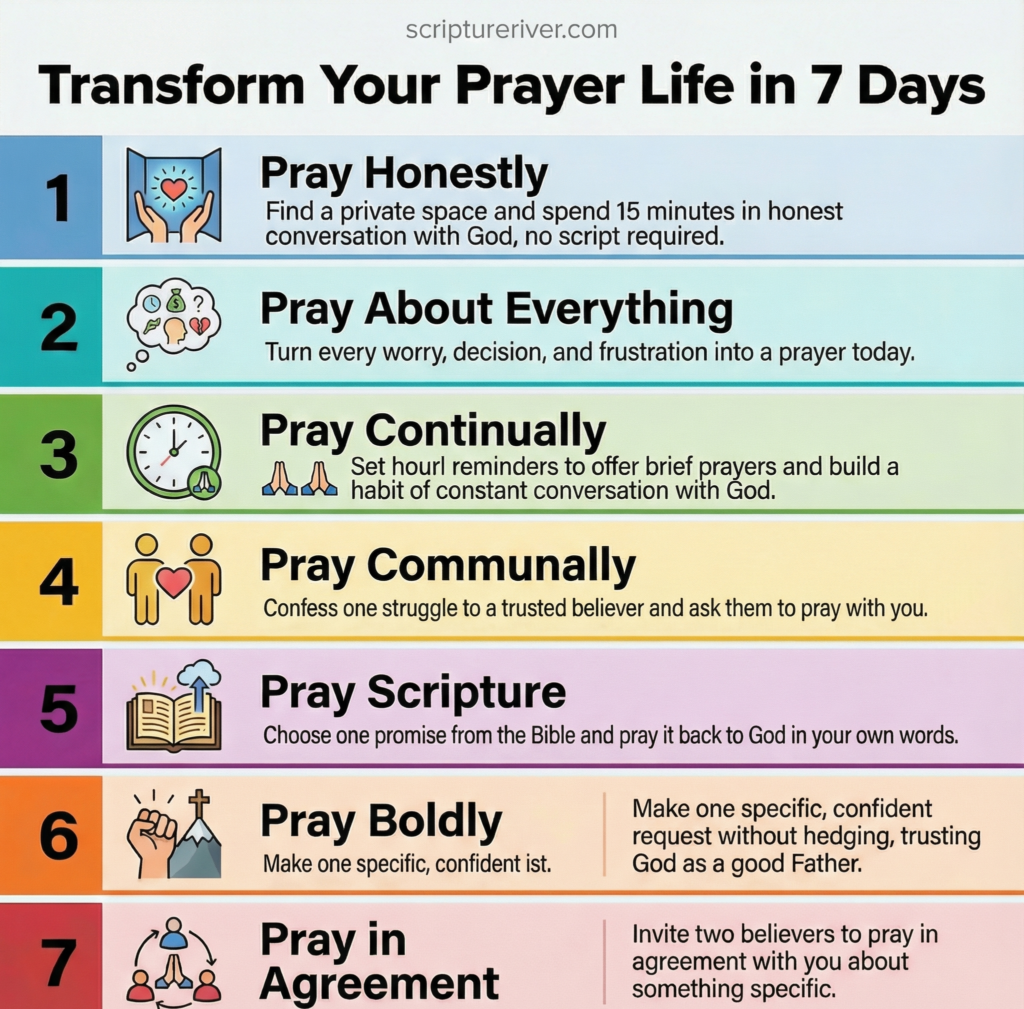
Don’t just read these verses and do nothing.
Apply them intentionally and watch your prayer life change.
Day 1: Find your private prayer space and spend 15 minutes in honest conversation with God. No script, no formula, just talking to Him like He’s actually there.
Day 2: Pray about everything that creates anxiety today. Every worry, every decision, every frustration. Practice Philippians 4:6-7 literally.
Day 3: Set hourly reminders to pray brief prayers throughout the day. Build the habit of continual prayer 1 Thessalonians 5:17 describes.
Day 4: Confess one struggle to a trusted believer and ask them to pray with you. Experience the power of honest, communal prayer.
Day 5: Choose one Scripture promise and pray it back to God in your own words. Practice Scripture-saturated prayer.
Day 6: Pray one bold, specific request without hedging. Ask confidently based on God’s character as a good Father.
Day 7: Invite two believers to pray in agreement with you about something specific. Experience corporate prayer power.
Seven days. Thirteen verses. Complete transformation of how you pray and experience God.
Our Closing Thoughts on Prayer
I’ve counseled hundreds of believers who felt like prayer failures.
They’d tried everything to fix their prayer lives and still felt like they weren’t doing it right.
The problem was never their effort or discipline.
The problem was building prayer on wrong foundations. Cultural Christianity’s performance-based version instead of Scripture’s relationship-centered reality.
These thirteen verses gave me back my prayer life after years of religious struggle. They’ve done the same for countless others.
Prayer isn’t complicated. It’s not about technique, posture, timing, or eloquence.
It’s about talking honestly to your Father who loves you, hears you, and responds to you.
Start there. Build on these verses. Watch everything change.
Prayer for Prayer Life Transformation
Father, I confess prayer has felt more like religious obligation than intimate relationship. I’ve been trying to pray the way I think I should instead of the way You’ve invited me to.
Thank You for these verses that reveal prayer as You designed it. Transform my prayer life from performance to relationship. Teach me to pray honestly, boldly, persistently, and confidently.
Help me bring You everything, not just spiritual concerns. Build in me the habit of continual conversation throughout my day. Give me faith to believe You actually hear and respond.
Connect me with other believers for agreement prayer. Most of all, let me experience prayer as intimate connection with You, not just religious duty. Make these verses alive in my practice, not just theology I know.
In Jesus’s Name, Amen.
References
Barker, K. L. (Ed.). (2011). NIV Study Bible. Zondervan.
Bounds, E. M. (1997). The Complete Works of E.M. Bounds on Prayer. Baker Books.
Carson, D. A. (2010). A Call to Spiritual Reformation: Priorities from Paul and His Prayers. Baker Academic.
Keller, T. (2014). Prayer: Experiencing Awe and Intimacy with God. Dutton.
Miller, P. E. (2009). A Praying Life: Connecting with God in a Distracting World. NavPress.
Morris, L. (1992). The Gospel According to Matthew. Eerdmans Publishing.
Murray, A. (2007). With Christ in the School of Prayer. Whitaker House.
Peterson, E. H. (2005). The Message: The Bible in Contemporary Language. NavPress.
Strong, J. (2010). Strong’s Exhaustive Concordance of the Bible. Hendrickson Publishers.
Wiersbe, W. W. (2007). The Bible Exposition Commentary. David C. Cook.

