

Life has a way of knocking us flat when we least expect it.
Maybe you’re reading this at 2 AM because anxiety won’t let you sleep.
Or perhaps you just got news that changed everything, and you’re searching for something to hold onto.
I’ve spent over fifteen years in pastoral ministry, and I can tell you this: the believers with the deepest faith aren’t the ones who’ve avoided hardship.
They’re the ones who’ve learned where to find strength when their own runs out.
In this post, we will discuss 15 powerful verses that have sustained countless Christians through impossibly dark seasons.
These aren’t just pretty words for Instagram posts. They’re battle-tested promises from a God who specializes in strengthening the weak.
We’ll explore what these passages meant in their original context, how they apply to your specific struggle today, and practical ways to let these truths reshape your perspective when everything feels like it’s falling apart.
Audio Overview
For those who prefer to listen, I’ve provided an audio overview of this post.
Press play below to hear a summary of the key insights we’ll be exploring about finding supernatural strength in your hardest moments.
What Scripture Actually Teaches About Strength: Beyond Positive Thinking
Before we get into specific verses, let’s clear up a massive misconception that’s caused unnecessary suffering for thousands of believers.
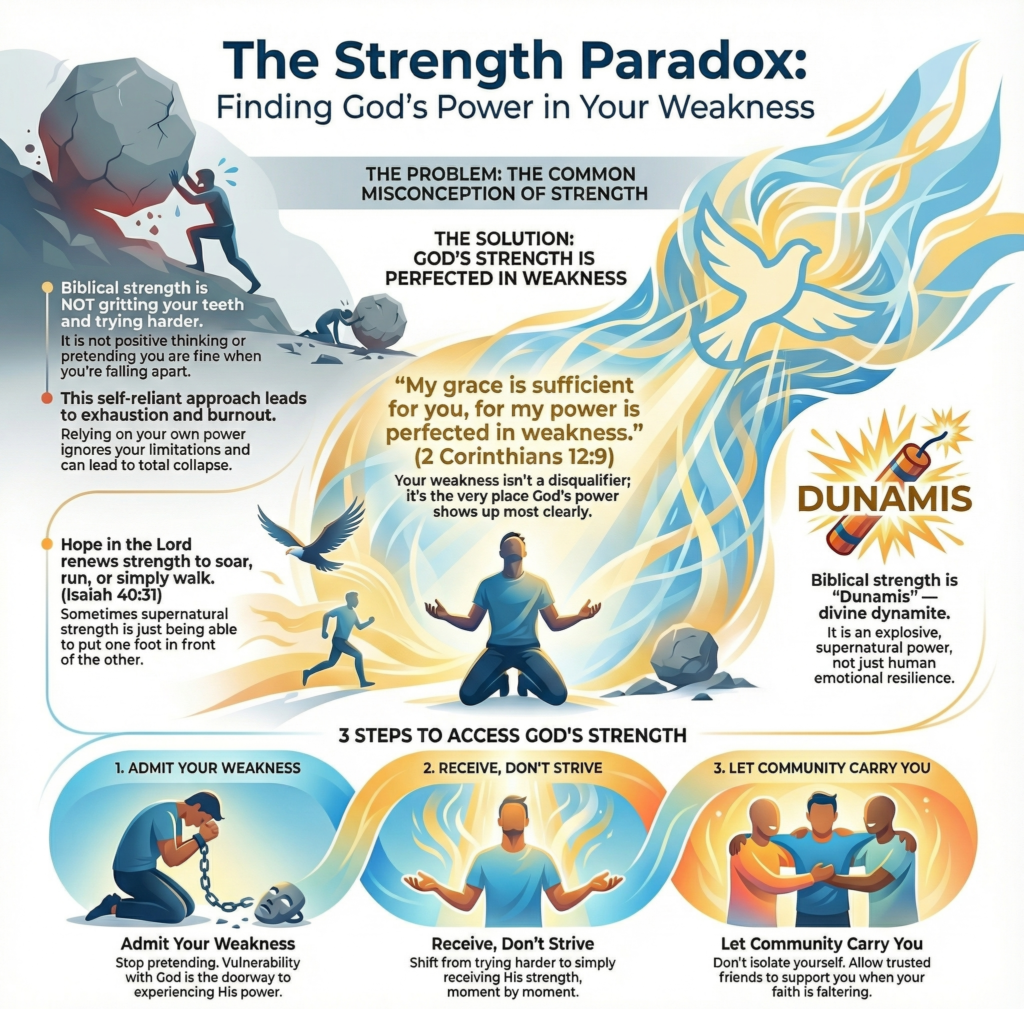
Biblical strength isn’t about gritting your teeth and pushing through.
It’s not about pretending you’re fine when you’re falling apart.
And it’s definitely not about generating positive thoughts until you feel better.
I learned this the hard way during my second year of ministry when I hit a wall so hard I couldn’t get out of bed for three days.
I’d been counseling hurting people while ignoring my own exhaustion.
I kept telling myself to be strong, to have more faith, to try harder.
Then I opened my Bible to 2 Corinthians 12:9 and everything shifted.
Paul wasn’t writing about manufactured strength or positive confession.
He was writing about weakness that becomes the exact place where God’s power shows up most clearly.
The Greek word for strength that appears throughout the New Testament is “dunamis.”
It’s where we get our word dynamite.
This isn’t willpower or emotional resilience. It’s explosive divine power that operates best when we’ve got nothing left.
Every single verse we’re about to explore comes back to this central truth: God’s strength becomes most accessible when ours is completely depleted.
Your weakness isn’t disqualifying you. It’s positioning you.
Powerful Bible Verses About Strength When You’re at Your Breaking Point

1. Isaiah 40:31 – New International Version (NIV)
“But those who hope in the Lord will renew their strength. They will soar on wings like eagles; they will run and not grow weary, they will walk and not be faint.”
Isaiah wrote this to Jewish exiles who’d lost everything. Their nation was destroyed, their temple demolished, their identity shattered.
The Hebrew word “qavah” translated as “hope” literally means to bind together by twisting, like making a rope.
This isn’t passive wishing. It’s actively intertwining your life with God’s, even when you can’t see the outcome.
Notice the progression: soaring, then running, then walking. Sometimes strength looks like flying above your circumstances.
Other times, it’s just putting one foot in front of the other without collapsing.
I’ve counseled dozens of believers who thought they were failing because they weren’t soaring.
But walking without fainting when you’re exhausted? That’s supernatural strength, too.
2. Philippians 4:13 – The Passion Translation (TPT)
“I find that the strength of Christ’s explosive power infuses me to conquer every difficulty.”
Paul wrote this from prison, not from a prosperity conference. The context matters tremendously here.
He’d just listed experiences of abundance and lack, honor and humiliation.
This verse isn’t a blank check for achieving whatever you want.
It’s a promise that Christ’s power enables you to endure whatever circumstances you face.
The Greek word “ischuo” means to have strength, to be strong in body or resources.
Paul discovered something revolutionary: Christ’s strength didn’t remove his difficulties but empowered him to face them victoriously.
When I was going through my own dark season, this verse stopped being a motivational slogan and became a lifeline.
I wasn’t asking God to make everything easy. I was asking Him to strengthen me for what was actually happening.
3. Psalm 46:1 – English Standard Version (ESV)
“God is our refuge and strength, a very present help in trouble.”
The Sons of Korah wrote this psalm, likely after Jerusalem was threatened by enemy armies.
The Hebrew word “machaceh” for refuge means a shelter or place of trust. It’s not just that God provides strength. He IS your strength.
Present help means right now, in this moment, not eventually when things calm down.
I’ve watched believers wait for God to show up after their crisis passes, not realizing He’s most present in the middle of it.
4. Nehemiah 8:10 – New Living Translation (NLT)
“Don’t be dejected and sad, for the joy of the Lord is your strength!”
Nehemiah said this to the Israelites who were weeping after hearing God’s Word read for the first time in years.
They were devastated by how far they’d fallen. But Nehemiah redirected them from self-focused sorrow to God-focused celebration.
The Hebrew “chedvah” for joy isn’t about feeling happy.
It’s about the gladness that comes from knowing who God is, regardless of circumstances.
That joy becomes “ma’owz,” your fortress and place of safety.
This completely revolutionized my understanding of strength. It’s not gritted-teeth endurance.
It’s the strange stability that comes from knowing God is good even when life isn’t.
5. 2 Corinthians 12:9-10 – Christian Standard Bible (CSB)
“But he said to me, ‘My grace is sufficient for you, for my power is perfected in weakness.’ Therefore, I will most gladly boast all the more about my weaknesses, so that Christ’s power may reside in me. So I take pleasure in weaknesses, insults, hardships, persecutions, and in difficulties, for the sake of Christ. For when I am weak, then I am strong.”
Paul begged God three times to remove his “thorn in the flesh.” God said no.
But He offered something better: grace that’s always enough and power that shows up most clearly in weakness.
The word “teleioo” for perfected means to complete, to bring to an end by finishing or perfecting. God’s power reaches its full expression when you’ve exhausted your own resources.
This isn’t theological theory for Paul. He genuinely learned to take pleasure in difficulties because that’s where he experienced Christ’s strength most dramatically.
I had a woman in my congregation who battled chronic illness for eight years.
She told me once, “I wouldn’t choose this, but I’ve met Jesus in my weakness in ways healthy people never will.” That’s this verse lived out.
6. Isaiah 41:10 – New King James Version (NKJV)
“Fear not, for I am with you; Be not dismayed, for I am your God. I will strengthen you, Yes, I will help you, I will uphold you with My righteous right hand.”
God spoke this to Israel facing exile and terrifying uncertainty. Notice He starts with His presence before His promises. “I am with you” comes before “I will strengthen you.”
The Hebrew “amats” for strengthen means to be alert physically, to be courageous mentally. God doesn’t just give you emotional comfort. He fortifies your entire being.
The phrase “righteous right hand” refers to God’s power that always does what’s right, even when you can’t understand it.
7. Psalm 73:26 – Amplified Bible (AMP)
“My flesh and my heart may fail, but God is the rock and strength of my heart and my portion forever.”
Asaph wrote this after wrestling with why wicked people prosper while righteous people suffer.
He was brutally honest about his physical and emotional exhaustion. The word “kalah” for fail means to be finished, consumed, destroyed.
But then comes the “but.” God becomes the “tsuwr,” the rock or cliff that’s unshakable.
When everything in you is depleted, God Himself becomes your strength. Not just a source of strength but the very substance of it.
This verse saved me during a season when ministry felt impossible. My flesh was failing. My heart was failing. But God remained my rock anyway.
8. Exodus 15:2 – The Message (MSG)
“God is my strength, God is my song, and, yes! God is my salvation.”
Moses sang this after the Red Sea deliverance.
They’d been trapped between Pharaoh’s army and impossible waters. Then God split the sea and drowned their enemies.
This isn’t abstract theology. It’s the testimony of someone who just experienced a miraculous rescue.
The Hebrew “oz” for strength means might, power, especially as an attribute of God.
When God becomes your song, you’re not singing about circumstances. You’re singing about His character, which never changes, regardless of what you’re facing.
9. Deuteronomy 31:6 – New American Standard Bible (NASB)
“Be strong and courageous, do not be afraid or tremble in fear of them, for the Lord your God is the One who is going with you. He will not desert you or abandon you.”
Moses spoke this to Joshua as he prepared to lead Israel into the Promised Land without Moses.
Joshua was terrified. He’d been second-in-command his entire adult life. Now the entire nation’s survival rested on him.
Moses didn’t minimize the fear. He addressed it directly, then pointed Joshua to the reality that trumps fear: God’s unfailing presence.
The Hebrew “raphah” for desert means to sink down, to relax. God will never relax His commitment to you.
10. Psalm 18:32 – New Century Version (NCV)
“God gives me strength for battle and keeps my way secure.”
David wrote this after God delivered him from Saul and all his enemies. He’d spent years running for his life, hiding in caves, wondering if God had forgotten him.
The word “azar” for gives me strength means to gird, to encompass with strength.
God doesn’t just hand you strength like a battery pack. He wraps you in His strength, surrounding you completely. And He makes your path secure even when it feels unstable.
11. Habakkuk 3:19 – English Standard Version (ESV)
“God, the Lord, is my strength; he makes my feet like the deer’s; he makes me tread on my high places.”
Habakkuk wrote this after describing complete agricultural failure. No figs, no grapes, no olives, no food, no flocks, no herds. Everything gone.
Yet his response is worship and a declaration of God’s sufficiency.
Deer feet are remarkably stable on treacherous mountain terrain. God gives you supernatural stability in places that should destroy you.
Your “high places” aren’t just victories. They’re the dangerous, elevated situations where one wrong step means disaster, yet God keeps you secure.
12. Psalm 28:7 – New International Version (NIV)
“The Lord is my strength and my shield; my heart trusts in him, and he helps me. My heart leaps for joy, and with my song I praise him.”
David wrote this when facing violent enemies who wanted him dead.
Notice the progression: God is strength, the heart trusts, God helps, the heart rejoices. Trust doesn’t wait for help to arrive. Trust believes help is already on the way.
The Hebrew “magen” for shield means a small shield used in hand-to-hand combat. God isn’t distant protection. He’s right there in the fight with you.
13. 2 Timothy 4:17 – The Passion Translation (TPT)
“But the Lord himself stood near me as my champion, empowering me to complete my ministry of preaching the wonderful news of God’s kingdom realm to all the non-Jewish people. And I was victoriously rescued from the mouth of the lion!”
Paul wrote this from prison, awaiting execution. Everyone had abandoned him. But the Lord stood near.
The Greek “paristemi” means to stand beside, to be present. Jesus physically positioned Himself next to Paul in his greatest isolation.
And notice what Jesus empowered Paul to do. Not escape. Not comfort. But continue his calling even in chains.
Sometimes strength means being able to fulfill your purpose despite devastating circumstances.
14. Isaiah 12:2 – New Living Translation (NLT)
“See, God has come to save me. I will trust in him and not be afraid. The Lord God is my strength and my song; he has given me victory.”
Isaiah wrote this as a future song of thanksgiving for restored Israel. But here’s what strikes me: the trust comes before the rescue is complete.
“God has come” is stated as present reality, even though full deliverance hasn’t arrived yet.
The strength isn’t for after you’re safe. The strength is for right now, while you’re still in danger but trusting that God is already moving.
15. Psalm 27:1 – King James Version (KJV)
“The Lord is my light and my salvation; whom shall I fear? the Lord is the strength of my life; of whom shall I be afraid?”
David asked rhetorical questions that have real answers. When God is your strength, fear loses its power.
Not because circumstances aren’t threatening, but because the One who is your strength is greater than anything threatening you.
The Hebrew “ma’owz” for strength means a place or means of safety, a fortress. God isn’t just giving you strength. He’s becoming the fortified place where you’re protected.
How to Apply These Biblical Truths When You Can’t Feel Anything
Knowing these verses is one thing. Actually accessing God’s strength when you’re barely functioning is another.
Let me share what I’ve learned both personally and through years of walking with hurting people through their darkest seasons.
From My Own Breaking Point
Three years ago, I hit a wall I didn’t see coming. Ministry was thriving on the outside, but I was dying on the inside.
I’d been operating in my own strength for so long that I’d forgotten what God’s strength even felt like.
One Tuesday morning, I couldn’t get out of bed. Not because I was physically ill, but because I had absolutely nothing left.
I counseled a couple through their daughter’s death on Monday.
I’d preached three times over the weekend. I’d handled two staff conflicts.
And I’d been ignoring my own grief over my father’s declining health.
I laid there and whispered, “I can’t do this.” And I heard the Spirit whisper back, “I know. That’s why I’m here.”
That morning, flat on my back and completely depleted, I discovered what Paul meant about God’s power being perfected in weakness.
I wasn’t looking for a sermon illustration. I was desperate for survival.
Here’s what helped me access God’s strength when I had none of my own.
1. Stop Pretending You’re Fine
The first step to experiencing God’s strength is admitting you don’t have your own. I’d been wearing a mask for months, telling everyone I was great while falling apart internally.
Biblical strength doesn’t start with you pulling yourself together. It starts with you falling apart honestly before God.
Look at the psalms. David didn’t clean up his emotions before bringing them to God. He brought rage, fear, depression, and confusion, all of it.
Try this: Set a timer for five minutes. Tell God exactly how you feel with zero filtering. Don’t worry about faith-filled language or positive confession. Just be brutally honest.
“God, I’m terrified. I’m exhausted. I don’t know how I’ll make it through today.”
That vulnerability isn’t faithlessness. It’s the doorway to experiencing His strength.
2. Replace Striving with Receiving
For years, I thought accessing God’s strength meant praying harder, fasting longer, believing bigger. But that’s still trying to generate something from your own effort.
Isaiah 40:31 says those who hope in the Lord will renew their strength.
The Hebrew word for hope means to wait expectantly, to look eagerly for. It’s active trust, not passive wishing, but it’s not striving either.
I started practicing what I call “breath prayers.”
Inhale: “God, I’m weak.” Exhale: “You are strong.” That’s it.
No elaborate intercession. Just acknowledging reality and receiving His strength with every breath.
You’d be amazed at how this simple practice can steady you when panic is rising or exhaustion is overwhelming.
3. Read These Verses Out Loud
There’s power in speaking Scripture when you can’t feel anything.
Not because your words have magic power, but because God’s words carry His authority and strength.
I made a list of five verses from this post that particularly spoke to my situation.
Every morning before my feet hit the floor, I read them out loud. Some days I believed them. Most days I didn’t feel anything. But I kept speaking them anyway.
After about two weeks, something shifted. The verses started penetrating deeper than my emotions. They were reprogramming how I thought about my circumstances.
God’s truth was doing its work regardless of whether I felt inspired.
Pick three verses from this list that address your specific struggle. Write them on index cards.
Read them aloud morning and night for two weeks. Don’t wait to feel something. Just let the truth do its work.
4. Let Others Carry You
Pride keeps us isolated in our weakness. But biblical strength often comes through community, not just personal prayer.
When I finally admitted to two trusted friends that I was struggling, they started checking on me daily.
They’d text me the verses about God’s strength. They’d pray with me when I couldn’t form words. They carried my faith when mine was faltering.
Galatians 6:2 says to carry each other’s burdens. Sometimes receiving God’s strength means letting His people be the hands and feet that support you.
If you’re going through something devastating, don’t hide. Tell someone safe. Let them speak truth to you when you can’t see it yourself.
5. Do the Next Right Thing
When everything feels impossible, don’t think about next week or next month. Just do the next right thing in front of you.
God’s strength often comes in portions sufficient for the moment, not for the whole journey at once.
Remember in Exodus when God provided manna daily?
The Israelites couldn’t store it up. They had to trust He’d provide again tomorrow.
For me, it looked like this: Get out of bed. Shower. Eat breakfast. Read one psalm. Make it to noon.
Those small steps, empowered by asking God for strength for just this moment, eventually added up to full days, then weeks, then complete healing.
Don’t overwhelm yourself by looking at the mountain. Ask God for strength for the next step. Then the next. He’s faithful to provide exactly what you need, exactly when you need it.
The Surprising Truth Most Christians Miss About Biblical Strength
Here’s what fifteen years of ministry have taught me about strength that nobody told me in Bible college.
Biblical strength isn’t about becoming strong. It’s about discovering that God’s strength is already available and learning how to access it.
Most Christians approach hard times thinking, “I need to get stronger so I can handle this.”
But that’s backwards.
God’s strength isn’t something you develop. It’s something you receive. You don’t become strong enough to access His power. You access His power from your weakness.
Think about it…
If Paul had been naturally strong, he wouldn’t have needed God’s grace to be sufficient.
If David had felt capable, he wouldn’t have needed God to be his rock.
If the Israelites had possessed internal resources, they wouldn’t have needed God to be their refuge.
Every single person in Scripture who experienced God’s strength started from a place of total inadequacy.
That’s not coincidental. That’s the prerequisite.
The early church father Augustine said, “God gives where He finds empty hands.” You’re not too weak to experience God’s strength. Your weakness is exactly the right qualification.
I’ve counseled hundreds of believers who thought they were failing spiritually because they couldn’t pull themselves together.
They’d compare themselves to Christians who seemed to have it all figured out and feel deficient.
But here’s what I’ve observed: the believers with the most authentic faith aren’t the ones who never struggle.
They’re the ones who’ve learned to run to God in their struggles instead of running away in shame.
Your weakness isn’t evidence that God’s strength isn’t available. It’s evidence that you need it desperately, which means you’re perfectly positioned to receive it.
Stop waiting until you feel stronger to seek God’s strength. Seek His strength right now, in your weakness, and watch what He does.
Our Thoughts on Finding Strength in Impossible Seasons
I wish I could tell you that knowing these verses will make your hard time disappear.
It won’t.
I wish I could promise that God’s strength always looks like miraculous intervention.
It doesn’t.
But I can tell you this from both Scripture and personal experience: God’s strength is real, it’s available, and it’s sufficient for whatever you’re facing.
Some days, His strength will look like sudden peace flooding your anxious mind.
Other days, it’ll look like simply being able to get out of bed when everything in you wants to stay hidden.
Both are supernatural. Both are His power at work.
The hardest seasons of my life have also been the seasons where I’ve known God most intimately. Not because suffering is good, but because desperation drove me to Him in ways comfort never could.
I discovered that His presence is more sustaining than His presents, that His character is more reliable than my circumstances.
If you’re in a hard time right now, I’m not going to tell you it’s all going to be okay soon.
I don’t know that.
What I do know is that God is with you in it, His strength is available to you in it, and He will not waste one moment of what you’re enduring.
Hold onto these verses. Speak them out loud. Let them reshape how you see both your weakness and His power.
And when you can’t hold on anymore, know that He’s holding onto you with a grip that will never loosen.
You’re going to make it through this. Not because you’re strong enough, but because He is.
Prayer for Supernatural Strength
Father, I come to You today with empty hands and a depleted heart. I’ve tried so hard to be strong in my own power, and I’m exhausted. I’m done pretending I’ve got this figured out.
Thank You that You never asked me to be strong enough on my own. Thank You that my weakness doesn’t disqualify me from accessing Your power. Thank You that right now, in this moment, Your strength is available to me.
I receive Your strength by faith today. I receive it for this hour, this conversation, this decision, this fear I’m carrying. Holy Spirit, energize my inner being with power I can’t manufacture myself.
Help me stop striving and start receiving. Help me recognize Your strength when it shows up in unexpected ways. Give me grace to keep putting one foot in front of the other, even when I can’t see the path ahead.
I declare that You are my refuge, my fortress, my rock, and my deliverer. I declare that when I am weak, then I am strong because Your power rests on me. I declare that I can endure all things through Christ who infuses me with strength.
Thank You for being with me in this hard time, not just waiting for me on the other side of it. Thank You that Your presence is my greatest source of strength.
Help me walk in the reality of these truths today.
In Jesus’s Name, Amen.
References
Barker, K. L. (Ed.). (2011). NIV Study Bible. Zondervan.
Fee, G. D., & Hubbard, R. L. (2011). The Eerdmans Companion to the Bible. Eerdmans Publishing.
Köstenberger, A. J., Kellum, L. S., & Quarles, C. L. (2009). The Cradle, the Cross, and the Crown: An Introduction to the New Testament. B&H Academic.
Longman, T., & Garland, D. E. (Eds.). (2008). The Expositor’s Bible Commentary (Revised Edition). Zondervan.
Peterson, E. H. (2005). The Message: The Bible in Contemporary Language. NavPress.
Strong, J. (2010). Strong’s Exhaustive Concordance of the Bible. Hendrickson Publishers.
Walton, J. H., Matthews, V. H., & Chavalas, M. W. (2000). The IVP Bible Background Commentary: Old Testament. InterVarsity Press.
Wiersbe, W. W. (2007). The Bible Exposition Commentary (Old and New Testament). David C. Cook.

