


My phone buzzed at 2 AM with the text no parent wants to receive: “Mom, I’m in the ER.”
My daughter had been in a car accident. Serious but not critical.
As I drove through empty streets toward the hospital, every worst-case scenario flooded my mind.
That’s when a verse I’d memorized years ago surfaced: “Trust in the Lord with all your heart.”
I wasn’t feeling it.
But I prayed it anyway, over and over, until I reached her room.
She was okay. Shaken but okay.
And I learned something crucial about trust that night: it’s not a feeling you wait for.
It’s a choice you make when feelings fail you completely.
These ten verses have carried me through moments when trust felt impossible but was absolutely necessary.
Why Trusting God During Hardship Is So Difficult
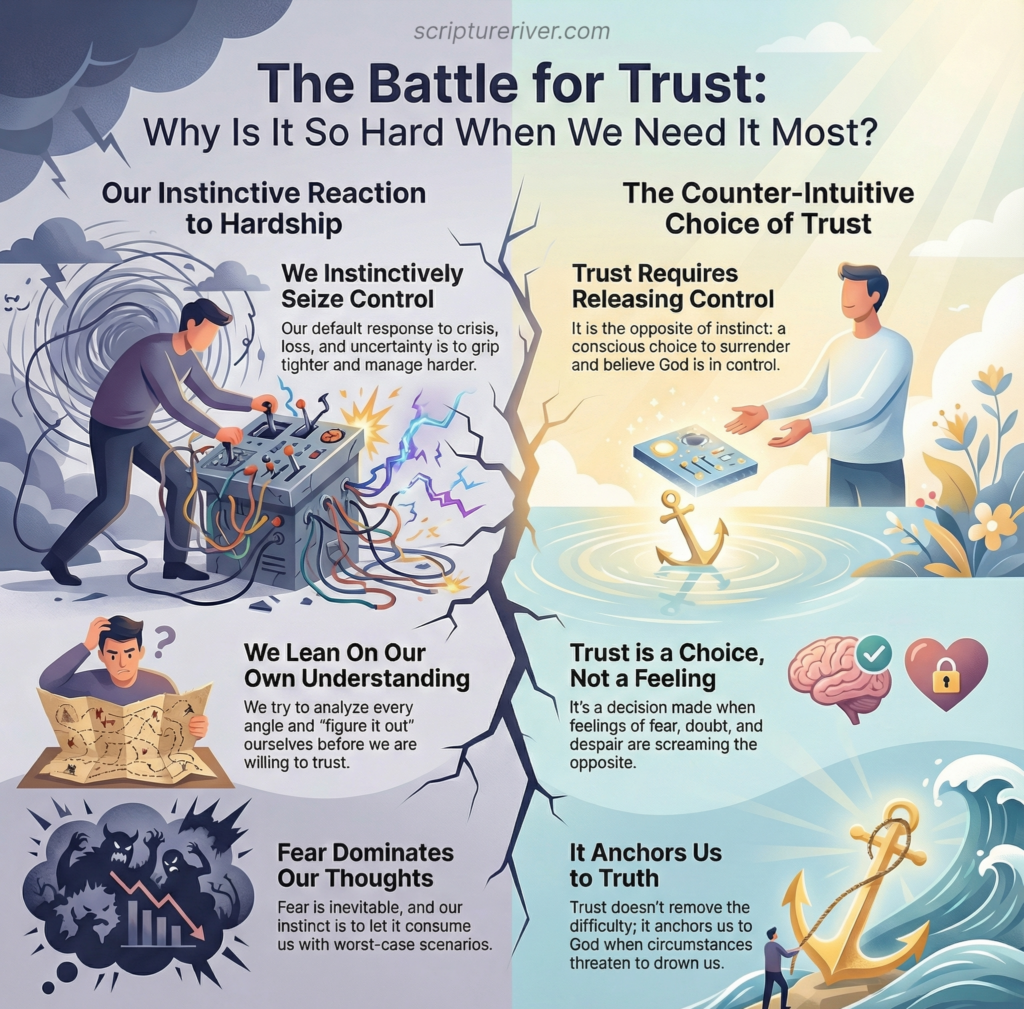
Trust requires surrendering control.
That’s why it’s hardest precisely when we want control most: during crises, uncertainty, suffering, loss.
Our instinct during difficulty is to grip tighter. Manage harder. Worry more.
Trust asks the opposite: release, surrender, believe God’s got this when everything visible says He doesn’t.
The Bible never promises trust will feel natural or easy.
It promises that trust is necessary and possible. Even when circumstances scream that God isn’t trustworthy, Scripture insists He is.
These verses don’t remove difficulty. They anchor you to truth when difficulty threatens to drown you in fear, doubt, and despair.
The Verses That Anchor Trust When Everything Shakes

1. Proverbs 3:5-6 – The Foundation of Biblical Trust
New International Version (NIV)
“Trust in the Lord with all your heart and lean not on your own understanding; in all your ways submit to him, and he will make your paths straight.”
This is the definitive trust passage.
“With all your heart” means complete trust, not partial. You can’t trust God 70% and yourself 30%. Trust is all-in, or it isn’t real trust.
“Lean not on your own understanding” addresses our default mode during hardship: figure it out yourself, analyze every angle, understand before you trust.
God says stop. Your understanding is limited. Your analysis is incomplete. Your perspective is too narrow.
Submit to Him in all your ways. Not just spiritual decisions. All ways. Career. Relationships. Finances. Health. Everything.
The promise: straight paths. Not easy paths. Not pain-free paths. Straight paths that lead where God intends, even through valleys you’d never choose.
I’ve tested this verse through job loss, health crises, ministry failures, and family struggles.
The times I truly surrendered control and trusted fully, God’s path became clear eventually.
The times I trusted partially while trying to maintain control, I stayed stuck in confusion.
Application: Identify one area where you’re still trying to understand everything before trusting. Consciously choose today to trust God’s understanding over your own in that specific situation.
2. Psalm 56:3-4 – Trust as a Weapon Against Fear
English Standard Version (ESV)
“When I am afraid, I put my trust in you. In God, whose word I praise—in God I trust and am not afraid. What can mere mortals do to me?”
David wrote this when enemies literally wanted him dead.
Notice he doesn’t say “if I am afraid.” He says, “When.” Fear is inevitable. What you do with fear determines whether it controls you or drives you to trust.
“I put my trust in you” is an active, intentional choice. You place fear somewhere. David placed it in God’s hands instead of letting it consume his thoughts.
The result: “I trust and am not afraid.” Trust doesn’t remove threatening circumstances. It removes fear’s power over you in those circumstances.
During my daughter’s accident, fear was real and rational. The trust verse didn’t eliminate fear. It gave me something stronger to hold onto than fear.
Application: Next time fear grips you, speak this verse out loud. “When I am afraid, I put my trust in You.” Make it a declaration, not just a thought.
3. Isaiah 26:3 – Perfect Peace Through Steady Trust
New King James Version (NKJV)
“You will keep him in perfect peace, whose mind is stayed on You, because he trusts in You.”
Perfect peace during imperfect circumstances comes from a mind “stayed” on God.
Stayed means fixed, steadfast, anchored. Not wandering to worst-case scenarios. Not spiraling into anxiety. Deliberately focused on God’s character and faithfulness.
The peace isn’t circumstantial. It’s supernatural. Peace that exists despite circumstances, not because of them.
I’ve counseled people in devastating situations who had this peace. It made no logical sense given what they were facing. But their minds stayed on God, not their circumstances.
Application: When anxiety about your situation dominates your thoughts, deliberately redirect your focus. List God’s character qualities out loud: faithful, powerful, good, loving, wise. Stay your mind on Him, not your crisis.
4. Jeremiah 29:11 – Trusting God’s Long-Term Plans
Christian Standard Bible (CSB)
“For I know the plans I have for you”—this is the Lord’s declaration—”plans for your well-being, not for disaster, to give you a future and a hope.”
Context matters here. God spoke this to exiles in Babylon facing 70 years of captivity.
Their current reality looked like a disaster. God said He had plans for their welfare and future, but those plans included decades of hardship first.
Trust isn’t believing God will fix everything immediately. It’s believing He’s working a good plan through circumstances that currently look terrible.
When the ministry imploded around me years ago, this verse sustained me. I couldn’t see any good plan. Everything looked like a disaster. But God was rebuilding something better through what felt like destruction.
Application: Write down your current difficulty. Under it write: “God has plans for my welfare and future that I can’t see yet.” Read it daily until you believe it.
5. Romans 8:28 – Trust That God Wastes Nothing
New Living Translation (NLT)
“And we know that God causes everything to work together for the good of those who love God and are called according to his purpose for them.”
“Everything” includes the bad stuff.
God doesn’t cause evil, but He does work all things—even evil things—together for good for those who love Him.
This doesn’t mean everything is good. It means God is so powerful and wise that He can take genuinely bad things and weave them into a good outcome you couldn’t have reached any other way.
I’ve watched this happen repeatedly. Losses that became gains. Failures that became lessons. Suffering that became compassion. God wasted none of it.
Application: Look back at a past difficulty. Can you see now how God worked it for good? Let that past faithfulness strengthen present trust that He’s doing the same with your current struggle.
6. Nahum 1:7 – God as Refuge in Trouble
New International Version (NIV)
“The Lord is good, a refuge in times of trouble. He cares for those who trust in him.”
Refuge means shelter, protection, a safe place.
God doesn’t promise to remove trouble. He promises to be your refuge during trouble.
When storms hit, you don’t stop the storm. You find shelter. God is that shelter for believers willing to run to Him instead of away from Him during hardship.
The verse explicitly states He cares for those who trust Him. Not those who have everything figured out. Not those who never doubt. Those who trust despite confusion and fear.
Application: During your current difficulty, are you running to God or away from Him? Make a daily practice of literally saying out loud: “God, You’re my refuge. I’m running to You, not from You.”
7. Psalm 37:5 – The Trust-Commitment-Action Cycle
English Standard Version (ESV)
“Commit your way to the Lord; trust in him, and he will act.”
Notice the sequence: commit, trust, God acts.
Commitment means entrusting your path to God’s direction. Trust means believing He’ll handle what you’ve entrusted. God’s action follows your commitment and trust.
We want it backwards. We want God to act first, then we’ll trust and commit. Scripture says commit and trust first, then watch God act.
I’ve seen this work with decisions I couldn’t make confidently. I committed the decision to God, chose to trust His guidance, and clarity came after commitment, not before.
Application: Take one decision or situation causing anxiety. Formally commit it to God in prayer: “I’m committing this to Your hands and trusting You to act.” Then stop trying to control it.
8. Proverbs 16:20 – Blessing Hidden in Trust
Christian Standard Bible (CSB)
“The one who understands a matter finds success, and the one who trusts in the Lord will be happy.”
Happiness during difficulty sounds impossible.
But this verse links happiness to trust, not circumstances. When you trust God, you access joy that circumstances can’t touch.
Happiness here isn’t a frivolous emotion. It’s deep contentment knowing you’re held by Someone bigger than your problems.
Application: Test this. Choose to trust God with something specific today. Notice whether peace and even happiness begin replacing anxiety, even while circumstances remain unchanged.
9. Isaiah 41:10 – God’s Presence Accompanies His Strength
New American Standard Bible (NASB)
“Do not fear, for I am with you; do not be afraid, for I am your God. I will strengthen you, I will also help you, I will also uphold you with My righteous right hand.”
Four promises anchor trust here.
God’s presence: “I am with you.” God’s relationship: “I am your God.” God’s strengthening: “I will strengthen you.” God’s support: “I will uphold you.”
Trust doesn’t require you to be strong enough for your difficulty. It requires you to believe God is strong enough and He’s with you.
Application: Memorize this verse. When weakness overwhelms you, recite it section by section as a prayer: “You are with me. You are my God. You will strengthen me. You will uphold me.”
10. Psalm 62:8 – Pouring Out Your Heart in Trust
New Living Translation (NLT)
“O my people, trust in him at all times. Pour out your heart to him, for God is our refuge.”
Trust doesn’t mean suppressing honest emotion.
“Pour out your heart” means bring God everything: fear, anger, confusion, desperation. Trust and honesty coexist.
David poured out his heart constantly in Psalms, often with brutally honest complaints and questions. Yet he consistently returned to trust.
That’s mature trust. Not pretending you’re fine. Not hiding your struggle. Bringing everything to God while still choosing to trust Him with outcomes you can’t control.
Application: Set aside time today to literally pour out your heart to God. Say everything you’re feeling about your difficulty. Then consciously choose to trust Him with it.
When Trust Feels Impossible

Some difficulties make trust feel absurd.
Terminal diagnosis. Devastating loss. Betrayal by trusted people. Unanswered prayers for things that matter desperately.
In those moments, these verses might feel like empty religious platitudes.
Let me tell you what I’ve learned through years of ministry and personal crisis: trust isn’t a feeling. It’s a choice you make despite feelings screaming the opposite.
You trust by praying these verses when you don’t believe them.
You trust by choosing obedience when emotions demand rebellion.
You trust by staying connected to God when you want to run.
Trust that’s only possible when you feel it isn’t really trust. It’s confidence based on favorable circumstances.
Biblical trust operates when everything in you says God isn’t trustworthy. You trust Him anyway because His character doesn’t change even when your circumstances do.
That’s faith. That’s what these verses call you to.
The Choice Every Difficulty Presents
Your current hardship gives you two options.
Trust yourself—your understanding, your ability, your control. Or trust God—His understanding, His ability, His control.
One leads to anxiety, exhaustion, and ultimately failure because you’re insufficient for what you’re facing.
The other leads to peace, strength, and eventually breakthrough because He’s sufficient for anything you face.
These ten verses aren’t magic formulas. They’re anchors. Truth to cling to when everything else is sinking.
Read them. Pray them. Memorize them. Speak them out loud when fear threatens to overwhelm you.
And choose trust even when—especially when—it feels impossible.
Prayer for Trust in Difficulty
Father, I’m in a difficult situation that makes trust feel impossible. Everything visible says You’re not working, not listening, not helping. But these verses say You’re trustworthy regardless of what I see.
I choose to trust You today despite my feelings. I’m surrendering control I never actually had. I’m committing this situation fully into Your hands. Strengthen my weak trust. Replace fear with faith.
Give me supernatural peace that makes no logical sense. Help me keep my mind stayed on You instead of my circumstances.
I believe You’re good, You’re with me, and You’re working even when I can’t see it. I’m trusting You.
In Jesus’s Name, Amen.
References
Carson, D. A. (1984). Matthew: The Expositor’s Bible Commentary (Vol. 8). Zondervan.
Kidner, D. (2008). Psalms 1-72: An Introduction and Commentary. InterVarsity Press.
Longman, T. (2008). Proverbs. Baker Academic.
Moo, D. J. (1996). The Epistle to the Romans. Eerdmans Publishing Company.
Motyer, J. A. (1999). Isaiah: An Introduction and Commentary. InterVarsity Press.
Peterson, E. H. (2005). The Message: The Bible in Contemporary Language. NavPress.
Strong, J. (2010). Strong’s Exhaustive Concordance of the Bible. Hendrickson Publishers.
VanGemeren, W. A. (2008). Psalms. Zondervan.
Wiersbe, W. W. (2007). The Bible Exposition Commentary: Old Testament. David C. Cook.

