


The high school basketball player wrote Philippians 4:13 on his shoes before every game: “I can do all things through Christ who strengthens me.”
He believed it meant Jesus would help him win.
His team lost in the first round of playoffs. Badly.
He called me on the phone, confused and angry. “I prayed before every game. I claimed the verse. Why didn’t God help me win?”
That’s when I had to tell him something that crushed his theology but saved his faith: Philippians 4:13 isn’t about sports performance.
It’s not about winning games, acing tests, or achieving goals.
Paul wrote it from prison, not a locker room.
And the context changes everything.
The Most Misused Verse in Sports
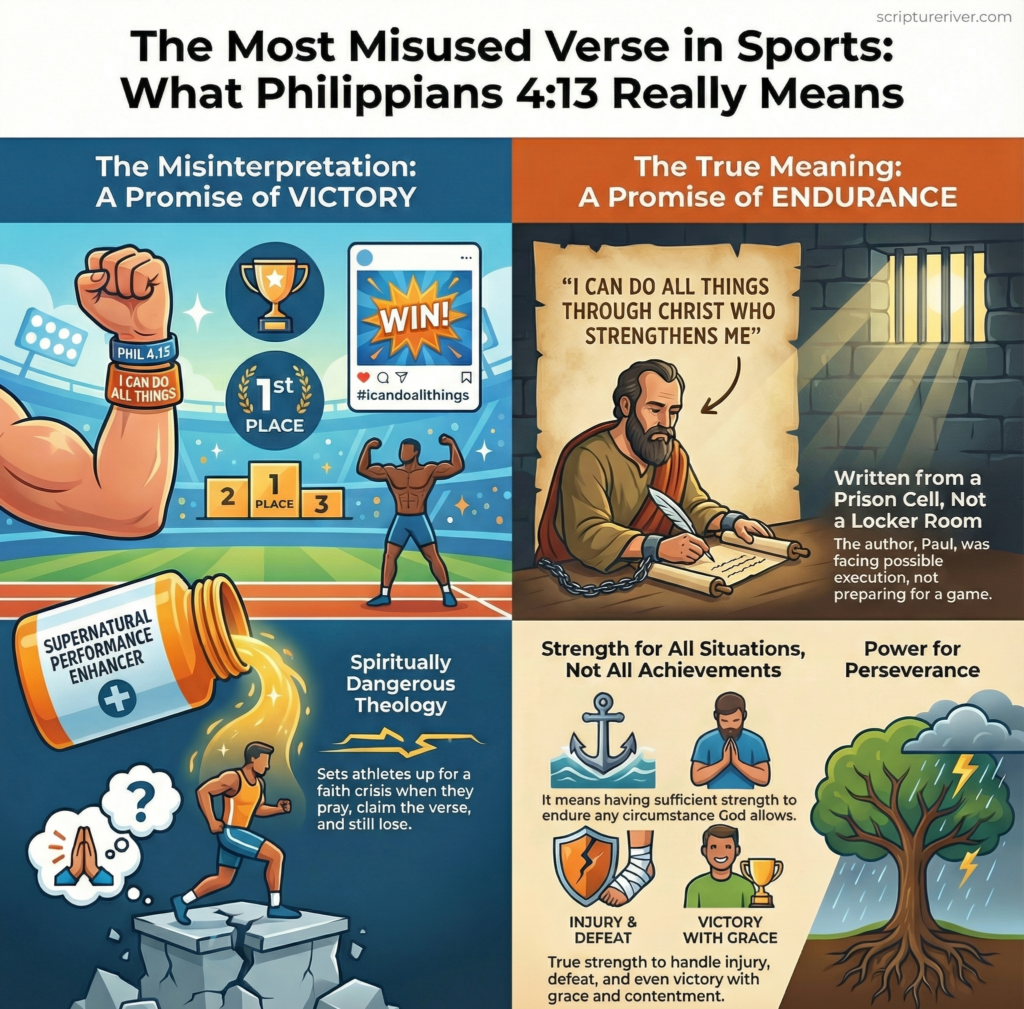
Philippians 4:13 appears everywhere in Christian athletics.
Written on wristbands. Printed on t-shirts. Posted on social media after victories. Quoted in pre-game prayers.
Athletes treat it like a supernatural performance enhancer. A biblical steroid that guarantees success if you just believe hard enough.
Here’s the problem: that’s not what Paul meant. At all.
The verse has become disconnected from its context, twisted into a prosperity gospel promise about achieving whatever you want if you have enough faith.
That’s not just bad theology.
It’s spiritually dangerous because it sets up young athletes for devastating faith crises when they pray, claim the verse, and still lose.
Let’s look at what Paul actually said and what he actually meant.
What Philippians 4:13 Actually Says in Context
Here’s the famous verse in full:
Philippians 4:13, New King James Version (NKJV)
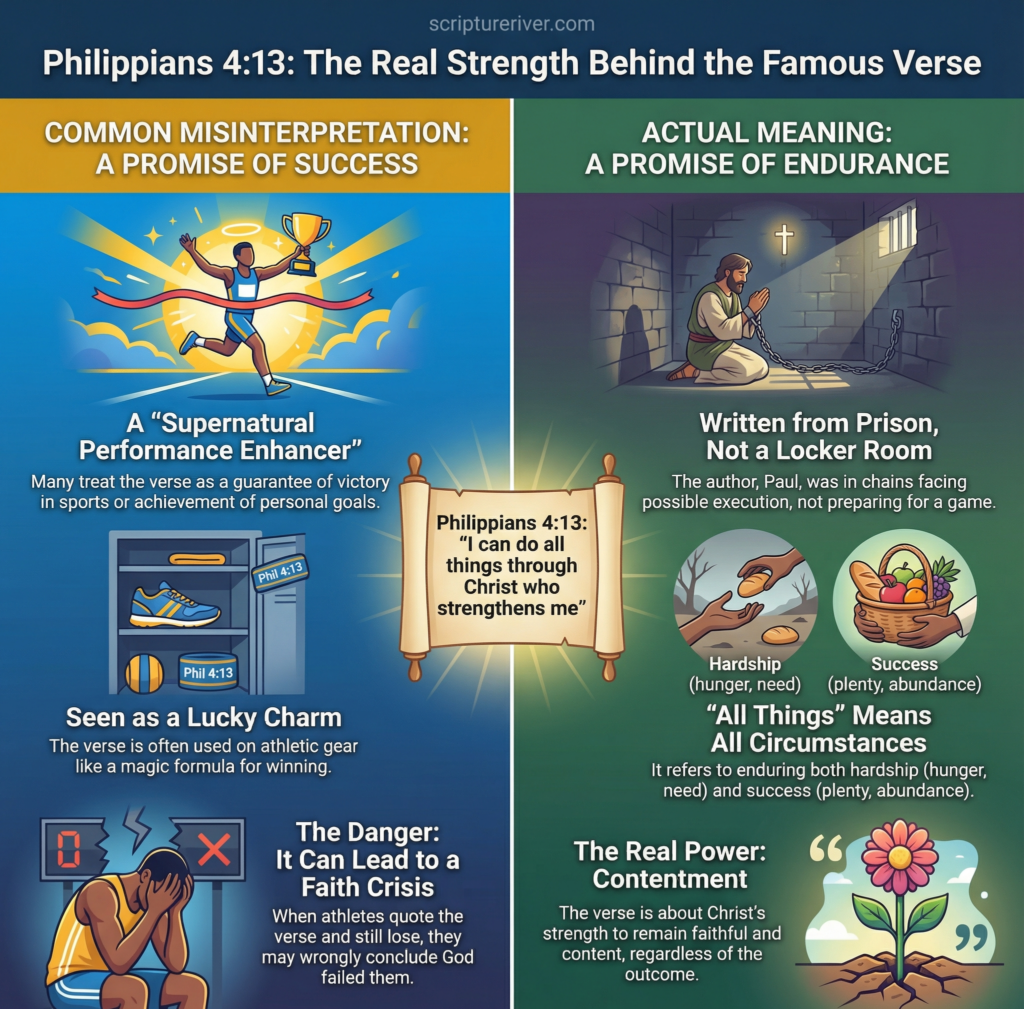
“I can do all things through Christ who strengthens me.”
Now here’s the context most people skip. Philippians 4:11-13, English Standard Version (ESV):
“Not that I am speaking of being in need, for I have learned in whatever situation I am to be content. I know how to be brought low, and I know how to abound. In any and every circumstance, I have learned the secret of facing plenty and hunger, abundance and need. I can do all things through him who strengthens me.”
Paul wrote this from prison.
He wasn’t training for competition.
He wasn’t preparing for a game. He was chained to Roman guards, facing possible execution, uncertain whether he’d live or die.
The “all things” he could do through Christ wasn’t winning or achieving.
It was enduring. Persevering. Remaining content, whether circumstances were good or terrible.
Paul had learned contentment in plenty and in hunger. In freedom and in chains. In success and in suffering.
That’s what Christ’s strength enabled: the ability to remain faithful regardless of circumstances, not the ability to control circumstances through faith.
What “All Things” Actually Means
The Greek phrase “panta ischyo” translated “I can do all things” doesn’t mean “I can accomplish whatever I set my mind to.”
It means “I have strength for all situations.”
Paul isn’t claiming unlimited power to achieve goals.
He’s declaring sufficient strength to endure any circumstance God allows.
Look at what Paul endured before writing Philippians.
2 Corinthians 11:23-28 lists his suffering: imprisoned frequently, beaten severely, exposed to death repeatedly, flogged five times with 39 lashes, beaten with rods three times, stoned once, shipwrecked three times, constantly in danger, hungry, thirsty, cold, and anxious.
That’s the “all things” Christ strengthened Paul to endure.
Not winning. Not success. Not achievement. Faithful endurance through circumstances that would destroy most people.
When Paul says, “I can do all things through Christ,” he means: “No circumstance is strong enough to destroy my faith or contentment because Christ strengthens me for whatever comes.”
That’s radically different from “Jesus will help me win the championship.”
Why This Misinterpretation Damages Young Athletes

I’ve counseled dozens of Christian athletes whose faith was shaken by this verse’s misuse.
They prayed. They believed. They claimed the promise. Then they lost, failed, got injured, or didn’t make the team.
The conclusion they reached: either God doesn’t keep His promises or their faith wasn’t strong enough.
Both conclusions are wrong and spiritually devastating.
God never promised to make you win if you quote Philippians 4:13 before games.
That’s not what the verse means. You’re claiming a promise God never made.
This misinterpretation turns Christianity into superstition.
The verse becomes a lucky charm, a magic formula, a way to manipulate God into giving you athletic success.
When it doesn’t work as promised, young believers conclude either God isn’t real or that they’re spiritual failures.
I’ve watched high school athletes walk away from faith entirely because this verse didn’t produce the results they were promised it would.
That’s theological malpractice with real casualties.
What the Bible Actually Teaches Athletes

Scripture has plenty to say that applies to athletics. Just not what gets quoted most often.
1. Excellence as Worship
Colossians 3:23, New International Version (NIV)
“Whatever you do, work at it with all your heart, as working for the Lord, not for human masters.”
This applies perfectly to athletics.
Play with full effort as an act of worship.
Not to impress scouts, not to win approval, not to earn a scholarship.
Because you’re ultimately performing for God, who gave you the ability.
Excellence in athletics can glorify God whether you win or lose.
Effort, discipline, integrity, and character honor God more than victories.
2. Your Body as God’s Temple
1 Corinthians 6:19-20, Christian Standard Bible (CSB)
“Don’t you know that your body is a temple of the Holy Spirit who is in you, whom you have from God? You are not your own, for you were bought at a price. So glorify God with your body.”
Athletes should care for their bodies because they belong to God.
Training, nutrition, rest, and avoiding substances that harm your body. These honor God by stewarding what He gave you.
But notice: this isn’t about winning. It’s about stewardship and worship through how you treat your body.
3. Discipline and Self-Control
1 Corinthians 9:24-27, New Living Translation (NLT)
“Don’t you realize that in a race everyone runs, but only one person gets the prize? So run to win! All athletes are disciplined in their training. They do it to win a prize that will fade away, but we do it for an eternal prize. So I run with purpose in every step. I am not just shadowboxing. I discipline my body like an athlete, training it to do what it should.”
Paul uses athletics as a metaphor for spiritual discipline.
Athletes train with incredible discipline for temporary prizes.
Christians should train spiritually with even greater discipline for eternal rewards.
The point isn’t that God will make you win. It’s that athletic discipline models spiritual discipline.
4. Competition with Character
2 Timothy 2:5, English Standard Version (ESV)
“An athlete is not crowned unless he competes according to the rules.”
Compete with integrity.
No cheating. No cutting corners. No compromising character for competitive advantage.
Victory without integrity is worthless. Honor God by how you compete, not just whether you win.
5. Ultimate Identity Beyond Performance
Galatians 2:20, New King James Version (NKJV)
“I have been crucified with Christ; it is no longer I who live, but Christ lives in me; and the life which I now live in the flesh I live by faith in the Son of God, who loved me and gave Himself for me.”
Your identity isn’t athlete. It’s child of God.
When athletics end through injury, aging, or not making the next level, your core identity remains secure in Christ.
Performance fluctuates. God’s love doesn’t. This verse anchors identity where it belongs: in Christ, not in what you achieve.
How to Actually Apply Philippians 4:13 to Athletics
If Philippians 4:13 isn’t about winning, can athletes apply it at all?
Yes. Just correctly.
Apply it to perseverance through injury. When rehab is grueling, and you’re tempted to quit, Christ strengthens you to endure the process.
Apply it to contentment on the bench. When you’re not starting, and it hurts, Christ gives strength to remain faithful and supportive instead of bitter.
Apply it to handling both victory and defeat. Win with humility, lose with grace, because Christ strengthens you to remain content regardless of outcome.
Apply it to character under pressure. When competition tempts you to compromise integrity, Christ strengthens you to do right regardless of cost.
Apply it to transitioning out of sports. When your athletic career ends and identity shifts, Christ strengthens you through that painful transition.
That’s how Paul intended the verse to be used. Not as a performance promise. As an endurance promise.
A Better Prayer for Christian Athletes
Instead of asking God to help you win, pray what honors Him and builds actual faith.
Father, thank You for the ability to compete. Help me glorify You through effort, discipline, and character regardless of outcomes.
Give me strength to train hard, compete honorably, and handle both victory and defeat with grace.
Keep me from making athletics an idol that replaces You. Let me find my identity in Christ, not in performance. Win or lose, may my life point others to You.
In Jesus’s Name, Amen.
That prayer aligns with Scripture.
It honors God’s actual priorities. It builds faith that survives when athletics end.
It doesn’t manipulate God into guaranteeing success. It asks for strength to honor Him through competition however it turns out.
What to Tell Young Athletes About Faith and Sports
If you coach, parent, or mentor Christian athletes, here’s what they need to hear.
God cares more about your character than your stats. He’s more concerned with who you’re becoming than what you’re achieving.
Prayer isn’t a performance enhancer. It’s relationship with God. Pray before games, but pray for strength, wisdom, and character. Not guaranteed victory.
Faith doesn’t guarantee success. It guarantees God’s presence and strength through both success and failure.
Your worth isn’t determined by performance. You’re valuable because God created and loves you, not because you won a game.
Athletics are temporary. Even professional careers end. Build your life on what’s eternal: a relationship with Christ.
Losing doesn’t mean God abandoned you. Sometimes God’s best plan includes losing, injury, or not making the team. Trust Him anyway.
These truths protect young athletes from the spiritual destruction that comes from misapplying verses like Philippians 4:13.
The Real Strength Philippians 4:13 Offers
Paul’s promise in Philippians 4:13 is actually more powerful than the misinterpretation.
Promising Jesus will help you win is weak theology. What happens when you lose? The promise failed, or you failed. Either way, faith crumbles.
But promising Christ give strength for any circumstance? That never fails.
Injured and career over? Christ strengthens you through that. Cut from the team? Christ strengthens you through disappointment. Win the championship? Christ strengthens you to handle success humbly.
Lost everything athletically? Christ strengthens you to find contentment and purpose beyond sports.
The real promise is better than the fake one.
You don’t need Christ to guarantee winning. You need Christ to be enough when winning doesn’t happen.
That’s the promise Paul made. That’s the promise that’s always true. And that’s the promise that builds unshakeable faith.
Final Thoughts for Athletes and Those Who Influence Them
Stop putting Philippians 4:13 on your shoes expecting it to improve performance.
Start living it by finding contentment in Christ regardless of athletic outcomes.
Compete hard. Train diligently. Pursue excellence. But do it as worship, not as a way to manipulate God into giving you success.
Let athletics reveal character, not define identity.
And when your athletic career ends, whenever and however that happens, may you discover that Christ’s strength was never about making you a winner in sports.
It was about making you faithful in everything.
That’s a promise you can build your life on.
References
Fee, G. D. (1995). Paul’s Letter to the Philippians. Eerdmans Publishing Company.
Hawthorne, G. F., & Martin, R. P. (2004). Philippians. Zondervan.
Longman, T., & Garland, D. E. (Eds.). (2008). The Expositor’s Bible Commentary: Ephesians-Philemon. Zondervan.
O’Brien, P. T. (1991). The Epistle to the Philippians. Eerdmans Publishing Company.
Peterson, E. H. (2005). The Message: The Bible in Contemporary Language. NavPress.
Silva, M. (2005). Philippians (2nd ed.). Baker Academic.
Strong, J. (2010). Strong’s Exhaustive Concordance of the Bible. Hendrickson Publishers.
Thielman, F. (1995). Philippians. InterVarsity Press.
Wiersbe, W. W. (2007). The Bible Exposition Commentary: New Testament (Vol. 2). David C. Cook.

