

Children can memorize Scripture before they can fully understand it.
That’s not a problem. It’s a feature of how God designed memory to work.
The neural pathways formed by memorizing verses at age five become the foundation for theological understanding at age fifteen and spiritual stability at age thirty-five.
Pediatric neurologist Dr. Lise Eliot’s research on brain development shows that children ages 3-7 have exceptional rote memorization capacity.
Their brains are wired to absorb and retain information through repetition, even when they don’t yet grasp abstract concepts.
This makes early childhood the optimal window for Scripture memorization.
The verses you teach your five-year-old will be accessible to them at fifty, ready to provide comfort, guidance, and truth when they need it most.
But which verses matter most? With 31,102 verses in the Bible, where do you start?
These 15 verses provide a theological foundation, practical wisdom, and gospel truth that every child needs embedded in their heart before they face the challenges of adolescence and adulthood.
Verses About God’s Character
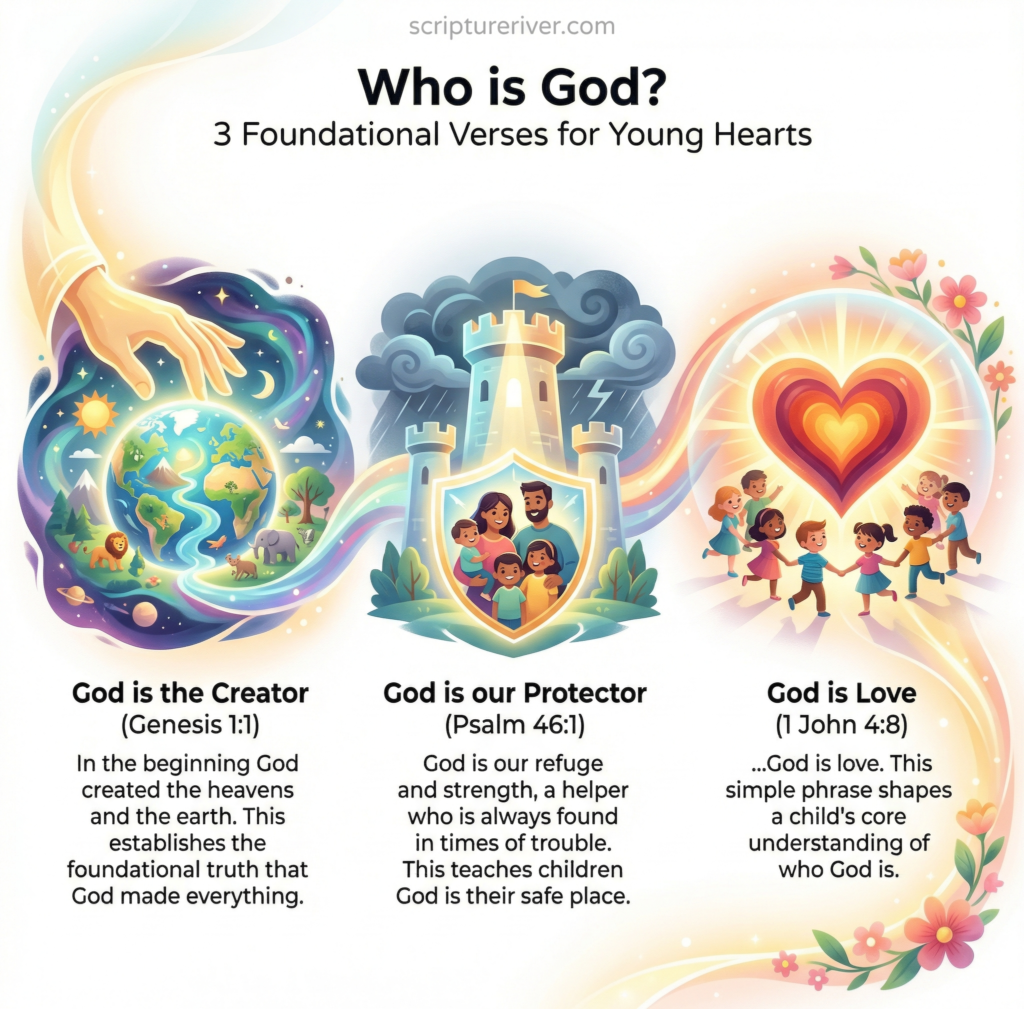
1. Genesis 1:1
Genesis 1:1, New International Version (NIV)
“In the beginning God created the heavens and the earth.”
Why this verse matters: This establishes the most foundational truth of reality: God exists and He created everything. Every other biblical truth builds on this foundation.
How to teach it: Point to creation during nature walks. “God made that tree. God made those clouds. God made you.” Connect the verse to what they observe daily.
2. Psalm 46:1
Psalm 46:1, Christian Standard Bible (CSB)
“God is our refuge and strength, a helper who is always found in times of trouble.”
Why this verse matters: Children need to know God is their safe place when they’re scared, hurt, or confused. This verse provides comfort that lasts a lifetime.
How to teach it: Use it during actual moments of fear. Thunderstorm scary? “Remember, God is our refuge and strength.” Nightmare wake them up? Pray this verse together.
3. 1 John 4:8
1 John 4:8, English Standard Version (ESV)
“Anyone who does not love does not know God, because God is love.”
Why this verse matters: “God is love” is theologically profound yet simple enough for toddlers to grasp. It shapes their foundational understanding of God’s character.
How to teach it: Connect it to experiences of love. “When Mommy hugs you, that’s showing love. God is love. God’s love for you is even bigger than Mommy’s love.”
Verses About Jesus
4. John 3:16
John 3:16, New King James Version (NKJV)
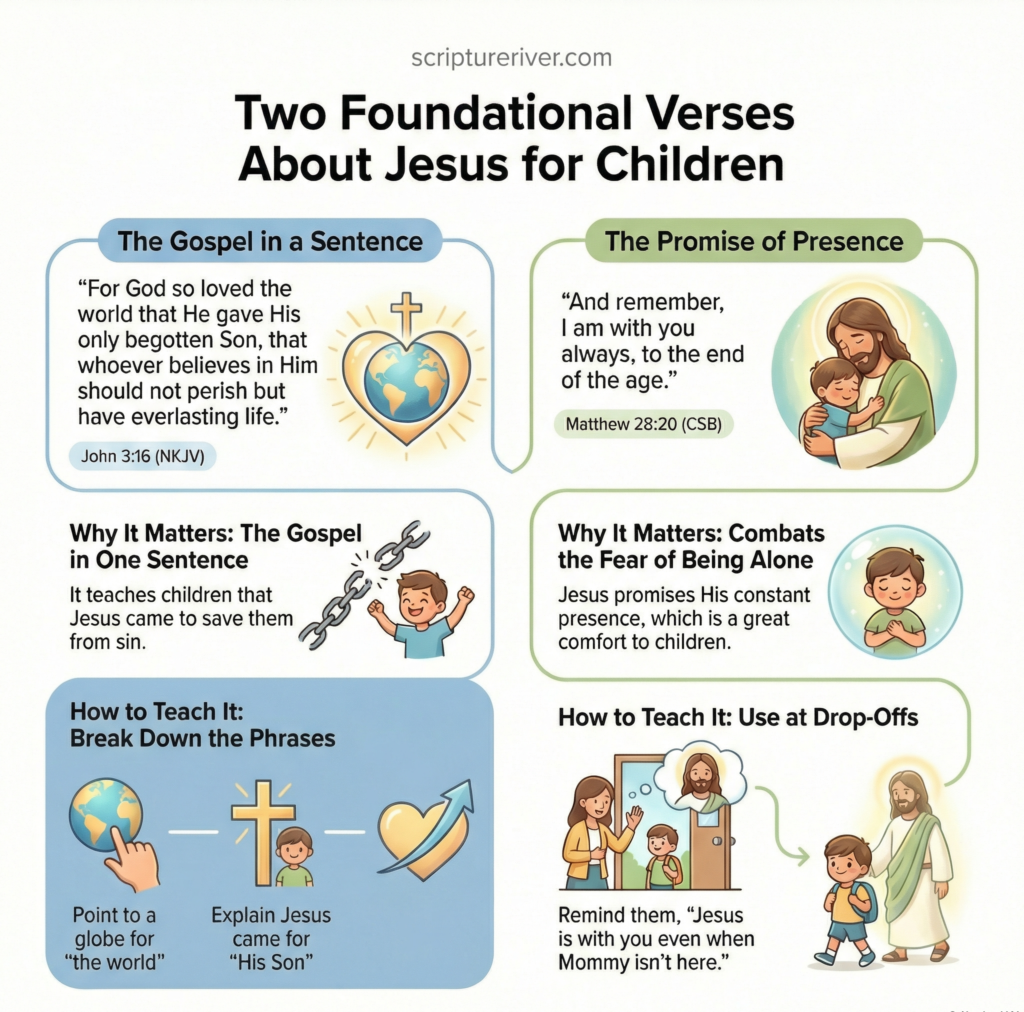
“For God so loved the world that He gave His only begotten Son, that whoever believes in Him should not perish but have everlasting life.”
Why this verse matters: This is the gospel in one sentence. Children need to understand early that Jesus came, died, and rose again to save them from sin.
How to teach it: Break it into phrases. “God loved the world” (point to globe). “Gave His Son” (explain Jesus came to earth). “Whoever believes” (that includes you). “Everlasting life” (forever with God).
5. Matthew 28:20
Matthew 28:20, Christian Standard Bible (CSB)
“And remember, I am with you always, to the end of the age.”
Why this verse matters: Jesus’s promise to always be present combats the fear of being alone that many children experience.
How to teach it: Use it at drop-offs (school, babysitter). “Jesus is with you even when Mommy isn’t here. He never leaves you.”
Verses About Scripture
6. Psalm 119:105
Psalm 119:105, New International Version (NIV)
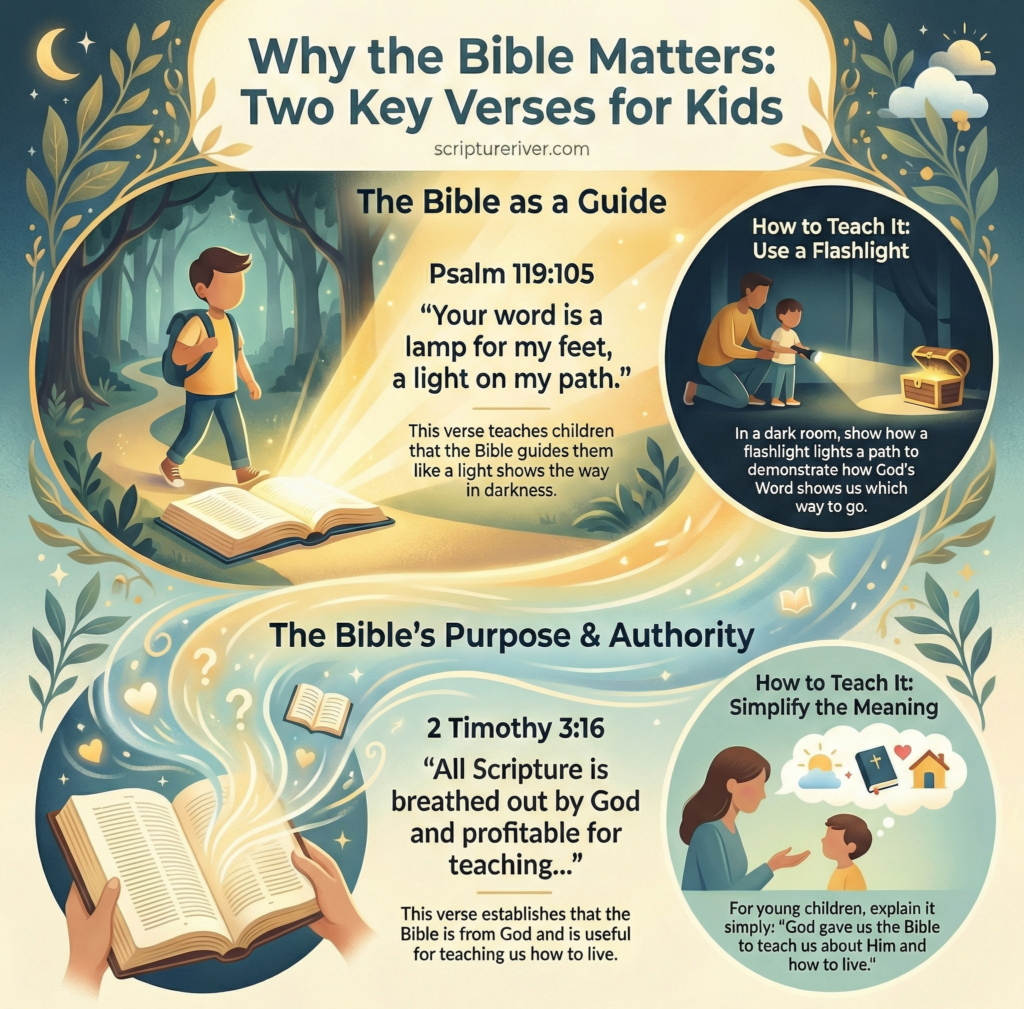
“Your word is a lamp for my feet, a light on my path.”
Why this verse matters: Children need to understand the Bible guides them like a light shows the way in darkness.
How to teach it: Use an actual flashlight in a dark room. Show how it lights the path. “God’s Word does this for our choices. It shows us which way to go.”
7. 2 Timothy 3:16
2 Timothy 3:16, English Standard Version (ESV)
“All Scripture is breathed out by God and profitable for teaching, for reproof, for correction, and for training in righteousness.”
Why this verse matters: This establishes the Bible’s authority and purpose. It’s not just a book. It’s God’s Word that teaches us how to live.
How to teach it: Simplify for young children: “God gave us the Bible to teach us about Him and how to live.” Expand for older kids by explaining what reproof, correction, and training mean.
Verses About Obedience
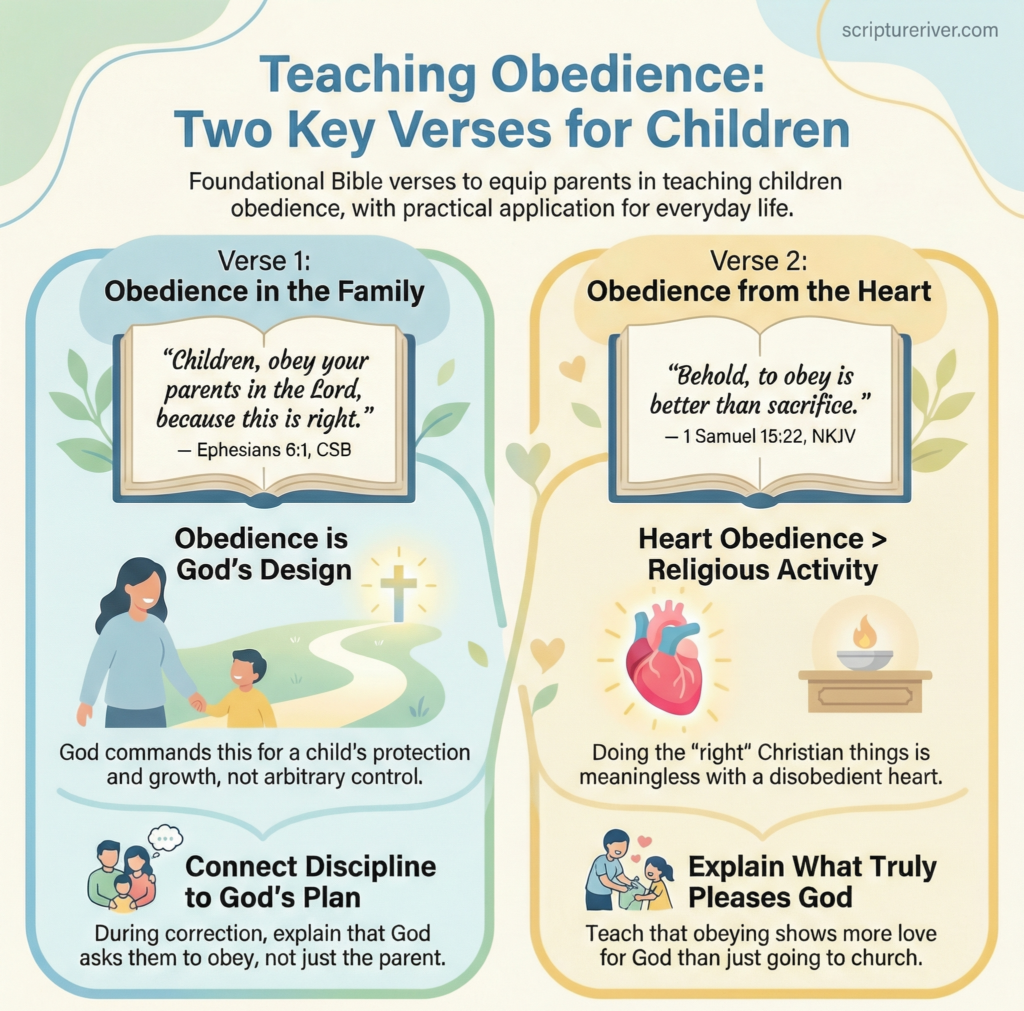
8. Ephesians 6:1
Ephesians 6:1, Christian Standard Bible (CSB)
“Children, obey your parents in the Lord, because this is right.”
Why this verse matters: God commands children to obey parents. This isn’t arbitrary. It’s God’s design for their protection and growth.
How to teach it: Reference it during discipline. “I’m asking you to obey, and God says children should obey their parents.” Connect obedience to God’s plan, not just your preference.
9. 1 Samuel 15:22
1 Samuel 15:22, New King James Version (NKJV)
“Has the Lord as great delight in burnt offerings and sacrifices, as in obeying the voice of the Lord? Behold, to obey is better than sacrifice.”
Why this verse matters: Obedience matters more than religious activity. Children can do all the “right” Christian things while harboring disobedient hearts.
How to teach it: Explain that going to church or praying doesn’t replace obeying what God and parents ask. Obedience shows love for God more than religious actions.
Verses About How to Treat Others
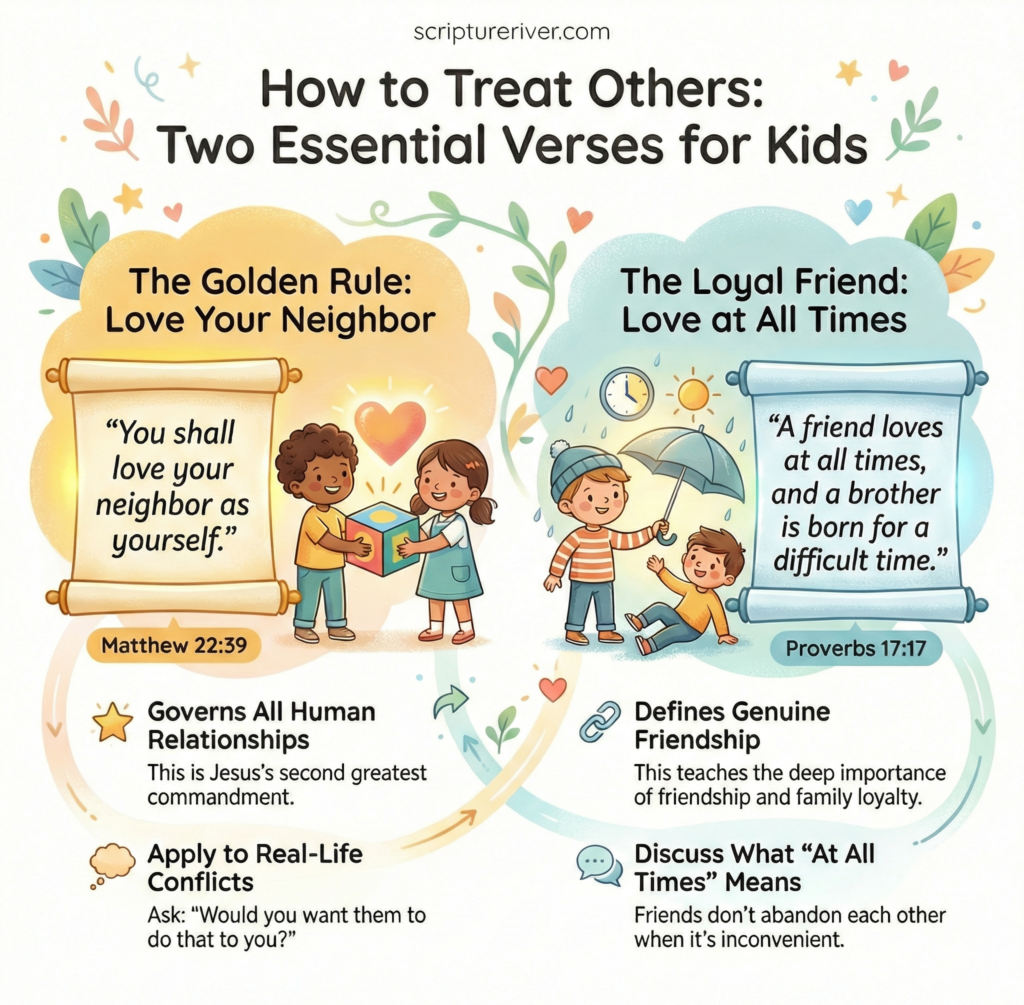
10. Matthew 22:39
Matthew 22:39, English Standard Version (ESV)
“You shall love your neighbor as yourself.”
Why this verse matters: This is Jesus’s second greatest commandment. It governs all human relationships.
How to teach it: Apply it to sibling conflicts, playground interactions, and how they treat kids who are different. “Would you want them to do that to you? Then don’t do it to them.”
11. Proverbs 17:17
Proverbs 17:17, Christian Standard Bible (CSB)
“A friend loves at all times, and a brother is born for a difficult time.”
Why this verse matters: Friendship and family loyalty matter deeply. This verse teaches what genuine relationship looks like.
How to teach it: Discuss what “at all times” means. Friends don’t abandon each other when it’s inconvenient. Use examples of when they stuck with a friend or when someone stuck with them.
Verses About Character
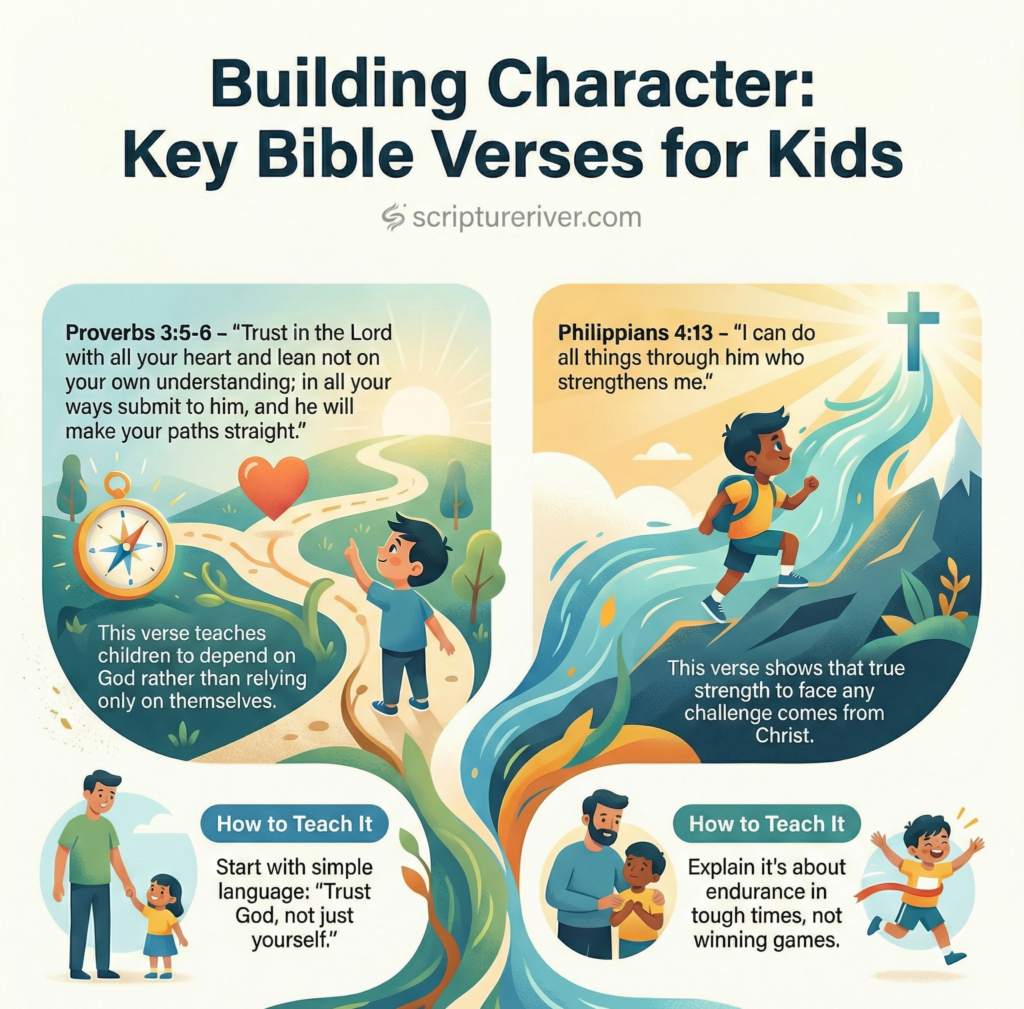
12. Proverbs 3:5-6
Proverbs 3:5-6, New International Version (NIV)
“Trust in the Lord with all your heart and lean not on your own understanding; in all your ways submit to him, and he will make your paths straight.”
Why this verse matters: This teaches dependence on God rather than self-reliance. It’s especially crucial as children approach independence in adolescence.
How to teach it: Start early with simple language: “Trust God, not just yourself.” As they mature, explain what leaning on your own understanding means and why God’s way is better.
13. Philippians 4:13
Philippians 4:13, English Standard Version (ESV)
“I can do all things through him who strengthens me.”
Why this verse matters: Children need to know their strength comes from Christ, especially when facing challenges.
How to teach it: Clarify what this verse means. It’s not about winning games or getting what you want. It’s about Christ giving strength for whatever circumstances you face. Use it during actual struggles, not just as a motivational slogan.
Verses About Prayer
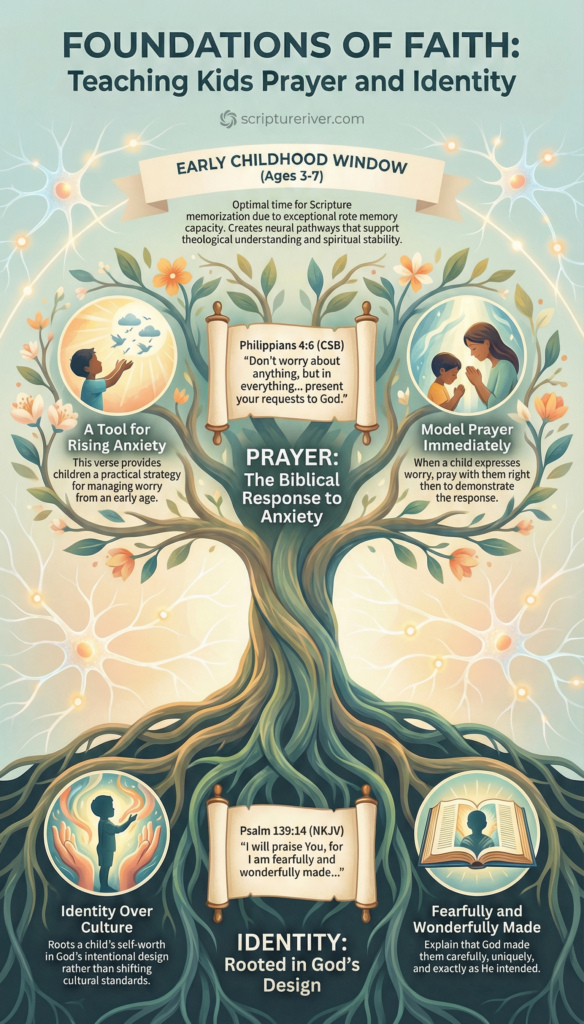
14. Philippians 4:6
Philippians 4:6, Christian Standard Bible (CSB)
“Don’t worry about anything, but in everything, through prayer and petition with thanksgiving, present your requests to God.”
Why this verse matters: Anxiety affects children increasingly young. This verse teaches them what to do when they’re worried.
How to teach it: Model it. When they express worry, say “Let’s pray about that right now.” Show them that prayer is the biblical response to anxiety, not just positive thinking.
Verses About Identity in Christ
15. Psalm 139:14
Psalm 139:14, New King James Version (NKJV)
“I will praise You, for I am fearfully and wonderfully made; marvelous are Your works, and that my soul knows very well.”
Why this verse matters: Children need to know they’re intentionally created by God, not accidents. This verse provides identity rooted in God’s design rather than culture’s standards.
How to teach it: Explain what “fearfully and wonderfully made” means. God made them carefully, on purpose, uniquely. When culture tells them they’re not enough, this verse reminds them God made them exactly as He intended.
How to Make Scripture Memory Effective
Start Young But Keep It Age-Appropriate
According to child development research published in the Journal of Experimental Child Psychology, children as young as two can begin memorizing short phrases. Start with partial verses and build to complete verses as language develops.
Use Multiple Senses
Dr. Carla Hannaford’s research on learning and the brain shows multisensory learning improves retention. Say verses while doing hand motions. Sing them. Write them. Draw pictures representing them.
Repeat Consistently
Neuroscience research on memory consolidation demonstrates that spaced repetition over weeks is far more effective than cramming. Review verses daily for a week, then weekly for a month, then monthly.
Apply Immediately
Don’t treat Scripture memory as academic exercise. Use verses in real situations. When your child is scared, pray Psalm 46:1. When they’re unkind to siblings, reference Matthew 22:39.
Make It Relational, Not Performance-Based
The goal isn’t perfect recitation to impress others. It’s hiding God’s Word in their hearts. Celebrate progress without creating pressure that makes Scripture memory feel like a test they can fail.
Frequently Asked Questions About Teaching Bible Verses to Kids
At what age should I start teaching my child Bible verses?
You can start as early as 18 months with very short phrases from verses. By age 3-4, many children can memorize complete short verses. The key is age-appropriate expectations. Toddlers learn phrases, preschoolers learn verses, elementary kids can learn longer passages.
What if my child doesn’t understand what the verse means?
That’s normal and acceptable. Memorization creates the foundation for later understanding. A five-year-old won’t grasp all the theology in John 3:16, but when they’re fifteen and facing peer pressure, that memorized verse will resurface with new meaning. Explain what you can at their level and trust understanding deepens over time.
How many verses should I teach at once?
Focus on one verse at a time until it’s solidly memorized. For young children, this might take 1-2 weeks of daily review. Trying to memorize multiple verses simultaneously usually results in confusion and none being retained well.
Should I use the same Bible translation for all verses?
Consistency helps, especially for young children. Choose one translation for memory work. That said, as children mature, exposing them to different translations helps them understand Scripture isn’t magic words but conveyed meaning.
What if my child resists Scripture memory?
Make it engaging rather than tedious. Use songs, games, rewards, and variety. The Bible Memory app has games for kids. Scripture memory songs set verses to catchy tunes. Hand motions make memorization active. If it feels like punishment, they’ll resist it.
How do I help my child remember verses long-term?
Regular review is essential. Create a review rotation where you revisit previously memorized verses monthly. Family devotions can include reciting memory verses together. Car rides are perfect for review. The key is ongoing exposure, not just memorizing once and moving on.
Prayer for Parents Teaching Scripture
Father, thank You for Your Word that provides truth, guidance, and life. Give me wisdom as I teach my children to hide Scripture in their hearts. Help me model love for Your Word through my own life. Give me patience when they struggle to memorize. Give me creativity to make learning engaging. And most importantly, use these verses to draw their hearts toward You. May Your Word embedded in their memories become the foundation for faith that withstands every challenge they’ll face. Protect them from forgetting what they’ve learned. Bring these verses to mind when they need them most. And use my imperfect teaching to accomplish Your perfect purposes in their lives. In Jesus’s Name, Amen.
Sources Cited
Eliot, L. (1999). What’s Going On in There? How the Brain and Mind Develop in the First Five Years of Life. Bantam Books. [Book]
Hannaford, C. (2005). Smart Moves: Why Learning Is Not All in Your Head. Great River Books. [Book]
Peterson, E. H. (2005). The Message: The Bible in Contemporary Language. NavPress. [Bible Translation]
Siegler, R. S., DeLoache, J. S., & Eisenberg, N. (2011). How Children Develop (3rd ed.). Worth Publishers. [Book]
Strong, J. (2010). Strong’s Exhaustive Concordance of the Bible. Hendrickson Publishers. [Reference Book]
Tripp, T. (1995). Shepherding a Child’s Heart. Shepherd Press. [Book]
Willard, D. (1988). The Spirit of the Disciplines: Understanding How God Changes Lives. HarperOne. [Book]

