


Growing up, if I got a dollar for every time I heard the phrase “Cleanliness is next to godliness,” I’d be a millionaire.
No jokes.
The phrase gets quoted as if it’s Scripture.
Well, it’s not.
It appears nowhere in the Bible.
Not in the Old Testament ceremonial laws. Not in Jesus’s teachings. Not in Paul’s letters.
Nowhere.
Yet Christians repeat it constantly, using it to justify everything from obsessive housekeeping to judging people whose homes or appearances don’t meet arbitrary cleanliness standards.
Churches use it to guilt volunteers into facility maintenance.
Parents weaponize it against messy teenagers.
The phrase sounds biblical. It feels true.
But it’s actually contradicted by what Scripture actually teaches about cleanliness, godliness, and their relationship.
Let’s settle this definitively.
Would You Rather Listen to This Teaching??
Just in case you’d rather listen to this message, we’ve provided an audio version of this post for your convenience.
You can listen to it while you go about your day, doing other things on your to-do list.
Where Cleanliness Is Next to Godliness Actually Comes From
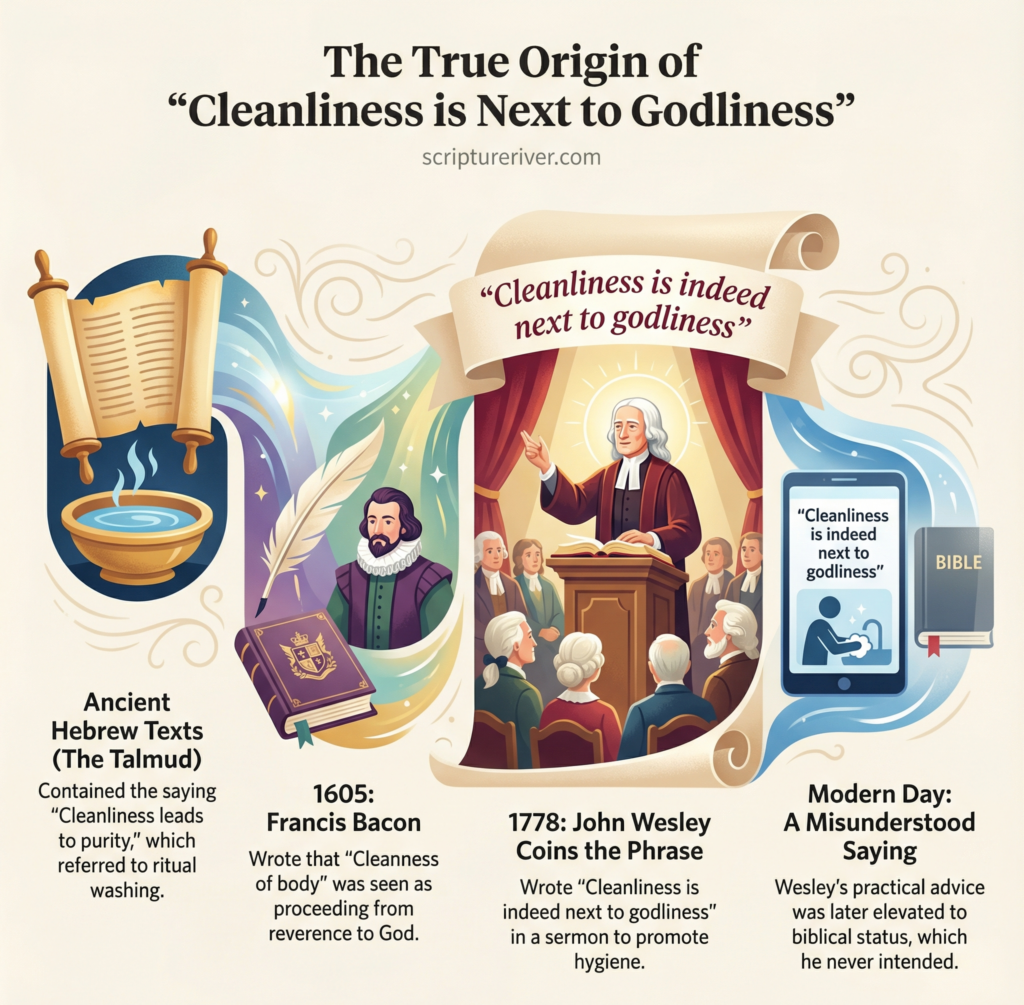
The phrase originated with John Wesley in a 1778 sermon titled “On Dress.”
Wesley wrote: “Cleanliness is indeed next to godliness.”
He was advocating for personal hygiene among Methodist followers, not establishing biblical doctrine.
Before Wesley, similar sentiments appeared in ancient Hebrew texts.
The Talmud contains a saying: “Cleanliness leads to purity.”
But this referred to ritual washing, not general hygiene.
Francis Bacon used a related phrase in 1605: “Cleanness of body was ever esteemed to proceed from a due reverence to God.”
The concept existed before Wesley, but he popularized the specific wording that became mistaken for Scripture.
Here’s the critical point: Wesley never claimed it was biblical.
He offered practical wisdom about hygiene in an era when bathing was infrequent and disease was rampant.
Later generations elevated his practical advice to biblical status.
It’s cultural wisdom, not divine revelation.
What the Bible Actually Says About Physical Cleanliness

Scripture addresses cleanliness in specific contexts.
Understanding these distinctions prevents misapplying Old Testament law to New Testament living.
Old Testament Ceremonial Cleanliness
The Mosaic Law contained extensive cleanliness regulations.
Leviticus 11-15 details what makes someone ceremonially unclean: certain foods, skin diseases, bodily discharges, touching corpses, childbirth.
These laws required ritual washing for purification.
But here’s what most people miss: ceremonial uncleanness wasn’t sinfulness.
It was temporary ritual impurity requiring specific cleansing procedures before participating in worship.
Touching a dead body made you unclean but wasn’t sinful. Giving birth made you unclean but wasn’t sinful.
These were unavoidable aspects of life in a fallen world.
The cleanliness laws pointed forward to spiritual realities about sin’s defilement and the need for purification through sacrifice, ultimately fulfilled in Christ.
They were never about general hygiene or household tidiness.
New Testament Declarations About Ceremonial Law
Jesus fundamentally redefined cleanliness.
Mark 7:18-19, New International Version (NIV) records His revolutionary teaching:
“‘Don’t you see that nothing that enters a person from the outside can defile them? For it doesn’t go into their heart but into their stomach, and then out of the body.’ (In saying this, Jesus declared all foods clean.)”
Jesus abolished ceremonial food laws.
External things don’t make you unclean spiritually. What comes from inside your heart determines your spiritual condition.
Acts 10 reinforces this when God tells Peter in a vision:
“Do not call anything impure that God has made clean.” (Acts 10:15, NIV)
God was preparing Peter to take the gospel to Gentiles by destroying the ceremonial barrier between clean and unclean.
The ceremonial cleanliness system ended with Christ’s sacrifice.
Christians aren’t bound by Levitical cleanliness laws. Those regulations served their purpose and were fulfilled in Christ.
What Jesus Actually Taught About True Defilement
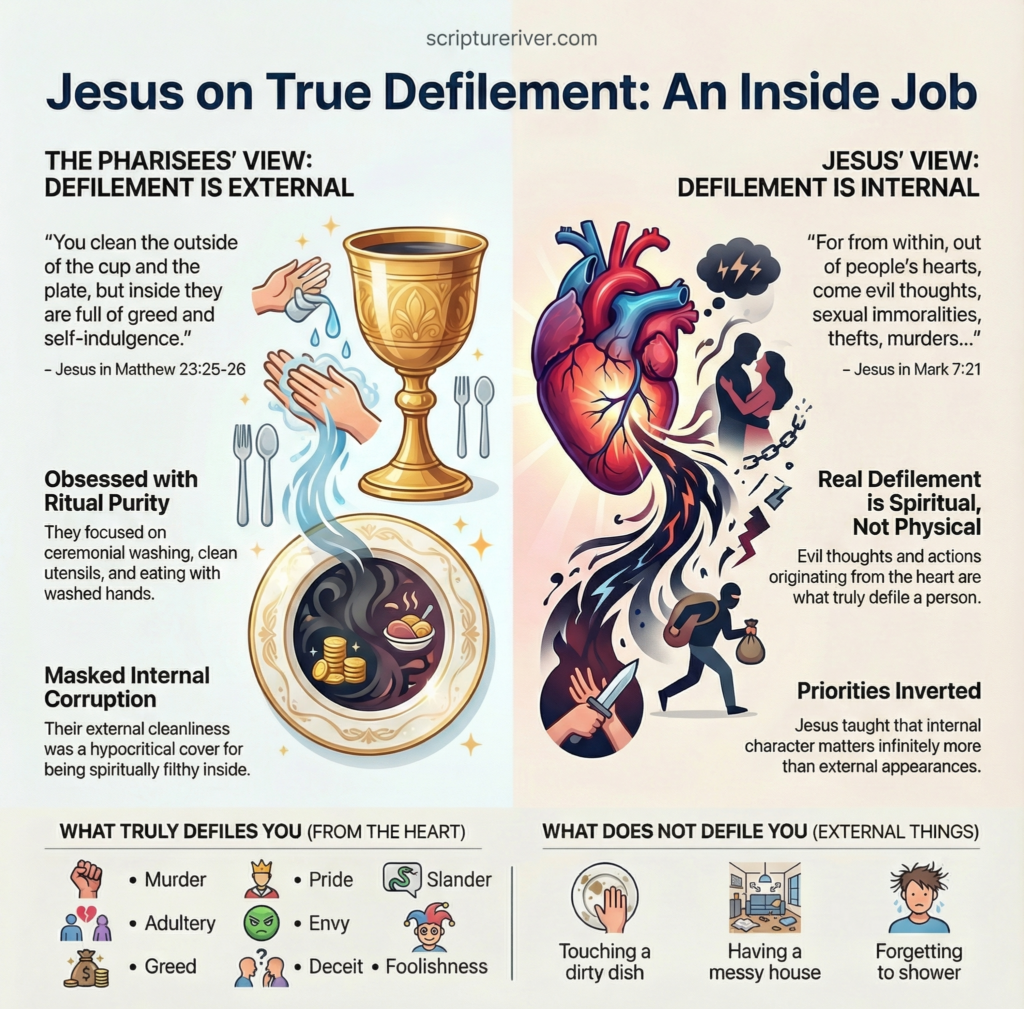
Jesus confronted religious leaders who obsessed over external cleanliness while ignoring internal corruption.
Matthew 23:25-26, English Standard Version (ESV) records His scathing rebuke:
“Woe to you, scribes and Pharisees, hypocrites! For you clean the outside of the cup and the plate, but inside they are full of greed and self-indulgence. You blind Pharisee! First clean the inside of the cup and the plate, that the outside also may be clean.”
The Pharisees were meticulous about ceremonial washing and ritual purity.
They judged others for eating with unwashed hands. They obsessed over which utensils were clean. They created elaborate systems for maintaining external cleanliness.
Jesus called them hypocrites.
Their external cleanliness masked internal corruption. They were spiritually filthy while being ceremonially clean.
Mark 7:20-23, Christian Standard Bible (CSB) explains what actually defiles:
“What comes out of a person is what defiles him. For from within, out of people’s hearts, come evil thoughts, sexual immoralities, thefts, murders, adulteries, greed, evil actions, deceit, self-indulgence, envy, slander, pride, and foolishness. All these evil things come from within and defile a person.”
Real defilement is spiritual, not physical.
Murder defiles you. Touching a dirty dish doesn’t. Adultery defiles you. Having a messy house doesn’t. Pride defiles you. Forgetting to shower doesn’t.
Jesus completely inverted the Pharisees’ priority system.
What the Bible Actually Says About Godliness
Godliness in Scripture has nothing to do with cleanliness.
The Greek word for godliness is “eusebeia,” meaning reverence toward God, piety, devotion to God.
1 Timothy 4:7-8, New King James Version (NKJV) defines its priority:
“Exercise yourself toward godliness. For bodily exercise profits a little, but godliness is profitable for all things, having promise of the life that now is and of that which is to come.”
Godliness involves spiritual discipline, not household organization.
2 Peter 1:5-7, New Living Translation (NLT) lists what accompanies godliness:
“Make every effort to respond to God’s promises. Supplement your faith with a generous provision of moral excellence, and moral excellence with knowledge, and knowledge with self-control, and self-control with patient endurance, and patient endurance with godliness, and godliness with brotherly affection, and brotherly affection with love for everyone.”
Notice what’s absent: cleanliness, organization, hygiene, tidiness.
Godliness develops through faith, knowledge, self-control, endurance, and love. Physical cleanliness isn’t mentioned because it’s irrelevant to godliness.
Why This Misquote Causes Real Harm
Treating “cleanliness is next to godliness” as biblical produces multiple problems.
1. It Creates False Standards for Spirituality
People judge their own and others’ spiritual condition based on external appearance.
The person with the immaculate home must be godly.
The person with the messy car must be carnal.
The family whose kids always look perfect must be closer to God than the family with stained clothes.
This is Pharisaism. Exactly what Jesus condemned.
I’ve watched believers with genuine godliness, deep prayer lives, and sacrificial love be dismissed as unspiritual because their homes didn’t meet someone’s cleanliness standard.
Meanwhile, people with spotless houses and zero love for others were considered spiritually mature.
That’s not biblical discernment. That’s cultural prejudice baptized with religious language.
2. It Burdens People Unnecessarily
Single parents working multiple jobs don’t have time for Pinterest-perfect homes.
People with depression struggle to maintain basic hygiene, much less household cleanliness.
Families caring for special needs children live in controlled chaos.
Telling these people that cleanliness is next to godliness adds crushing guilt to already overwhelming circumstances.
They’re failing spiritually because they can’t keep up with arbitrary cleanliness standards that have nothing to do with actual godliness.
That’s not the gospel. That’s legalism.
3. It Distorts Gospel Priorities
When you equate cleanliness with godliness, you divert energy from what actually matters.
Time spent obsessing over perfect homes could be spent serving others.
Energy devoted to maintaining appearances could be devoted to prayer.
Resources used for aesthetic perfection could be used for kingdom work.
I’ve known believers who wouldn’t invite unbelievers into their homes because the house wasn’t clean enough.
Their concern for cleanliness literally blocked evangelism.
That’s priorities completely backwards.
4. It Misrepresents Jesus
Jesus touched lepers.
He ate with unwashed hands. He let a woman with a bleeding disorder touch Him, making Him ceremonially unclean. He defended His disciples when Pharisees criticized them for not washing before eating.
Jesus prioritized people over cleanliness every single time.
If cleanliness were next to godliness, Jesus violated it repeatedly. He was perfectly godly while being ceremonially unclean regularly.
Using this phrase as if it’s biblical misrepresents Jesus’s actual priorities and example.
What Christians Should Actually Care About
If cleanliness isn’t next to godliness, what is?
Scripture gives clear answers.
Love Is Next to Godliness
1 John 4:7-8, New International Version (NIV):
“Dear friends, let us love one another, for love comes from God. Everyone who loves has been born of God and knows God. Whoever does not love does not know God, because God is love.”
Godliness manifests through love, not cleanliness.
Holiness Is Next to Godliness
1 Peter 1:15-16, English Standard Version (ESV):
“But as he who called you is holy, you also be holy in all your conduct, since it is written, ‘You shall be holy, for I am holy.'”
Holiness means being set apart for God, morally pure, reflecting His character. That’s next to godliness because it’s part of godliness.
Obedience Is Next to Godliness
1 John 2:3-6, Christian Standard Bible (CSB):
“This is how we know that we know him: if we keep his commands. The one who says, ‘I have come to know him,’ and yet doesn’t keep his commands, is a liar, and the truth is not in him.”
Obeying God’s actual commands matters infinitely more than meeting cultural cleanliness standards.
Christlikeness Is Next to Godliness
Romans 8:29, New Living Translation (NLT):
“For God knew his people in advance, and he chose them to become like his Son.”
God’s goal is conforming you to Christ’s image. That’s godliness. And it has nothing to do with how organized your closet is.
Practical Wisdom About Cleanliness Without False Theology
Rejecting “cleanliness is next to godliness” doesn’t mean embracing filth.
Wisdom about cleanliness exists without making it a spiritual issue.
Basic hygiene is practical, not spiritual. Bathing prevents illness and shows respect for others. That’s wisdom, not godliness.
Cleanliness can be stewardship. Maintaining your home protects your investment and provides a healthy environment. That’s responsible, not righteous.
Hospitality may involve cleanliness. Making guests comfortable might mean tidying your home. That’s love in action, not earning spiritual points.
Cleanliness preferences are cultural, not biblical. Different cultures have different cleanliness standards. None are more godly than others.
The key is keeping cleanliness in proper perspective: practical wisdom, cultural preference, or loving consideration. Never spiritual requirement.
The Truth That Actually Matters
Godliness comes from relationship with God through Christ, transformation by the Holy Spirit, and obedience to Scripture.
Your spiritual condition isn’t determined by your home’s cleanliness, your car’s organization, or your children’s appearance.
God sees your heart, not your countertops.
He’s concerned with internal transformation, not external presentation.
The Pharisees had cleanliness mastered and godliness absent. Jesus had people questioning His ceremonial purity while being perfectly godly.
Follow Jesus, not cultural Christianity’s false equations between cleanliness and spirituality.
Stop judging yourself and others by standards God never established.
Focus on what Scripture actually identifies as godliness: love, holiness, obedience, Christlikeness.
And if someone quotes “cleanliness is next to godliness” as if it’s biblical, lovingly correct them. That phrase isn’t Scripture, contradicts Jesus’s teaching, and creates false guilt for struggling believers.
Truth matters. And the truth is that cleanliness has nothing to do with godliness.
Prayer for Right Priorities
Father, forgive me for elevating cultural standards to biblical commands. I’ve judged myself and others by cleanliness when You judge hearts by godliness.
Help me distinguish between practical wisdom and spiritual requirement. Free me from false guilt about not meeting arbitrary cleanliness standards.
Redirect my energy toward what actually matters: loving You, obeying You, and becoming like Christ. Teach me to prioritize people over appearances, love over legalism, grace over judgment.
When I’m tempted to equate external cleanliness with internal godliness, remind me of Jesus’s example and teaching.
Make me truly godly according to Your standards, not culture’s.
In Jesus’s Name, Amen.
References
Carson, D. A. (1984). Matthew: The Expositor’s Bible Commentary (Vol. 8). Zondervan.
Edwards, J. R. (2002). The Gospel According to Mark. Eerdmans Publishing Company.
France, R. T. (2007). The Gospel of Matthew. Eerdmans Publishing Company.
Mounce, W. D. (2000). Pastoral Epistles. Thomas Nelson Publishers.
Peterson, E. H. (2005). The Message: The Bible in Contemporary Language. NavPress.
Schreiner, T. R. (2003). 1, 2 Peter, Jude. B&H Publishing Group.
Strong, J. (2010). Strong’s Exhaustive Concordance of the Bible. Hendrickson Publishers.
Stott, J. R. W. (1988). The Letters of John: An Introduction and Commentary. InterVarsity Press.
Wesley, J. (1872). Sermons on Several Occasions (Vol. 2). Wesleyan Conference Office.
Wiersbe, W. W. (2007). The Bible Exposition Commentary: New Testament (Vol. 1). David C. Cook.

