

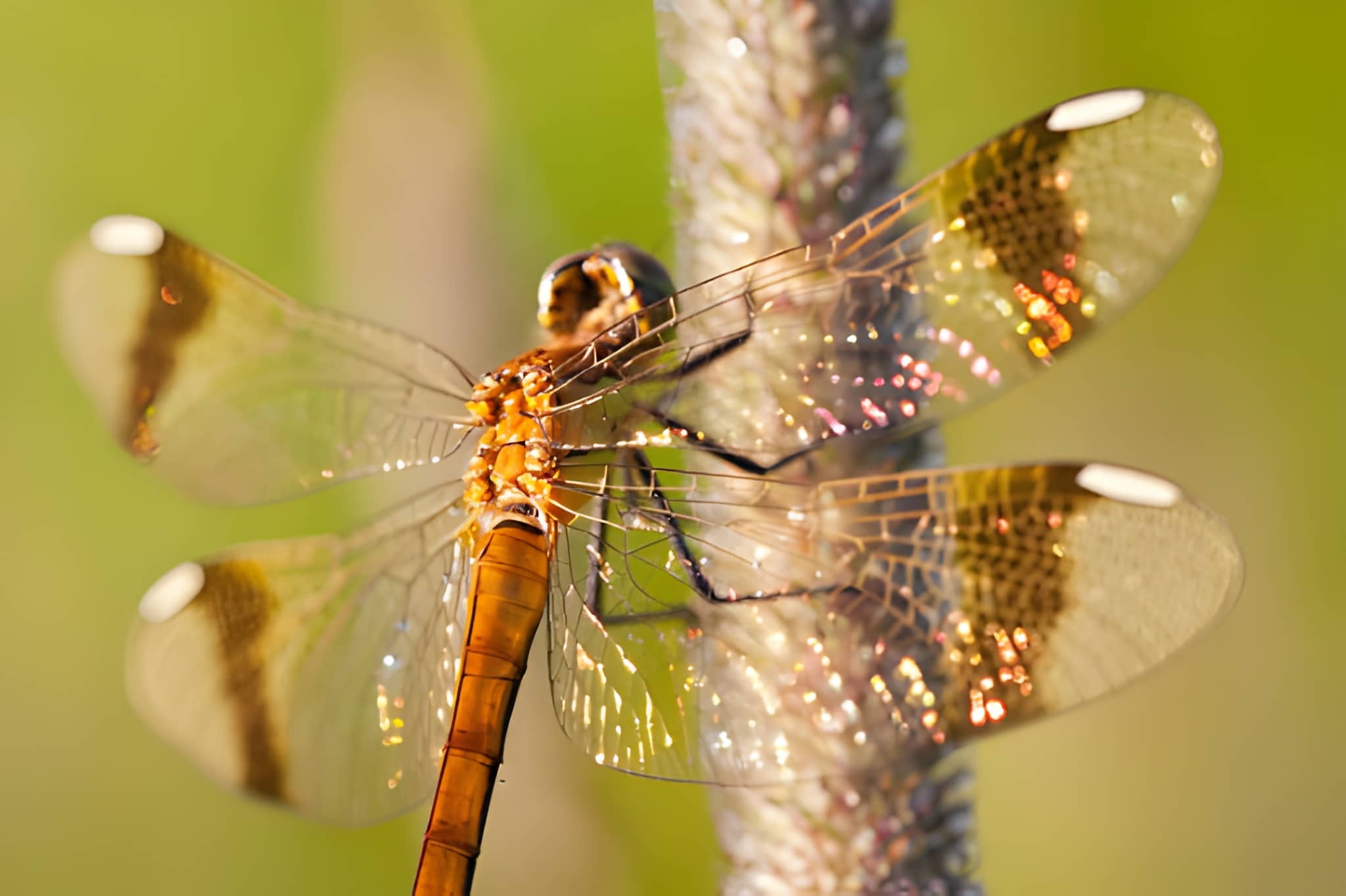
Dragonflies don’t appear anywhere in the Bible.
Not once.
The Hebrew and Greek texts that comprise Scripture never mention these iridescent insects.
Yet if you search “dragonfly Christian meaning” online, you’ll find hundreds of websites claiming dragonflies symbolize transformation, resurrection, God’s light, spiritual maturity, and the Holy Spirit.
Here’s the problem: most of these claimed meanings have no biblical or historical Christian basis.
They’re modern inventions that blend nature appreciation with vague spiritual language, then package it as Christian symbolism.
This matters because Christians should distinguish between legitimate biblical symbolism grounded in Scripture and cultural symbolism that gets labeled “Christian” without theological foundation.
When we assign spiritual meanings to things God never addressed, we risk creating a Christianity that’s more superstition than Scripture.
Let’s examine what dragonflies actually symbolize in Christianity (spoiler: very little historically), where modern dragonfly symbolism came from, what Scripture does say about insects and transformation, and how to think biblically about nature symbolism.
The Historical Christian Silence About Dragonflies
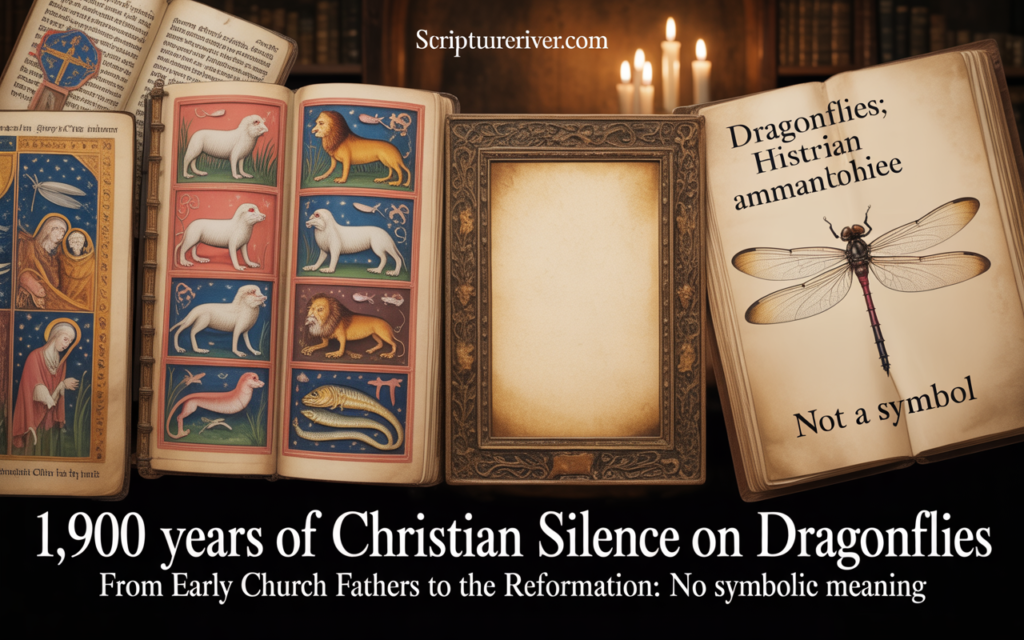
Christian art, literature, and theology from the first century through the 19th century contain virtually no references to dragonflies as Christian symbols.
Early Church Fathers: No Mention
Writings from early church fathers like Augustine, Jerome, Origen, Tertullian, and Chrysostom contain extensive commentary on biblical symbolism.
They discussed lambs, doves, lions, serpents, fish, and numerous other creatures mentioned in Scripture.
Dragonflies? Nothing.
These theological giants who spent lifetimes studying Scripture and developing Christian doctrine never connected dragonflies to resurrection, transformation, or spiritual truth.
Medieval Christian Art and Symbolism
Medieval Christians developed rich symbolic traditions around creatures mentioned in Scripture or those that illustrated biblical principles.
Bestiaries (medieval books describing animals with moral lessons) included real and mythical creatures like pelicans, phoenixes, lions, and unicorns.
According to art historian George Ferguson’s work on Christian symbolism, dragonflies appear occasionally in medieval illuminated manuscripts as decorative elements in nature scenes, but never as symbolic figures with theological meaning.
Reformation and Post-Reformation: Still Silent
Protestant reformers who emphasized returning to biblical authority didn’t develop dragonfly symbolism.
Puritan writers who found spiritual lessons in nature focused on creatures Scripture mentions, not insects the Bible ignores.
The historical Christian tradition simply doesn’t include dragonfly symbolism as meaningful or important.
Where Modern Dragonfly Christian Symbolism Came From
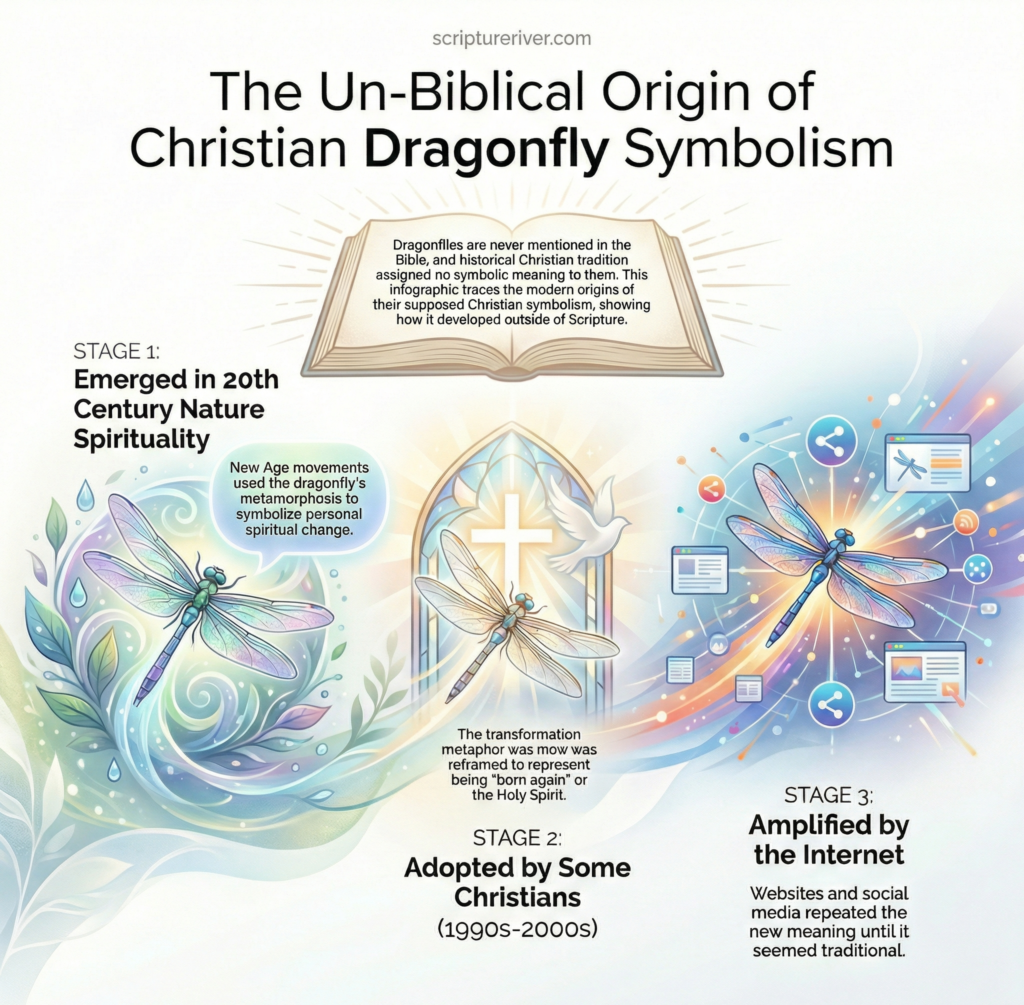
If historical Christianity didn’t assign spiritual meaning to dragonflies, where did current claims about their Christian symbolism originate?
20th Century Nature Spirituality Movement
The modern connection between dragonflies and spiritual transformation emerged primarily in the late 20th century New Age and nature spirituality movements.
These movements emphasized finding spiritual meaning in nature experiences, particularly through animals and insects as “spirit guides” or symbols.
Dragonflies became popular symbols in this context due to their biological metamorphosis (from water-dwelling nymph to flying adult) and their striking appearance.
The transformation metaphor resonated with people seeking symbols for personal spiritual change.
Christian Adoption of Cultural Symbolism
Some Christians, particularly in American evangelical culture, began adopting dragonfly symbolism in the 1990s and 2000s, reframing the transformation metaphor in Christian terms.
Instead of “spirit guides,” dragonflies represented being “born again” or the Holy Spirit.
This represents what theologian D.A. Carson calls “Christianizing” cultural symbols by adding biblical language to meanings that didn’t originate from Scripture.
Internet Amplification
The internet dramatically accelerated the spread of dragonfly Christian symbolism.
Websites, social media, and Christian greeting card companies repeated and reinforced these meanings until they became accepted as traditional Christian symbolism, despite having no historical basis.
What Scripture Actually Says About Insects and Transformation
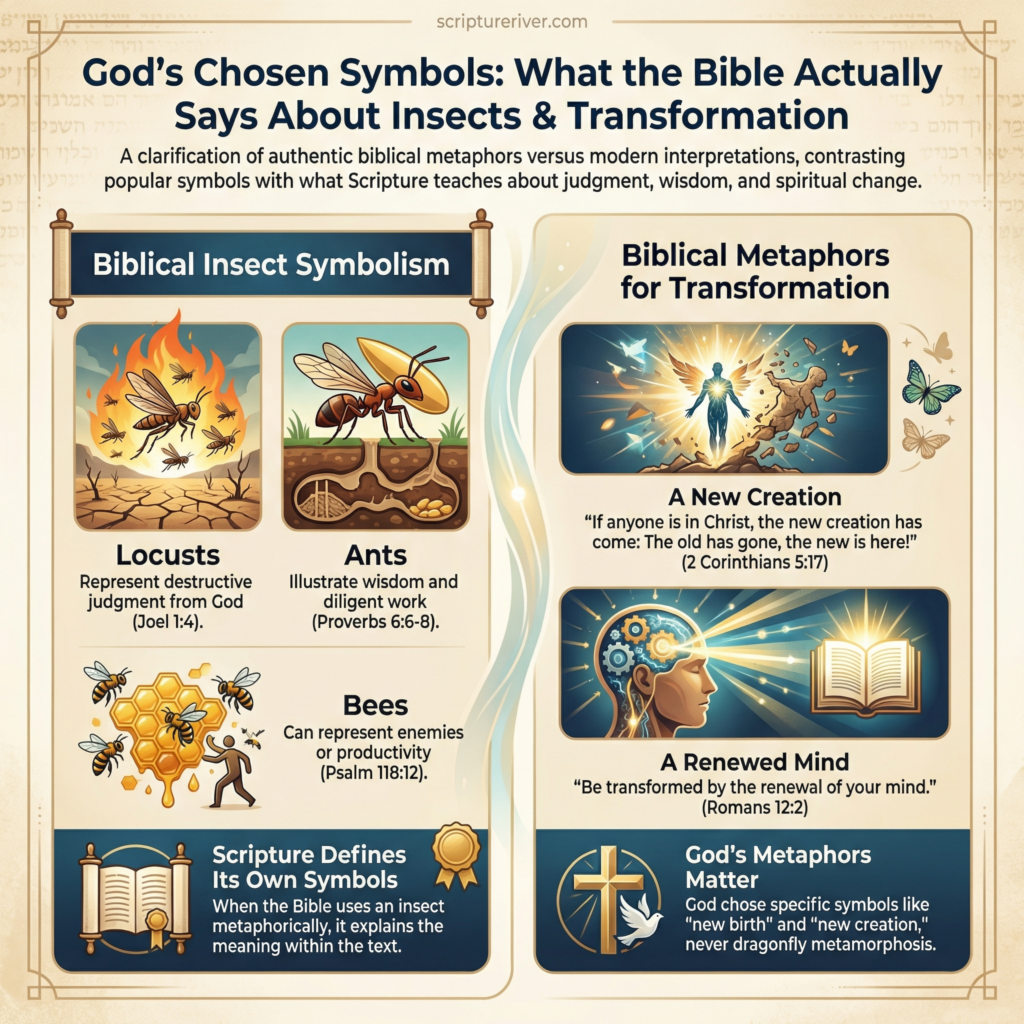
The Bible does use insects symbolically and addresses transformation extensively.
Understanding what Scripture actually teaches helps us evaluate whether dragonfly symbolism aligns with biblical theology.
Biblical Insect Symbolism
Scripture mentions insects metaphorically in specific contexts:
Locusts represent destructive judgment (Joel 1:4, Exodus 10:12-15).
Ants illustrate wisdom and diligent work (Proverbs 6:6-8).
Bees can represent enemies (Psalm 118:12) or productivity (Isaiah 7:18).
Moths symbolize things that decay and don’t last (Matthew 6:19-20).
Notice the pattern: when Scripture uses insects symbolically, it explains the symbolism within the text.
God doesn’t expect readers to invent meanings for creatures He doesn’t mention.
Biblical Teaching on Transformation
Scripture extensively addresses spiritual transformation using specific metaphors God chose to reveal:
2 Corinthians 5:17, New International Version (NIV)
“Therefore, if anyone is in Christ, the new creation has come: The old has gone, the new is here!”
Romans 12:2, English Standard Version (ESV)
“Do not be conformed to this world, but be transformed by the renewal of your mind.”
God uses metaphors like new birth (John 3:3), new creation, and renewed minds to explain transformation. He never uses dragonfly metamorphosis.
Why God’s Chosen Metaphors Matter
God’s decision to use certain metaphors and not others isn’t arbitrary.
He chose symbols that communicate specific theological truths effectively.
Lambs emphasize sacrifice and innocence. Doves emphasize peace and purity.
New birth emphasizes radical change and dependence. Each metaphor teaches something essential about spiritual reality.
Adding our own symbolic meanings to things God didn’t address risks obscuring what He actually wants to communicate.
The Problem With Assigning Christian Meaning to Non-Biblical Symbols
Creating Christian symbolism for things Scripture doesn’t address creates several theological problems.
It Suggests Scripture Is Insufficient
When we need to find Christian meaning in dragonflies, are we implicitly saying God’s revealed metaphors aren’t enough?
That Scripture’s extensive teaching on transformation needs supplementing with nature observations?
2 Timothy 3:16-17, Christian Standard Bible (CSB) addresses Scripture’s sufficiency:
“All Scripture is inspired by God and is profitable for teaching, for rebuking, for correcting, for training in righteousness, so that the man of God may be complete, equipped for every good work.”
It Risks Mixing Biblical Christianity With Other Spiritualities
Many symbols that get Christianized originated in spiritual traditions incompatible with biblical faith.
When we adopt these symbols and reinterpret them Christianly, we blur the distinction between biblical revelation and human religious invention.
It Creates Confusion About What Christians Actually Believe
When non-Christians encounter “Christian dragonfly symbolism,” they may conclude Christianity is about finding spiritual meaning in nature experiences rather than about Jesus’s death and resurrection for sin.
The gospel gets obscured when peripheral nature symbolism gets presented as central Christian teaching.
It Turns Personal Preferences Into Spiritual Truths
If dragonflies can symbolize transformation because we observe their metamorphosis and find it spiritually meaningful, then any natural phenomenon can symbolize whatever we want it to symbolize.
That’s not theology. That’s personal interpretation masquerading as spiritual truth.
How To Think Biblically About Nature and Symbolism
Rejecting invented dragonfly symbolism doesn’t mean rejecting nature’s spiritual value.
Scripture does teach that creation reveals God’s character.
What Creation Actually Reveals
Psalm 19:1, New King James Version (NKJV)
“The heavens declare the glory of God; and the firmament shows His handiwork.”
Romans 1:20, English Standard Version (ESV)
“For his invisible attributes, namely, his eternal power and divine nature, have been clearly perceived, ever since the creation of the world, in the things that have been made.”
Creation reveals God’s existence, power, creativity, and glory. It points us toward God Himself, not toward specific symbolic meanings we assign to individual creatures.
The Difference Between General and Special Revelation
Theologians distinguish between general revelation (what nature reveals about God) and special revelation (what Scripture reveals about God).
General revelation shows God exists and is powerful. Special revelation shows who God is specifically, what He’s done through Christ, and how we’re saved.
We can admire dragonflies as examples of God’s creative power without inventing symbolic meanings God never assigned.
Appreciating Nature Without Inventing Symbolism
You can watch a dragonfly and worship God for His creativity without claiming the dragonfly symbolizes transformation.
You can marvel at its design without Christianizing it with symbolic meanings.
Nature points to God simply by being what God created. It doesn’t need our symbolic interpretations to accomplish its purpose.
What To Say When Someone Gives You Dragonfly Christian Symbolism
You’ll encounter dragonfly Christian symbolism in greeting cards, social media posts, and well-meaning gifts.
How should you respond biblically without being unkind?
Appreciate the Intention
When someone shares dragonfly symbolism with you, they’re usually trying to encourage you. Appreciate their kind intention even if the theology is questionable.
Gently Redirect to Scripture
You might say something like: “I appreciate the thought. You know, the Bible has some beautiful passages about transformation that really encourage me,” then share actual Scripture about new creation or renewal.
Don’t Make It a Major Issue
Dragonfly symbolism is theologically weak, but it’s not heresy worth creating conflict over. Save your theological battles for issues that actually affect core Christian doctrine.
Use It as a Teaching Opportunity If Appropriate
With people genuinely interested in biblical accuracy, you can explain that while dragonflies display God’s creative power, the transformation symbolism isn’t found in Scripture or historical Christianity. Then discuss what Scripture actually teaches about spiritual transformation.
Frequently Asked Questions About Dragonflies and Christianity
Are dragonflies mentioned anywhere in the Bible?
No. Dragonflies don’t appear in any biblical text in the original Hebrew or Greek. While the Bible mentions several insects symbolically (locusts, ants, moths, bees), dragonflies are never referenced.
Is it wrong for Christians to appreciate dragonflies?
Not at all. Appreciating any part of God’s creation is good and appropriate. The issue isn’t enjoying dragonflies but claiming they have specific Christian symbolic meanings that aren’t grounded in Scripture or Christian tradition.
What about dragonflies representing resurrection?
This is a modern symbolic association without biblical foundation. The dragonfly’s metamorphosis from nymph to flying adult is biologically fascinating, but God never used this process as a resurrection metaphor in Scripture. Biblical resurrection imagery focuses on Jesus rising from death, believers being spiritually reborn, and future bodily resurrection.
Can I have dragonfly jewelry or art as a Christian?
Yes. Owning dragonfly-themed items isn’t spiritually problematic. The issue is assigning theological meanings God didn’t assign. You can appreciate dragonflies as beautiful examples of God’s creation without accepting non-biblical symbolic interpretations.
What should I focus on instead of nature symbolism?
Focus on what Scripture explicitly teaches. The Bible provides extensive teaching about transformation, the Holy Spirit, resurrection, and spiritual growth using metaphors God chose. These are sufficient for understanding spiritual truth without adding our own symbolic interpretations to things Scripture doesn’t address.
Is this just legalism about symbols?
No. This is about maintaining biblical authority. The question isn’t whether dragonflies are acceptable but whether Christians should invent symbolic meanings for things Scripture doesn’t address, then present those meanings as Christian teaching. Distinguishing between human invention and divine revelation isn’t legalism. It’s faithfulness to Scripture.
Referenced Sources
Carson, D. A. (2010). Christ and Culture Revisited. Eerdmans Publishing Company. [Book]
Ferguson, G. (1961). Signs and Symbols in Christian Art. Oxford University Press. [Book]
Peterson, E. H. (2005). The Message: The Bible in Contemporary Language. NavPress. [Bible Translation]
Strong, J. (2010). Strong’s Exhaustive Concordance of the Bible. Hendrickson Publishers. [Reference Book]
Wiersbe, W. W. (2007). The Bible Exposition Commentary: New Testament (Vol. 2). David C. Cook. [Book]

