

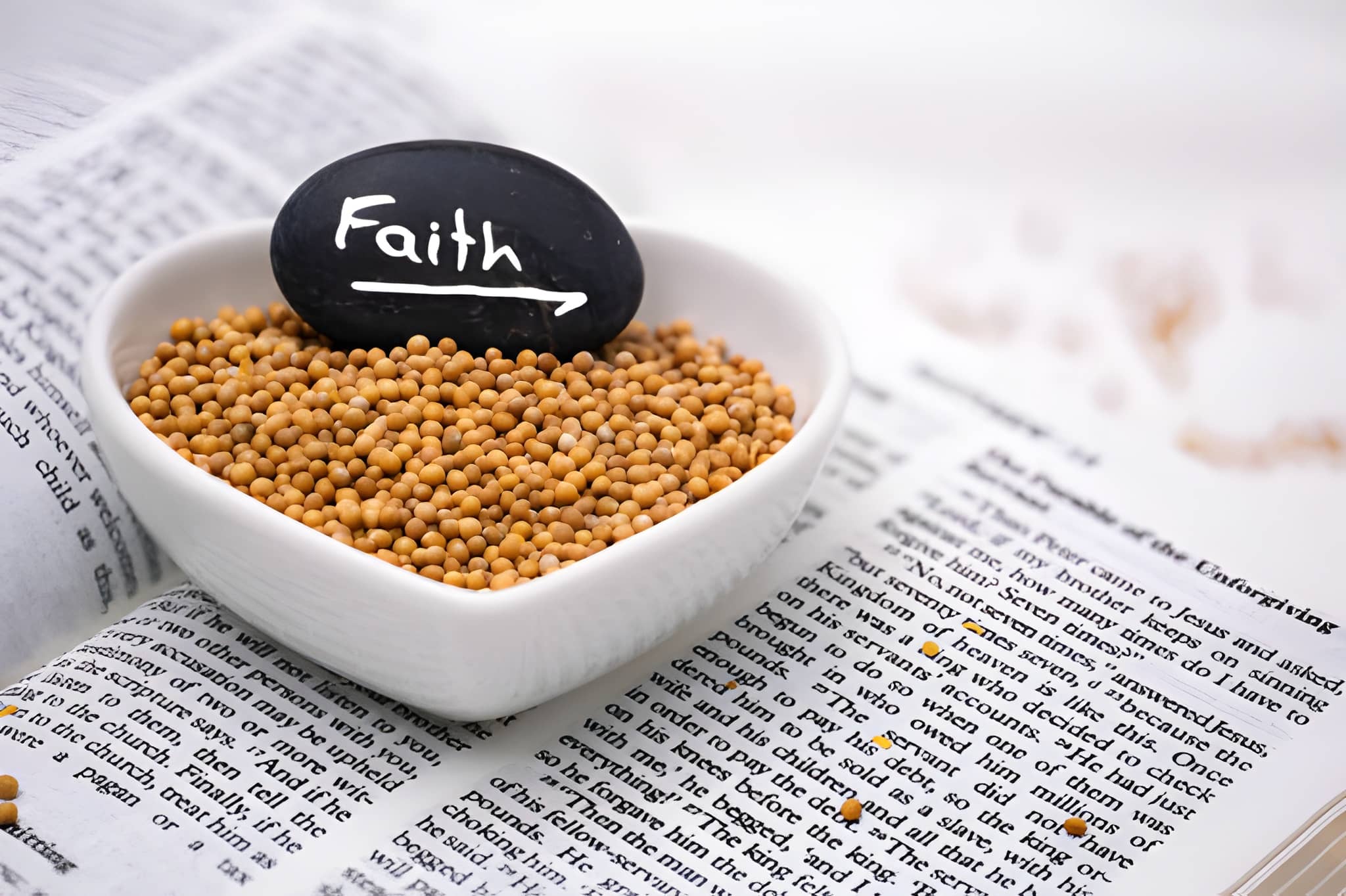
I used to think the faith of a mustard seed was about having small faith.
Tiny faith. Barely-there faith.
The kind of faith that’s better than nothing, but obviously not impressive or powerful.
I figured Jesus was basically saying, “Look, even if your faith is pathetic and microscopic like this tiny seed, at least it’s something.”
Turns out I had it completely backwards.
The mustard seed illustration isn’t about the smallness of your faith.
It’s about the nature of authentic faith versus the religious performance most of us mistake for the real thing.
And when you understand what Jesus was actually saying in Matthew 17:20, it doesn’t just change how you think about faith.
It changes everything about how you approach God, prayer, and spiritual power.
I have spent years preaching messages about mustard seed faith without actually understanding what Jesus meant.
Then a crisis forced me to examine this passage more carefully, and what I discovered revolutionized my entire ministry and spiritual life.
And so, I’m hoping that we’re going to unpack exactly what Jesus meant by faith of a mustard seed.
Together, we’ll look at the context that makes His statement make sense, examine what mustard seeds actually are, and explore how this teaching applies to the specific struggles you’re facing right now.
Audio Explanation: Why This Teaching Changes Everything
Listen to this brief audio message explaining why Jesus’s mustard seed teaching is one of the most misunderstood passages in the Gospels and how grasping what He actually meant will transform your prayer life, your expectations of God, and your understanding of spiritual power.
The Crisis That Prompted Jesus’s Mustard Seed Teaching
You can’t understand what Jesus meant about faith of a mustard seed without knowing why He said it.
Matthew 17 records one of the most embarrassing failures in the disciples’ ministry.
A desperate father brought his demon-possessed son to Jesus’s disciples, begging them to heal the boy.
These were the same disciples who’d been healing people and casting out demons throughout their ministry.
Jesus had given them the authority to do this work.
But this time, nothing happened.
They tried everything they knew.
They commanded the demon to leave. They prayed.
They probably worked up quite a religious performance trying to make something happen. And the demon didn’t budge.
The boy remained tormented while the disciples stood there looking incompetent in front of a growing crowd.
When Jesus arrived and saw what was happening, He was frustrated.
The Gospel accounts record Him saying things like “You unbelieving and perverse generation, how long shall I stay with you?”
He wasn’t happy about this failure.
Then Jesus healed the boy instantly with a simple command.
Later, when the disciples got Jesus alone, they asked the question that’s haunted believers for two thousand years: “Why couldn’t we drive it out?”
They’d done this successfully before. They had Jesus’s authority. They went through all the right motions. So why did their faith fail this time?
Here’s Jesus’s full response from Matthew 17:20:
“He replied, ‘Because you have so little faith. Truly I tell you, if you have faith as small as a mustard seed, you can say to this mountain, “Move from here to there,” and it will move. Nothing will be impossible for you.'”
(Matthew 17:20, New International Version)
At first glance, this seems contradictory.
Jesus says they have “so little faith,” but then He says faith as small as a mustard seed can move mountains.
That doesn’t make sense unless you understand what He’s actually talking about.
What Mustard Seeds Actually Are and Why That Matters
The mustard seed was the smallest seed commonly used in first-century Jewish agriculture.
That’s why Jesus used it as His illustration.
But here’s what most people miss about mustard seeds.
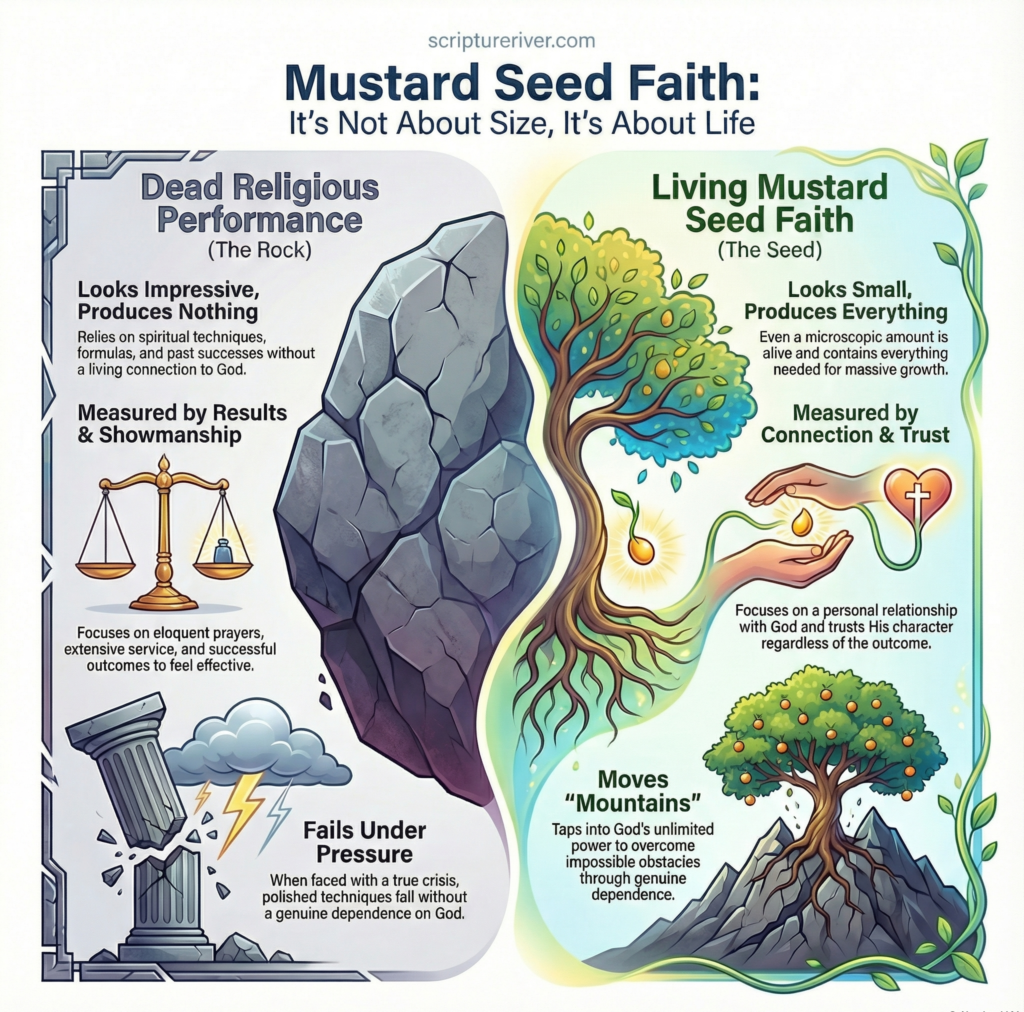
A mustard seed isn’t just small. It’s alive.
That’s the entire point of Jesus’s illustration.
He’s contrasting dead religious activity with living, organic faith.
The disciples had lots of religious effort, lots of spiritual techniques, lots of going through motions.
But they didn’t have living faith connected to the living God.
A mustard seed is tiny, yes. But it contains everything necessary to produce a massive plant.
Given proper conditions, that microscopic seed grows into a tree large enough for birds to nest in its branches.
The potential isn’t in the seed’s size but in its life.
Dead faith, no matter how big or impressive, produces nothing. Living faith, no matter how small, produces everything.
The disciples’ problem wasn’t that their faith was too small.
Their problem was that their faith was dead, disconnected from an actual relationship with God and dependence on His power.
They were operating on technique, formula, and past success rather than present connection with the Father.
I made this same mistake for years in ministry.
I had all the right theology. I knew all the right prayer formulas. I could quote Scripture eloquently.
But much of my “faith” was actually religious performance disconnected from living dependence on God.
When crisis came, and my polished techniques didn’t work, I had to discover what living faith actually looks like.
And it was humbling to realize that a tiny amount of real faith accomplishes more than massive amounts of religious showmanship.
The Difference Between Faith Size and Faith Type
Here’s where we need to get crystal clear on what Jesus was actually saying about the faith of a mustard seed.
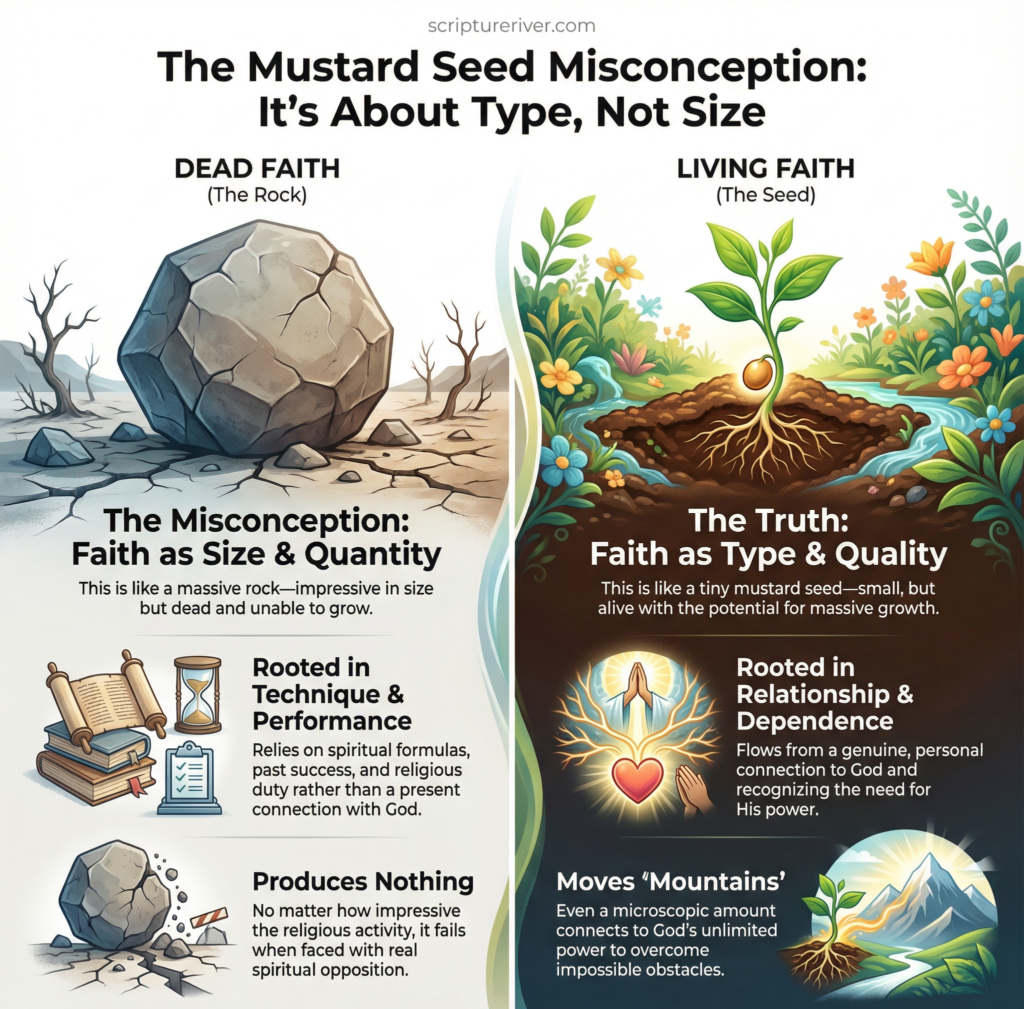
Jesus wasn’t measuring faith by size or quantity.
He was identifying faith by type or quality. The issue isn’t how much faith you have but whether your faith is alive and genuine.
Think about it this way.
A tiny seed planted in soil will grow.
A massive rock placed in soil will not, no matter how long you wait.
The seed’s power isn’t in its size but in its nature. It’s alive.
Religious activity feels like faith, but it’s dead.
It’s going through spiritual motions without an actual connection to God’s presence and power.
You can pray eloquent prayers that sound impressive but contain no living faith.
You can attend church faithfully, serve extensively, and give generously while operating primarily on duty rather than relationship.
Living faith, even in microscopic amounts, taps into God’s unlimited power because it’s connected to Him.
It’s organic, alive, growing, and productive.
It doesn’t depend on your spiritual resume or religious credentials.
It depends on a genuine relationship with the Father.
The disciples had cultivated impressive religious technique.
They could perform exorcisms successfully when the demons were relatively weak.
But when they encountered serious spiritual opposition, their technique failed because it wasn’t rooted in a living connection with God’s power.
Jesus was telling them: you don’t need more techniques, more training, more spiritual experience.
You need real faith, even if it’s tiny.
Living connection with God, even if it feels small and inadequate, accomplishes what religious showmanship never can.
What “Moving Mountains” Actually Means
When Jesus said faith the size of a mustard seed can move mountains, He wasn’t being literal.
He was using a common Jewish metaphor.
In rabbinic teaching, “moving mountains” referred to overcoming impossible obstacles or solving impossibly difficult problems.
It wasn’t about geographic relocation. It was about doing the humanly impossible through God’s power.
Mountains represented whatever was blocking you from God’s purposes.
Immovable obstacles.
Insurmountable problems.
Situations so massive and fixed that human effort can’t budge them.
Jesus was saying that living faith, regardless of how small it feels to you, connects you to God’s power that can handle anything.
No obstacle is too big for God. No problem is beyond His ability.
And even tiny, genuine faith gives you access to that unlimited power.
But here’s the critical nuance most people miss: moving mountains isn’t about getting whatever you want through positive thinking or name-it-claim-it theology.
Moving mountains is about participating in God’s purposes.
It’s about obstacles to His kingdom work being removed through faith-filled prayer and obedience.
It’s not a blank check for personal wishes. It’s an invitation to partnership with God in accomplishing what He wants done.
I’ve seen mountains moved in ministry when I’ve prayed with even small amounts of living faith about things aligned with God’s heart.
I’ve also seen my “mountain moving” prayers fail completely when I was trying to manipulate God into supporting my agenda rather than aligning myself with His.
The faith of a mustard seed moves mountains when it’s faith in God’s character and commitment to His purposes, not faith in your ability to force outcomes you want.
Five Characteristics of Living Mustard Seed Faith
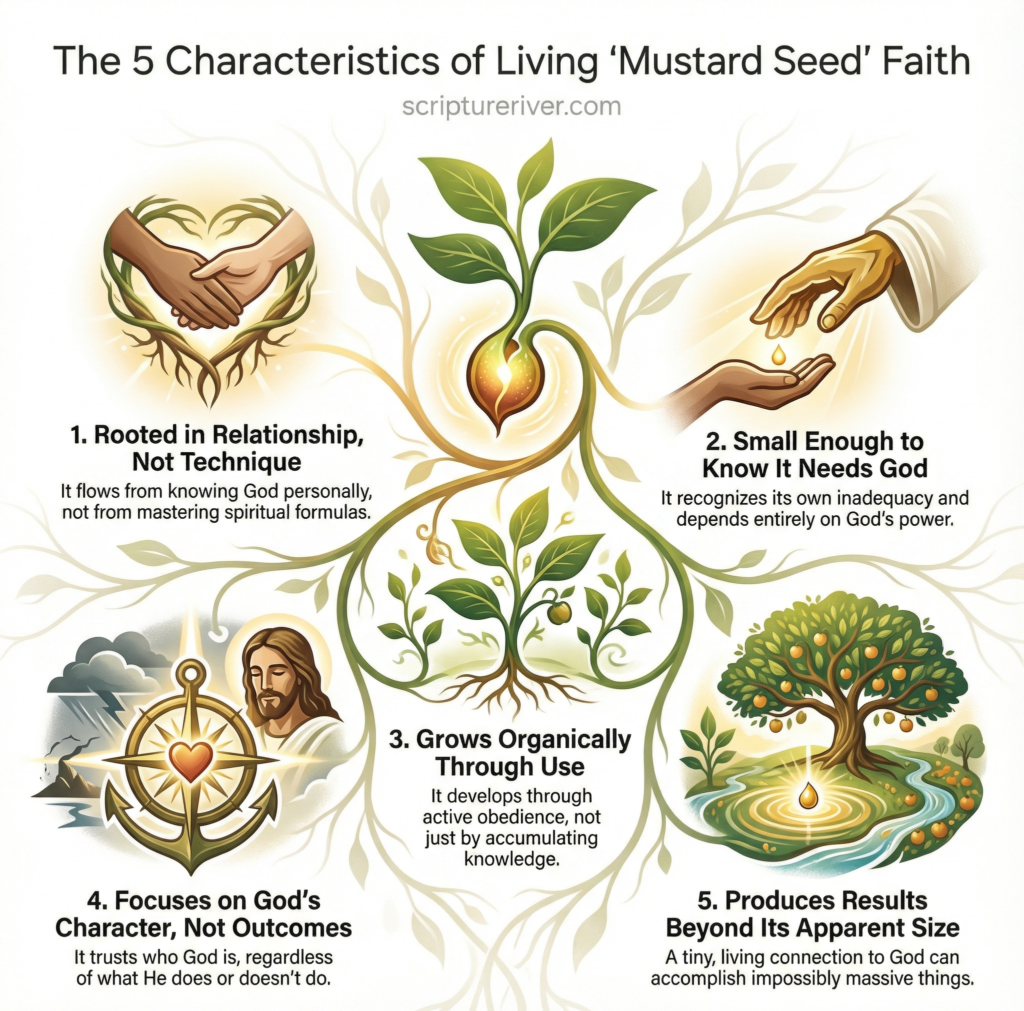
Let me break down what living faith actually looks like so you can recognize the difference between genuine faith and religious performance.
1. It’s Rooted in Relationship, Not Technique
Living faith flows from knowing God personally, not from mastering spiritual formulas.
The disciples were trying a technique when they should have been depending on a relationship.
They’d learned methods for casting out demons, but they’d disconnected those methods from ongoing communion with the Father.
Real faith doesn’t pray certain words because those words are magical.
It talks to God because it knows Him.
It doesn’t follow formulas mechanically.
It engages personally with a living Person who hears and responds.
When I pray with living faith, I’m not reciting scripts or following spiritual protocols.
I’m talking to my Father who loves me, knows me, and wants to respond to me.
That shift from technique to relationship changes everything.
2. It’s Small Enough to Know It Needs God
Mustard seed faith recognizes its own inadequacy and therefore clings to God’s sufficiency.
The disciples’ problem was that their past successes had made them confident in their methods rather than dependent on God.
They thought they knew how to cast out demons.
They had the technique down. So they tried operating independently of moment-by-moment connection with the Father.
Living faith says, “I can’t do this, but God can, so I’m depending entirely on Him.”
It’s not confidence in your faith. It’s confidence in the God your faith is connected to.
I’ve discovered that my most powerful prayers aren’t the eloquent ones where I feel spiritually impressive.
They’re the desperate ones where I know I’m completely out of my depth and utterly dependent on God showing up.
3. It Grows Organically Through Use
A seed isn’t static. It grows. Similarly, living faith develops through exercise, not through the accumulation of knowledge.
You don’t build living faith by reading more books about faith or attending more seminars on spiritual power.
You build it by stepping out in obedience to what God’s already told you and watching Him prove faithful.
Every time you obey God in something that requires His intervention to succeed, your faith grows.
Not because you’re becoming more impressive but because you’re accumulating personal evidence of God’s faithfulness.
My faith is stronger today than five years ago, not because I’ve learned more theology but because I’ve tested God’s promises more frequently and found Him faithful every time.
4. It Focuses on God’s Character, Not Desired Outcomes
Living faith trusts who God is, regardless of what He does.
The disciples wanted outcomes.
They wanted the demon gone, the boy healed, their reputation intact.
When outcomes didn’t materialize, they concluded their faith was insufficient.
But living faith isn’t measured by getting what you want.
It’s measured by trusting God even when you don’t get what you want.
It says, “God is good, God is faithful, God is wise, and I trust Him whether He gives me this specific request or not.”
I’ve prayed with mustard seed faith for things God didn’t give me.
My faith wasn’t proven false by unanswered prayers.
It was proven real by my continued trust in God’s character despite disappointing outcomes.
5. It Produces Results Beyond Its Apparent Size
This is the miracle of living faith.
Tiny amounts accomplish massive things because they’re connected to unlimited divine power.
You don’t need to feel super spiritual or generate enormous amounts of confidence.
You just need a genuine connection to God, even if it feels small and inadequate.
That living link to infinite power makes the impossible possible.
I’ve watched believers with simple, uncomplicated faith see God move powerfully while highly educated theologians with impressive religious credentials see nothing happen.
The difference wasn’t intelligence or training. It was a living connection versus a dead technique.
How to Develop Faith of a Mustard Seed in Your Life
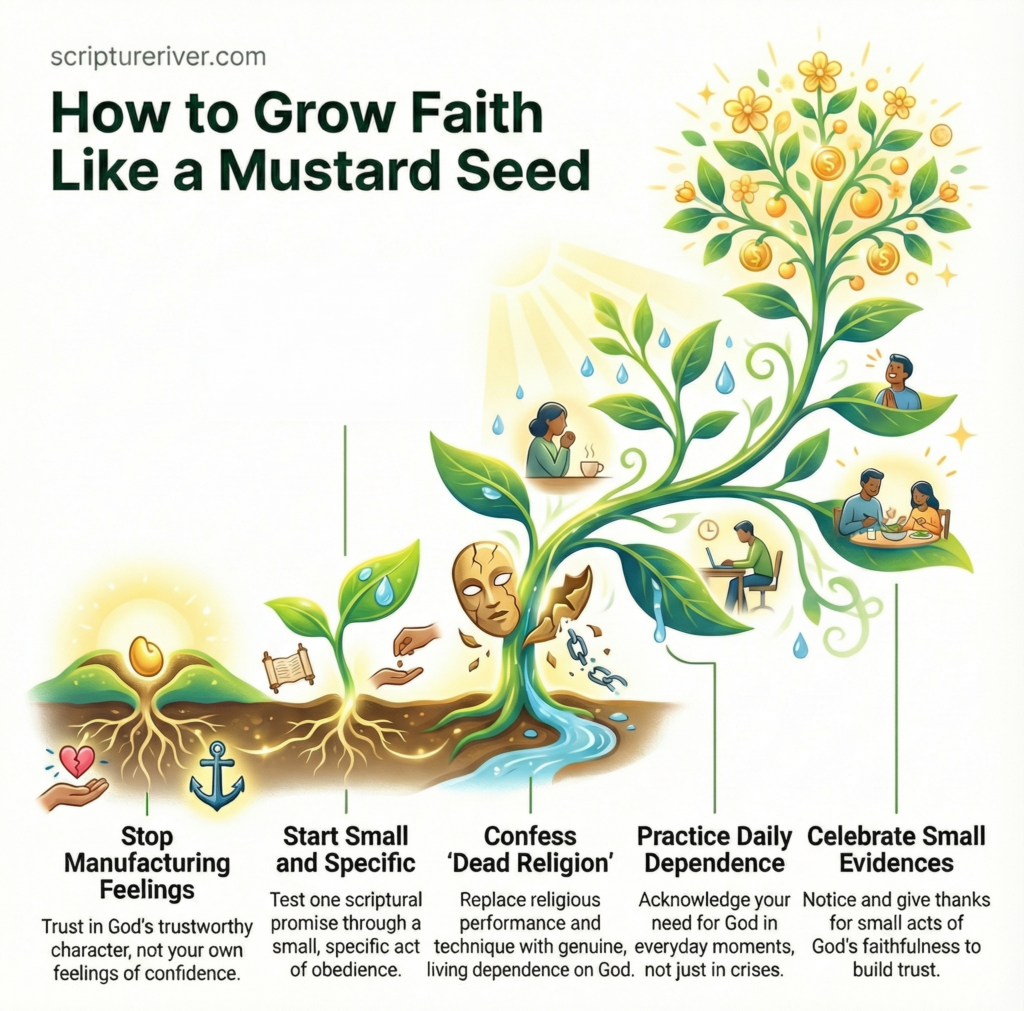
Understanding mustard seed faith theoretically is one thing. Actually developing it is another.
Here are practical steps for cultivating living faith.
1. Stop Trying to Manufacture Feelings
Faith isn’t a feeling you generate. It’s trust in a Person who’s trustworthy.
Stop waiting to feel super spiritual before you pray with faith. Just talk to God based on who He is, not on how confident you feel.
2. Start Small and Specific
Take one promise from Scripture. Test it through obedience in something small and specific.
Watch what God does. That becomes evidence for bigger faith later.
I started with small financial faithfulness, tithing when it felt impossible. Watching God provide built faith for bigger risks later.
3. Confess Dead Religion Honestly
Ask God to show you where your “faith” is actually religious performance disconnected from relationship.
Confess it. Let Him replace dead technique with living dependence.
This was painful for me as a pastor.
Recognizing how much of my ministry was polished performance rather than dependent faith required humility I didn’t want to embrace.
But it was necessary for developing real faith.
4. Practice Desperate Dependence Daily
Living faith grows through regular acknowledgment that you need God for everything, not just crisis moments.
Before meetings, before conversations, before decisions, pause and say, “God, I need You. I can’t do this without You. I’m depending on You.”
That’s mustard seed faith in practice.
5. Celebrate Small Evidences of God’s Faithfulness
When God shows up in small ways, notice and thank Him.
Each small act of faithfulness builds evidence for bigger trust later. This is how tiny faith grows organically.
When Your Mustard Seed Faith Feels Nonexistent
Let me address what you’re probably thinking right now: “I don’t even have mustard seed faith. I barely believe anything at this point.”
Here’s the secret: if you’re concerned about whether you have faith, that concern itself is evidence of living faith.
Dead faith doesn’t worry about faith levels.
It’s content with religious performance.
The fact that you want genuine faith, that you’re dissatisfied with going through motions, suggests there’s life there even if it feels microscopic.
Bring your tiny, struggling, question-filled faith to Jesus exactly as it is.
Don’t wait until you feel more spiritual. Don’t try to manufacture confidence you don’t have. Just be honest.
“God, I barely believe, but I want to believe. Help my unbelief.”
That prayer is mustard seed faith. It’s small, it feels inadequate, but it’s alive and connected to God. And that’s enough for Him to work with.
The father of the demon-possessed boy in this very passage said to Jesus, “I believe; help my unbelief!” And Jesus healed his son.
Struggling, conflicted, question-filled faith that stays connected to Jesus is still living faith.
Our Understanding of Faith of a Mustard Seed
After years of misunderstanding this passage and then encountering Jesus’s actual meaning, here’s what I want you to take away.
You don’t need impressive spiritual credentials, and you also don’t need to master religious techniques or generate enormous amounts of spiritual enthusiasm.
What you need is a genuine, living connection to God, even if it’s tiny.
That’s the faith of a mustard seed. Not small faith that’s barely adequate.
But living faith, regardless of size, that taps into unlimited divine power because it’s organically connected to the Source.
Stop measuring your faith by feelings or comparing yourself to other believers who seem more spiritual.
Start cultivating living dependence on God in small, daily ways.
Watch that tiny seed of genuine faith grow into something that accomplishes the impossible.
The mountains in your life aren’t too big for God.
Your faith doesn’t need to be enormous.
It just needs to be alive, connected, and directed toward the Father who can do infinitely more than you ask or imagine.
That’s what Jesus meant by faith the size of a mustard seed.
And it’s available to you right now, regardless of how spiritually inadequate you feel.
Prayer for Living Faith
Father, I confess that so much of what I’ve called faith has actually been religious performance. I’ve gone through spiritual motions without living connection to You. Forgive me for substituting technique for relationship. I want genuine faith, even if it feels tiny and inadequate. I want living connection to Your power, not dead religious activity. Plant mustard seed faith in me. Help it grow organically as I depend on You daily. Teach me to trust Your character regardless of outcomes. Give me courage to step out in obedience to what You’ve already told me. And show me Your power moving mountains I could never move on my own. I’m done with impressive religious showmanship. I want real faith in the real You. In Jesus’s Name, Amen.
References
Bloomberg, C. L. (1992). Matthew: An Exegetical and Theological Exposition of Holy Scripture. B&H Publishing Group.
Carson, D. A. (2010). Matthew: The Expositor’s Bible Commentary. Zondervan.
France, R. T. (2007). The Gospel of Matthew. Eerdmans Publishing.
Keener, C. S. (2009). The Gospel of Matthew: A Socio-Rhetorical Commentary. Eerdmans Publishing.
Morris, L. (1992). The Gospel According to Matthew. Eerdmans Publishing.
Nolland, J. (2005). The Gospel of Matthew: A Commentary on the Greek Text. Eerdmans Publishing.
Peterson, E. H. (2005). The Message: The Bible in Contemporary Language. NavPress.
Strong, J. (2010). Strong’s Exhaustive Concordance of the Bible. Hendrickson Publishers.
Wiersbe, W. W. (2007). The Bible Exposition Commentary: New Testament. David C. Cook.
Wilkins, M. J. (2004). Matthew: The NIV Application Commentary. Zondervan.

