


The funeral director asked if I wanted a Scripture reading.
I nodded, numb.
My grandmother had died two days earlier, and I was making arrangements I’d never imagined making.
He pulled out a binder of common funeral verses and pointed to John 11:25: “I am the resurrection and the life.”
I’d heard that verse at every funeral I’d ever attended.
It was the default, the safe choice, the verse everyone uses when they don’t know what else to say.
But sitting in that funeral home, I actually read it for the first time.
Not as religious background noise at someone else’s funeral.
As a promise spoken directly into my fresh grief about someone I loved who was gone.
That verse became my anchor through the funeral, through the months after, through every wave of grief that hit without warning.
Not because it made the pain disappear. Because it gave me something true to hold onto when everything else felt impossibly uncertain.
What Jesus Actually Said in John 11:25

John 11:25 appears in the story of Lazarus’s death.
Martha’s brother had died four days earlier. Jesus hadn’t come when they called Him.
By the time He arrived, Lazarus was buried, and Martha was grieving, confused, and probably angry.
Jesus met her outside the tomb and spoke these words:
John 11:25-26, New International Version (NIV)
“Jesus said to her, ‘I am the resurrection and the life. The one who believes in me will live, even though they die; and whoever lives by believing in me will never die. Do you believe this?'”
This isn’t generic comfort. It’s a specific theological claim Jesus makes about Himself in response to real death and real grief.
Jesus doesn’t say “I teach about resurrection” or “I believe in eternal life.”
He says, “I AM the resurrection and the life.”
Present tense. Personal identity. He’s claiming that resurrection power exists in His very being, not just His teaching.
Then He makes two promises that sound contradictory but aren’t: believers will live even though they die physically, and believers will never die even though they’re living physically.
Understanding what Jesus meant transforms this from a nice funeral verse into genuine comfort.
The Two Deaths Jesus Addresses
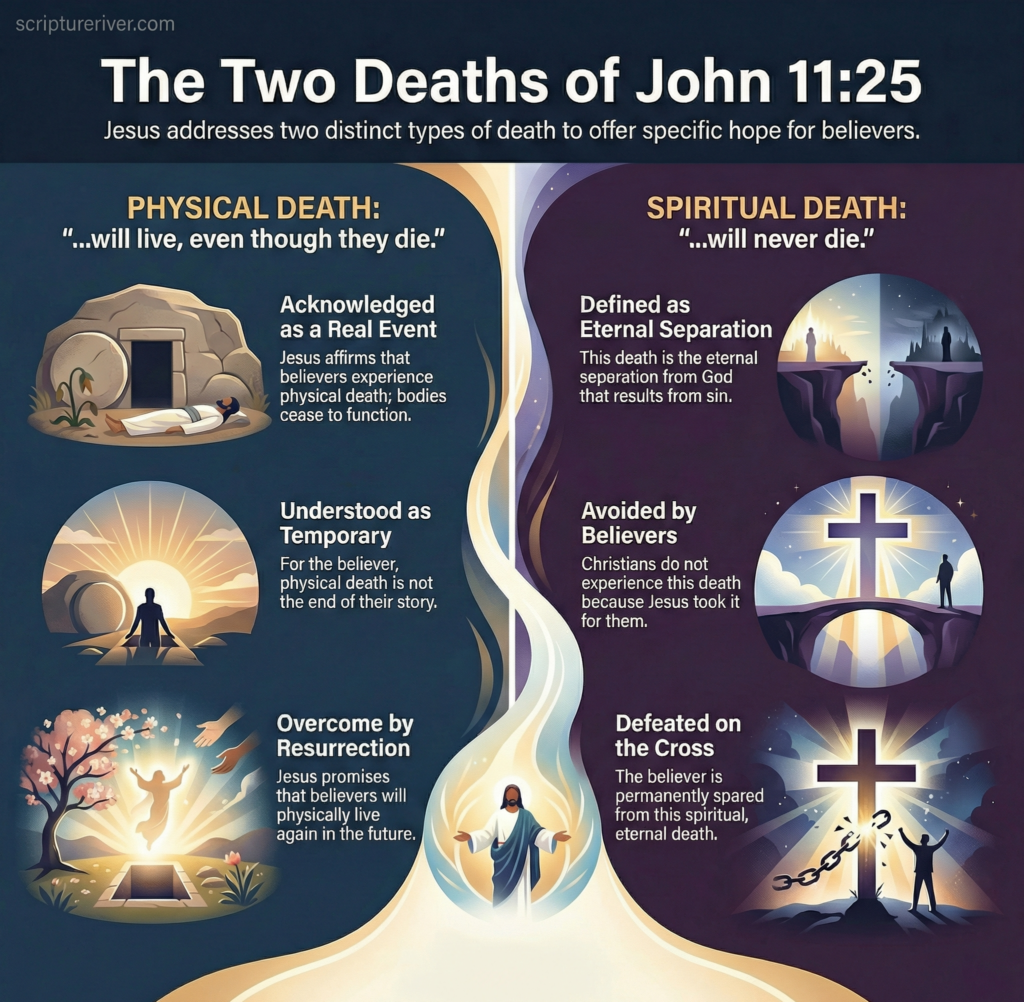
When Jesus says believers “will live, even though they die,” He’s acknowledging physical death is real.
Christians die. Bodies stop functioning. Hearts stop beating. Brains cease activity. Death happens.
But He promises believers will live again.
Physical death isn’t the end. It’s temporary. Resurrection is coming.
When Jesus says believers “will never die,” He’s talking about spiritual death. The eternal separation from God that results from sin.
Believers don’t experience that death because Jesus took it for them on the cross.
So Christians experience physical death (temporary) but not spiritual death (eternal).
Physical death is the last enemy to be destroyed, according to 1 Corinthians 15:26.
But it’s already a defeated enemy because of Jesus’s resurrection.
That’s what makes this verse appropriate for funerals. It acknowledges death’s reality while declaring death’s defeat.
Why This Verse Matters at Funerals
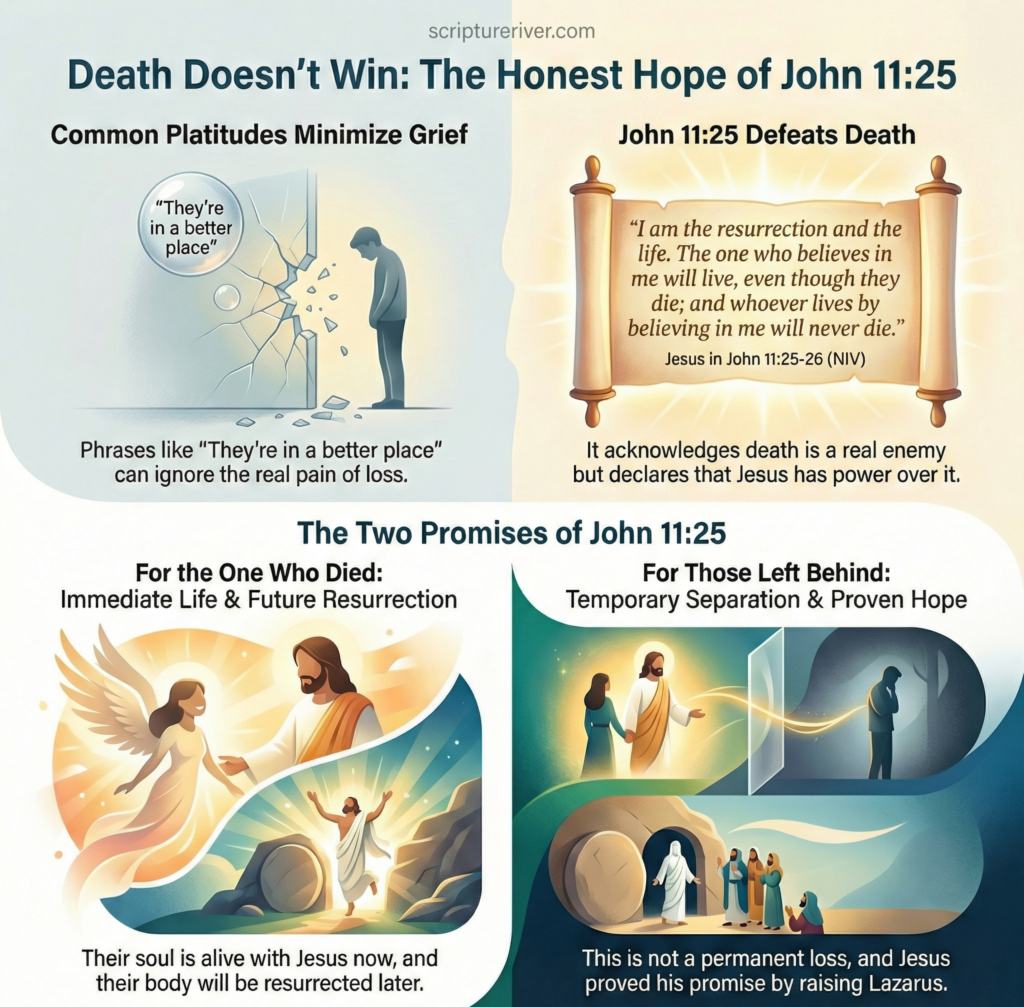
I’ve attended too many funerals where well-meaning people tried to minimize death’s pain with Christian platitudes.
“They’re in a better place.” “God needed another angel.” “At least they’re not suffering anymore.” “Don’t cry, they’re with Jesus now.”
All of those might be true in some sense.
But they don’t honor the reality that death is an enemy, grief is painful, and losing someone you love is legitimately terrible.
John 11:25 does something different. It doesn’t minimize death. It defeats death.
Jesus doesn’t tell Martha, “Don’t be sad, Lazarus is in heaven.”
He acknowledges Lazarus is dead, really dead, and then declares He has power over that death because He IS resurrection itself.
That’s honest comfort. Not pretending death doesn’t hurt. Declaring death doesn’t win.
What This Verse Promises the Person Who Died
If the person who died believed in Jesus, this verse promises they’re alive right now. Not metaphorically. Actually alive.
Their body is dead. That’s real. But they, the person you loved, the soul that made them who they were, is alive with Jesus.
2 Corinthians 5:8, English Standard Version (ESV) explains:
“We are of good courage, and we would rather be away from the body and at home with the Lord.”
Physical death for believers means immediate presence with Jesus.
Not soul sleep. Not waiting in some intermediate state. Immediate transition from earthly life to presence with Christ.
And this isn’t the end of their story.
John 11:25 promises resurrection. That dead body will be raised, transformed, and reunited with the soul.
Christians don’t just get immortal souls. We get resurrected bodies.
What This Verse Promises Those Left Behind
For those of us grieving, John 11:25 promises death is a temporary separation, not a permanent loss.
You will see them again if you both believe in Jesus. That’s not wishful thinking. That’s Jesus’s direct promise.
When He asks Martha, “Do you believe this?” He’s asking if she trusts His claim to be resurrection power personified. If she believes He has authority over death itself.
Martha answered, “Yes, Lord, I believe that you are the Messiah, the Son of God.”
She believed Jesus could do what He claimed, even though Lazarus’s body had been dead for four days.
Then Jesus proved it by raising Lazarus from the dead.
That story is our evidence that Jesus’ claim in John 11:25 is not a metaphor. It’s reality.
He demonstrated resurrection power in Lazarus.
He demonstrated it in Himself three days after the crucifixion.
And He promises to demonstrate it for all believers when He returns.
The Question Jesus Asks: Do You Believe This?
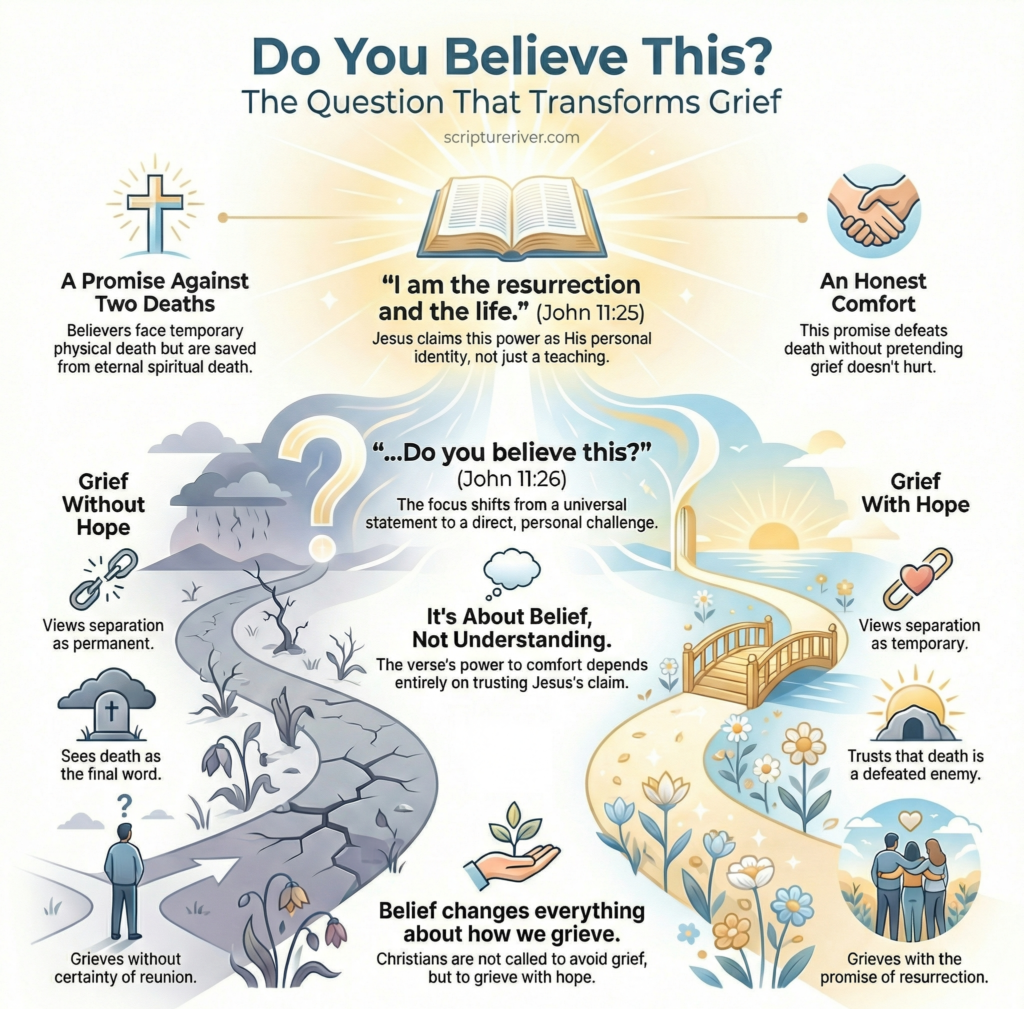
John 11:25 ends with a question directed at you: “Do you believe this?”
Not “Do you understand this?” Not “Does this make sense to you?” Do you believe it?
That question matters because this verse only comforts if you actually believe what Jesus claims about Himself.
If Jesus isn’t really the resurrection and the life, then this is just pretty religious poetry that doesn’t actually help when someone dies.
But if Jesus IS who He claims to be, if He genuinely has power over death because He conquered it through His own resurrection, then this promise changes everything about grief.
Grief With Hope Versus Grief Without Hope
1 Thessalonians 4:13, Christian Standard Bible (CSB) addresses Christian grief:
“We do not want you to be uninformed, brothers and sisters, concerning those who are asleep, so that you will not grieve like the rest, who have no hope.”
Notice Paul doesn’t say “don’t grieve.” He says, “don’t grieve like those who have no hope.”
Christians grieve. Death hurts. Loss is painful. Funerals are sad. That’s all appropriate and healthy.
But Christian grief includes hope that death isn’t the end.
Jesus’s resurrection proves death is temporary for believers. We grieve the separation, but not as people who think separation is permanent.
John 11:25 gives Christian grief its unique character. We cry because death hurts. We hope because death lost.
How I Applied This Verse Through My Grandmother’s Death
Let me be specific about how John 11:25 actually helped me, not theoretically but practically.
The day after my grandmother’s funeral, I woke up, and the crushing reality hit: she was gone. I’d never hear her voice again. Never get her advice. Never share another meal with her.
The grief was physical. My chest hurt. I couldn’t breathe properly.
In that moment, I spoke John 11:25 out loud. “
Jesus, You said You are the resurrection and the life. You said whoever believes in You will live even though they die.
Grandma believed in You. So she’s alive right now. And I’ll see her again.”
Did that make the pain disappear? No.
Did it give me something true to hold onto when grief felt like it would drown me? Yes.
I repeated that verse probably a hundred times over the next few months.
Every time grief ambushed me unexpectedly.
Every time I reached for my phone to call her and remembered I couldn’t.
Every time I drove past her house and realized she wasn’t there anymore.
“Jesus is the resurrection and the life. She believed in Him. She’s alive. This separation is temporary.”
That’s not denial. That’s biblical hope working in the middle of real grief.
What This Verse Doesn’t Promise
We need to be honest about what John 11:25 doesn’t say, because false hope is cruel.
It doesn’t promise everyone lives forever with Jesus. Jesus specifically says “whoever believes in me” will live even though they die. Belief in Jesus is the condition for this promise.
If the person who died didn’t believe in Jesus, this verse doesn’t apply to them. That’s a painful truth that requires honest confrontation with what Scripture teaches about salvation.
It doesn’t promise that physical resurrection will happen immediately. Christians who die are alive spiritually with Jesus. But physical resurrection waits until Christ returns. The dead body stays dead until resurrection day.
That matters because some people expect immediate resurrection. When it doesn’t happen, they question God’s promise. But the promise is future resurrection at Christ’s return, not immediate resuscitation.
It doesn’t promise grief will be easy or short. Jesus wept at Lazarus’s tomb even though He knew He was about to raise him. He didn’t rebuke Mary and Martha for grieving. He grieved with them.
John 11:25 gives hope in grief. It doesn’t eliminate grief or make it less painful.
Using This Verse at Funerals
If you’re planning a funeral and considering John 11:25, here’s why it’s appropriate and how to use it well.
It addresses death honestly. Unlike verses that focus only on heaven’s joy, this verse acknowledges death’s reality before declaring resurrection’s certainty.
It centers on Jesus, not the deceased. Funerals can become celebrations of the person’s life that barely mention Jesus. John 11:25 keeps Jesus central as the source of resurrection hope.
It invites belief. The verse ends with Jesus’s question: “Do you believe this?” Funerals are appropriate places to invite unbelievers to trust Christ, and this verse does that naturally.
It provides specific comfort. Generic funeral verses offer vague comfort. This verse makes specific, testable claims about Jesus’s identity and power over death.
A pastor or family member might read the verse at the funeral and then say something like:
“Jesus spoke these words to Martha right before raising her brother Lazarus from death. He proved He has power over death by raising Lazarus. He proved it again by rising from His own death three days after crucifixion. And He promises that everyone who believes in Him will live even though they die. [Name] believed in Jesus. So [Name] is alive right now with Jesus. And everyone here who believes in Jesus will see [Name] again when Jesus returns and raises all believers to eternal life. That’s not wishful thinking. That’s Jesus’s direct promise, proven by His own resurrection.”
A Prayer for Those Grieving
Jesus, You said You are the resurrection and the life. I believe that. But right now, death feels more real than resurrection. Loss feels more present than life. I’m grieving someone I loved and I don’t know how to do this. Help me believe Your promise even when death feels like it won. Help me trust that the person I lost who believed in You is alive with You right now. Help me remember this separation is temporary, not permanent. Give me hope in the middle of grief. Let me grieve honestly without losing faith. And bring me through this grief to the other side where I can function again, love again, and trust that You really are the resurrection and the life. Until I see my loved one again, sustain me with Your presence. In Your Name, Amen.
References
Alcorn, R. (2004). Heaven. Tyndale House Publishers. [Book]
Keller, T. (2013). Walking with God Through Pain and Suffering. Dutton. [Book]
Köstenberger, A. J. (2004). John. Baker Academic. [Book]
Lewis, C. S. (1961). A Grief Observed. HarperCollins. [Book]
Peterson, E. H. (2005). The Message: The Bible in Contemporary Language. NavPress. [Bible Translation]
Strong, J. (2010). Strong’s Exhaustive Concordance of the Bible. Hendrickson Publishers. [Reference Book]
Wiersbe, W. W. (2007). The Bible Exposition Commentary: New Testament (Vol. 1). David C. Cook. [Book]
Wright, N. T. (2008). Surprised by Hope: Rethinking Heaven, the Resurrection, and the Mission of the Church. HarperOne. [Book]

