
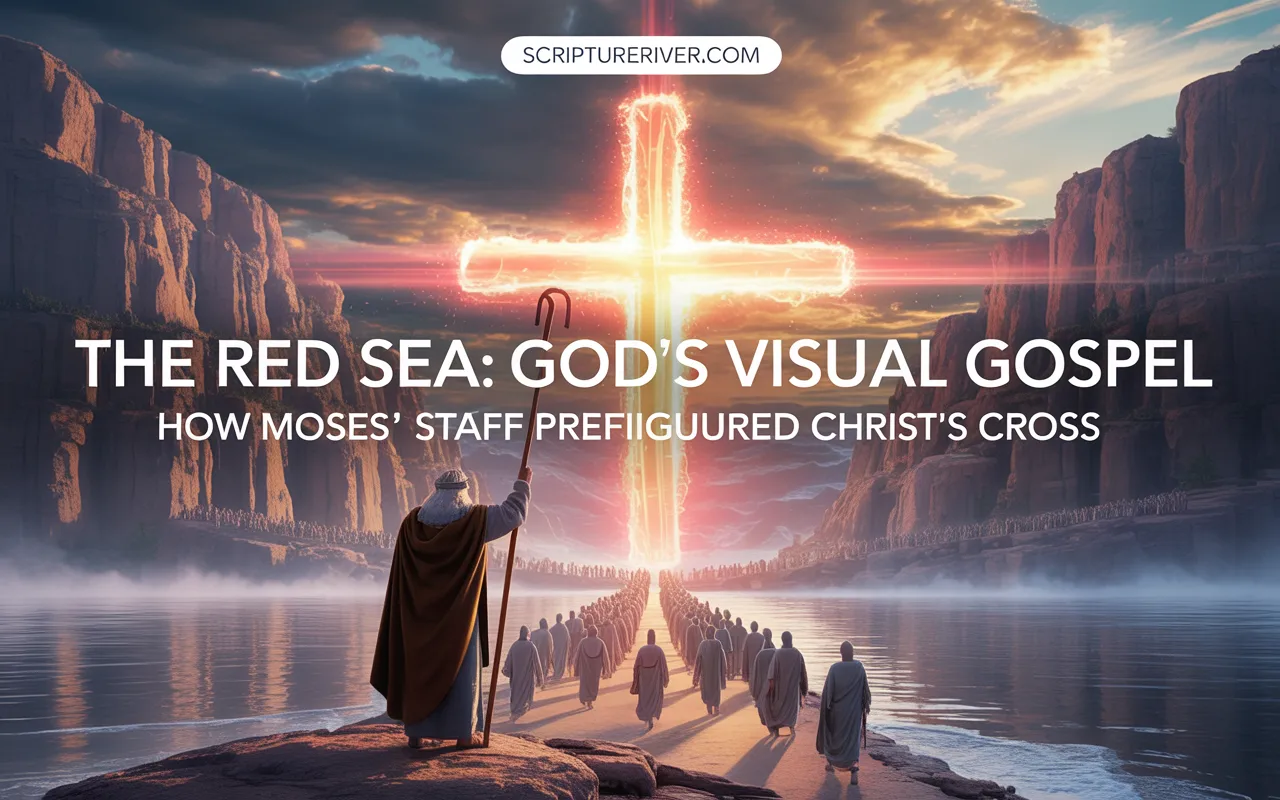
When most Christians read about Moses parting the Red Sea, they see a powerful miracle and move on.
But the Church Fathers saw something far deeper.
This wasn’t merely about escaping Pharaoh.
The Red Sea crossing contains layered spiritual meanings that transform our understanding of salvation, baptism, and Christ Himself.
The Mediator Pattern God Established
God didn’t have to use Moses.
He could have parted the waters with a word or destroyed Egypt’s army before pursuit.
Yet He chose Moses, a staff, and water deliberately.
St. Augustine wrote that “the Red Sea, so called because sanctified by the blood of the crucified Lord,” pointed forward to Christ’s mediatorial work.
For there is one God and one mediator between God and mankind, the man Christ Jesus, who gave himself as a ransom for all people.
(1 Timothy 2:5-6, NIV)
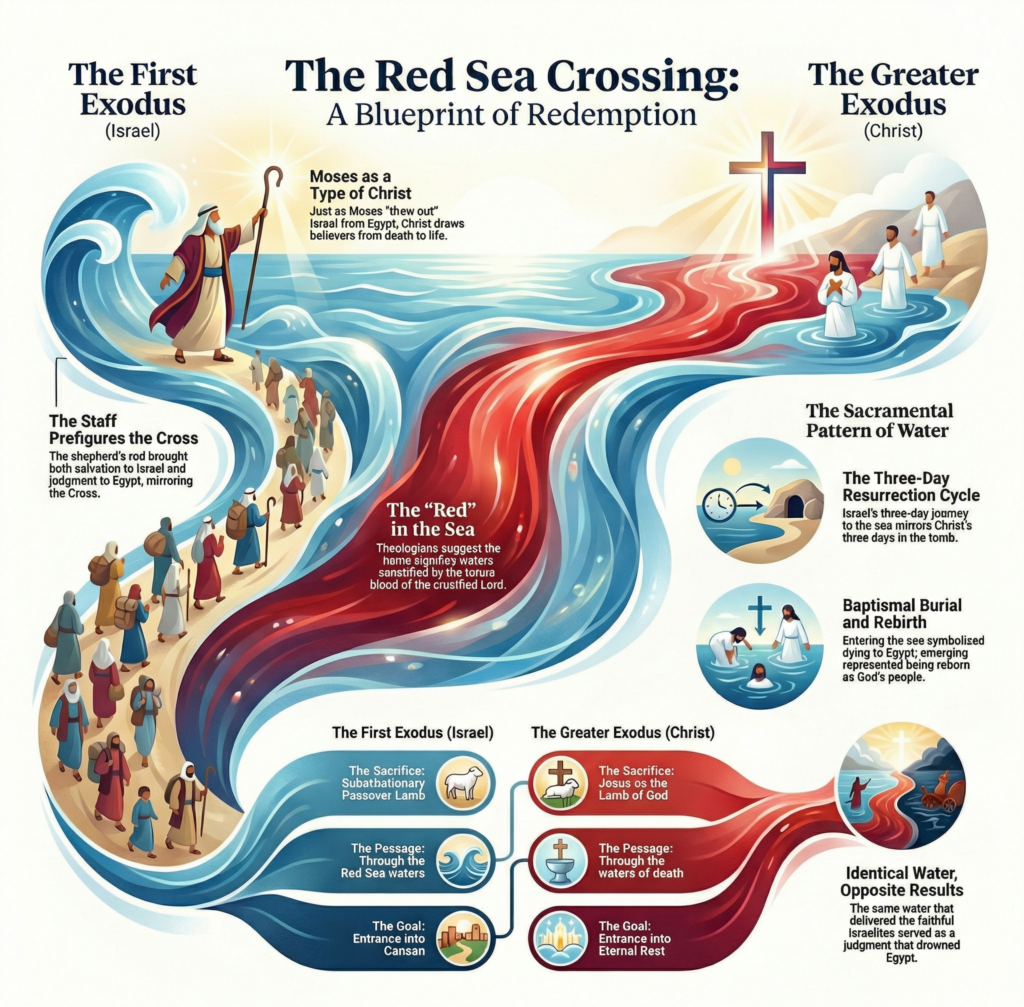
The Hebrew name Moshe means “to draw out.” Moses drew Israel through the Red Sea. Christ draws believers from death to life.
St. John Chrysostom observed: “You did not see Pharaoh drowned with his armies, but you have seen the devil with his weapons overcome by the waters of baptism.”
This wasn’t metaphor. It was the same redemptive pattern operating at different scales.
The Staff: Death and Authority Combined
When God asked Moses, “What is that in your hand?” (Exodus 4:2, NKJV), He was revealing principle, not requesting information. An ordinary shepherd’s rod became matteh ha-Elohim, the “staff of God.”
The LORD said to Moses, “Why do you cry to me? Tell the people of Israel to go forward. Lift up your staff, and stretch out your hand over the sea and divide it, that the people of Israel may go through the sea on dry ground.”
(Exodus 14:15-16, ESV)
Ancient shepherds used staffs for guidance and defense, both functions involving potential death.
When Moses lifted his staff, he wielded an instrument of deliverance and judgment simultaneously.
Israel passed safely. Egypt drowned in identical waters.
This prefigures the cross. Jesus said, “Just as Moses lifted up the snake in the wilderness, so the Son of Man must be lifted up, that everyone who believes may have eternal life in him” (John 3:14-15, NIV).
The cross, like Moses’ staff, brings salvation to those who trust and judgment to those who reject.
Midrashic tradition claims Moses’ staff was inscribed with God’s name and created on the sixth day of creation.
Whether historically accurate, this captures theological truth: the instrument of deliverance existed before the crisis. God’s redemptive plan preceded humanity’s fall.
Baptism Into Death and Resurrection
Here’s where Christians miss the depths. Paul doesn’t merely compare the Red Sea to baptism. He declares Israel was baptized:
For I do not want you to be ignorant of the fact, brothers and sisters, that our ancestors were all under the cloud and that they all passed through the sea. They were all baptized into Moses in the cloud and in the sea. They all ate the same spiritual food and drank the same spiritual drink; for they drank from the spiritual rock that accompanied them, and that rock was Christ.
(1 Corinthians 10:1-4, NIV)
Notice Paul’s shocking claim: “that rock was Christ.” Christ was present at the Red Sea, providing spiritual sustenance.
The Exodus wasn’t merely history pointing forward. It was Christ’s preliminary work of redemption.
St. Gregory of Nyssa taught: “The people by passing through the Red Sea, proclaimed good tidings of salvation by water. The people passed over, and the Egyptian king and his host was engulfed, and by these actions this sacrament of baptism was foretold.”
When Israel entered the sea, they symbolically died to Egypt.
Emerging on the opposite shore, they were reborn as God’s liberated people.
Guido de Brès explained: “We must pass through our Red Sea, which is the precious blood of the Son of God, who is our Red Sea, through which we must pass to escape the tyranny of Pharaoh, who is the devil.”
The Three-Day Death-Resurrection Pattern
A detail most readers overlook: Israel’s journey follows the three-day pattern saturating Scripture.
Israel left Egypt on Passover night. Three days later, they crossed the Red Sea. This mirrors Jesus’ burial and resurrection.
The Israelites’ passage through the sea, enclosed by water walls and darkened by night, symbolized burial.
Their emergence at dawn represented resurrection.
Or don’t you know that all of us who were baptized into Christ Jesus were baptized into his death? We were therefore buried with him through baptism into death in order that, just as Christ was raised from the dead through the glory of the Father, we too may live a new life.
(Romans 6:3-4, NIV)
Paul connects baptism to Christ’s death, burial, and resurrection. He also connects the Red Sea to baptism.
The logic is inescapable: the Red Sea prefigured Christ’s paschal mystery.
The darkness covering the sea (Exodus 14:20) represented death’s darkness.
The cloud separating Israel from Egypt symbolized God’s presence in the tomb with His Son.
Morning light revealing their deliverance (Exodus 14:24) prefigured resurrection dawn.
Water’s Double Function: Salvation and Judgment
The same water that saved Israel drowned Egypt.
By faith the people passed through the Red Sea as on dry land; but when the Egyptians tried to do so, they were drowned.
(Hebrews 11:29, NIV)
The water didn’t change. Faith did. Israel trusted God’s promise. Egypt pursued in defiance. Identical water produced opposite results.
This extends to baptism and Christ Himself. Peter wrote: “This water symbolizes baptism that now saves you also not the removal of dirt from the body but the pledge of a clear conscience toward God. It saves you by the resurrection of Jesus Christ” (1 Peter 3:21, NIV).
Water saves those submitting to God’s appointed means. Water judges those approaching with unrepentant hearts. The cross demonstrates this perfectly. To believers, it’s salvation power. To those perishing, it’s foolishness (1 Corinthians 1:18).
St. Augustine taught that the sea represents divisive forces separating us from God. Only God’s power unites us despite chaos threatening to overwhelm. When Moses lifted his staff, he didn’t create the path. He revealed it. God had already ordained deliverance.
The Scarlet Thread: Why “Red” Matters
The Hebrew Yam Suph literally means “Sea of Reeds,” not “Red Sea.” Yet the Septuagint consistently translates it erythra thalassa, “Red Sea.” The New Testament maintains this (Acts 7:36; Hebrews 11:29).
Why? Divine reinterpretation. St. Augustine wrote the sea was “so called because sanctified by the blood of the crucified Lord.” The “redness” comes from what the water represents: Christ’s blood.
In him we have redemption through his blood, the forgiveness of sins, in accordance with the riches of God’s grace.
(Ephesians 1:7, NIV)
Israel passed through the “Red” (blood-sanctified) Sea from slavery to freedom. Believers pass through Christ’s red (blood-stained) cross from death to life. The linguistic shift wasn’t translation error. It was God making explicit what was always implicit.
This explains why Paul could write confidently about Israel drinking from “the spiritual rock that accompanied them, and that rock was Christ” (1 Corinthians 10:4). Christ wasn’t merely prefigured. He was present, working salvation through foreshadowing means.
The Greater Exodus
When Jesus stood on the Mount of Transfiguration with Moses and Elijah, Luke records they discussed His exodus He would accomplish in Jerusalem (Luke 9:31). The Greek word: exodos.
Jesus’ death wasn’t just sacrifice. It was exodus. Departure from death to life. Liberation from sin’s bondage.
Just as Israel’s exodus involved:
- Substitutionary lamb (Passover)
- Passage through water (Red Sea)
- Wilderness journey (testing)
- Entry into promised inheritance (Canaan)
Christ’s exodus involves:
- Himself as Lamb of God
- Passage through death’s waters
- The Church’s wilderness journey
- Entry into eternal rest
Therefore, since we are receiving a kingdom that cannot be shaken, let us be thankful, and so worship God acceptably with reverence and awe, for our God is a consuming fire.
(Hebrews 12:28-29, NIV)
Hebrews saturates its message with Exodus imagery because the Red Sea event was never just about escaping Pharaoh. It was God’s visual aid, written in water and blood, showing how He would tear open death itself to create a path to eternal life.
The Sacramental Reality: Why Water Still Matters
Modern Christianity often treats baptism as mere symbol, devoid of spiritual power. The Church Fathers found this incomprehensible.
Tertullian wrote that “we, little fishes, are born in water after the manner of our ichthus, Jesus Christ.” Water in baptism functions as water functioned at the Red Sea: the medium through which God’s saving power operates.
The water at the Red Sea wasn’t special. What made it significant was God’s command to pass through in faith. Similarly, baptismal water has no inherent power. What matters is God’s promise attached to it and faith receiving that promise.
Repent and be baptized, every one of you, in the name of Jesus Christ for the forgiveness of your sins. And you will receive the gift of the Holy Spirit.
(Acts 2:38, NIV)
Peter didn’t say baptism symbolizes forgiveness. He said it’s for forgiveness. Paul said we are buried with Christ through baptism (Romans 6:4). These are precise theological claims rooted in Red Sea typology.
When Israelites stepped into the parted sea, they simply trusted God’s word through Moses. When believers submit to baptism, they participate in the same act, not merely commemorating Christ’s death but liturgically entering it, passing through it, and emerging on resurrection ground.
The Warning: Not All Who Cross Are Saved
Paul’s Red Sea treatment in 1 Corinthians 10 carries sobering warning. After establishing that all Israel was “baptized into Moses” and all ate spiritual food and drank spiritual drink, he writes:
Nevertheless, God was not pleased with most of them; their bodies were scattered in the wilderness. Now these things occurred as examples to keep us from setting our hearts on evil things as they did.
(1 Corinthians 10:5-6, NIV)
External participation in God’s saving acts doesn’t guarantee salvation. Israel crossed the Red Sea, witnessed the miracle, received manna. Yet most perished in wilderness because of unbelief.
This demolishes easy believism. Mere intellectual assent isn’t saving faith. True faith perseveres, produces obedience, crosses the Red Sea, then continues following God through wilderness journey.
The Red Sea was decisive deliverance from Egypt. But it wasn’t the journey’s end. It was the beginning. Those who stop at the Red Sea experience deliverance but never inherit promises.
The Staff Raised, The Cross Lifted
When Moses raised his staff, he enacted prophetically what Christ accomplished definitively.
The staff divided waters, creating a way where none existed. The cross divided death’s dominion, creating life where only death reigned.
The staff held high brought deliverance for those passing through. The cross lifted high brings salvation to believers.
The staff released both salvation and judgment. The cross releases both mercy and wrath, depending on faith’s response.
And I, when I am lifted up from the earth, will draw all people to myself.
(John 12:32, ESV)
Jesus’ language is precise. He’ll draw all people. The Greek helkyo suggests irresistible pulling. Just as Israelites were drawn through the Red Sea by Moses’ raised staff, believers are drawn to Christ by His lifted cross.
This doesn’t violate will more than Israel’s crossing violated theirs. They still chose to walk into divided waters. But God’s commanding grace made that path so clearly the only option for life that refusing would have meant choosing death.
Prayer for Deeper Revelation
Father, You who commanded light to shine out of darkness, shine now into my heart. You who divided the Red Sea for Your people’s deliverance, divide the veil of my understanding that I might see Christ in every shadow, recognize His blood in every type, and know His resurrection in every deliverance You’ve wrought. Like Israel at the sea, I stand before impossibilities my strength cannot overcome. Teach me to see beyond water walls to the death and resurrection they represent. Teach me to see beyond Moses’ staff to the cross it prefigured. I confess I’ve read these accounts as mere history, missing the spiritual realities they embody. Open my eyes. Deepen my faith. Draw me through death’s waters into resurrection life. In Jesus’ name, Amen.
Questions Frequently Asked
How does the Red Sea crossing specifically prefigure baptism beyond just involving water?
The correspondence goes beyond water. Both involve: (1) passing from bondage to freedom through decisive moment, (2) dying to old identity and rising to new one, (3) God’s appointed mediator creating the way (Moses/Christ), (4) waters saving those who trust, judging those who don’t, (5) entering wilderness journey toward promised inheritance. Paul’s language in 1 Corinthians 10:2 declares Israel was baptized, meaning the Red Sea functioned for them exactly as baptism functions for Christians, uniting them to their deliverer through water representing death.
If Moses prefigures Christ, why did God use him instead of acting directly?
God established the mediator principle saturating Scripture. From Adam as humanity’s representative, to priesthood standing between God and Israel, to Christ as ultimate mediator, God consistently works through appointed intermediaries. This isn’t divine limitation but divine pedagogy. By using Moses, God taught Israel (and us) that salvation requires a mediator standing between holy God and sinful humanity. Moses’ mediation was temporal and limited. Christ’s is eternal and perfect. But Moses’ role taught what Christ’s would fully accomplish.
What spiritual reality do the “walls of water” represent that most Christians miss?
Water walls represent God’s restraint of chaos and death. Ancient cosmology viewed seas as chaotic, destructive forces. For Israel to walk through sea while water stood vertically meant God held death itself at bay during passage. This prefigures Christ’s descent into death. Jesus entered death, but death couldn’t hold Him because God’s power restrained its dominion. When believers are baptized “into Christ’s death” (Romans 6:3), they pass through death’s domain while God’s power keeps it from destroying them, just as water walls stood firm while Israel crossed.
Why do Church Fathers emphasize the Red Sea being “sanctified by Christ’s blood” when Exodus predates Christ by centuries?
This reflects understanding that Christ’s work operates outside linear time. John 8:58: “before Abraham was born, I am.” Hebrews 13:8: Christ “the same yesterday and today and forever.” From God’s perspective, Christ’s sacrificial blood existed before creation. The Red Sea was “red” not because of Christ’s future sacrifice, but because God retroactively applied Christ’s blood to that moment. This is why Paul wrote Israel “drank from the spiritual rock that accompanied them, and that rock was Christ” (1 Corinthians 10:4). Christ wasn’t merely foreshadowed; He was present and active, providing salvation through preliminary means later fully revealed on the cross.
How does understanding the Red Sea’s spiritual significance change practical Christian living today?
It transforms how we view crisis and salvation. First, impossible situations aren’t obstacles to God’s glory but opportunities for it. God deliberately positioned Israel at the Red Sea with Egypt pursuing to demonstrate saving power. Our “Red Sea moments” serve identical purposes. Second, salvation isn’t just initial conversion but ongoing deliverance. Just as Israel had to walk through the sea, we must actively appropriate Christ’s finished work. Third, the same means saving us also judges others. The gospel we embrace some reject, as identical waters saved Israel but drowned Egypt. This sobers evangelism and deepens gratitude. Finally, recognizing Christ’s presence in Israel’s exodus helps us see Him throughout Scripture, transforming Bible reading from historical study to encountering the living Christ on every page.
Scholarly Works and Historical Sources Consulted
Adoremus. (2022). Baptism and the waters of Exodus.
Augustine. (4th-5th century). Sermon 223E.2.
Augustine. (4th-5th century). The City of God.
BibleAsk. (2024). What is the significance of the parting of the Red Sea?
de Brès, G. (1567). Belgic Confession.
Chrysostom, J. (4th century). Moses and Christ.
Coptic Church. School of Alexandria: Allegorical interpretation of Scripture.
Crossroads Initiative. (2024). Moses and Christ: St. John Chrysostom.
First Baptist Church Chariton. (2022). An Easter exodus.
GotQuestions.org. What is the importance of the parting of the Red Sea?
Gregory of Nyssa. (4th century). On the Baptism of Christ.
Hoffmeier, J. K. (1997). Israel in Egypt. Oxford University Press.
Laitman, M. (2025). What is the spiritual meaning of the parting of the Red Sea? Medium.
The Catholic Voice. Parting of the Red Sea: Faith and freedom.
The Gospel Coalition. (2020). Rightly dividing the Red Sea.
Tertullian. (2nd-3rd century). De Baptismo.
Visual Commentary on Scripture. Crossing the Red Sea.

