


Your home will never be perfect, but it can be genuinely happy.
Not the Instagram-perfect happiness where everyone smiles on command and conflict doesn’t exist.
Real happiness where people feel safe, loved, and known.
Where mistakes are forgiven. Where laughter is frequent. Where God’s presence is welcomed and His principles shape how you treat each other.
The difference between homes that thrive and homes that merely survive isn’t luck, income level, or perfect circumstances.
It’s intentional application of biblical principles that create environments where people flourish.
Scripture provides specific, practical instructions for building homes characterized by peace, love, respect, and joy.
These aren’t vague spiritual platitudes.
They’re concrete practices that when implemented consistently, transform houses into homes and families into communities that reflect God’s character.
Understanding and applying these biblical principles won’t eliminate all conflict or difficulty.
But it creates foundation strong enough to withstand the inevitable storms that every family faces and builds atmosphere where happiness is possible even during hard seasons.
The Foundation: God at the Center

Happy homes don’t start with better communication techniques or conflict resolution strategies.
They start with God at the center of family life.
What “God at the Center” Actually Means
This isn’t just attending church weekly or praying before meals.
It’s orienting your entire family around God’s priorities, values, and presence.
Joshua 24:15, English Standard Version (ESV)
“And if it is evil in your eyes to serve the Lord, choose this day whom you will serve, whether the gods your fathers served in the region beyond the River, or the gods of the Amorites in whose land you dwell. But as for me and my house, we will serve the Lord.”
Joshua declared his household’s allegiance publicly. Serving the Lord as a family means collective commitment to prioritize God’s ways over cultural values, personal preferences, or temporary convenience.
How to Make God Central Practically
Establish family worship. This doesn’t require elaborate productions. Read Scripture together, even briefly. Pray together about real concerns. Sing worship songs. Make God’s Word and prayer normal parts of daily rhythms.
Make biblical values explicit. When making decisions, reference what God’s Word says. “We’re going to forgive because God forgave us.” “We’re generous because everything we have belongs to God.” Connect actions to biblical principles.
Welcome God’s correction. When Scripture convicts you about how you’re living, respond with humility and change. Children learn to value God’s authority by watching parents submit to it.
According to family discipleship researcher Timothy Paul Jones’ work documented in Family Ministry Field Guide, families who practice regular spiritual disciplines together report significantly higher satisfaction with family relationships and stronger faith transmission to children.
7 Biblical Principles That Create Happy Homes
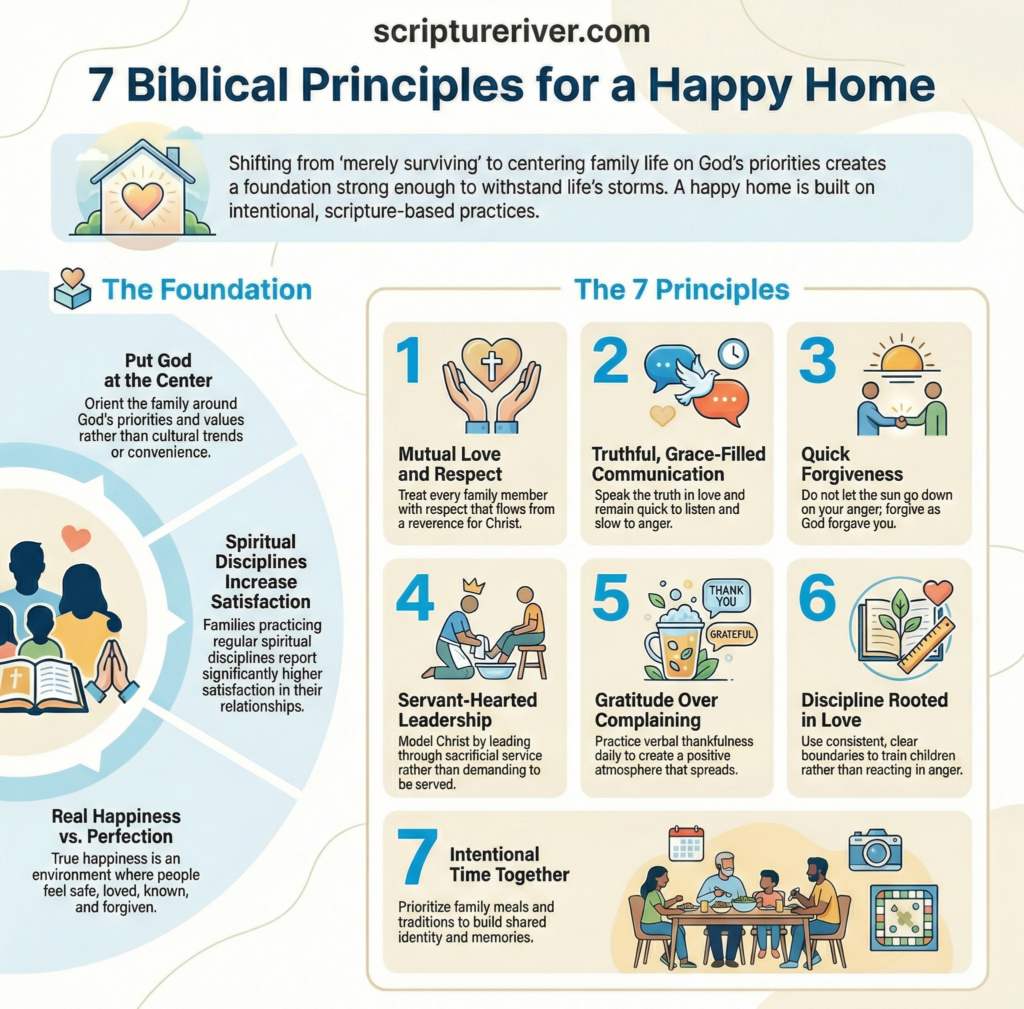
Principle 1: Mutual Love and Respect
Ephesians 5:21, Christian Standard Bible (CSB)
“Submitting to one another in the fear of Christ.”
Before Paul addresses specific family roles, he commands mutual submission. Every family member treats others with respect that flows from reverence for Christ.
In marriage: Husbands love sacrificially (Ephesians 5:25). Wives respect genuinely (Ephesians 5:33). Both submit needs and preferences to each other’s wellbeing.
With children: Parents don’t exasperate children through inconsistency, harshness, or favoritism (Ephesians 6:4). Children honor and obey parents (Ephesians 6:1-2).
Among siblings: Treat each other with kindness, patience, and forgiveness rather than rivalry and cruelty.
Principle 2: Truthful, Grace-Filled Communication
Ephesians 4:15, New International Version (NIV)
“Instead, speaking the truth in love, we will grow to become in every respect the mature body of him who is the head, that is, Christ.”
Happy homes require both truth and love in communication. Truth without love becomes harsh. Love without truth becomes enabling.
Speak honestly. Don’t lie to avoid conflict. Don’t hide problems until they explode. Address issues directly with kindness.
Listen actively. James commands being “quick to listen, slow to speak, slow to become angry” (James 1:19). Most family conflict escalates when people talk over each other rather than genuinely listening.
Use words that build up. Ephesians 4:29 commands speaking only what is helpful for building others up according to their needs. Eliminate sarcasm, mockery, and cutting remarks disguised as jokes.
Control your tongue. Proverbs 15:1 promises “a gentle answer turns away wrath, but a harsh word stirs up anger.” How you say something matters as much as what you say.
Principle 3: Quick Forgiveness
Colossians 3:13, English Standard Version (ESV)
“Bearing with one another and, if one has a complaint against another, forgiving each other; as the Lord has forgiven you, so you also must forgive.”
Unforgiveness poisons homes. Grudges, silent treatments, and keeping score of wrongs destroy happiness systematically.
Forgive quickly. Don’t let the sun go down on your anger (Ephesians 4:26). Address offenses and forgive before bitterness takes root.
Forgive repeatedly. Peter asked if forgiving seven times was enough. Jesus answered “seventy-seven times” (Matthew 18:21-22), meaning unlimited forgiveness for family members who repeatedly fail.
Forgive as you’ve been forgiven. You’ve been forgiven infinitely more by God than family members could ever owe you. Let that reality fuel your willingness to forgive.
According to research by psychologist Everett Worthington published in studies on forgiveness interventions, families who practice regular forgiveness report lower conflict, higher satisfaction, and better mental health outcomes.
Principle 4: Servant-Hearted Leadership and Service
Mark 10:45, Christian Standard Bible (CSB)
“For even the Son of Man did not come to be served, but to serve, and to give his life as a ransom for many.”
Jesus modeled leadership through service. Husbands leading families means serving families sacrificially. Parents serving children’s genuine needs. Older siblings helping younger ones.
Leadership isn’t dictatorship. Biblical headship in marriage means husband bears primary responsibility for family’s spiritual direction and wellbeing. That’s burden, not privilege. It requires listening, considering wife’s counsel, and leading in ways that protect and nurture.
Everyone serves. Happy homes aren’t built on one person doing everything while others demand service. Everyone contributes according to ability.
Service is sacrifice. Real service costs you something: time, energy, preferences. Serving when convenient isn’t remarkable. Serving when it’s inconvenient is Christlike.
Principle 5: Gratitude Over Complaining
1 Thessalonians 5:18, New King James Version (NKJV)
“In everything give thanks; for this is the will of God in Christ Jesus for you.”
Complaining creates negative atmosphere that spreads. Gratitude creates positive atmosphere that also spreads.
Practice verbal thankfulness. Thank your spouse for providing, for faithfulness, for specific acts of service. Thank your children for obedience, helpfulness, growth. Thank God together for daily provisions.
Focus on what you have, not what you lack. Homes become unhappy when everyone focuses on what’s missing rather than appreciating what’s present.
Model contentment. Philippians 4:12 describes Paul’s learned secret: “I know what it is to be in need, and I know what it is to have plenty. I have learned the secret of being content in any and every situation.” Children learn contentment or complaining primarily from parents.
Principle 6: Consistent Discipline Rooted in Love
Hebrews 12:11, English Standard Version (ESV)
“For the moment all discipline seems painful rather than pleasant, but later it yields the peaceful fruit of righteousness to those who have been trained by it.”
Discipline isn’t punishment meant to hurt. It’s training meant to teach. Happy homes require parents who love children enough to correct them consistently.
Discipline with clear boundaries. Children need to know what’s expected. Vague or constantly changing rules create anxiety and resentment.
Be consistent. Enforcing rules only when you’re in the mood or have energy teaches children to manipulate circumstances rather than obey principles.
Discipline without anger. Ephesians 6:4 warns fathers not to exasperate children. Discipline administered in anger teaches children that might makes right and damages relationships.
Always explain why. Help children understand the biblical principle behind the rule and the natural consequences of disobedience.
According to developmental psychologist Diana Baumrind’s research on parenting styles, authoritative parenting (high expectations with high warmth) produces the most well-adjusted, happy children compared to authoritarian, permissive, or neglectful approaches.
Principle 7: Intentional Time Together
Deuteronomy 6:6-7, Christian Standard Bible (CSB)
“These words that I am giving you today are to be in your heart. Repeat them to your children. Talk about them when you sit in your house and when you walk along the road, when you lie down and when you get up.”
Building happy homes requires quantity time together, not just quality moments. God’s instruction assumes regular, ongoing contact throughout normal daily rhythms.
Prioritize family meals. Research consistently shows families who eat together regularly have stronger relationships, better academic outcomes in children, and lower rates of destructive behavior.
Create family traditions. Weekly game nights, annual camping trips, holiday rituals, or regular service projects build shared memories and identity.
Turn off screens. Devices compete for attention. Intentional time together requires putting phones away and actually engaging with people physically present.
Work together. Shared work builds relationships differently than shared entertainment. Cooking together, yard work, home projects create opportunities for conversation and cooperation.
When Your Home Feels Far from Happy

These principles don’t create instant transformation. Implementing them in homes with established negative patterns takes time, consistency, and grace.
Start Where You Are
You can’t change everything simultaneously. Pick one principle to focus on first. Maybe it’s eliminating harsh words. Maybe it’s establishing family prayer. Small consistent changes compound over time.
Acknowledge Past Failures
If your home has been characterized by conflict, neglect, or dysfunction, acknowledge it. Apologize to family members you’ve hurt. Ask forgiveness. Commit to change.
Get Help When Necessary
Some situations require outside intervention. Biblical counseling, marriage therapy, or pastoral guidance aren’t admissions of failure. They’re wise responses to problems you can’t solve alone.
Remember Grace
You’ll fail at implementing these principles perfectly. Everyone will. Happy homes aren’t perfect homes. They’re homes where people extend grace to each other repeatedly while pursuing growth.
Frequently Asked Questions
What if only one spouse is committed to biblical principles?
1 Peter 3:1-2 addresses wives with unbelieving husbands, encouraging them to win husbands through godly conduct rather than words. Apply biblical principles in your own behavior without demanding spouse do likewise. Pray. Model. Trust God to work. Don’t enable sin, but don’t create division through self-righteousness.
How do we implement these principles with teenagers who resist?
Maintain consistency while acknowledging their growing autonomy. Explain why principles matter rather than just demanding compliance. Give increasing freedom with increasing responsibility. Keep relationship strong through consistent time together and genuine interest in their lives. Teenagers resist control but respect authentic love and consistency.
What about blended families or single-parent homes?
Biblical principles apply in all family structures. Single parents can’t fulfill both parent roles simultaneously, but they can implement truth-telling, forgiveness, service, gratitude, and discipline. Blended families face unique challenges, but the same principles that build unity in biological families build unity in blended ones when applied with patience and grace.
How do we balance biblical discipline with modern parenting advice?
Evaluate all parenting advice through Scripture. Some modern research aligns with biblical principles. Some contradicts them. When conflict exists, Scripture takes precedence. However, the Bible gives principles more than specific techniques. Research on child development can inform how you apply biblical principles age-appropriately.
What if our home is already deeply broken?
Start with prayer. Confession. Repentance. Then begin implementing one principle consistently while trusting God to heal what’s broken. Rebuild trust slowly through consistent behavior over time. Consider professional Christian counseling to address deep wounds. Remember redemption is God’s specialty. No home is too broken for Him to restore.
How long before we see change?
Some changes appear quickly. Others take months or years. Relationships damaged over years won’t heal overnight. Persist even when progress feels slow. Trust that faithful application of God’s Word produces fruit in God’s timing, not necessarily yours.
Prayer for Your Home
Father, I want my home to be happy, peaceful, and honoring to You. Forgive me for ways I’ve contributed to conflict, negativity, or dysfunction. Help me apply biblical principles consistently even when it’s difficult. Give me patience when change is slow. Give me grace for myself and family members when we fail. Help us communicate with truth and love. Help us forgive quickly and completely. Help us serve each other sacrificially. Fill our home with gratitude instead of complaining. Guide us as we discipline children with love and consistency. Help us prioritize time together. Make our home a place where Your presence is welcomed and Your character is reflected. Transform us from the inside out. Build happiness rooted in holiness. In Jesus’s Name, Amen.
Documented Sources
Baumrind, D. (1967). “Child Care Practices Anteceding Three Patterns of Preschool Behavior.” Genetic Psychology Monographs, 75(1), 43-88. [Research Study]
Jones, T. P. (2011). Family Ministry Field Guide. Wesleyan Publishing House. [Pastoral Resource]
Peterson, E. H. (2005). The Message: The Bible in Contemporary Language. NavPress. [Bible Translation]
Strong, J. (2010). Strong’s Exhaustive Concordance of the Bible. Hendrickson Publishers. [Reference Book]
Worthington, E. L. (2005). Handbook of Forgiveness. Routledge. [Academic Study]

