


I stood in the grocery store staring at cereal boxes for more than six minutes.
Not because I couldn’t decide which one to buy.
Because anxiety had paralyzed my brain so completely, I couldn’t remember why I was in that aisle.
My hands shook. My vision tunneled. A woman asked if I was okay, and I couldn’t form words to answer her.
This wasn’t my first panic attack, but it was the first one in public, surrounded by strangers doing normal things while I fell apart over breakfast cereal.
The anxiety I’d been managing through sheer willpower and extra prayer time had finally overwhelmed my ability to function.
That grocery store breakdown forced me to learn what 1 Peter 5:7 actually means about casting anxiety on God.
Not the theological theory I’d been teaching—the desperate, practical reality of releasing what I physically could not carry anymore.
Listen to This Audio Message: What Casting Anxiety Actually Means
Just in case you don’t have the time to go through this post, you can listen to this 12-minute explanation of the difference between suppressing anxiety through religious performance and actually casting it on God, like 1 Peter 5:7 instructs.
You’ll discover the Greek meaning behind “casting,” why God invites anxious prayers, and practical steps for releasing anxiety when it threatens to overwhelm you, based on both Scripture and clinical understanding of how anxiety works.
What 1 Peter 5:7 Says
Here’s the verse that sounds simple but proves incredibly difficult to practice:
1 Peter 5:7, New International Version (NIV)
“Cast all your anxiety on him because he cares for you.”
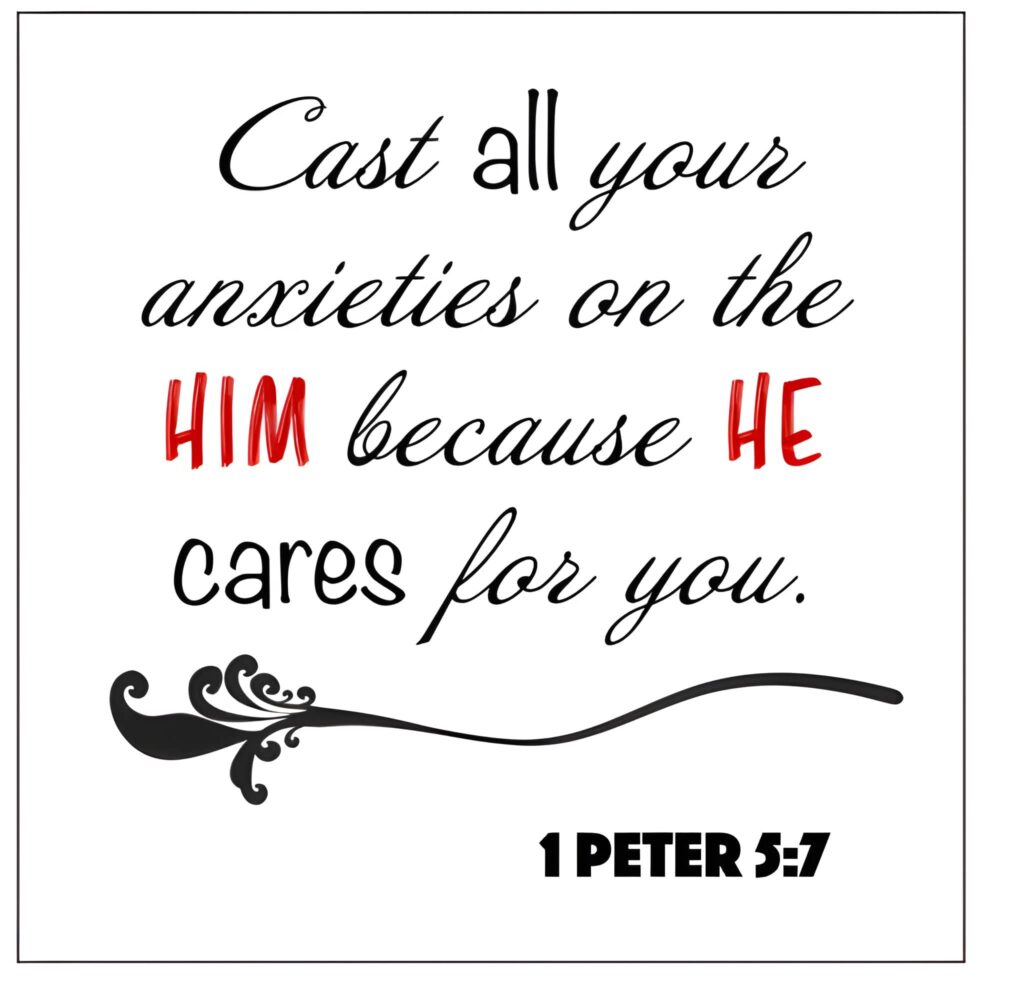
The command is clear. The execution is complicated.
Peter wrote this to Christians scattered throughout Asia Minor facing persecution, social rejection, and genuine danger.
According to New Testament scholar Karen Jobes in her commentary on 1 Peter, these believers had real reasons for anxiety beyond normal life stress.
Yet Peter commands them to cast their anxiety on God.
Not suppress it. Not pretend it doesn’t exist. Not feel guilty about experiencing it.
Cast it on God who cares.
What “Cast” Actually Means
The Greek word “epiriptō” translates to “cast, meaning to throw upon, to place upon, to deposit on someone else.
According to Greek lexicographer William Mounce’s research, this word carries the sense of deliberately, forcefully transferring a burden from yourself to another person.
It’s not passive. It’s an active, intentional movement of weight.
The same Greek word appears in Luke 19:35 when disciples threw their cloaks on the donkey for Jesus to ride.
They transferred the weight from themselves to the animal.
That’s the picture Peter uses.
Your anxiety has weight. And you’re carrying it.
Peter says throw that weight onto God. Let Him carry what’s crushing you.
Why Casting Anxiety Is So Difficult
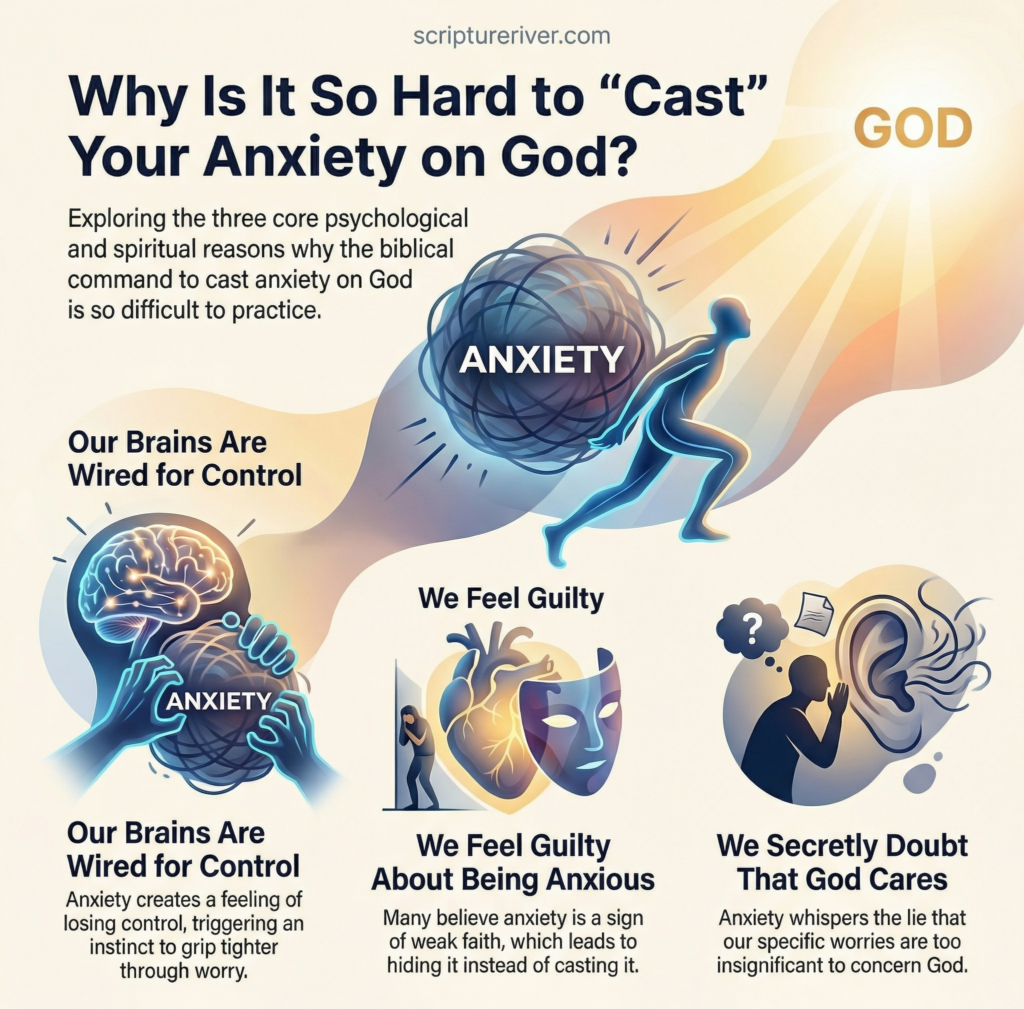
If casting anxiety on God were easy, Peter wouldn’t need to command it.
We’re Wired to Control
Neuroscience research by Dr. Robert Sapolsky at Stanford University demonstrates that perceived control over stressful situations significantly reduces anxiety responses in both humans and animals.
When control is removed, anxiety increases dramatically.
Anxiety makes you feel out of control.
Your instinct is to regain control through worry, planning, and mental problem-solving.
But that’s the opposite of casting anxiety on God, which requires releasing control.
That’s why it’s so hard. Every instinct screams to grip tighter.
Casting anxiety requires deliberately loosening your grip on outcomes you desperately want to control.
We Feel Guilty About Anxiety
I spent years believing my anxiety proved weak faith.
If I really trusted God, I wouldn’t be anxious.
So I hid my anxiety behind a performance of spiritual strength while internally drowning.
According to Christian psychologist Dr. Henry Cloud’s research on faith and mental health, this guilt about anxiety is pervasive in Christian communities and prevents people from accessing both spiritual resources and professional help they need.
But anxiety isn’t a sin. It’s a human response to perceived threat.
Even Jesus experienced anxiety in Gethsemane, sweating drops of blood from stress.
Peter himself likely wrote about casting anxiety because he’d experienced it personally.
We Don’t Believe God Actually Cares
Peter adds, “because he cares for you,” because that’s the truth anxiety lies about.
Anxiety whispers: You’re alone in this. No one understands. Not even God cares about this specific worry consuming you.
The Greek word “melei” for cares means it matters to Him, it’s His concern, He’s interested in it.
Your anxiety isn’t annoying God. It’s concerning Him because He cares about you.
But believing that notion when anxiety is screaming the opposite requires faith most of us struggle to maintain.
The Personal Experience That Taught Me This

Let me tell you about the season that forced me to learn what casting anxiety actually means.
My daughter was struggling in school. Not just academically but socially and emotionally.
Every day brought new crises. Phone calls from teachers. Tears at bedtime. Watching her hurt and not being able to fix it.
I prayed constantly. I read every parenting book. I tried every intervention. And anxiety consumed me.
I couldn’t sleep. I couldn’t focus.
I replayed conversations, wondering what I should have done differently. I worried about her future, her self-esteem, her faith.
One night at 2 AM, after hours of anxious spiraling, I finally whispered: “God, I can’t carry this anymore. I don’t know how to help her. I’m giving this to You because I’m drowning.”
And I physically mimed throwing something off me.
Dramatic, maybe. But it helped.
I visualized taking the weight of anxiety about my daughter and hurling it onto God’s shoulders.
The circumstances didn’t change that night.
But something in me did. The anxiety loosened its chokehold on my chest. I slept for the first time in weeks.
I had to repeat that practice daily. Sometimes multiple times daily.
The anxiety would creep back, and I’d have to consciously “cast” it again. It wasn’t a one-time deliverance. It was an ongoing practice.
But it worked.
Not because I mastered some spiritual technique. Because I finally stopped trying to carry alone what God never intended me to carry.
How to Actually Cast Anxiety on God
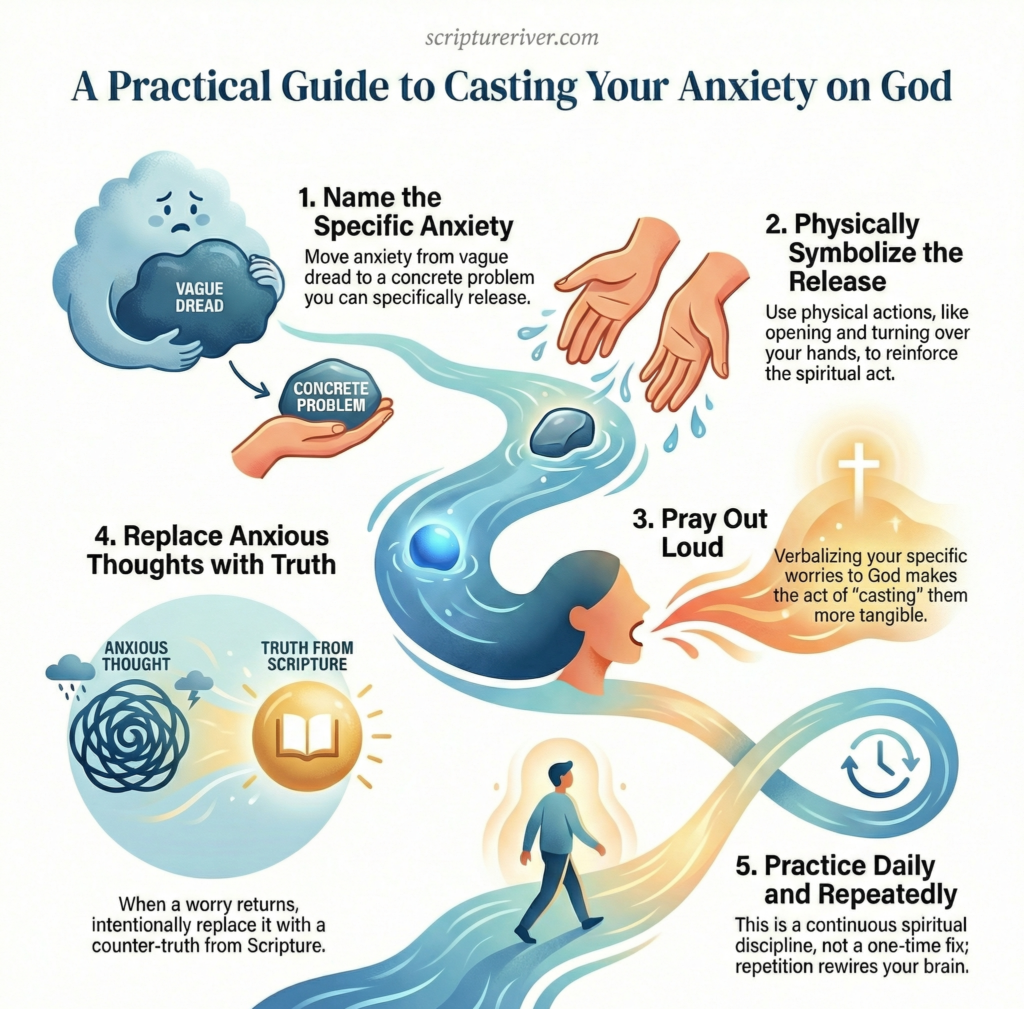
Based on Scripture, psychological research, and personal experience, here’s how to practically apply 1 Peter 5:7.
1. Name the Specific Anxiety
Vague prayers about “all my anxiety” often don’t help because anxiety needs specificity to release.
According to clinical psychologist Dr. Edmund Bourne’s research on anxiety treatment, naming specific anxious thoughts reduces their power by moving them from amorphous dread to concrete concerns you can address.
Instead of “God, I’m anxious,” pray “God, I’m anxious about how I’ll pay rent next month,” or “God, I’m anxious about my child’s behavior at school,” or “God, I’m anxious about my medical test results.”
Specific anxiety can be specifically cast. General anxiety just swirls.
2. Physically Symbolize the Casting
This might sound strange, but physical action helps your brain process spiritual reality.
When I’m overwhelmed with anxiety, I physically open my hands, palms up, and imagine placing my specific worry in my palms.
Then I lift my hands upward and turn them over, symbolically dumping the anxiety onto God.
Research by psychologist Dr. James Pennebaker on expressive writing demonstrates that physical expression of emotion aids psychological processing.
The same principle applies to casting anxiety. Physical action reinforces spiritual intention.
3. Pray the Anxiety Out Loud
Saying anxious thoughts out loud to God reduces their power by bringing them into His presence.
Philippians 4:6, English Standard Version (ESV) instructs:
“Do not be anxious about anything, but in everything by prayer and supplication with thanksgiving let your requests be made known to God.”
Notice it says “let your requests be made known to God,” not “think your requests silently.”
Verbalizing anxiety to God is part of casting it on Him.
I started praying my anxiety out loud during drives alone. “God, I’m terrified about this situation. I don’t know what to do. I’m giving it to You because I can’t carry it.”
Hearing myself say it out loud made the casting more real.
4. Replace Anxious Thoughts With Truth
After casting anxiety on God, your mind will try to pick it back up through habitual anxious thinking patterns.
Cognitive behavioral therapy research by Dr. Aaron Beck demonstrates that anxiety maintains itself through repetitive negative thought loops that can be interrupted by deliberately replacing anxious thoughts with rational, truthful alternatives.
When anxiety tries to reclaim your mind, replace it with truth from Scripture:
Anxious thought: “Everything’s falling apart.” Truth: “God works all things together for good for those who love Him” (Romans 8:28).
Anxious thought: “I’m alone in this.” Truth: “God will never leave me or forsake me” (Hebrews 13:5).
Anxious thought: “This situation is hopeless.” Truth: “Nothing is impossible with God” (Luke 1:37).
5. Practice This Multiple Times Daily
Casting anxiety on God isn’t once-for-all deliverance. It’s a daily, sometimes hourly practice.
According to psychiatrist Dr. Curt Thompson’s research on neuroplasticity and spiritual formation, repetitive spiritual practices literally rewire neural pathways over time.
The more you practice casting anxiety on God, the more natural it becomes.
I cast anxiety on God every morning before getting out of bed.
Throughout the day, when anxiety resurfaces, I pause and cast it again. Before sleep, I consciously release the day’s worries to Him.
It’s now a spiritual discipline like prayer or Bible reading. Not because I’m especially spiritual, but because I need it to survive.
What Casting Anxiety Doesn’t Mean
Let’s clear up misconceptions that make this practice harmful instead of helpful.
It doesn’t mean ignoring real problems. Casting anxiety on God doesn’t eliminate your responsibility to address problems you can actually solve. If you’re anxious about unpaid bills, cast the anxiety on God and also create a budget. Both are necessary.
It doesn’t mean anxiety instantly disappears. Sometimes anxiety lifts immediately when you cast it on God. More often, it lessens gradually over time through repeated casting. Don’t measure success by instant emotional relief.
It doesn’t replace medical treatment for clinical anxiety. The National Institute of Mental Health reports that anxiety disorders are highly treatable through therapy and, when necessary, medication. Casting anxiety on God works alongside professional treatment, not instead of it.
It doesn’t mean you have weak faith if you’re still anxious. Needing to cast anxiety on God repeatedly doesn’t indicate spiritual failure. It indicates you’re human, living in a broken world, facing real challenges that produce real anxiety.
When Professional Help Is Necessary
There’s a difference between normal anxiety you can cast on God and clinical anxiety disorders requiring professional treatment.
According to the Diagnostic and Statistical Manual of Mental Disorders (DSM-5), clinical anxiety disorders involve persistent, excessive worry that impairs daily functioning and doesn’t respond adequately to spiritual practices alone.
Seek professional help if:
- Anxiety prevents you from fulfilling basic responsibilities (work, parenting, relationships)
- You experience frequent panic attacks
- Anxiety persists despite consistent spiritual practices over several months
- You’re having thoughts of self-harm
- Anxiety is accompanied by depression, substance abuse, or other mental health concerns
Faith and therapy work together. God often provides healing through trained professionals using evidence-based treatments.
Using therapy doesn’t indicate a lack of faith any more than using doctors for physical illness does.
The Promise Behind the Command
Peter commands casting anxiety on God “because he cares for you.”
That’s the theological foundation making this practice possible.
You can cast anxiety on God because He’s willing to carry it.
He’s not annoyed by your anxiety. He’s concerned about what’s concerning you.
The Greek construction emphasizes this.
It’s not just “God cares” generally. It’s “it matters to God” specifically what you’re anxious about right now.
Your financial stress matters to God.
Your relationship conflict matters to God.
Your health concerns matter to God.
Your children’s struggles matter to God.
Your work pressure matters to God.
Nothing you’re anxious about is too small or too insignificant for God’s concern. And nothing is too big for Him to carry.
Living Free From Anxiety’s Control
1 Peter 5:7 doesn’t promise life without anxiety. It promises a way to not be controlled by anxiety.
You’ll still face situations that produce anxious feelings. That’s normal human experience in a fallen world.
But those feelings don’t have to dominate your thoughts, paralyze your decisions, or steal your peace.
When you practice casting anxiety on God consistently, over time, you develop what psychologists call “stress resilience” and what Scripture calls peace that transcends understanding.
You still feel anxious.
But underneath the anxiety is bedrock confidence that God’s got this, God cares, and God is carrying what you can’t.
That changes everything.
Prayer for Releasing Anxiety
Father, I’m carrying anxiety that’s crushing me. I’ve tried managing it myself and I can’t. So right now, I’m taking every anxious thought and casting it on You.
My finances, my relationships, my health, my children, my future, all of it. I’m throwing it onto Your shoulders because You’re strong enough to carry what’s breaking me.
Thank You that my anxiety matters to You. Thank You that You’re not annoyed when I keep coming back with the same worries.
Teach me to cast my anxiety on You daily, hourly, as often as I need to. Replace my anxious thoughts with Your truth.
Give me Your peace that doesn’t make logical sense given my circumstances. I trust You with what I can’t control.
In Jesus’s Name, Amen.
Disclaimer: This biblical instruction contained in this post doesn’t replace professional mental health treatment for clinical anxiety disorders.
According to the Anxiety and Depression Association of America, approximately 40 million American adults suffer from anxiety disorders requiring therapeutic intervention.
If your anxiety is severe, persistent, or debilitating, please consult a licensed mental health professional.
References
American Psychiatric Association. (2013). Diagnostic and Statistical Manual of Mental Disorders (5th ed.). American Psychiatric Publishing. [Clinical Manual]
Anxiety and Depression Association of America. (2023). Facts & Statistics. ADAA. [Research Report]
Beck, A. T. (1979). Cognitive Therapy and the Emotional Disorders. Penguin Books. [Book]
Bourne, E. J. (2015). The Anxiety and Phobia Workbook (6th ed.). New Harbinger Publications. [Book]
Cloud, H., & Townsend, J. (2017). Boundaries: When to Say Yes, How to Say No. Zondervan. [Book]
Jobes, K. H. (2005). 1 Peter. Baker Academic. [Book]
Mounce, W. D. (2006). Mounce’s Complete Expository Dictionary of Old and New Testament Words. Zondervan. [Reference Book]
National Institute of Mental Health. (2022). Anxiety Disorders. NIMH. [Research Report]
Pennebaker, J. W. (1997). Opening Up: The Healing Power of Expressing Emotions. Guilford Press. [Book]
Peterson, E. H. (2005). The Message: The Bible in Contemporary Language. NavPress. [Bible Translation]
Sapolsky, R. M. (2004). Why Zebras Don’t Get Ulcers (3rd ed.). Henry Holt and Company. [Book]
Strong, J. (2010). Strong’s Exhaustive Concordance of the Bible. Hendrickson Publishers. [Reference Book]
Thompson, C. (2010). Anatomy of the Soul: Surprising Connections Between Neuroscience and Spiritual Practices. Tyndale House Publishers. [Book]

