

I’d been avoiding God for three months when I finally broke.
Not because I wanted to. Because I ran out of ways to numb the guilt.
The thing I’d done sat in my chest like a stone, growing heavier every day I pretended it wasn’t there.
One Tuesday morning, sitting in my car before work, I finally whispered: “God, I’m sorry. I don’t know how to fix this.”
That was repentance. Not eloquent. Not dramatic.
Just honest acknowledgment that I’d messed up and needed God to do what I couldn’t do myself.
If you’re carrying something you can’t carry anymore, this is how you turn back to God.
No religious performance required.
Just honesty, surrender, and trust that He’s been waiting for you the whole time.
What Repentance Actually Is

Repentance sounds like old-fashioned religious language that doesn’t apply to modern life.
It does. Desperately.
The Greek word “metanoia” means to change your mind, to turn around, to go a different direction.
It’s not just feeling bad about sin. It’s deciding to stop going toward sin and start going toward God instead.
Acts 3:19, English Standard Version (ESV) explains it clearly:
“Repent therefore, and turn back, that your sins may be blotted out.”
Notice the two actions: repent and turn back. Both are necessary.
Repentance without turning back is just regret.
Turning back without repentance is just behavior modification.
True repentance includes both: acknowledging you were wrong and actively changing direction toward God.
Why Repentance Matters More Than You Think
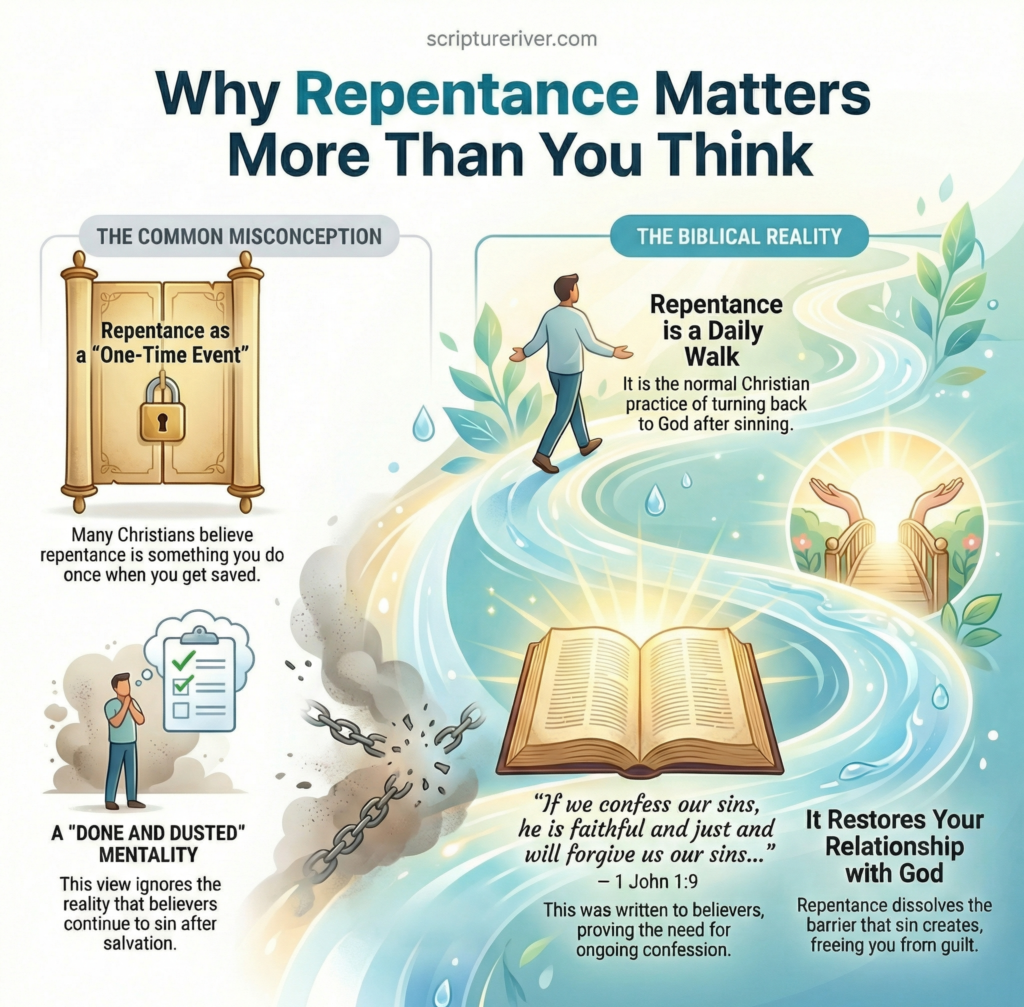
Some Christians treat repentance as a one-time salvation event. You repented when you got saved, and that’s done.
That’s not what Scripture teaches.
1 John 1:8-9, New International Version (NIV) addresses believers:
“If we claim to be without sin, we deceive ourselves and the truth is not in us. If we confess our sins, he is faithful and just and will forgive us our sins and purify us from all unrighteousness.”
John’s writing to Christians, not unbelievers.
He’s saying believers need ongoing confession and repentance because we keep sinning after salvation.
Repentance isn’t just the door into Christianity. It’s how you walk with God daily.
When you mess up, you repent. When you realize you’ve been going the wrong direction, you turn back.
That’s normal Christian life.
The Personal Experience That Taught Me This
Let me be specific about what I avoided God over for three months.
I’d said something cruel to someone I loved.
Not in a moment of anger. Calculated. Meant to hurt. And it worked exactly as I intended.
Immediately after, guilt hit.
But instead of repenting, I justified it.
They’d hurt me first. I was just being honest. They needed to hear it.
For three months, I avoided quiet time with God because I knew He’d address what I didn’t want to address.
I read devotionals but skipped passages about forgiveness and reconciliation.
I prayed about everything except the one thing eating me alive.
That Tuesday morning in my car, I finally admitted the truth: what I’d done was wrong, my justifications were lies, and I couldn’t fix it myself.
I repented. Out loud. “God, what I said was cruel and wrong. I meant to hurt them. I’m sorry. Please forgive me. Help me make this right.”
The relief was immediate.
Not because circumstances changed.
Because the barrier between God and me dissolved the moment I stopped defending myself and admitted I needed forgiveness.
I still had to apologize to the person I’d hurt.
Repentance to God didn’t eliminate earthly consequences.
But it restored my relationship with Him, which gave me the courage to face the consequences I deserved.
6 Simple Steps for Biblical Repentance
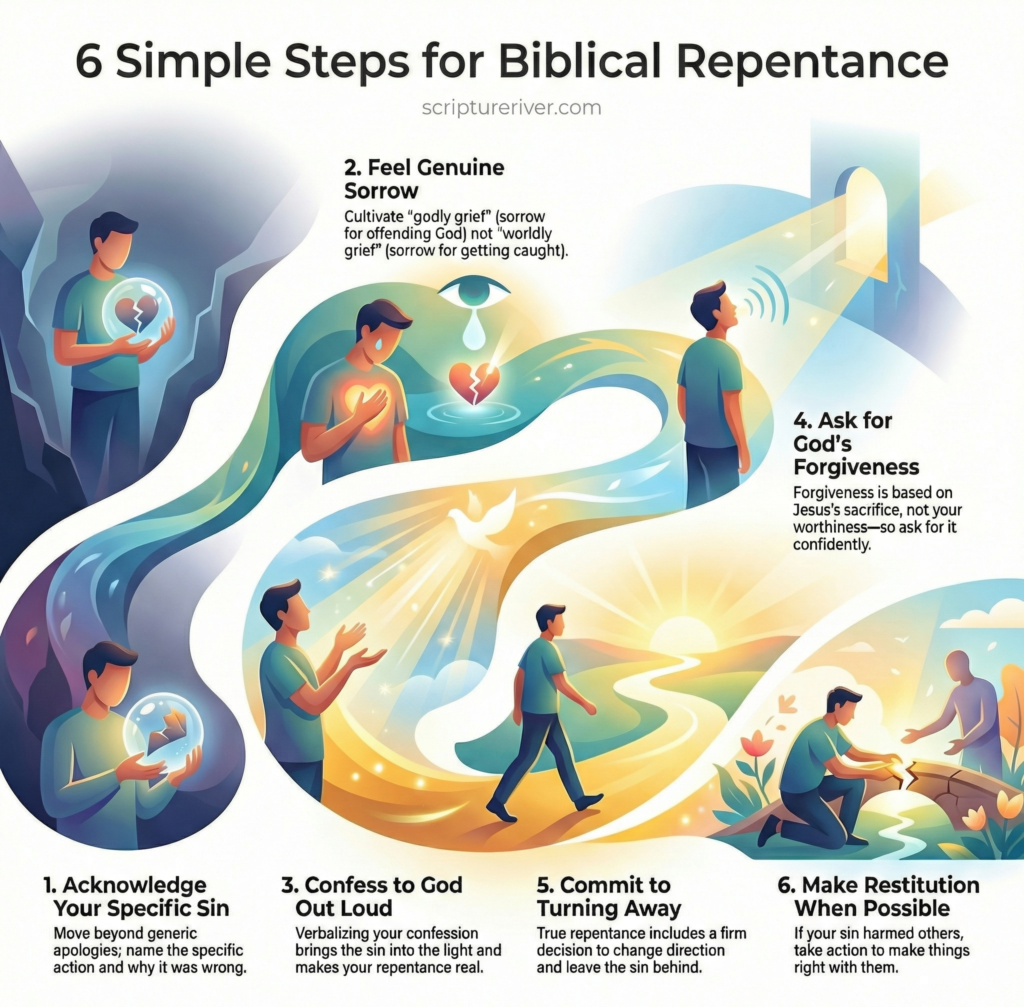
Repentance isn’t complicated. Religion makes it complicated. Scripture keeps it simple.
1. Acknowledge What You Did Wrong
You can’t repent of something you won’t name.
Generic prayers like “Forgive me for all my sins” don’t accomplish repentance.
You have to get specific about what you did and why it was wrong.
Not “Forgive me for being imperfect.” But “Forgive me for lying to my boss about why I missed work.”
Not “Help me be a better person.” But “I gossiped about my friend, destroying her reputation because I was jealous.”
Specific confession of specific sin is the first step of repentance.
2. Feel Genuine Sorrow for the Sin
2 Corinthians 7:10, Christian Standard Bible (CSB) distinguishes between two types of sorrow:
“For godly grief produces a repentance that leads to salvation without regret, but worldly grief produces death.”
Worldly sorrow means you’re sorry you got caught or sorry about consequences. Godly sorrow means you’re sorry you offended God and hurt others.
You don’t need to manufacture dramatic emotions.
But genuine repentance includes actual sorrow over sin, not just regret about consequences.
3. Confess to God Out Loud
There’s power in verbalizing repentance.
I could have thought my confession silently.
But saying it out loud to God made it real in a way silent thoughts don’t.
Proverbs 28:13, New King James Version (NKJV) promises:
“He who covers his sins will not prosper, but whoever confesses and forsakes them will have mercy.”
Confession means bringing sin into the light before God. Not hiding it. Not minimizing it. Saying clearly what you did wrong.
4. Ask for God’s Forgiveness
This is where many people get stuck.
They confess but don’t actually ask for forgiveness because they don’t believe they deserve it.
You don’t deserve it. That’s the whole point.
1 John 1:9 promises that if you confess, God “is faithful and just and will forgive us our sins and purify us from all unrighteousness.”
God’s faithfulness to forgive isn’t based on your worthiness. It’s based on Jesus’s finished work on the cross.
When you confess and ask for forgiveness, God forgives. Not because you earned it. Because Jesus already paid for it.
5. Commit to Turning Away from the Sin
Repentance requires decision to change direction.
You can’t keep doing the same sin while claiming you’ve repented.
That’s not repentance. That’s just apologizing so you feel better while continuing the behavior.
Romans 6:1-2, New Living Translation (NLT) addresses this directly:
“Well then, should we keep on sinning so that God can show us more and more of his wonderful grace? Of course not! Since we have died to sin, how can we continue to live in it?”
Repentance includes commitment to stop the sin. You might fail and need to repent again.
That’s different from never intending to stop in the first place.
6. Make Restitution When Possible
Some sins require more than confession to God. They require making things right with people you’ve wronged.
Luke 19:8-9 records Zacchaeus’s repentance:
“But Zacchaeus stood up and said to the Lord, ‘Look, Lord! Here and now I give half of my possessions to the poor, and if I have cheated anybody out of anything, I will pay back four times the amount.’ Jesus said to him, ‘Today salvation has come to this house.'”
Zacchaeus didn’t just confess to God. He made restitution to people he’d defrauded.
If you’ve stolen, return what you took. If you’ve lied, tell the truth. If you’ve slandered someone, set the record straight. If you’ve broken trust, rebuild it through consistent changed behavior.
Repentance to God doesn’t eliminate responsibility to people you’ve harmed.
What Repentance Doesn’t Require
Let’s clear up religious baggage that makes repentance harder than God intended.
You don’t need to feel a certain way. Repentance is a decision, not an emotion. Sometimes you feel deep remorse. Sometimes you feel nothing and repent anyway. Both are valid.
You don’t need to punish yourself first. Self-punishment isn’t repentance. It’s works-based religion trying to earn forgiveness. Jesus already bore your punishment. Accept His finished work.
You don’t need perfect behavior before approaching God. You come to God messy and broken. He cleans you up. You don’t clean yourself up before coming to Him.
You don’t need to repent perfectly. If imperfect repentance didn’t count, no one would be forgiven. God responds to sincere, messy, imperfect repentance because He sees your heart.
When You’ve Repented But Don’t Feel Forgiven
This is where many believers get stuck.
You’ve confessed. You’ve asked for forgiveness. You’ve committed to change. But you still feel guilty.
Here’s the truth: feelings don’t determine reality. God’s Word does.
1 John 1:9 doesn’t say “If we confess our sins and feel forgiven, then we are forgiven.” It says “If we confess our sins, he is faithful and just and will forgive.”
God forgave you the moment you confessed. Your feelings will catch up eventually.
But you’re forgiven whether you feel it or not because God’s promise is more reliable than your emotions.
Sometimes ongoing guilt is spiritual attack, not conviction. Satan is called “the accuser” in Revelation 12:10.
He accuses believers constantly, trying to make them doubt God’s forgiveness.
When you’ve genuinely repented and guilt persists, quote 1 John 1:9 out loud. “God, Your Word says if I confess, You forgive. I’ve confessed. So according to Your promise, I’m forgiven whether I feel it or not. I trust Your Word over my feelings.”
Living in the Freedom of Repentance

Repentance isn’t just about being forgiven. It’s about being free.
Free from guilt crushing you. Free from sin controlling you. Free from hiding from God. Free from pretending you’re fine when you’re not.
The most freeing moment of my life wasn’t when everything was going well.
It was that Tuesday morning in my car when I stopped defending my sin and admitted I needed God’s forgiveness.
Because hiding from God is exhausting. Justifying sin is exhausting. Carrying guilt you won’t release is exhausting.
Repentance ends the exhaustion. You bring everything into the light, God forgives it, and you get to breathe again.
That’s what turning back to God feels like. Not religious performance. Just honest admission that you messed up and desperate trust that He’s willing to forgive anyway.
He is. He always has been. He’s been waiting for you to come back the whole time you’ve been avoiding Him.
Prayer of Repentance
Father, I’ve been running from You because I knew what You’d say about what I’ve done. I’m tired of running. I’m tired of guilt. I’m tired of pretending I’m fine.
So, here’s the truth: I sinned. I was wrong. I can’t fix this myself. I’m sorry for what I did and I’m sorry it hurt You.
Please forgive me because of Jesus, not because I deserve it. I don’t deserve it. But Jesus paid for it, so I’m asking You to forgive me based on His finished work, not my worthiness.
Help me turn away from this sin. Give me strength to make things right where I can.
Thank You that Your faithfulness to forgive is more reliable than my feelings. I trust Your Word that says if I confess, You forgive. So I’m confessing, and I’m receiving Your forgiveness by faith.
In Jesus’s Name, Amen.
References
Allender, D. B., & Longman, T. (1994). Bold Love. NavPress. [Book]
Bridges, J. (2006). Respectable Sins: Confronting the Sins We Tolerate. NavPress. [Book]
Cloud, H., & Townsend, J. (2017). Boundaries: When to Say Yes, How to Say No. Zondervan. [Book]
Fee, G. D., & Stuart, D. (2014). How to Read the Bible for All Its Worth (4th ed.). Zondervan. [Book]
Keller, T. (2008). The Prodigal God: Recovering the Heart of the Christian Faith. Dutton. [Book]
Marshall, I. H. (1978). The Epistles of John. Eerdmans Publishing Company. [Book]
Mounce, W. D. (2006). Mounce’s Complete Expository Dictionary of Old and New Testament Words. Zondervan. [Reference Book]
Packer, J. I. (1973). Knowing God. InterVarsity Press. [Book]
Peterson, E. H. (2005). The Message: The Bible in Contemporary Language. NavPress. [Bible Translation]
Smedes, L. B. (1984). Forgive and Forget: Healing the Hurts We Don’t Deserve. HarperOne. [Book]
Stott, J. R. W. (1988). The Letters of John: An Introduction and Commentary. InterVarsity Press. [Book]
Strong, J. (2010). Strong’s Exhaustive Concordance of the Bible. Hendrickson Publishers. [Reference Book]
Tripp, P. D. (2002). Instruments in the Redeemer’s Hands: People in Need of Change Helping People in Need of Change. P&R Publishing. [Book]
Wiersbe, W. W. (2007). The Bible Exposition Commentary: New Testament (Vol. 2). David C. Cook. [Book]
Willard, D. (1988). The Spirit of the Disciplines: Understanding How God Changes Lives. HarperOne. [Book]

