
The question of Jesus’ relationship to God has divided religious communities for centuries and remains one of Christianity’s most profound mysteries.
When someone asks if Jesus walked the dusty roads of Galilee speaking to Himself, they’ve misunderstood the question entirely.
The answer requires precision: Jesus is fully God, but He is not the same Person as God the Father.
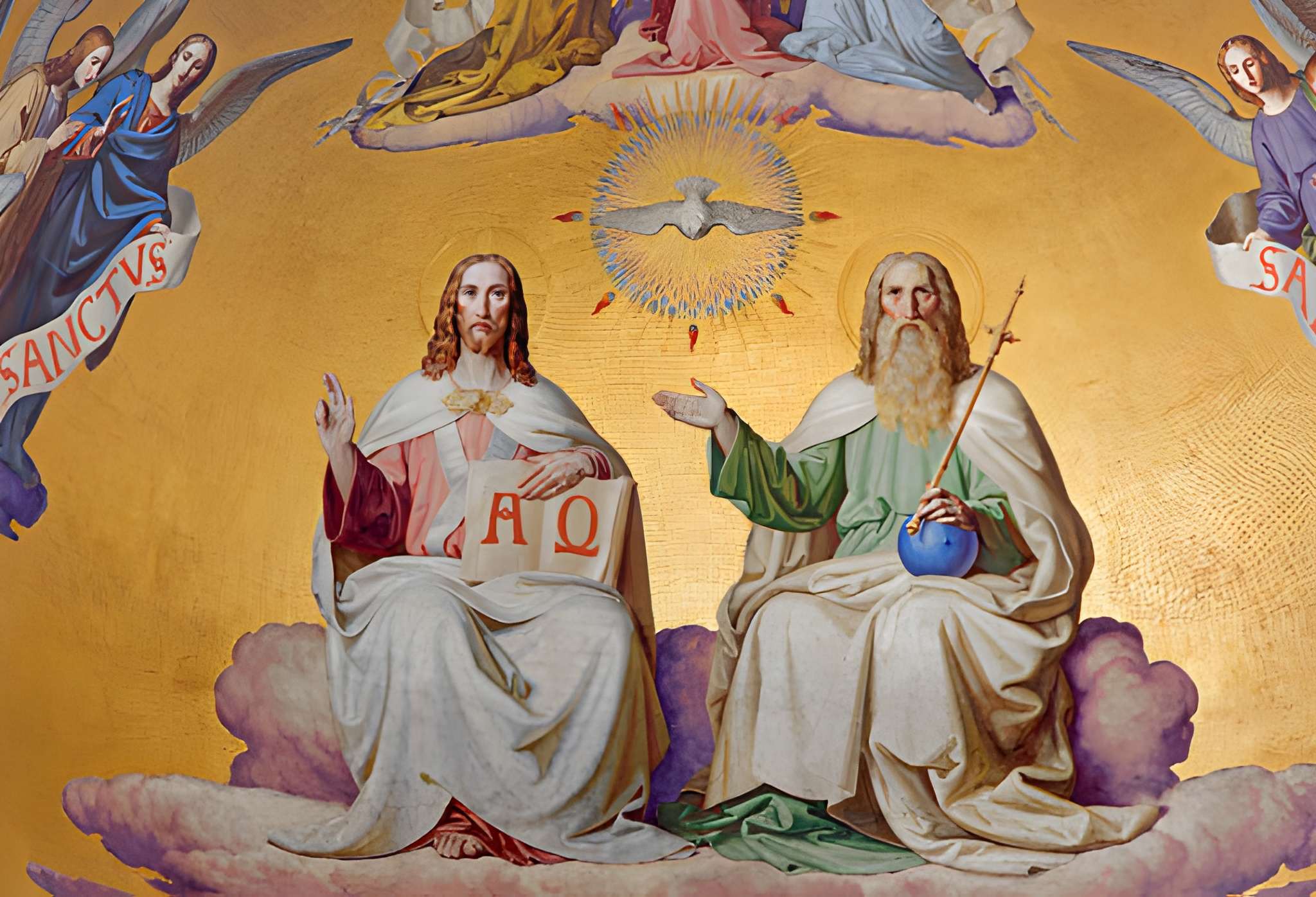
According to orthodox Christian doctrine established at the Council of Nicaea in 325 AD and refined at Constantinople in 381 AD, there is one God who eternally exists in three distinct Persons: Father, Son, and Holy Spirit.
Jesus is the second Person of this Trinity, sharing the same divine nature as the Father while remaining a distinct Person.
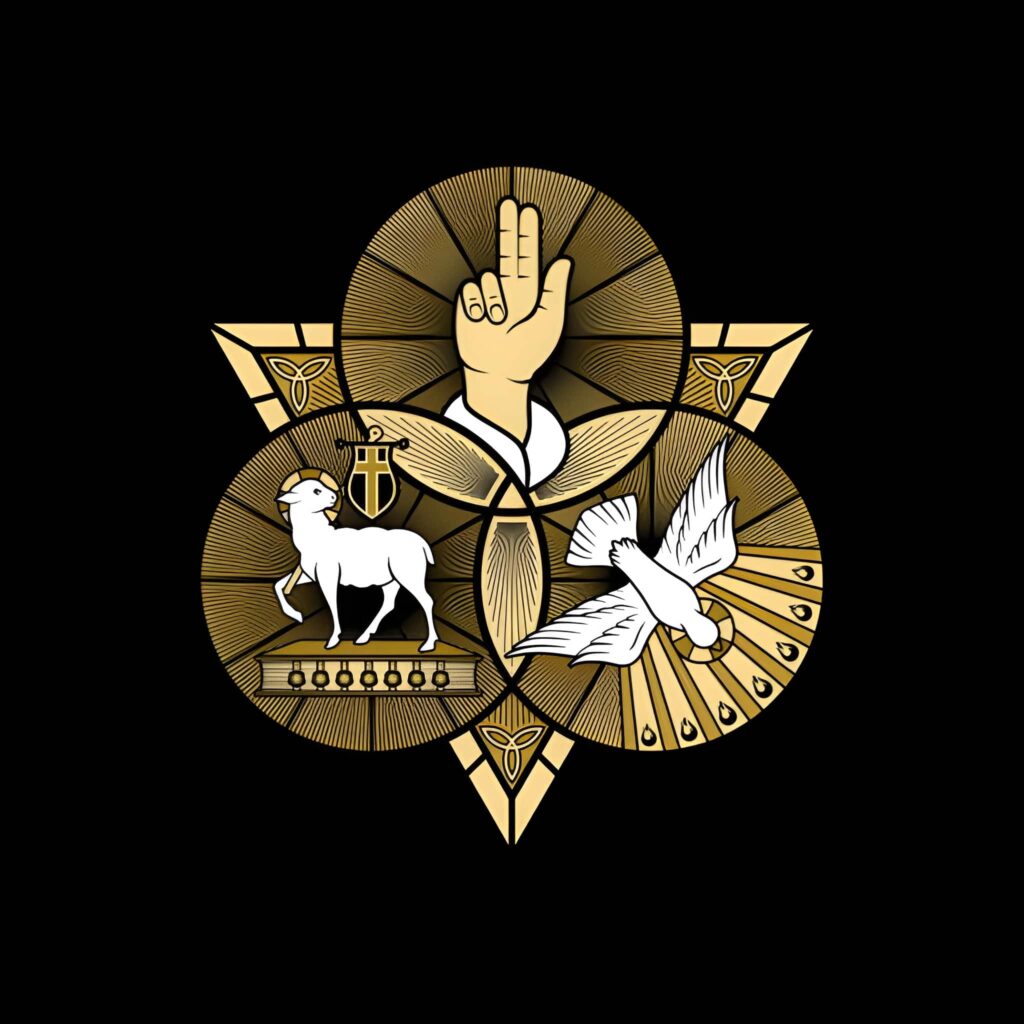
This is not three gods, but one God in three Persons—a truth that stretches human language to its breaking point.
What The Bible Actually Says About Jesus’ Divine Identity
John 1:1 Settles The Foundation
The Gospel of John opens with a declaration that has sparked more theological debate than perhaps any other verse in Scripture.
The Greek reads: En archē ēn ho logos, kai ho logos ēn pros ton theon, kai theos ēn ho logos.
In English:
In the beginning was the Word, and the Word was with God, and the Word was God.
John 1:1 (ESV)
Notice the careful wording.
John says the Word (Jesus) was with God, establishing distinction between two Persons.
Yet in the same breath, he declares the Word was God, establishing shared divine nature.
The Greek grammar is precise here.
When John writes kai theos ēn ho logos (“and the Word was God”), he uses theos without the definite article to indicate quality or nature rather than identity.
If John had written kai ho theos ēn ho logos, he would have been saying the Word was identical to the Father, which would collapse the Trinity into modalism—the heresy that God is one Person wearing different masks.
The absence of the article before theos (God) in the final clause is grammatically significant.
As Greek scholar Daniel Wallace explains, this construction indicates that John is telling us what kind of being the Word is (divine) rather than which Person He is (not the Father).
The Word shares the same divine essence as the Father but is not the same Person as the Father.
This is not polytheism, because both share one divine nature.
It is not modalism, because they are distinct Persons.
Philippians 2:6 Reveals Pre-Incarnate Equality
Paul provides another crucial text in his letter to the Philippians, where he quotes what scholars believe to be an early Christian hymn:
who, though he was in the form of God, did not count equality with God a thing to be grasped, but emptied himself, by taking the form of a servant, being born in the likeness of men.
Philippians 2:6-7 (ESV)
The Greek word morphē (“form”) refers to the essential nature or reality of something, not merely its outward appearance.
Jesus existed en morphē theou—in the form of God, possessing the very nature of deity.
The phrase “equality with God” (to einai isa theō) uses language of precise mathematical equality.
Paul is saying Jesus possessed full equality with God the Father in His pre-incarnate state.
The genius of this passage is what it reveals about Jesus’ humility.
He didn’t consider His divine status something to be “grasped” or “clung to” (harpagmon).
Unlike Adam, who grasped at equality with God though he didn’t possess it, Jesus possessed full divine equality but didn’t cling to its privileges.
He voluntarily set aside the independent exercise of divine prerogatives to take on human nature.
This makes no sense unless Jesus is fully God—you cannot surrender what you never possessed.
Thomas’ Declaration And Jesus’ Response
After the resurrection, when the skeptical disciple Thomas encountered the risen Christ, his response was immediate and unambiguous:
Thomas answered him, “My Lord and my God!” Jesus said to him, “Have you believed because you have seen me? Blessed are those who have not seen and yet have believed.”
John 20:28-29 (ESV)
Thomas didn’t merely call Jesus “lord” in the sense of “master.” He used the Greek ho kyrios mou kai ho theos mou—”the Lord of me and the God of me.” This is the language Jews reserved exclusively for Yahweh.
In the Greek Old Testament (Septuagint), ho kyrios translates the divine name YHWH.
Thomas was making a direct claim to Jesus’ deity.
Notice Jesus’ response.
He didn’t rebuke Thomas for blasphemy.
He didn’t say, “Wait, I’m not God—only the Father is God.” Instead, He commended Thomas’ faith.
Jesus accepted worship that belongs to God alone, because He is God.
The Historical Development of Trinitarian Doctrine
The Council Of Nicaea (325 AD)
The early church didn’t invent the Trinity in the fourth century.
What the councils did was clarify and defend what Christians had believed from the beginning against heresies that threatened biblical truth.
The primary threat came from Arius, a presbyter in Alexandria who taught that the Son was the first and greatest of God’s creatures but not eternal or equal with the Father.
The Council of Nicaea responded with the Nicene Creed, which declared:
We believe in one Lord Jesus Christ, the only Son of God, eternally begotten of the Father, God from God, Light from Light, true God from true God, begotten, not made, of one Being with the Father.
The critical Greek term was homoousios—”of one substance” or “consubstantial.” The Son shares the identical divine essence (ousia) as the Father.
They are not two gods sharing similar natures, but two Persons sharing one nature.
Athanasius, the great defender of Nicene orthodoxy, understood that if the Son were a creature—even the greatest creature—then our salvation collapses.
Only God can save us from sin and death.
If Jesus is not fully God, we have no Savior.
The Council Of Constantinople (381 AD)
The Council of Constantinople expanded the Nicene Creed to explicitly include the Holy Spirit in the same divine unity:
We believe in the Holy Spirit, the Lord, the giver of life, who proceeds from the Father and the Son, who with the Father and the Son is worshiped and glorified.
This settled the question that was implicit in Nicaea: the Trinity consists of three co-equal, co-eternal Persons sharing one divine essence.
The Athanasian Creed Provides Precision
Later, in the fifth or sixth century, the Athanasian Creed emerged as the most precise statement of Trinitarian and Christological doctrine.
It addresses our question directly:
The Father is God, the Son is God, and the Holy Spirit is God. And yet there are not three gods but one God. The Father is one Person, the Son is another, and the Holy Spirit is another. But the Godhead of the Father, Son, and Holy Spirit is all one, the glory equal, the majesty coeternal.
The creed’s genius is its clarity: neither confounding the Persons nor dividing the substance.
We must not collapse the three Persons into one Person (modalism), nor divide the one God into three gods (tritheism).
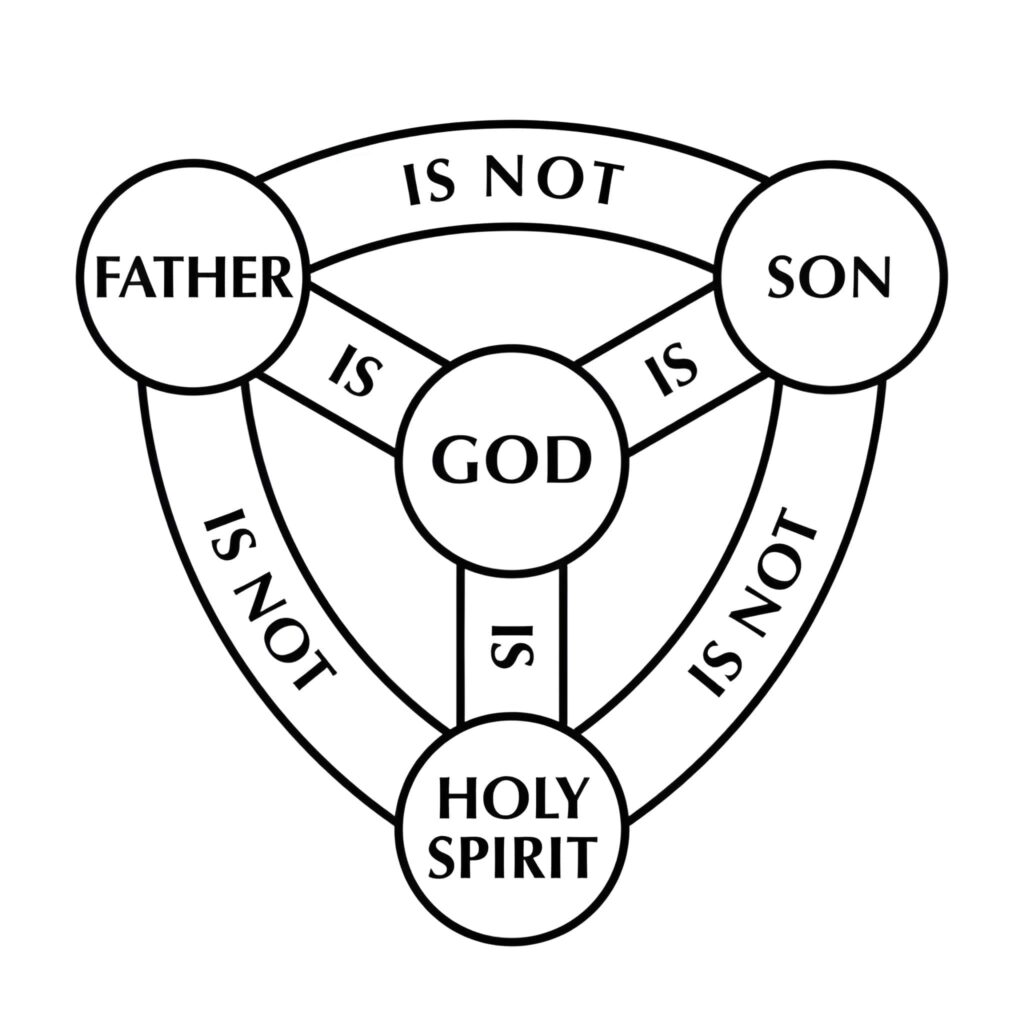
The Father is not the Son.
The Son is not the Spirit.
The Spirit is not the Father.
Yet each is fully God, and there is only one God.
The Doctrine Of The Hypostatic Union
The question becomes more complex when we consider Jesus’ incarnation.
How can one Person be both fully God and fully man?
This is where the doctrine of the hypostatic union enters.
The term “hypostatic union” comes from the Greek hypostasis (person or substance).
It teaches that in the one Person of Jesus Christ, two complete natures—divine and human—are united without confusion, change, division, or separation.
These are the “four nots” articulated at the Council of Chalcedon in 451 AD.
Jesus is not half God and half man.
He is not God dwelling in a human body like a hand in a glove.
He is not God who temporarily became human.
He is one Person with two complete natures.
As the Westminster Shorter Catechism states: “Christ, the Son of God, became man by taking to himself a true body and a reasonable soul, being conceived by the power of the Holy Ghost in the womb of the Virgin Mary, and born of her, yet without sin.”
This explains how Jesus could pray to the Father, experience human limitations like hunger and fatigue, yet also forgive sins, receive worship, and declare, “Before Abraham was, I am” (John 8:58), using the divine name Yahweh revealed to Moses at the burning bush.
Why The Distinction Between Person And Nature Matters
The confusion in the question “Is Jesus the same Person as God?” comes from failing to distinguish between person and nature.
In ordinary human experience, these always correspond: one person equals one nature.
You are one person with one human nature.
I am one person with one human nature.
But God is not bound by our categories.
In God, three Persons share one divine nature.
And in Jesus Christ, one Person possesses two natures—divine and human.
When we ask, “Is Jesus God?” the answer is yes—He possesses the divine nature fully.
When we ask, “Is Jesus the Father?” the answer is no—He is a distinct Person.
When we ask, “Are Jesus and the Father the same God?” the answer is yes—they share the identical divine essence.
Think of it this way: If you asked, “Are the Father and Son two Gods?” The answer is no.
If you asked, “Are the Father and Son one Person?” The answer is also no.
They are two Persons who are one God.
Common Heresies That Misunderstand This Truth
Modalism (Sabellianism)
This heresy teaches that God is one Person who appears in three modes or roles.
Sometimes He shows up as Father, sometimes as Son, sometimes as Spirit—like an actor wearing different masks.
This contradicts Scripture, where the Father and Son clearly interact as distinct Persons.
At Jesus’ baptism, the Father speaks from heaven, the Son is baptized in the Jordan, and the Spirit descends like a dove.
Three Persons are simultaneously present.
Arianism
Arius taught that Jesus is the first and greatest creature but not truly God.
This makes Jesus a demigod—superior to us but inferior to the Father.
The problem is that this gives us no Savior.
As Athanasius argued, “He became what we are that He might make us what He is.” If Jesus is not fully God, He cannot bridge the infinite gap between God and humanity.
Tritheism
This error goes the opposite direction, teaching three separate gods who work together closely.
This contradicts the foundational Jewish confession that Christians inherited: “Hear, O Israel: The LORD our God, the LORD is one” (Deuteronomy 6:4).
Christianity is radically monotheistic.
We worship one God, not three.
Practical Implications Of This Doctrine
We Can Know God Personally
Jesus declared, “Whoever has seen me has seen the Father” (John 14:9).
Because Jesus is God incarnate, His revelation of the Father is not approximate or symbolic but exact.
The invisible God has made Himself visible in Jesus Christ.
We don’t have to guess what God is like.
We look at Jesus.
Our Salvation Is Secure
Only God can forgive sins.
Only God can conquer death.
Only God can reconcile humanity to Himself.
If Jesus is not fully God, then His death on the cross was the tragic martyrdom of a good man, not the atoning sacrifice that satisfies divine justice.
But because Jesus is God, His sacrifice has infinite value.
We Worship Without Division
When we worship Jesus, we are not worshiping a different God than the Father.
We worship the one God who exists eternally as Father, Son, and Holy Spirit.
Jesus said, “I and the Father are one” (John 10:30).
He didn’t mean they are the same Person, but that they share the same divine will, purpose, and nature.
To honor the Son is to honor the Father.
Frequently Asked Questions
If Jesus Is God, Why Did He Pray To The Father?
Jesus prayed to the Father because He is a distinct Person from the Father, and because in His incarnation He took on human nature. As a man, Jesus modeled perfect dependence on the Father. His prayers don’t indicate inferiority in nature but distinction in Person and role. The Son eternally proceeds from the Father—this describes their eternal relationship, not a hierarchy of being.
How Can Jesus Be God If He Said The Father Is Greater Than He Is?
In John 14:28, Jesus says, “The Father is greater than I.” This refers to His incarnate state and His mediatorial role as Savior. In taking on human nature and becoming our representative, Jesus voluntarily submitted to the Father’s will. The Athanasian Creed captures this: Jesus is “equal to the Father as touching His Godhead, and inferior to the Father as touching His manhood.” His human nature is subordinate to the Father, but His divine nature is co-equal.
Doesn’t The Trinity Mean Christians Worship Three Gods?
No. The doctrine explicitly affirms one God. The Athanasian Creed states: “We worship one God in Trinity, and Trinity in Unity, neither confounding the Persons nor dividing the substance.” Christians are fiercely monotheistic. We do not worship three gods; we worship the one God who has revealed Himself as three Persons.
Is The Word “Trinity” In The Bible?
The word “Trinity” does not appear in Scripture, just as “incarnation” and “omnipotence” don’t appear. But the reality these words describe saturates the biblical text. The Father is called God. The Son is called God. The Spirit is called God. Yet Scripture insists there is only one God. The doctrine of the Trinity is the church’s best attempt to remain faithful to all that Scripture reveals about God’s nature.
If This Is So Important, Why Didn’t Jesus Explain It More Clearly?
Jesus did explain it, but not in systematic theological terms. He revealed it through His life, death, and resurrection. He called God His Father in unique ways that scandalized His opponents. He accepted worship. He forgave sins. He claimed preexistence before Abraham. He promised to send the Spirit. The apostles, guided by the Spirit Jesus promised, unpacked these truths in their letters. The early church formulated precise language to guard these biblical realities against distortion.
Conclusion: The Wonder Of This Mystery
The doctrine that Jesus is fully God yet a distinct Person from the Father is not a logical contradiction but a truth that transcends our finite categories.
God’s triune nature is not less than rational—it is more than rational, revealing depths of divine reality that exceed our comprehension without contradicting our reason.
We worship a God who is not a solitary monad but an eternal communion of love between Father, Son, and Holy Spirit.
And the stunning good news of the gospel is that this God has invited us, through Jesus Christ, to participate in that divine life.
As Peter writes, we “become partakers of the divine nature” (2 Peter 1:4).
Not that we become gods, but that through union with Christ, we are drawn into the life of the triune God.
So is Jesus God?
Yes, absolutely.
Is Jesus the same Person as God the Father?
No, He is the second Person of the Trinity.
Are there three gods?
No, there is one God who eternally exists as Father, Son, and Holy Spirit.
This is the faith once delivered to the saints, hammered out in the fires of controversy, tested by centuries of scrutiny, and worshiped by billions across two millennia.
It is the faith that transforms lives, because it reveals a God who is not distant and unknowable but who has come near in Jesus Christ.
A Prayer for Understanding the Trinity
Eternal God, Father, Son, and Holy Spirit, we stand in awe before the mystery of Your triune being. Grant us humble hearts to worship what we cannot fully comprehend, and grateful hearts to receive what You have revealed. Thank You that in Jesus Christ, You have made Yourself known not as an abstract concept but as a Person we can encounter, trust, and love. Deepen our understanding of who You are, not for the sake of winning arguments, but that we might know You more intimately and worship You more fully. In the name of the Father, and of the Son, and of the Holy Spirit. Amen.
Sources
Athanasius. On the Incarnation. [Classic Patristic Work]
Augustine. De Trinitate (On the Trinity). [Classic Patristic Work]
Basil of Caesarea. Epistle 38: To Gregory His Brother. [Patristic Letter]
The Book of Common Prayer. (1662). The Athanasian Creed. [Liturgical Resource]
Council of Chalcedon. (451). The Chalcedonian Definition. [Ecumenical Council Document]
Council of Constantinople. (381). The Niceno-Constantinopolitan Creed. [Ecumenical Council Document]
Council of Nicaea. (325). The Nicene Creed. [Ecumenical Council Document]
Erickson, M. J. (2013). Christian Theology (3rd ed.). Baker Academic. [Systematic Theology]
Frame, J. M. (2002). The Doctrine of God. P&R Publishing. [Theological Treatise]
Gaebelein, F. E. (Ed.). Expositor’s Bible Commentary (Vol. 9). Zondervan. [Biblical Commentary]
Gregory of Nyssa. Against Eunomius. [Patristic Work]
Grudem, W. (1994). Systematic Theology: An Introduction to Biblical Doctrine. Zondervan. [Systematic Theology]
Jacobs, N. A. (2018). The Begotten-Not-Made Distinction in the Eastern Pro-Nicenes. Religious Studies, 54(1), 9-26. [Journal Article]
Kelly, J. N. D. (1964). The Athanasian Creed. Harper & Row. [Historical Study]
Letham, R. (2004). The Holy Trinity: In Scripture, History, Theology, and Worship. P&R Publishing. [Theological Study]
Mathis, D. (2025). What Is the Hypostatic Union? Desiring God. [Theological Article]
Silva, M. Philippians: Baker Exegetical Commentary on the New Testament. Baker Academic. [Biblical Commentary]
Torrance, T. F. (1996). The Christian Doctrine of God: One Being Three Persons. T&T Clark. [Systematic Theology]
Wallace, D. B. (1996). Greek Grammar Beyond the Basics: An Exegetical Syntax of the New Testament. Zondervan. [Greek Grammar]
Warfield, B. B. (1968). The Biblical Doctrine of the Trinity. In Biblical and Theological Studies (pp. 21-59). Presbyterian and Reformed Publishing Company. [Theological Essay]
Wellum, S. (2016). God the Son Incarnate: The Doctrine of Christ. Crossway. [Christology]
Westminster Shorter Catechism. (1647). Questions 4-6, 21. [Confessional Document]

