
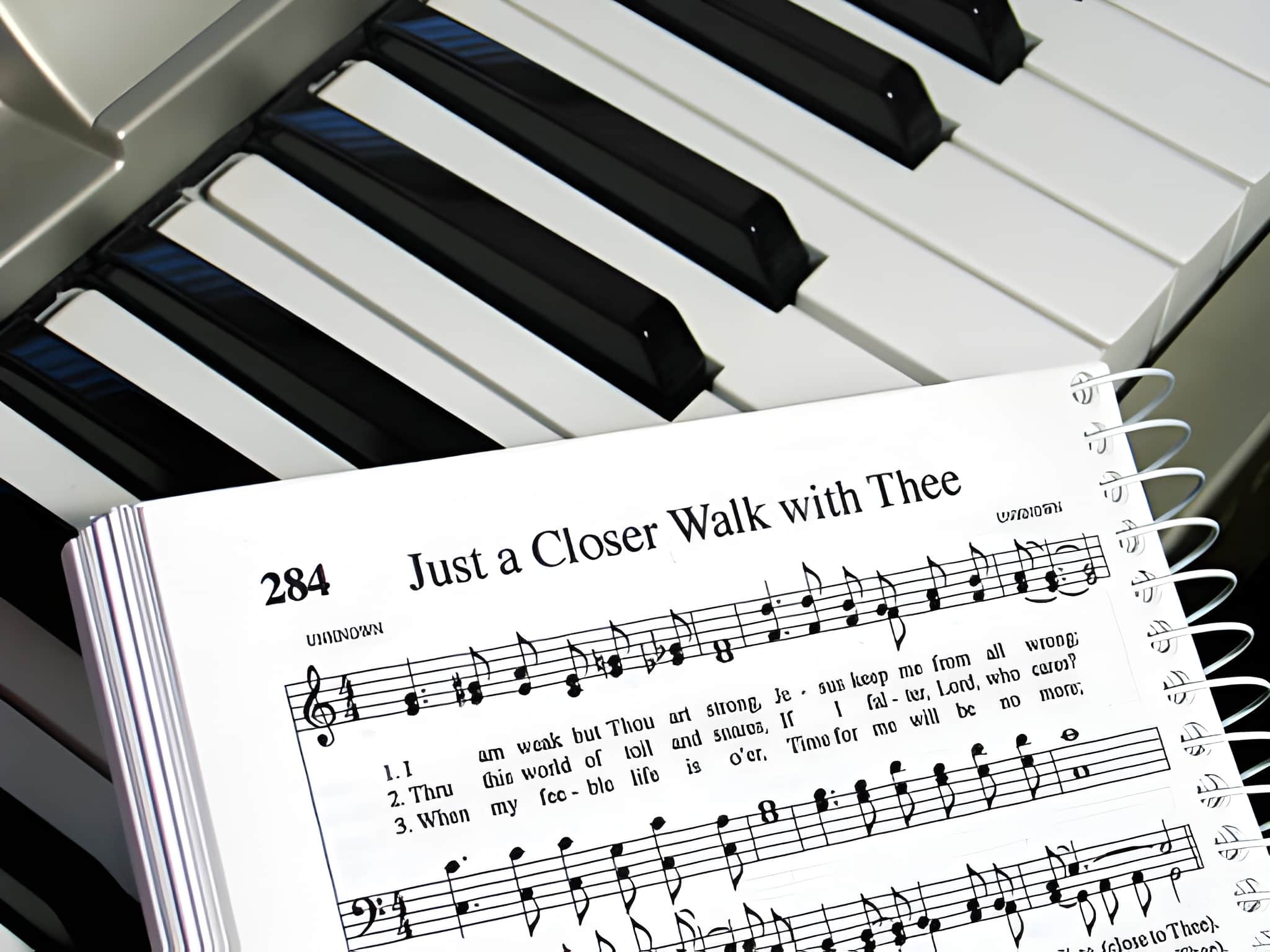
Nobody knows who wrote “Just a Closer Walk with Thee.”
The hymn that’s been sung at countless funerals, recorded by hundreds of artists from gospel choirs to jazz legends, and comforted millions of believers through loss and hardship has no known author.
No copyright. No documented origin story.
It simply appeared in African American churches in the early 20th century, passed along orally until it was finally transcribed and published in the 1940s.
The anonymity feels appropriate for a song whose entire message is about decreasing self so Christ can increase.
“Just a Closer Walk with Thee” has endured for nearly a century while countless contemporary worship songs fade after a season.
Its theological depth wrapped in simple language creates a prayer that resonates equally with new believers and those who’ve walked with God for decades.
Understanding the spiritual message embedded in each verse reveals why this hymn continues speaking to Christians across denominational lines, cultural backgrounds, and generations.
The longing it expresses is universal among believers: intimacy with Jesus that sustains through every season of life.
Want to quickly understand the message of this hymn?
Here’s an audio overview explaining the biblical foundation for each verse, why this hymn resonates so deeply across generations, and how to apply its message to your own walk with God.
The Complete Hymn Lyrics (Song Included)
I have taken the time to upload the hymn (as performed by Rosemary Siemens) for your listening convenience. It is worth every listen. I enjoyed it too.
Listen and be blessed
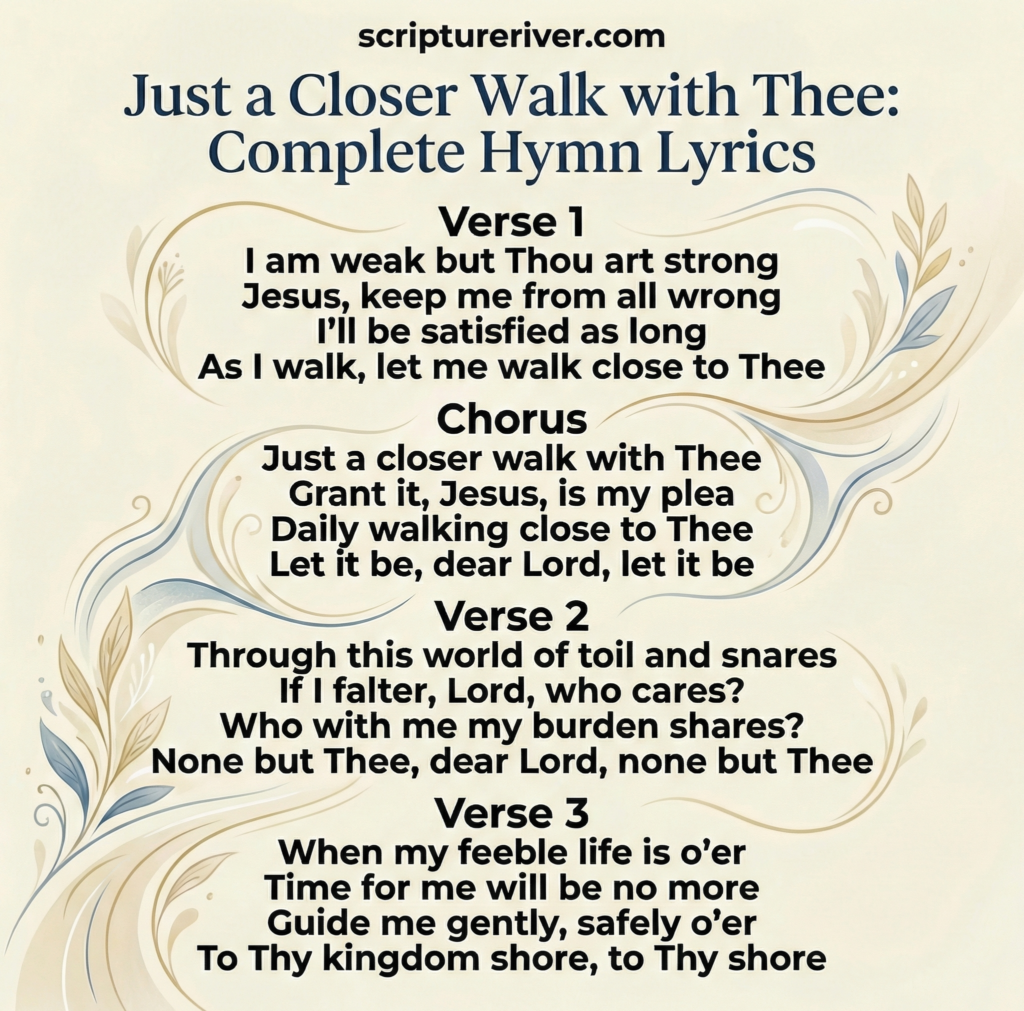
Verse 1
I am weak but Thou art strong Jesus, keep me from all wrong I’ll be satisfied as long As I walk, let me walk close to Thee
Chorus
Just a closer walk with Thee Grant it, Jesus, is my plea Daily walking close to Thee Let it be, dear Lord, let it be
Verse 2
Through this world of toil and snares If I falter, Lord, who cares? Who with me my burden shares? None but Thee, dear Lord, none but Thee
Verse 3
When my feeble life is o’er Time for me will be no more Guide me gently, safely o’er To Thy kingdom shore, to Thy shore
The Biblical Foundation of the Hymn’s Message
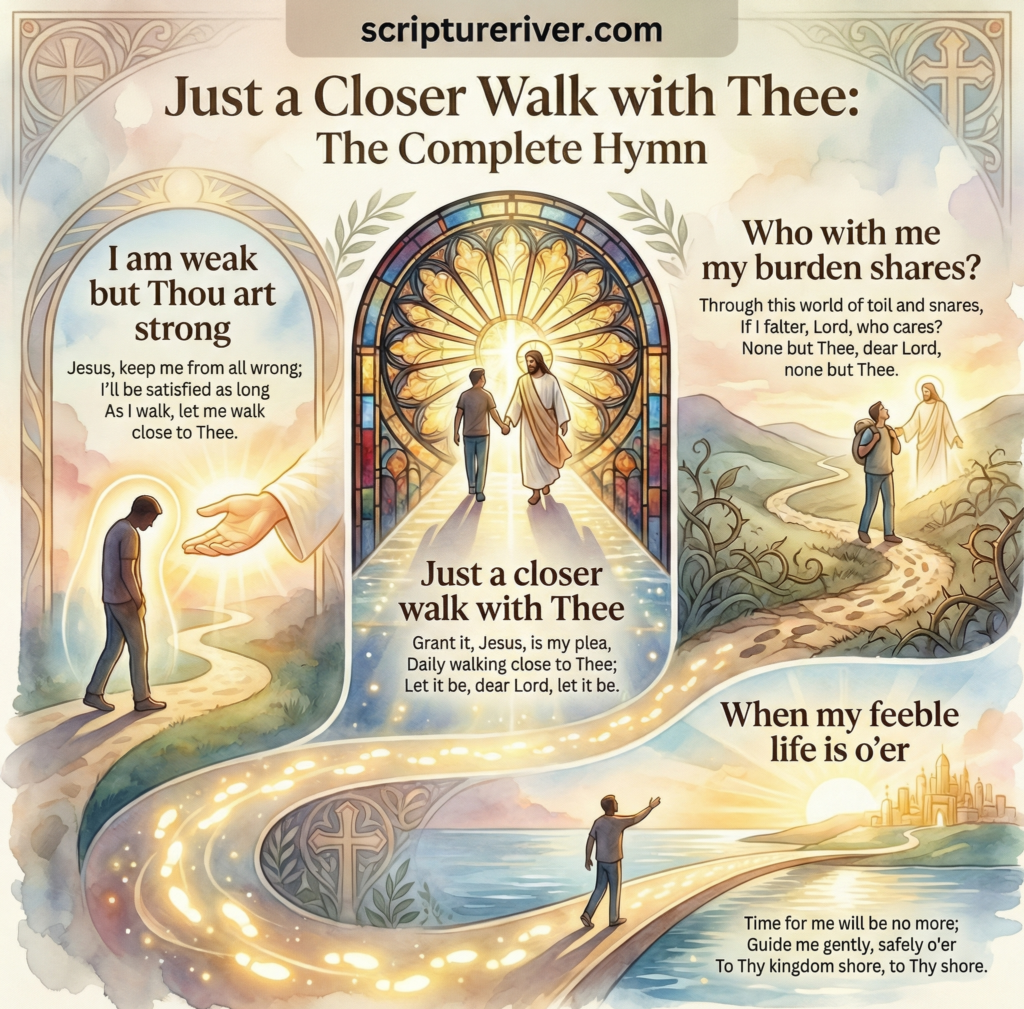
Every line of this hymn connects to scriptural truth about walking with God.
“I Am Weak But Thou Art Strong”
This opening line echoes Paul’s testimony in 2 Corinthians 12:9-10.
2 Corinthians 12:9-10, English Standard Version (ESV)
“But he said to me, ‘My grace is sufficient for you, for my power is made perfect in weakness.’ Therefore I will boast all the more gladly of my weaknesses, so that the power of Christ may rest upon me. For the sake of Christ, then, I am content with weaknesses, insults, hardships, persecutions, and calamities. For when I am weak, then I am strong.”
The hymn begins with honest acknowledgment of human frailty. This isn’t false humility or self-deprecation. It’s accurate self-assessment that creates dependence on Christ’s strength.
“Jesus, Keep Me From All Wrong”
This petition reflects the Lord’s Prayer: “Lead us not into temptation, but deliver us from evil” (Matthew 6:13).
It also connects to Jude 24, which describes God as “him who is able to keep you from stumbling.” The hymn asks Jesus to do what only He can do: preserve believers from falling into sin.
“Daily Walking Close to Thee”
The concept of walking with God appears throughout Scripture as the metaphor for ongoing relationship.
Micah 6:8, Christian Standard Bible (CSB)
“Mankind, he has told each of you what is good and what it is the Lord requires of you: to act justly, to love faithfulness, and to walk humbly with your God.”
Walking implies movement, progress, and companionship. It’s not standing still or running ahead. It’s moving forward at a pace that allows continual presence with God.
“Through This World of Toil and Snares”
Jesus promised difficulty in this world. John 16:33 records His words: “In this world you will have trouble. But take heart! I have overcome the world.”
The hymn acknowledges Christian life includes toil (hard work, weariness) and snares (temptations, traps, dangers). It doesn’t promise easy circumstances. It promises Jesus’s presence through difficult circumstances.
“None But Thee, Dear Lord”
This expresses what theologians call the sufficiency of Christ. He alone meets our deepest needs.
Psalm 73:25-26, New International Version (NIV)
“Whom have I in heaven but you? And earth has nothing I desire besides you. My flesh and my heart may fail, but God is the strength of my heart and my portion forever.”
The rhetorical question “Who with me my burden shares?” receives the answer: only Jesus. Friends fail. Family disappoints. Circumstances change. Jesus remains constant.
The Theological Themes in Each Verse
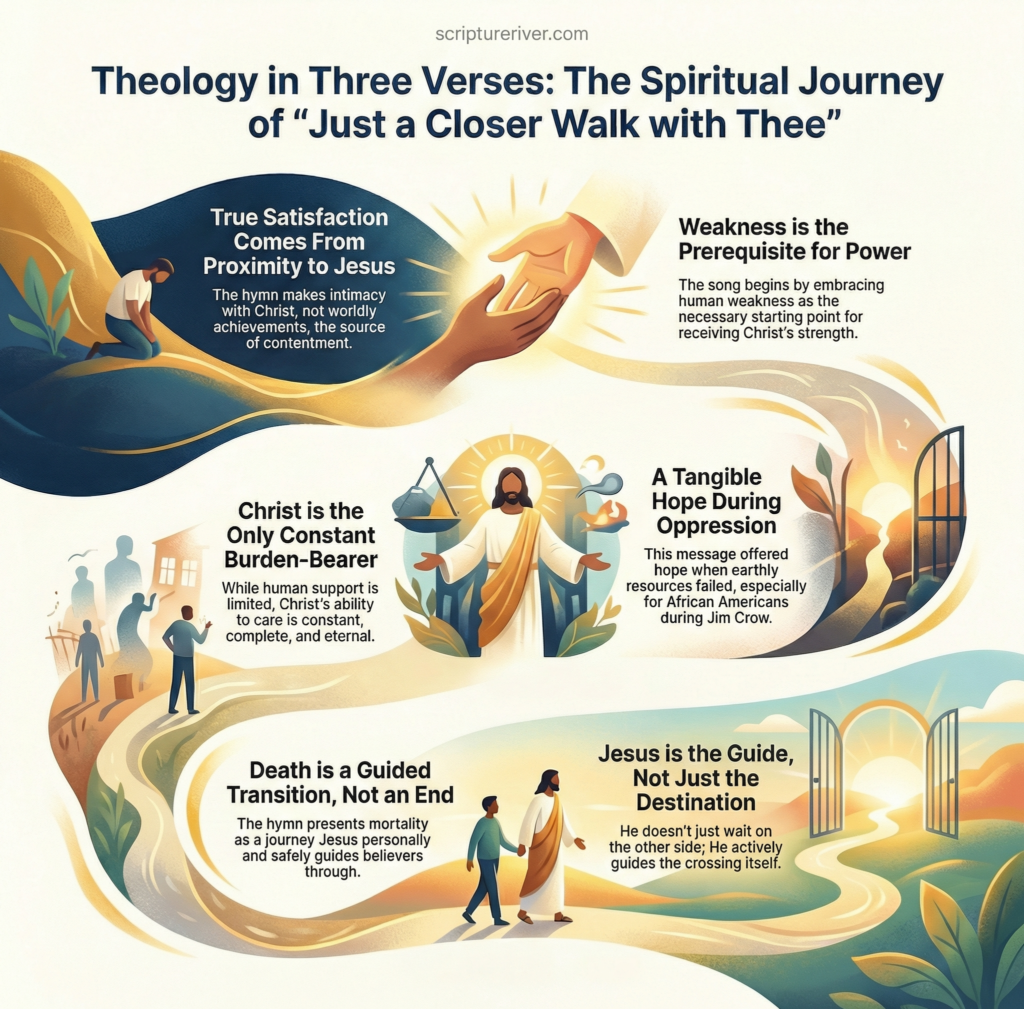
Verse 1: Dependence on Christ’s Strength
This verse establishes the foundational truth that Christian living requires Christ’s power, not human effort.
The satisfaction promised isn’t from achievements, possessions, or circumstances.
It comes from proximity to Jesus. “I’ll be satisfied as long as I walk close to Thee” makes intimacy with Christ the source of contentment.
This contradicts the self-sufficiency Western culture celebrates. The hymn begins by declaring “I am weak” without apology or embarrassment.
Weakness isn’t a problem to solve but the prerequisite for experiencing Christ’s strength.
Verse 2: Christ’s Exclusive Sufficiency
The second verse addresses the universal human experience of bearing burdens through difficult circumstances.
“If I falter, Lord, who cares?” isn’t cynical. It’s realistic.
People have limited capacity to bear others’ burdens consistently. Even those who love you most can’t be present always or understand fully.
“None but Thee” declares Christ’s unique ability to care constantly, understand completely, and bear burdens eternally.
He doesn’t grow weary of your struggles or impatient with your weakness.
According to hymn scholar William Reynolds’ research on gospel songs, this verse resonated particularly with African Americans during Jim Crow era when institutional oppression meant human help was often unavailable.
Christ’s sufficiency became tangible hope when earthly resources failed.
Verse 3: Hope for Eternity
The final verse addresses death without fear. “When my feeble life is o’er” acknowledges mortality plainly.
But death isn’t the end. It’s a transition Jesus guides: “Guide me gently, safely o’er to Thy kingdom shore.”
2 Timothy 4:18, New King James Version (NKJV)
“And the Lord will deliver me from every evil work and preserve me for His heavenly kingdom. To Him be glory forever and ever. Amen!”
The imagery of crossing to a shore suggests passing from this temporary world to eternal home. Jesus doesn’t just wait on the other side. He guides the crossing itself.
Why This Hymn Endures Across Generations
It’s Theologically Deep Yet Accessible
The hymn addresses profound theological concepts: human weakness, Christ’s sufficiency, sanctification, perseverance, and glorification. Yet it uses simple language accessible to anyone.
You don’t need seminary training to understand “I am weak but Thou art strong.” A child grasps it. A theologian finds depth in it.
It Expresses Universal Christian Longing
Every believer, regardless of maturity level, wants closer walk with Jesus. New converts long for it. Lifelong saints pursue it. The desire never disappears.
The chorus captures this longing perfectly: “Just a closer walk with Thee, grant it Jesus, is my plea.” It’s prayer, not declaration. Petition, not achievement. This humility keeps it relevant regardless of how long you’ve followed Christ.
It Addresses Real Suffering
The hymn doesn’t promise prosperity, health, or ease. It acknowledges “this world of toil and snares” and asks Jesus to sustain through difficulty, not remove it.
This honesty about Christian suffering makes the hymn trustworthy. People sing it at funerals and in hospital rooms and during personal crises. It doesn’t offer false hope but genuine comfort: Jesus walks with you through suffering.
It Balances Present and Future Hope
The hymn addresses current daily walk with God while looking toward eternal home. Both timeframes matter. Christians need sustaining grace for today and confident hope for eternity.
Verse 2 focuses on present: “Through this world of toil and snares.” Verse 3 focuses on future: “When my feeble life is o’er.” The balance prevents either excessive focus on this world or escapist obsession with heaven.
How to Apply This Hymn’s Message
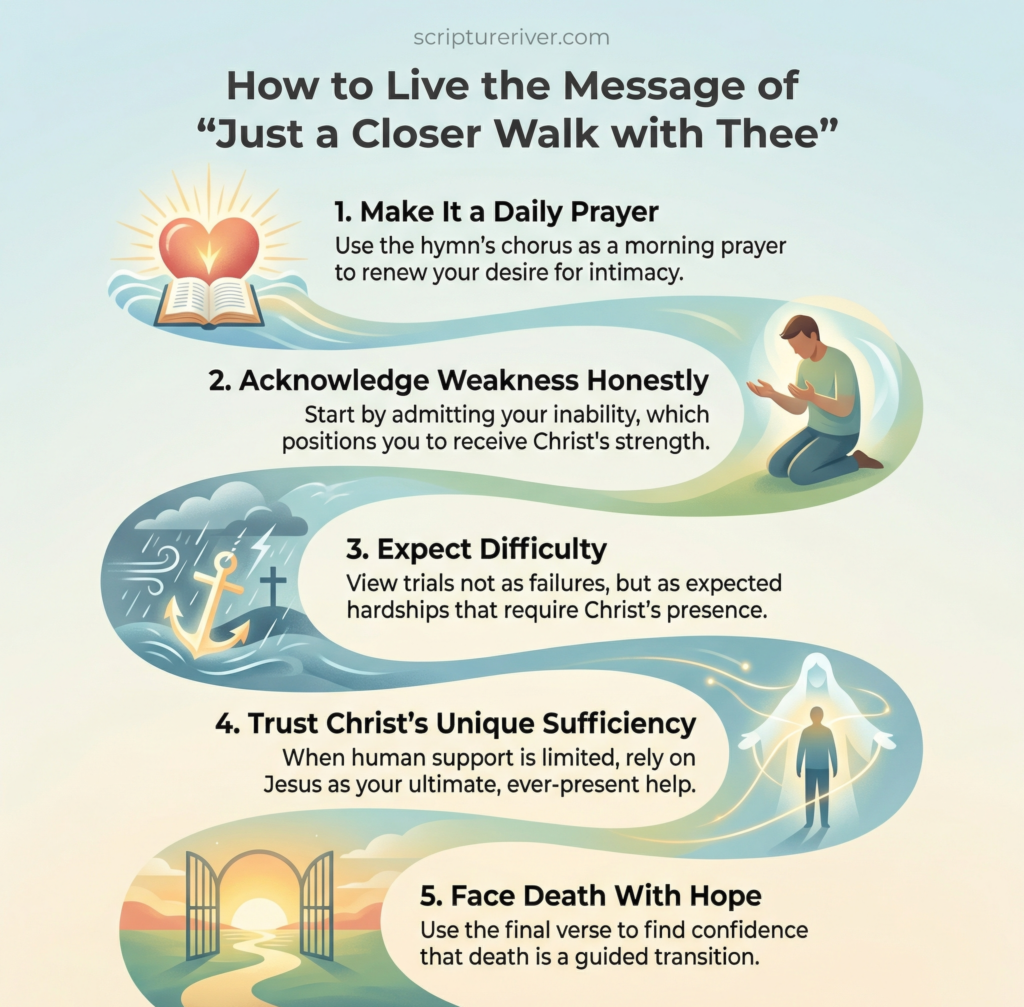
1. Make It Your Daily Prayer
Use the chorus as morning prayer. “Just a closer walk with Thee, grant it Jesus, is my plea.” Ask God each day to draw you nearer to Himself.
This isn’t once-for-all closeness you achieve and maintain. It requires daily renewal of desire for intimacy with Christ.
2. Acknowledge Weakness Honestly
The hymn’s opening “I am weak” contradicts cultural messages about self-sufficiency and positive self-talk.
Biblical Christianity begins with honest acknowledgment of inability. You can’t be holy in your own strength. You can’t resist temptation alone. You can’t persevere through trials independently.
Admitting weakness positions you to receive Christ’s strength.
3. Expect Difficulty
“Through this world of toil and snares” prepares you for hard circumstances rather than promising their absence.
When trials come, they don’t mean you’ve failed spiritually or God has abandoned you. They mean you’re experiencing what the hymn prepares believers to expect: difficulty that requires Christ’s sustaining presence.
4. Trust Christ’s Unique Sufficiency
When human help fails, remember “None but Thee.” Friends can’t be available constantly. Family can’t understand fully. Counselors have limited hours. Jesus is always present, completely understanding, and infinitely capable.
This doesn’t minimize human relationships. It properly orders them. People provide important support. Christ provides ultimate sufficiency.
5. Face Death With Hope
The third verse gives language for confronting mortality. “Guide me gently, safely o’er to Thy kingdom shore.”
When you face your own death or walk with dying loved ones, this verse provides biblical confidence that death is transition, not termination. Jesus guides the crossing.
Frequently Asked Questions About “Just a Closer Walk with Thee”
Who wrote “Just a Closer Walk with Thee”?
The author is unknown. The hymn emerged from African American church tradition in the early 20th century, passed orally before being transcribed. It was first published in print in 1940 in a collection called “Favorite Radio Songs” but likely existed in oral tradition for years prior.
Is “Just a Closer Walk with Thee” a funeral song?
While commonly sung at funerals due to its third verse about death, it’s not exclusively a funeral hymn. The song addresses daily Christian walk, suffering, and ultimate hope, making it appropriate for many contexts beyond funerals.
What does “closer walk” mean biblically?
Walking with God is biblical metaphor for ongoing relationship and obedience. Genesis 5:22 says Enoch “walked with God.” Micah 6:8 commands walking humbly with God. A closer walk means increased intimacy, deeper fellowship, and more consistent obedience in daily relationship with God.
Why do so many different artists record this hymn?
Its simple melody and profound lyrics make it adaptable across musical genres. Gospel choirs, jazz musicians, country artists, and classical vocalists all find it musically versatile while the message resonates universally among Christians and even appeals to non-Christian audiences appreciating its spiritual depth.
Can I sing this hymn if I’m struggling spiritually?
Yes. The hymn is petition, not testimony of achievement. You’re not declaring “I have a close walk with God.” You’re praying “Grant me a closer walk, Jesus, this is my plea.” It’s appropriate for any spiritual state because it expresses dependence, not accomplishment.
What’s the difference between this hymn and contemporary worship songs?
This hymn emphasizes weakness, need, and petition. Many contemporary songs emphasize victory, confidence, and declaration. Both have biblical basis, but this hymn’s focus on dependence and longing offers balance to triumphalistic worship that can feel disconnected from real struggle.
Prayer Based on the Hymn
Jesus, I am weak but You are strong. Keep me from all wrong today. I’ll be satisfied as long as I walk close to You. Grant me a closer walk with You. This is my daily plea. Let me walk close to You each moment. Through this world of toil and snares, when I falter, remind me that You care. You alone share my burdens. None but You, dear Lord. When my feeble life is over and time for me is no more, guide me gently and safely over to Your kingdom shore. Until that day, keep me close. In Your Name, Amen.
Sources Referenced
The Baptist Hymnal (1991). Convention Press. [Hymnal]
Osbeck, K. W. (1990). 101 Hymn Stories. Kregel Publications. [Book]
Peterson, E. H. (2005). The Message: The Bible in Contemporary Language. NavPress. [Bible Translation]
Reynolds, W. J. (1963). A Survey of Christian Hymnody. Holt, Rinehart and Winston. [Book]
Strong, J. (2010). Strong’s Exhaustive Concordance of the Bible. Hendrickson Publishers. [Reference Book]
Young, C. M. (1993). Companion to the United Methodist Hymnal. Abingdon Press. [Book]

