


I checked my bank account three times before buying groceries.
The balance hadn’t changed.
But my anxiety insisted I verify one more time. Milk, eggs, bread.
Each item felt like a financial risk despite having enough money to cover them.
That’s financial anxiety. It’s not rational.
It doesn’t respond to spreadsheets showing you’re fine.
It’s a knot in your stomach that tightens every time you think about money.
According to the American Psychological Association’s 2023 Stress in America survey, 72% of Americans report feeling stressed about money at least some of the time.
For many Christians, that stress coexists uncomfortably with Jesus’s command in Matthew 6:25 not to worry about material needs.
This creates spiritual guilt on top of financial stress.
You’re anxious about money and then anxious about being anxious because Jesus said don’t worry.
Let’s examine what Scripture actually teaches about financial anxiety and whether Jesus’s words address modern money stress.
Audio Overview: When Faith Meets Financial Stress
You can listen to this audio overview of what Jesus actually meant when He commanded His followers not to worry about food and clothing, how that applies to modern financial anxiety, and what the Bible offers believers drowning in money stress.
You’ll discover that Jesus’s teaching isn’t about denying financial reality but about redirecting faith when money fears threaten to overwhelm you.
Understanding Matthew 6:25 in Its Original Context
Here’s the verse that makes financially anxious Christians feel like failures:
Matthew 6:25, English Standard Version (ESV)
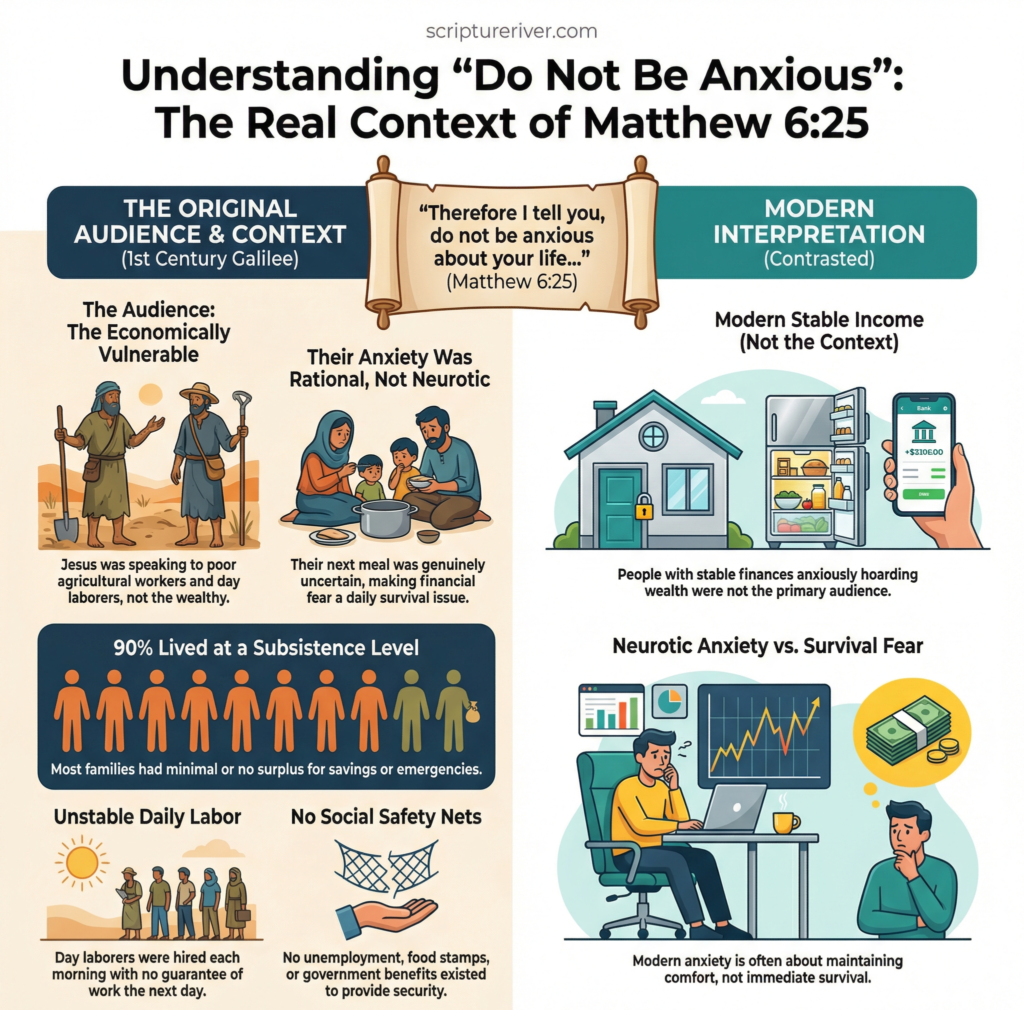
“Therefore I tell you, do not be anxious about your life, what you will eat or what you will drink, nor about your body, what you will put on. Is not life more than food, and the body more than clothing?”
Jesus delivers this command during the Sermon on the Mount immediately after teaching about serving God versus serving money.
The context matters tremendously.
Jesus isn’t addressing people with stable incomes and retirement accounts who are anxiously hoarding wealth.
According to New Testament scholar Craig Keener’s socio-historical commentary on Matthew, Jesus was speaking primarily to poor agricultural workers, day laborers, and economically vulnerable people whose next meal genuinely was uncertain.
These were people for whom financial anxiety was rational, not neurotic.
They didn’t know where tomorrow’s food would come from.
Jesus told them not to be anxious anyway.
The Financial Reality Jesus’s Audience Faced
Understanding first-century economic conditions reveals how radical Jesus’s command was.
Daily Economic Instability
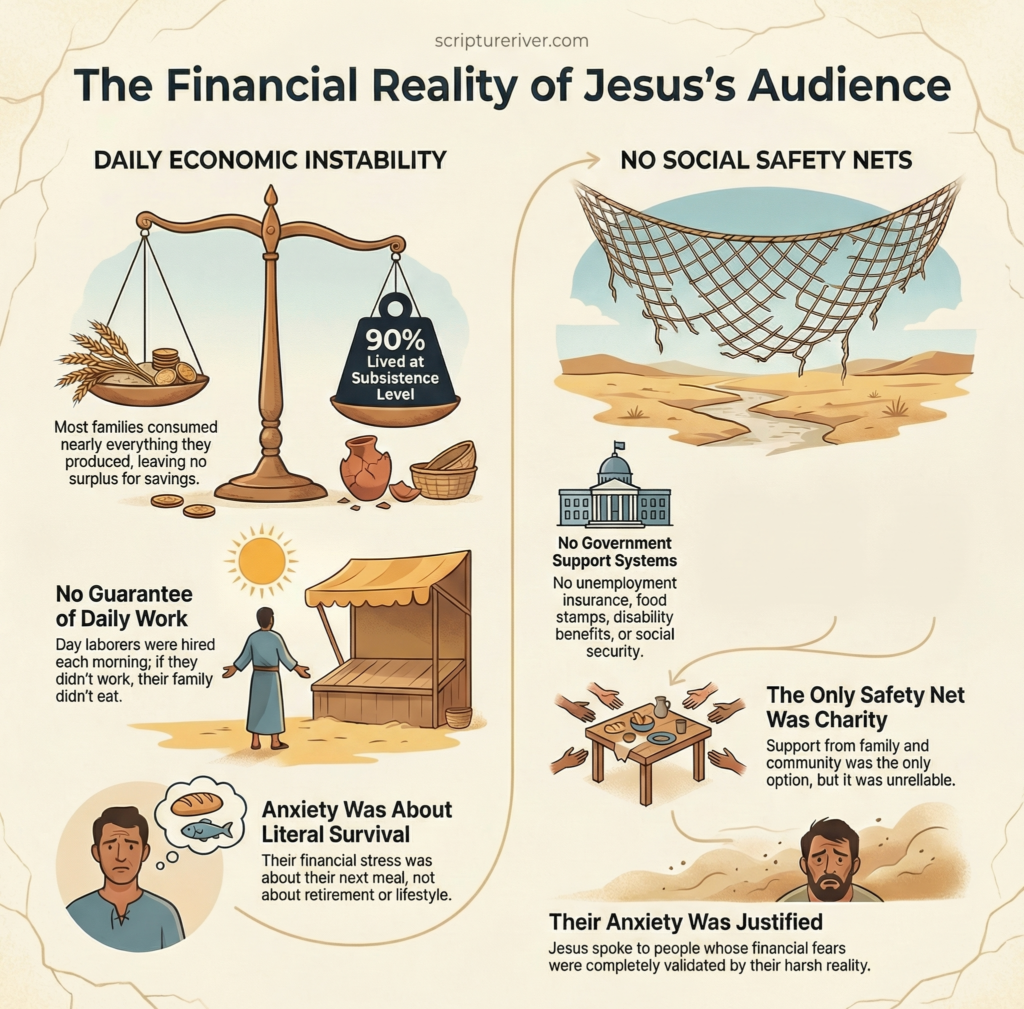
Biblical scholar Douglas Oakman’s research on the economy of Roman Palestine demonstrates that approximately 90% of people in first-century Galilee lived at the subsistence level.
Most families consumed nearly everything they produced, leaving minimal surplus for savings or emergencies.
Day laborers, whom Jesus references in Matthew 20:1-16, were hired each morning with no guarantee of work the next day.
If they didn’t work, they didn’t eat.
Their financial anxiety wasn’t about retirement planning or maintaining a lifestyle.
It was about literal survival.
No Social Safety Nets
Ancient Palestine had no unemployment insurance, no food stamps, no disability benefits, and no Social Security.
As theologian Richard Bauckham notes in his work on early Christian social ethics, the primary safety net was family and community charity, both of which were unreliable during widespread hardship.
When Jesus told His audience not to worry about food and clothing, He was addressing people whose financial anxiety was completely justified by their economic reality.
Yet He still commanded them not to be anxious.
What “Do Not Be Anxious” Actually Means
The Greek word “merimnao” translated “be anxious,” means to be worried, to have care, to be troubled with cares.
Biblical linguist William Mounce’s Greek dictionary clarifies that this word describes the mental state of being pulled in different directions by competing concerns, resulting in divided focus and emotional distraction.
Jesus isn’t commanding His followers to ignore financial reality or be irresponsible about provision.
The rest of Matthew 6:25-34 makes this clear through His reasoning about God’s provision patterns in creation and His instruction to “seek first the kingdom of God” rather than making provision seeking your primary life focus.
New Testament scholar R.T. France argues in his Matthew commentary that Jesus distinguishes between responsible planning (which He endorses elsewhere, like in Luke 14:28-30) and anxious worry that reveals misplaced trust.
The command isn’t “don’t think about finances.”
It’s “don’t let financial worry dominate your thoughts and dictate your decisions.”
The Modern Reality of Financial Anxiety
Recent financial anxiety operates somewhat differently from first-century economic stress, though both share common roots.
The Statistical Picture
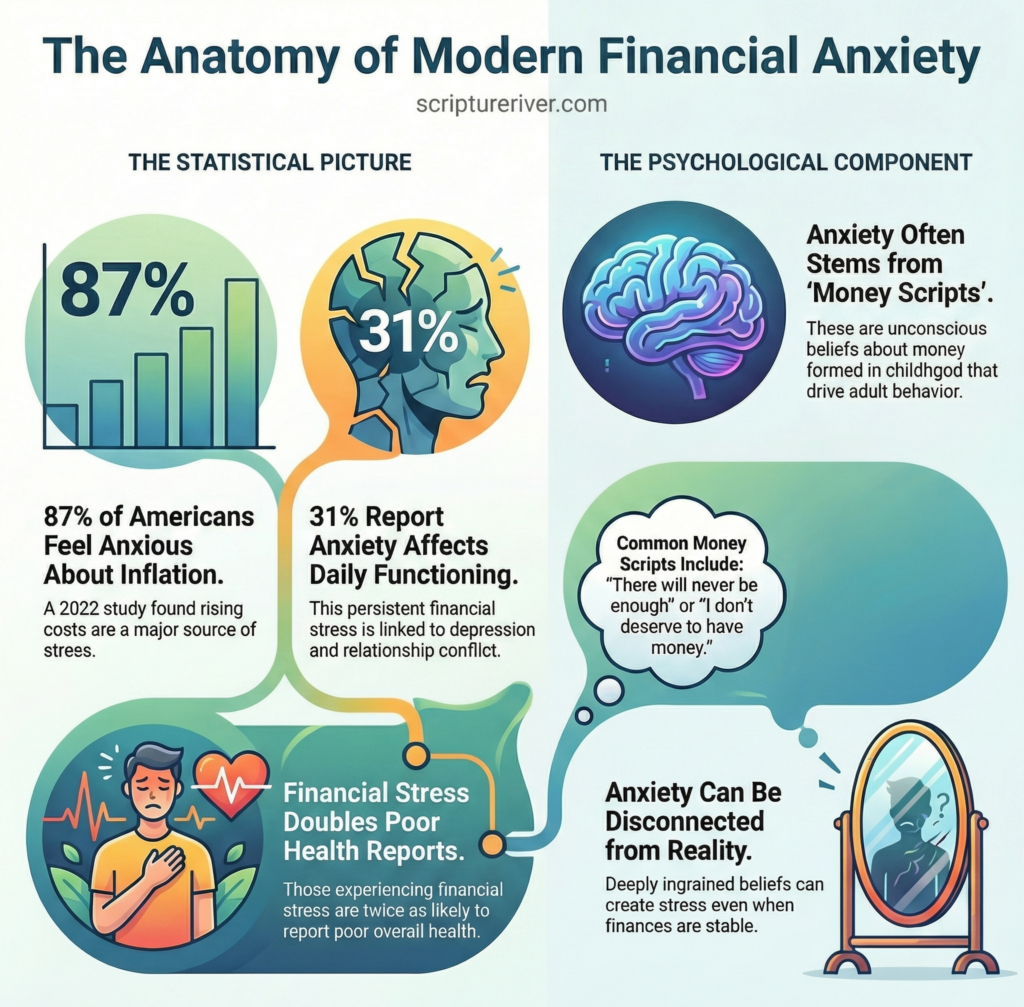
Research published in the Journal of Financial Therapy by financial psychologists Brad Klontz and Sonya Britt-Lutter found that financial stress affects mental and physical health significantly. Their 2012 study of 1,000 adults revealed that:
- 31% of respondents reported consistent financial anxiety affecting daily functioning
- Financial stress correlated with higher rates of depression, anxiety disorders, and relationship conflict
- People experiencing financial stress were twice as likely to report poor overall health
A 2022 study by the American Psychiatric Association found that 87% of Americans feel anxious about inflation and rising costs, with 62% specifically worried about being able to afford necessities.
This isn’t a frivolous worry about luxuries. Like Jesus’s audience, modern people experience anxiety about basic provisions.
The Psychological Component
Clinical psychologist Dr. Brad Klontz’s research on financial psychology reveals that money anxiety often stems from “money scripts,” unconscious beliefs about money formed in childhood that drive adult financial behavior and emotional responses.
These scripts include beliefs like “There will never be enough,” “Money is the root of all evil,” or “I don’t deserve to have money.”
According to Klontz’s work published in the Journal of Financial Planning, these deeply ingrained beliefs create anxiety that persists even when actual financial circumstances are stable.
This suggests that financial anxiety isn’t always proportional to actual financial danger.
Sometimes it’s psychological and spiritual, not just circumstantial.
What Jesus’s Teaching Actually Addresses

When you examine Matthew 6:25-34 comprehensively, Jesus addresses specific thought patterns that drive financial anxiety.
Provision Anxiety Rooted in Distrust
Jesus asks in Matthew 6:26, “Look at the birds of the air: they neither sow nor reap nor gather into barns, and yet your heavenly Father feeds them. Are you not of more value than they?”
The logic is theological, not economic.
God feeds birds who don’t work for their food.
You work and are more valuable to God than birds. Therefore, God will provide for you.
This isn’t the prosperity gospel promising wealth. It’s trust theology promising sufficiency.
As biblical scholar Dale Allison notes in his Sermon on the Mount commentary, Jesus assumes His followers will work (as the birds do in their own way), but their ultimate security rests in God’s faithful provision, not their earning capacity.
Future Anxiety That Immobilizes Present Action
Matthew 6:34 instructs, “Therefore do not be anxious about tomorrow, for tomorrow will be anxious for itself. Sufficient for the day is its own trouble.”
Theologian John Stott interprets this in his Sermon on the Mount exposition as Jesus teaching that worrying about potential future problems adds today’s trouble to tomorrow’s trouble, leaving you carrying a double burden mentally while accomplishing nothing practically.
Financial planning for future needs is wise. Jesus endorses planning in parables like Luke 14:28-30.
But anxiety about future financial scenarios you can’t control is what Jesus prohibits.
Priority Disorder That Makes Money Ultimate
Matthew 6:33 provides the alternative to financial anxiety: “But seek first the kingdom of God and his righteousness, and all these things will be added to you.”
New Testament scholar Craig Blomberg notes in his Matthew commentary that this verse diagnoses the root of financial anxiety as priority disorder.
When money becomes your primary security, anxiety naturally follows because money is an unreliable foundation.
When God’s kingdom becomes your primary pursuit, He takes responsibility for provision.
Not necessarily abundance, but adequacy.
What The Bible Actually Says About Money Stress
Beyond Matthew 6:25, Scripture addresses financial anxiety throughout both testaments with remarkably consistent principles.
Contentment as Antidote to Anxiety
Paul writes in Philippians 4:11-12 about learning contentment in all circumstances, whether well-fed or hungry, living in plenty or in want.
The Greek word “autarkes” translated contentment means self-sufficient, not needing external circumstances to provide satisfaction.
Biblical scholars note this was a Stoic concept Paul redeemed by locating sufficiency not in self but in Christ’s strength.
1 Timothy 6:6-8 connects contentment directly to financial anxiety: “godliness with contentment is great gain, for we brought nothing into the world, and we cannot take anything out of the world. But if we have food and clothing, with these we will be content.”
This establishes the biblical minimum for contentment: basic food and clothing. Not prosperity, not comfort, just necessities.
Practical Work as God’s Provision Method
2 Thessalonians 3:10 states, “If anyone is not willing to work, let him not eat.”
This isn’t harsh. It’s reality.
God’s normal provision pattern involves human work. Expecting provision without work isn’t faith. It’s presumption.
According to theologian Wayne Grudem’s work on business ethics and Scripture, the Bible consistently honors productive work as God’s designed means for provision.
Financial anxiety should drive you toward diligent work, not away from responsible effort.
Generosity Despite Limited Resources
2 Corinthians 8:1-5 describes Macedonian churches giving generously despite “extreme poverty.”
Paul celebrates them as examples of grace-driven generosity that defied their financial limitations.
This suggests biblical financial health isn’t measured by account balance but by generosity relative to capacity.
The widow’s mite in Luke 21:1-4 reinforces this principle.
Financial anxiety that prevents all generosity reveals trust disorder, not just money shortage.
Community as Financial Safety Net
Acts 2:44-45 and Acts 4:32-35 describe early Christians sharing resources so “there was not a needy person among them.”
While these passages don’t mandate communal ownership, they establish that the Christian community should function as a practical financial support network.
As New Testament scholar Scot McKnight argues in his Acts commentary, the early church took seriously its responsibility to prevent fellow believers from experiencing destitution.
This means believers facing a genuine financial crisis should seek help from the church community, not just rely on isolated personal faith.
Practical Application for Modern Financial Anxiety
Jesus’s teaching in Matthew 6:25 provides a framework for addressing contemporary money stress without dismissing financial reality.
Distinguish Between Responsible Planning and Anxious Worry
Financial planner Dave Ramsey’s research-backed approach distinguishes between wisdom (planning, budgeting, saving) and worry (obsessive focus on worst-case scenarios).
Create a realistic budget. Build emergency savings. Plan for retirement. These are responsible stewardship, not violations of Matthew 6:25.
Anxiety involves ruminating on financial fears without taking constructive action.
Planning involves taking action that addresses real financial needs.
Address Root Beliefs Driving Financial Fear
Clinical psychologist Dr. Brad Klontz’s money script inventory helps identify unconscious financial beliefs driving anxiety.
Questions like “What did I learn about money growing up?” and “What’s my earliest money memory?” reveal patterns that may require addressing through counseling or intentional belief reformation aligned with Scripture.
Sometimes financial anxiety is spiritual, requiring trust development. Sometimes it’s psychological, requiring therapeutic intervention. Often it’s both.
Practice Daily Trust Through Small Obedience
Matthew 6:34‘s instruction to not worry about tomorrow implies daily trust practice.
Each morning, consciously give that day’s financial concerns to God.
Not ignoring them, but entrusting them. Then work responsibly with what’s before you that day.
Repeat tomorrow. Trust builds through daily practice, not dramatic gestures.
Seek Community Support Without Shame
If a financial crisis creates genuine hardship, biblical precedent supports seeking church community help.
Galatians 6:2 commands believers to “bear one another’s burdens.” Financial burden qualifies.
Many Christians suffer silently through financial crisis from misguided pride.
That’s not biblical faith. It’s self-reliance, contradicting Scripture’s emphasis on community interdependence.
When Financial Anxiety Reveals Deeper Issues
Sometimes, persistent financial anxiety despite adequate provision reveals a spiritual diagnosis requiring attention.
Idolatry of Security
When no amount of savings feels sufficient, when you can’t enjoy present provision because you’re terrified about future lack, Jesus’s warning in Matthew 6:24 about serving money instead of God requires examination.
Money has become a functional god if losing it would devastate you more than losing access to God.
Unhealed Childhood Financial Trauma
Dr. Klontz’s research shows that childhood poverty or financial instability often creates adult anxiety disproportionate to current circumstances.
If you grew up poor, even current financial stability may not eliminate anxiety rooted in childhood fear.
This requires therapeutic healing, not just more Scripture reading.
Clinical Anxiety Disorder
Financial worry can be a symptom of generalized anxiety disorder requiring professional treatment.
If anxiety about money persists despite reasonable financial circumstances and spiritual practices, consult a mental health professional.
Seeking therapy isn’t a lack of faith. It’s stewarding health God gave you the responsibility to maintain.
The Promise Jesus Makes About Provision
Matthew 6:33‘s promise that God will “add” provision to those seeking His kingdom first isn’t blank check theology.
It’s priority theology.
When God’s kingdom truly takes priority over financial security, He commits to providing what you actually need.
Not necessarily what you want, prefer, or think you need. What He determines you need for the life He’s called you to.
Sometimes that includes abundance. Sometimes it includes just enough. Occasionally, it includes experiencing a need that drives deeper dependence on Him.
The promise isn’t prosperity. It’s sufficient for kingdom purposes.
As missionary George Müller demonstrated through decades of running orphanages by faith alone, God’s provision and faithfulness are real when His kingdom genuinely takes priority over personal financial security.
But Müller also kept detailed financial records, planned responsibly, and worked diligently. His faith didn’t eliminate practical responsibility. It coexisted with it.
Prayer for Financial Peace
Father, I’m anxious about money. I know You commanded me not to worry, but I don’t know how to stop. My bank account seems more real than Your promises.
My bills feel more pressing than Your kingdom. Forgive me for making financial security my functional god while claiming You as Lord.
Teach me to trust You with today’s provision without obsessing over tomorrow’s uncertainty. Help me work responsibly without anxious worry.
Show me if my anxiety reflects actual financial crisis requiring help or distorted thinking requiring healing.
Give me wisdom to steward money well and faith to trust You completely. Make Your kingdom my first priority and prove Your faithfulness to provide what I need.
In Jesus’s Name, Amen.
References and Citations
Allison, D. C. (1999). The Sermon on the Mount: Inspiring the Moral Imagination. Crossroad Publishing. [Book]
American Psychological Association. (2023). Stress in America 2023: Money and Inflation. APA Publishing. [Research Report]
American Psychiatric Association. (2022). 2022 Anxiety/Depression Poll. APA Polling. [Survey Report]
Bauckham, R. (1999). God and the Crisis of Freedom: Biblical and Contemporary Perspectives. Westminster John Knox Press. [Book]
Blomberg, C. L. (1992). Matthew. B&H Publishing Group. [Book]
France, R. T. (2007). The Gospel of Matthew. Eerdmans Publishing Company. [Book]
Grudem, W. (2003). Business for the Glory of God. Crossway Books. [Book]
Keener, C. S. (2009). The Gospel of Matthew: A Socio-Rhetorical Commentary. Eerdmans Publishing Company. [Book]
Klontz, B., & Britt, S. L. (2012). “How Clients’ Money Scripts Predict Their Financial Behaviors.” Journal of Financial Planning, 25(11), 33-43. [Journal Article]
Klontz, B., & Klontz, T. (2009). Mind Over Money. Broadway Books. [Book]
McKnight, S. (2023). The Letter of James. Eerdmans Publishing Company. [Book]
Mounce, W. D. (2006). Mounce’s Complete Expository Dictionary of Old and New Testament Words. Zondervan. [Reference Book]
Müller, G. (1984). The Autobiography of George Müller. Whitaker House. [Biography]
Oakman, D. E. (2008). Jesus and the Peasants. Cascade Books. [Book]
Peterson, E. H. (2005). The Message: The Bible in Contemporary Language. NavPress. [Bible Translation]
Ramsey, D. (2013). The Total Money Makeover. Thomas Nelson. [Book]
Stott, J. R. W. (1985). The Message of the Sermon on the Mount. InterVarsity Press. [Book]
Strong, J. (2010). Strong’s Exhaustive Concordance of the Bible. Hendrickson Publishers. [Reference Book]

