


The cashier at Target was having a terrible day.
You could see it in her eyes.
The way her hands shook slightly scanning items. How she avoided eye contact. The tremor in her voice saying “Have a nice day.”
Most customers before me were impatient.
Sighing. Checking phones.
One woman complained about how long the transaction took.
I asked if she was okay. Immediately, she burst into tears.
Her child was sick. She’d been up all night. She couldn’t afford to miss work, but couldn’t focus either.
I didn’t quote Scripture at her. I just listened. Offered to pray with her if she wanted. She did. Right there in the checkout lane.
That’s Matthew 7:12 lived out.
Not because I’m especially kind. Because I’ve been that cashier, falling apart while trying to work.
And I remembered how I wanted to be treated.
What Matthew 7:12 Actually Says

Here’s the verse everyone calls the Golden Rule:
Matthew 7:12, New International Version (NIV)
“So in everything, do to others what you would have them do to you, for this sums up the Law and the Prophets.”
Twelve words that seem simple.
Treat people the way you want to be treated.
Easy to understand. Difficult to actually live.
Most people think they know what this verse means because they’ve heard it their whole lives.
It’s been reduced to playground ethics: be nice to others so they’ll be nice to you.
But Jesus wasn’t teaching playground manners.
He was revealing the heart of God’s entire moral law.
And when you understand the full weight of what He said, this verse stops being a nice sentiment and becomes a radical life challenge.
Why Jesus Called It the Summary of Scripture

Notice what Jesus says at the end of the verse: “for this sums up the Law and the Prophets.”
The Law and the Prophets means the entire Old Testament.
Jesus is claiming that this single principle captures everything God commanded in Scripture about how to treat people.
That’s a massive claim.
The Old Testament contains 613 commandments.
Complex laws about justice, property, relationships, worship, and society.
Jesus says they all distill down to this: treat others as you’d want to be treated.
He’s not adding to Scripture. He’s revealing its essence.
Every commandment about loving neighbors, treating foreigners kindly, caring for the poor, practicing justice, showing mercy, and forgiving offenses.
All of it flows from this single principle.
Romans 13:9-10 echoes this when Paul writes that all commandments are summed up in loving your neighbor as yourself.
The Golden Rule isn’t separate from Old Testament law. It’s the interpretive key that unlocks what all those laws were accomplishing: teaching people to love others the way they love themselves.
What “Do to Others” Actually Requires
The Greek phrase “panta oun hosa ean thelēte” means “therefore all things whatever you wish.”
It’s active, not passive.
Don’t just avoid treating people badly. Actively do good to them.
That’s the revolutionary part.
Most ethical systems teach a negative version: don’t do to others what you don’t want done to you.
That’s called the Silver Rule. Don’t harm.
Jesus taught the positive version: actively do good to others the way you’d want good done to you. Not just avoid harm. Pursue their benefit.
There’s a massive difference.
The Silver Rule requires only restraint.
Don’t steal because you don’t want to be robbed. Don’t lie because you don’t want to be deceived. Passive ethics of avoidance.
On the other hand, the Golden Rule requires initiative.
Give generously because you’d want help if you were struggling.
Encourage actively because you’d want encouragement if you were discouraged. Forgive fully because you’d want forgiveness if you failed.
That’s infinitely harder.
You can follow the Silver Rule by just not being terrible.
You can’t follow the Golden Rule without actively pursuing others’ good the way you pursue your own good.
The Standard That Makes It Impossible
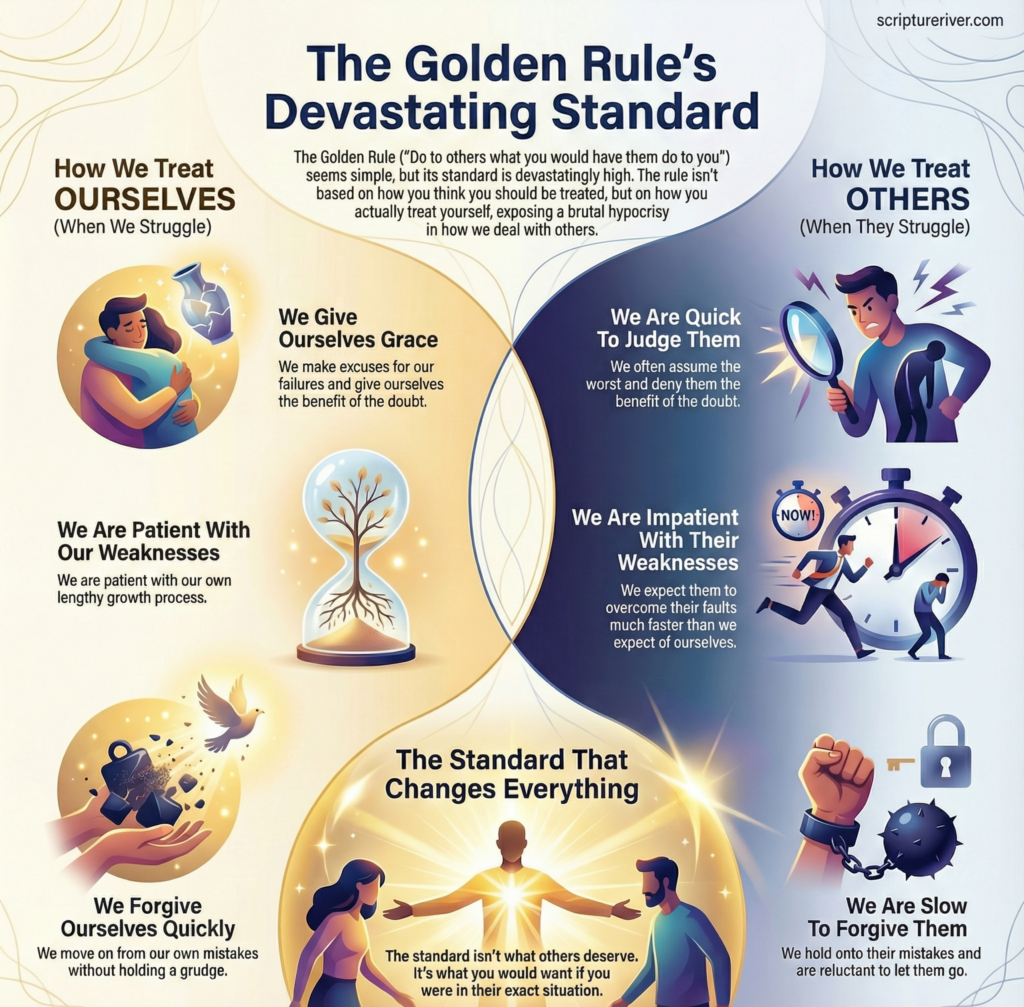
Here’s what makes the Golden Rule devastating: the standard is how you treat yourself.
Not how you think you should treat yourself. How you actually treat yourself.
Think about how you treat yourself when you’re struggling.
You give yourself grace. You make excuses for your failures. You’re patient with your weaknesses. You forgive your mistakes quickly.
Now think about how you treat others when they’re struggling. How quick you are to judge. How impatient with their weaknesses. How slow to forgive their mistakes.
The Golden Rule exposes that hypocrisy brutally.
You want others to give you the benefit of the doubt. Do you give them the benefit of the doubt?
You want others to forgive you quickly. Do you forgive them quickly?
You want others to be patient with your growth process. Are you patient with theirs?
You want others to help you when you’re in need. Do you help them when they’re in need?
The standard isn’t what others deserve. It’s what you’d want if you were in their situation.
That changes everything.
Why This Isn’t Just About Being Nice
The Golden Rule sounds like basic human decency until you apply it to people who’ve hurt you.
Treat your enemy the way you’d want to be treated if you were the enemy?
That’s insane by human standards.
But that’s exactly what Jesus means.
Matthew 5:43-44 clarifies this. Jesus said love your enemies and pray for those who persecute you.
That’s the context for understanding the Golden Rule.
You’re not just treating nice people nicely. You’re treating everyone, including people who wrong you, the way you’d want to be treated if positions were reversed.
How would you want to be treated if you were the one who betrayed a friend?
You’d want forgiveness and a chance to make it right.
How would you want to be treated if you were the one who gossiped?
You’d want grace and an opportunity to change.
How would you want to be treated if you were the difficult person everyone avoided?
You’d want someone to extend kindness anyway.
The Golden Rule isn’t selective. It applies to everyone. Including and especially people who don’t deserve it by any human standard.
That’s not being nice. That’s being Christlike.
The Motivation That Makes It Possible

You can’t live by the Golden Rule in your own strength.
Human nature is self-protective, not self-giving.
We default to treating others based on how they treat us, not how we’d want to be treated.
The only way to consistently treat others as you’d want to be treated is by experiencing how God treats you.
Ephesians 4:32, English Standard Version (ESV) connects these:
“Be kind to one another, tenderhearted, forgiving one another, as God in Christ forgave you.”
You forgive others as God forgave you. You show kindness as God showed you kindness. You give grace as God gave you grace.
When you’re deeply aware of how God treats you despite what you deserve, treating others well becomes possible.
God doesn’t treat you based on your performance. He treats you based on Christ’s performance on your behalf. That’s radical, undeserved grace.
When that reality grips your heart, you start extending that same grace to others.
Not because they deserve it. Because you’ve been shown grace you didn’t deserve.
That’s the motivation that makes the Golden Rule livable.
Five Areas Where the Golden Rule Changes Everything

Let me get specific about how this verse should transform how you actually live.
1. In Conflict
When someone wrongs you, how do you want them to respond? Probably with humility, apology, and effort to make things right.
Now flip it. When you’ve wronged someone, do you respond with humility, apology, and effort to make things right? Or do you get defensive, make excuses, and minimize your offense?
The Golden Rule demands you respond to your own failures the way you want others to respond to theirs.
2. In Judgment
You want others to give you grace when you mess up. To see your heart, not just your actions. To remember your good qualities, not just your failures.
Do you extend that same grace to others? Or do you judge quickly, assume the worst, and define people by their mistakes?
The Golden Rule requires extending the interpretive charity you want for yourself.
3. In Communication
You want others to listen to you fully before responding. To seek to understand, not just to be heard. To assume the best about what you mean, not the worst.
Do you listen to others that way?
Or do you interrupt, prepare your response while they’re talking, and interpret everything through suspicion?
The Golden Rule transforms how you communicate.
4. In Service
You want help when you’re overwhelmed. You want people to notice your struggles and offer assistance without you having to beg.
Do you notice when others are overwhelmed? Do you offer help proactively? Or do you wait until they explicitly ask and then complain about being inconvenienced?
The Golden Rule makes you observant and proactive about serving.
5. In Generosity
You want people to be generous with you when you’re in need. Not grudging. Not making you feel like a burden. Just freely giving because they care.
Are you generous that way with others? Or do you give reluctantly, make people feel guilty for needing help, and keep track of what you’ve sacrificed?
The Golden Rule determines how you give.
What the Golden Rule Doesn’t Mean
Let’s clear up common misinterpretations that weaken what Jesus actually taught.
It doesn’t mean doing whatever people want. Some people want the enablement of destructive behavior.
Treating them how you’d want to be treated means giving them what’s actually good for them, which might include tough love.
It doesn’t mean being a doormat. You wouldn’t want others to let you abuse them.
So the Golden Rule doesn’t require tolerating abuse. Healthy boundaries are part of treating both yourself and others rightly.
It doesn’t guarantee reciprocity. This isn’t karma. You don’t treat people well, so they’ll treat you well back.
You treat them well because that’s right, regardless of their response.
It doesn’t apply only to people who deserve it. The whole point is treating people better than they deserve because that’s how God treats you.
It doesn’t replace specific biblical commands. It’s a summary principle, not a replacement for clear Scripture. You still obey specific biblical instructions even when they’re hard.
How to Actually Live Matthew 7:12 Daily

Knowing the Golden Rule and living it are completely different.
Here’s how to move from knowledge to practice.
Before responding to anyone, pause and ask: “How would I want to be treated right now if I were them?” That single question changes reactions dramatically.
When tempted to judge someone, list how you’d want to be judged if you did what they did. Then extend that exact grace to them.
Before every conversation, pray: “God, help me listen the way I want to be listened to.” Watch how that transforms communication.
When someone needs help, imagine you’re in their situation. What kind of help would feel most loving? Give that.
After conflict, ask yourself: “Am I treating this person how I’d want to be treated if I were the one who messed up?” Adjust accordingly.
The Golden Rule requires constant self-awareness and intentional choice.
It’s not natural. It’s supernatural. It requires the Holy Spirit’s power operating through you.
But when you actually live it, people notice.
Not because you’re especially good. Because treating people the way you want to be treated is so rare that it stands out dramatically.
That cashier at Target? She told me no one had shown her kindness all day.
No one asked if she was okay. Everyone treated her like a service robot there to meet their needs.
I just treated her the way I’d want to be treated if I were falling apart at work.
That’s the Golden Rule. And it’s more powerful than any sermon I could preach.
Prayer for Living the Golden Rule
Father, I confess I treat myself better than I treat others. I want grace but give judgment. I want patience but offer impatience. I want forgiveness but withhold it from others.
Forgive me for violating Your Golden Rule constantly. Change my heart so I genuinely want good for others the way I want good for myself.
Help me see people the way You see them. Give me Your love for them. Before I speak, act, or respond to anyone today, remind me to ask how I’d want to be treated if I were them.
Make me a living example of this verse, not through my effort but through Your Spirit working in me.
In Jesus’s Name, Amen.
References
Blomberg, C. L. (1992). Matthew. B&H Publishing Group.
Carson, D. A. (1984). Matthew: The Expositor’s Bible Commentary (Vol. 8). Zondervan.
France, R. T. (2007). The Gospel of Matthew. Eerdmans Publishing Company.
Hagner, D. A. (1993). Matthew 1-13. Thomas Nelson Publishers.
Keener, C. S. (2009). The Gospel of Matthew: A Socio-Rhetorical Commentary. Eerdmans Publishing Company.
Morris, L. (1992). The Gospel According to Matthew. Eerdmans Publishing Company.
Peterson, E. H. (2005). The Message: The Bible in Contemporary Language. NavPress.
Strong, J. (2010). Strong’s Exhaustive Concordance of the Bible. Hendrickson Publishers.
Stott, J. R. W. (1985). The Message of the Sermon on the Mount. InterVarsity Press.
Wiersbe, W. W. (2007). The Bible Exposition Commentary: New Testament (Vol. 1). David C. Cook.

