

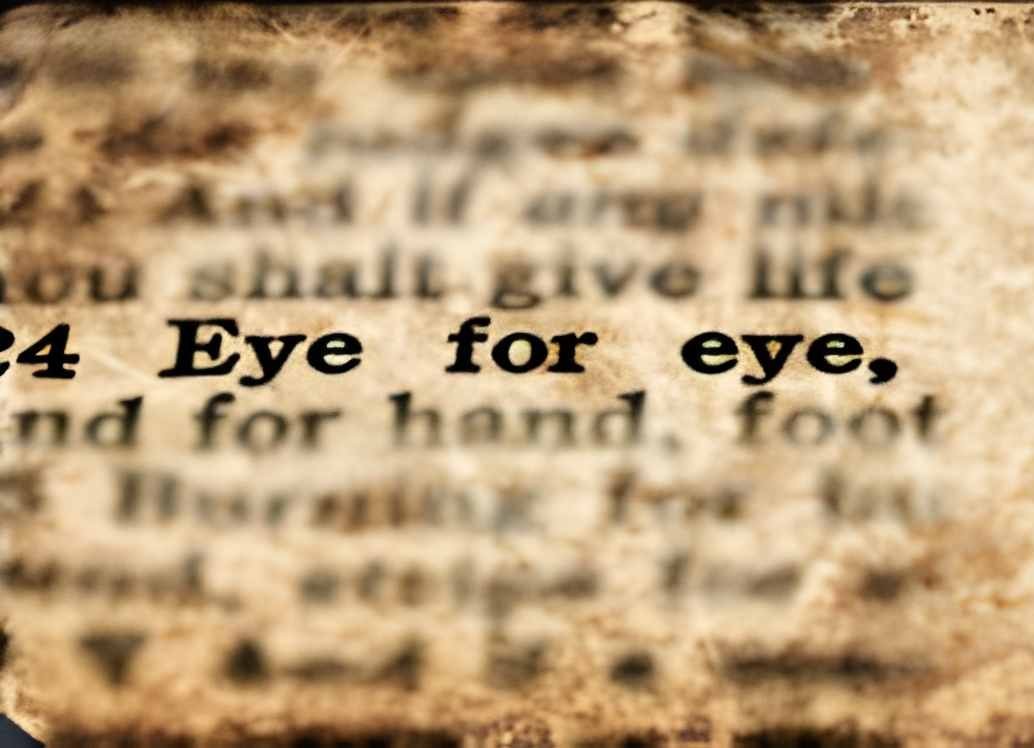
Critics use this verse to prove that the Old Testament God is vengeful.
Christians struggle to reconcile it with Jesus’s command to turn the other cheek.
Both groups misunderstand what “eye for eye” actually meant.
Exodus 21:23-25, English Standard Version (ESV)
“But if there is harm, then you shall pay life for life, eye for eye, tooth for tooth, hand for hand, foot for foot, burn for burn, wound for wound, stripe for stripe.”
This law, called lex talionis (law of retaliation), appears three times in the Old Testament and once in Jesus’s teaching.
Most people think it is authorized brutal revenge. It didn’t.
It actually limited revenge and established the revolutionary concept that punishment must be proportional to the crime.
Understanding this law requires examining its ancient Near Eastern context, what it replaced, how Israel applied it, why Jesus referenced it, and what it teaches about justice today.
The principle isn’t “go ahead and take revenge equally.” It’s “justice must be measured, not excessive.”
What “Eye for Eye” Replaced: Ancient Near Eastern Justice
The Code of Hammurabi
Hammurabi’s Code, written roughly 300 years before Moses received the Law, also contained “eye for eye” language.
However, Hammurabi’s Code applied it differently based on social class.
If a nobleman injured another nobleman’s eye, his own eye was taken.
But if he injured a commoner’s eye, he paid a fine.
If he injured a slave’s eye, he paid half the slave’s value.
Justice depended on social status.
Israel’s law made a radical departure: the same law applied regardless of social class.
Rich and poor, native and foreigner received equal treatment. This was revolutionary in the ancient world.
Unlimited Blood Feuds
Before lex talionis, vengeance escalated without limits.
If someone killed your family member, you killed multiple members of their family.
If someone injured you, you would injure them worse and destroy their property.
Genesis 4:23-24, Christian Standard Bible (CSB)
“Lamech said to his wives, ‘Adah and Zillah, hear my voice; wives of Lamech, pay attention to my words. For I killed a man for wounding me, a young man for striking me. If Cain is avenged sevenfold, then for Lamech it is seventy-sevenfold.'”
Lamech boasts about disproportionate revenge. He killed a man for wounding him and a young man for striking him.
This was the culture’s norm: escalating violence with no restraint.
What “Eye for Eye” Actually Established
Lex talionis said: the punishment must match the crime. No more. No less.
If someone takes an eye, you can’t take a life.
If someone kills one person, you can’t kill their entire family.
This was limitation on revenge, not authorization for cruelty.
The Three Old Testament Passages
1. Exodus 21:23-25: Personal Injury Law
The Exodus passage appears in context of laws governing accidental injury.
If men fighting accidentally struck a pregnant woman and caused premature birth, they paid fines.
But if serious harm resulted, the “eye for eye” principle applied.
This established proportionality in sentencing. The punishment couldn’t exceed the crime.
2. Leviticus 24:17-20: General Principle
Leviticus 24:17-20, New International Version (NIV)
“Anyone who takes the life of a human being is to be put to death. Anyone who takes the life of someone’s animal must make restitution—life for life. Anyone who injures their neighbor is to be injured in the same manner: fracture for fracture, eye for eye, tooth for tooth. The one who has inflicted the injury must suffer the same injury.”
This passage establishes the principle more broadly. It applies to murder, property damage, and personal injury.
The repeated phrase “the one who has inflicted the injury must suffer the same injury” emphasizes proportional justice.
3. Deuteronomy 19:16-21: False Testimony
Deuteronomy 19:18-21, New King James Version (NKJV)
“And the judges shall make careful inquiry, and indeed, if the witness is a false witness, who has testified falsely against his brother, then you shall do to him as he thought to have done to his brother; so you shall put away the evil from among you. And those who remain shall hear and fear, and hereafter they shall not again commit such evil among you. Your eye shall not pity: life shall be for life, eye for eye, tooth for tooth, hand for hand, foot for foot.”
This applies lex talionis to false witnesses. If someone testified falsely intending to harm another, they received the punishment their victim would have received.
This protected innocent people from malicious prosecution.
How This Law Was Actually Applied
Monetary Compensation, Not Literal Mutilation
Despite literal wording, most rabbinic scholarship indicates Israel applied this law through monetary compensation rather than literal physical mutilation.
The Mishnah, a Jewish legal text compiled around 200 AD but containing much older traditions, explains extensive calculations for compensating injuries financially rather than inflicting identical physical harm.
Someone who destroyed another’s eye paid damages covering medical treatment, lost wages, pain and suffering, and permanent disability.
The payment was proportional to the injury, fulfilling the law’s intent without literal eye removal.
Why Monetary Compensation Made Sense
Literal application created problems.
If someone with two functioning eyes destroyed a blind person’s remaining eye, taking the offender’s eye wouldn’t be proportional.
The blind person lost all sight. The offender would retain one functional eye.
Similarly, if a surgeon accidentally caused harm during legitimate medical treatment, removing the surgeon’s eye wouldn’t restore the patient and would deprive society of medical expertise.
Monetary compensation allowed flexible application of proportionality principle while avoiding these complications.
When Capital Punishment Applied
Murder was different. “Life for life” meant execution. This wasn’t symbolic or financial. Taking human life created blood guilt that required the murderer’s death.
Numbers 35:31, English Standard Version (ESV)
“Moreover, you shall accept no ransom for the life of a murderer, who is guilty of death, but he shall be put to death.”
Unlike other injuries that could be compensated financially, murder required capital punishment. This distinguished human life as uniquely valuable.
What Jesus Said About “Eye for Eye”
Matthew 5:38-42, Christian Standard Bible (CSB)
“You have heard that it was said, ‘An eye for an eye and a tooth for a tooth.’ But I tell you, don’t resist an evildoer. On the contrary, if anyone slaps you on your right cheek, turn the other to him also. As for the one who wants to sue you and take away your shirt, let him have your coat as well. And if anyone forces you to go one mile, go with him two. Give to the one who asks you, and don’t turn away from the one who wants to borrow from you.”
What Jesus Was Correcting
Jesus wasn’t correcting Moses’s law. He was correcting its misapplication.
People had twisted “eye for eye” from a limitation on excessive revenge into a justification for personal vengeance.
The law was meant for courts to administer just punishment. Individuals had distorted it into permission for personal retaliation.
Jesus’s New Standard
Jesus called disciples to go beyond legal justice to sacrificial love.
The law said courts should limit punishment to a proportional response.
Jesus said individuals should respond to wrongs with grace rather than demanding even proportional justice.
This doesn’t abolish law courts or criminal justice. It addresses personal response to personal wrongs.
When personally wronged, followers of Jesus absorb the wrong rather than demand retribution.
A pastor I know mediated a church conflict where one member demanded “justice” for wrongs another member committed against him.
He kept quoting “eye for eye” to justify his desire for punishment.
The pastor had to explain that “eye for eye” was never permission for individuals to take revenge. It limited what courts could do.
Jesus explicitly forbids personal vengeance in favor of forgiveness.
The member eventually understood, but it took weeks of careful teaching to undo the damage of misunderstanding this principle.
The Principle for Today
Justice Should Be Proportional
Criminal sentencing should match the crime.
Minor offenses shouldn’t receive major punishments. Serious crimes shouldn’t receive trivial penalties.
This principle remains valid.
Personal Vengeance Is Forbidden
Romans 12:19, New International Version (NIV)
“Do not take revenge, my dear friends, but leave room for God’s wrath, for it is written: ‘It is mine to avenge; I will repay,’ says the Lord.”
Individuals don’t have right to personal revenge. God reserves vengeance for Himself and delegates justice to governing authorities, not to private citizens settling personal scores.
The State Has Different Role Than Individuals
Romans 13:4, English Standard Version (ESV)
“For he is God’s servant for your good. But if you do wrong, be afraid, for he does not bear the sword in vain. For he is the servant of God, an avenger who carries out God’s wrath on the wrongdoer.”
Government bears the sword to execute justice. This is its God-given role. Citizens should support just governance while personally extending grace.
Forgiveness Doesn’t Eliminate Consequences
Forgiving someone doesn’t mean they avoid legal consequences.
If someone assaults you, you can forgive them personally while they face criminal prosecution.
Forgiveness is personal. Justice is communal.
Mercy Triumphs Over Judgment
James 2:13, Christian Standard Bible (CSB)
“For judgment is without mercy to the one who has not shown mercy. Mercy triumphs over judgment.”
When you have power to demand proportional justice, choosing mercy demonstrates Christ’s character.
This doesn’t mean never pursuing justice, but it means mercy should characterize your heart even when justice is pursued.
Frequently Asked Questions
Did ancient Israel literally take eyes and teeth?
Most evidence suggests they used monetary compensation rather than literal mutilation in most cases. The rabbinic tradition consistently interprets these laws financially. However, capital punishment for murder was literal.
Why does Jesus seem to contradict the Old Testament?
Jesus doesn’t contradict it. He corrects its misapplication. “Eye for eye” limited judicial punishment. People had twisted it into permission for personal revenge. Jesus clarifies that individuals should forgive, not seek even proportional retaliation.
Should we support capital punishment today?
Christians disagree on this. Some argue “life for life” establishes death penalty for murder. Others argue Jesus’s mercy teachings supersede it. Both positions have biblical support depending on how you weigh Old Testament law, Jesus’s teaching, and government’s role.
What about self-defense?
“Eye for eye” addressed punishment after the fact, not defense during attack. Self-defense and defense of others are separate issues addressed elsewhere in Scripture. Jesus’s command to turn the other cheek addresses response to insults, not violent assault.
How do I respond when someone wrongs me?
Personally, extend grace and forgiveness. If the wrong violates law, you can report it to authorities while personally forgiving. Don’t seek personal revenge, but trust God’s justice through proper channels.
Doesn’t forgiving wrongdoers enable their behavior?
Forgiveness doesn’t mean no consequences. It means releasing personal bitterness while allowing legal, social, or natural consequences to operate. You can forgive someone while they face imprisonment for their crime.
Prayer for Just Hearts in Unjust World
Father, You are perfectly just. Your justice is proportional, measured, and fair. You don’t punish excessively or leniently. You judge perfectly. Teach me to trust Your justice when I’ve been wronged. When I want revenge, remind me that vengeance is Yours. When I want to demand my rights, show me Jesus who surrendered His rights for my sake. Help me distinguish between personal forgiveness and communal justice. Give me grace to forgive those who hurt me while supporting just systems that protect society. Don’t let me become bitter person demanding revenge. Don’t make me passive person enabling evil. Make me wise person who extends personal mercy while supporting communal justice. Transform my heart from vengeance-seeking to grace-extending. Help me see wrongdoers as You see them: people needing both justice and mercy. Guide those who administer justice in our society. Give them wisdom to apply proportional punishment that protects society while respecting human dignity. In Jesus’s Name, Amen.
Resources
Brueggemann, W. (2002). Reverberations of Faith: A Theological Handbook of Old Testament Themes. Westminster John Knox Press. [Old Testament Theology]
Longman, T., & Dillard, R. B. (2006). An Introduction to the Old Testament (2nd ed.). Zondervan. [Old Testament Survey]
Peterson, E. H. (2005). The Message: The Bible in Contemporary Language. NavPress. [Bible Translation]
Sprinkle, J. M. (1994). ‘The Book of the Covenant’: A Literary Approach. Sheffield Academic Press. [Biblical Law]
Strong, J. (2010). Strong’s Exhaustive Concordance of the Bible. Hendrickson Publishers. [Reference Book]
Wright, C. J. H. (2004). Old Testament Ethics for the People of God. InterVarsity Press. [Biblical Ethics]

