


I’ve heard Revelation 3:20 quoted at hundreds of altar calls.
“Behold, I stand at the door and knock. If anyone hears My voice and opens the door, I will come in to him and dine with him, and he with Me.” Revelation 3:20, New King James Version (NKJV)
The preacher says Jesus is knocking on the sinner’s heart, waiting for them to invite Him in.
It’s emotional. It’s compelling. And it’s completely wrong.
Jesus isn’t talking to unbelievers in this verse.
He’s talking to Christians.
Specifically, wealthy, comfortable Christians who’d pushed Him out of their church because they didn’t think they needed Him anymore.
This might be the most misused verse in modern evangelism, and correcting it changes everything about how we understand both salvation and the danger of lukewarm Christianity.
Let me show you what Jesus actually said and who He was actually talking to.
The Context Everyone Ignores
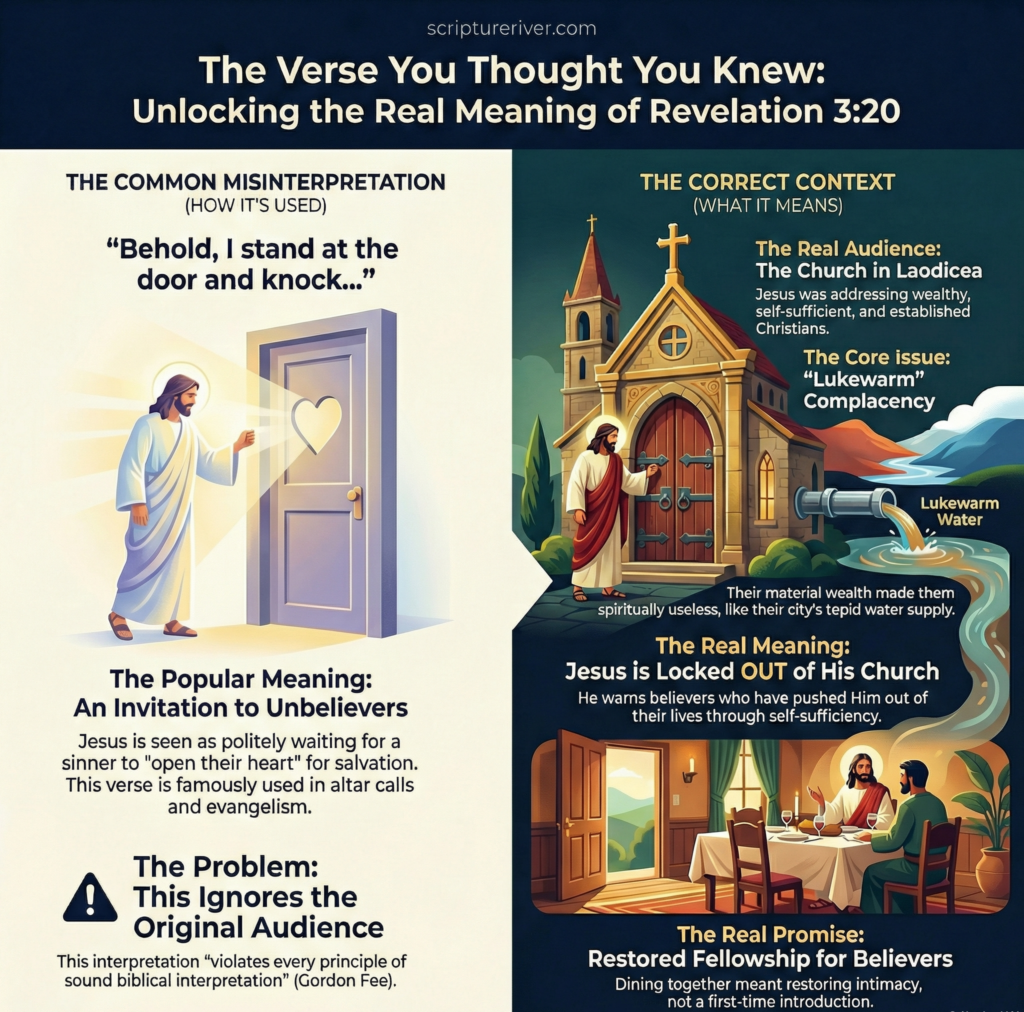
Revelation 3:20 doesn’t appear in isolation. It’s part of a specific letter to a specific church with specific problems.
Here’s what the Bible actually says immediately before the famous verse:
Revelation 3:14-16, English Standard Version (ESV)
“And to the angel of the church in Laodicea write: ‘The words of the Amen, the faithful and true witness, the beginning of God’s creation. I know your works: you are neither cold nor hot. Would that you were either cold or hot! So, because you are lukewarm, and neither hot nor cold, I will spit you out of my mouth.'”
The letter is explicitly addressed “to the church in Laodicea.”
Not to unbelievers. Not to people who’ve never met Jesus. To Christians in an established church.
New Testament scholar Gordon Fee states in his Revelation commentary that this context is “absolutely determinative” for understanding verse 20.
Jesus is addressing believers who’ve become spiritually useless through complacency and materialism, not unbelievers who need initial salvation.
Who the Laodicean Christians Actually Were

Understanding Laodicea’s historical and economic situation reveals why Jesus used such harsh language.
The Wealthiest City in Asia Minor
According to archaeological research documented by biblical scholar Colin Hemer in his work on the seven churches of Revelation, Laodicea was one of the richest cities in the Roman Empire during the first century.
The city was famous for three industries: banking and finance, production of glossy black wool garments, and manufacturing of Phrygian eye salve (a medicinal ointment for eye treatment).
When a devastating earthquake destroyed much of the city in 60 AD, Roman historian Tacitus records in his Annals that Laodicea refused imperial aid and rebuilt entirely with its own resources.
This historical fact reveals their pride in self-sufficiency.
The Lukewarm Water Problem
Laodicea had no natural water source.
Hot medicinal springs existed in Hierapolis, six miles north. Cold, refreshing drinking water came from Colossae, ten miles south.
Water reached Laodicea through stone aqueducts.
By the time it arrived, it was disgustingly lukewarm.
Not therapeutically hot like Hierapolis water. Not refreshingly cold like Colossae water.
Tepid, nauseating, useless.
Biblical archaeologist William Ramsay’s research on the historical geography of Asia Minor documents how this created a perfect metaphor.
The Laodiceans knew exactly what Jesus meant when He said their spiritual condition made Him want to vomit them out of His mouth.
What Jesus Actually Said About Them
Revelation 3:17-18, New International Version (NIV)
“You say, ‘I am rich; I have acquired wealth and do not need a thing.’ But you do not realize that you are wretched, pitiful, poor, blind, and naked. I counsel you to buy from me gold refined in the fire, so you can become rich; and white clothes to wear, so you can cover your shameful nakedness; and salve to put on your eyes, so you can see.”
Notice the devastating irony Jesus employs.
They said: “I am rich.” Jesus said: You’re actually poor.
They produced luxury black wool garments. Jesus said: You’re naked.
They manufactured eye salve. Jesus said: You’re blind.
Their material prosperity had deceived them into thinking they were spiritually prosperous.
According to theologian Robert Mounce’s commentary on Revelation, they exemplified the danger Jesus warned about in Matthew 6:24, where serving wealth is prioritized over serving God.
What “I Stand at the Door and Knock” Actually Means
Now we can understand Revelation 3:20 in its proper context:
Revelation 3:20, New King James Version (NKJV)
“Behold, I stand at the door and knock. If anyone hears My voice and opens the door, I will come in to him and dine with him, and he with Me.”
Jesus Is Outside the Church
British theologian David Pawson argues forcefully in his writings on Revelation that this verse depicts Jesus standing outside His own church, locked out by the congregation’s self-sufficiency and materialism.
He’s not begging unbelievers to let Him into their hearts.
He’s warning believers who’ve shut Him out of their lives and church through complacency.
The famous painting “The Light of the World” by William Holman Hunt depicts Jesus knocking on a door with no outside handle (as shown below).

The door can only be opened from within.
Hunt explicitly stated the door represents the human soul, but his painting’s context was the Laodicean church, believers who must choose to let Jesus back in.
“If Anyone Hears My Voice”
Dispensationalist theologian John Walvoord notes in his Revelation commentary that “if anyone” addresses individuals within the lukewarm church, not humanity in general.
Jesus is calling specific believers within Laodicea to respond individually to His correction.
Some in the church might repent and restore fellowship. Others might remain lukewarm and face judgment.
This isn’t an evangelistic invitation. It’s a disciplinary warning to Christians.
“I Will Come In and Dine With Him”
The dining imagery is crucial for understanding what Jesus promises.
In ancient Mediterranean culture, according to New Testament cultural background research by Kenneth Bailey, sharing a meal represented intimate fellowship between people who already knew each other.
You didn’t dine with strangers or enemies. Dining indicated a restored relationship, not an initial introduction.
Jesus isn’t offering to meet the Laodiceans for the first time.
He’s offering to restore the intimate fellowship they once had but lost through their self-sufficiency.
How This Verse Got Misused in Evangelism
The application of Revelation 3:20 to evangelism is relatively recent in church history.
The “Sinner’s Prayer” Innovation
According to church historian Michael Horton’s research on American evangelicalism, the concept of “inviting Jesus into your heart” through a sinner’s prayer became widespread in the mid-20th century through mass evangelism crusades.
Evangelists needed simple, immediate response mechanisms for large crowds.
Revelation 3:20 provided convenient imagery: Jesus knocking, you opening your heart’s door, instant salvation.
The problem is that’s not what the verse teaches.
As Fee notes, this interpretation “violates every principle of sound biblical interpretation” by ignoring context entirely.
The Theological Problem This Creates
When you tell unbelievers to “invite Jesus into your heart” based on Revelation 3:20, you create several theological distortions.
First, it makes salvation depend on human invitation rather than divine initiative.
The New Testament consistently teaches that God pursues sinners, not that Jesus politely waits for permission to save them.
Second, it reduces Jesus from sovereign Lord to humble petitioner.
Reformed theologian R.C. Sproul criticized this portrayal, arguing it presents Jesus as “a cosmic beggar” rather than the righteous King who commands repentance.
Third, it gives false assurance to people who prayed a prayer but never experienced genuine conversion.
They think they’re saved because they invited Jesus in, regardless of whether their lives show any evidence of transformation.
What Evangelism Should Actually Use
The New Testament provides clear evangelism messages that don’t require misusing Revelation 3:20.
Acts 2:38 records Peter’s evangelistic message: “Repent and be baptized, every one of you, in the name of Jesus Christ for the forgiveness of your sins.”
Acts 16:31 gives Paul’s answer to the Philippian jailer: “Believe in the Lord Jesus, and you will be saved.”
Romans 10:9-10 explains: “If you confess with your mouth that Jesus is Lord and believe in your heart that God raised him from the dead, you will be saved.”
None of these passages mention inviting Jesus into your heart. They emphasize repentance, faith, and confession of Jesus as Lord.
The Real Warning in Revelation 3:20
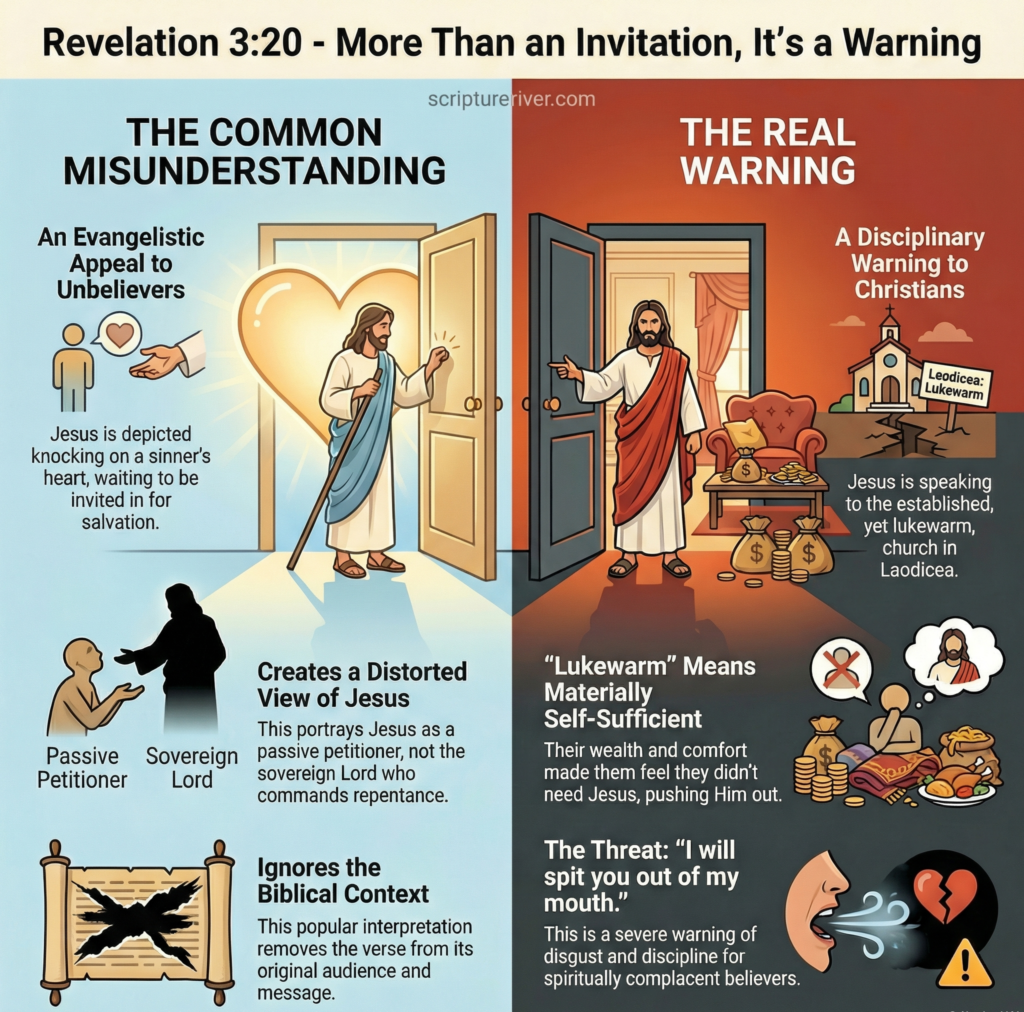
When you understand Revelation 3:20 correctly, it becomes far more challenging than the evangelistic misuse suggests.
It’s a Warning to Comfortable Christians
The Laodicean church represents Christians who’ve become so comfortable, wealthy, and self-sufficient that they no longer sense their need for Jesus.
Their lives work fine without desperate dependence on God. Their bank accounts are full. Their futures are secure. Their needs are met.
So Jesus has become optional rather than essential.
They haven’t rejected Him theologically. They’ve just made Him practically irrelevant to their daily lives.
That’s lukewarm Christianity, and Jesus finds it nauseating.
It’s Specifically About Materialism
Revelation 3:17 makes clear the Laodiceans’ problem was materialism masquerading as blessing.
“You say, ‘I am rich; I have acquired wealth and do not need a thing.'” Their wealth had convinced them they didn’t need God.
This directly parallels Jesus’s warning in Matthew 6:24 that you cannot serve both God and money. The Laodiceans thought they were serving God while actually serving wealth.
Author Randy Alcorn, in his book on biblical perspectives on money, argues that Laodicea represents the quintessential danger of prosperity: it makes us think we’re spiritually healthy when we’re actually spiritually bankrupt.
The Judgment Jesus Threatens
Revelation 3:16 contains a terrifying threat: “Because you are lukewarm, and neither hot nor cold, I will spit you out of my mouth.”
The Greek word “emeo” means to vomit, to reject violently.
Jesus isn’t mildly disappointed. He’s disgusted enough to expel them.
This isn’t language about losing salvation, according to most evangelical theologians.
It’s language about severe discipline and possible removal from ministry usefulness, similar to the warnings in 1 Corinthians 3:15 about works being burned up though the believer is saved “as through fire.”
But it’s still serious judgment language that should terrify any Christian who recognizes Laodicean symptoms in their own life.
How to Know If You’re Lukewarm
The Laodicean warning applies whenever Christians exhibit these specific patterns.
1. You’re Financially Comfortable and Spiritually Complacent
If your prayers have become routine because you don’t desperately need anything, you might be Laodicean.
If your giving is minimal because you’re focused on building your own security, you might be Laodicean.
If you can’t remember the last time you sacrificed anything significant for God’s kingdom, you might be Laodicean.
2. You Evaluate God’s Blessing by Material Prosperity
If you measure spiritual health by account balance, career success, or comfortable circumstances, you’re thinking like Laodicea.
God’s blessing sometimes includes prosperity.
But the Laodiceans’ mistake was equating prosperity with God’s approval, while Jesus called them wretched, poor, blind, and naked despite their wealth.
3. You Don’t Sense Need for Jesus Daily
If you go days without consciously depending on Jesus because life runs smoothly without Him, that’s the Laodicean danger.
They didn’t need Jesus. They had everything handled. That self-sufficiency is what pushed Him outside their church.
4. Your Christianity Is More Cultural Than Committed
If you identify as Christian, attend church occasionally, and consider yourself good, but your faith doesn’t actually cost you anything or change how you live, you might be Laodicean.
Lukewarm Christianity is Christianity that exists comfortably within your culture without challenging any of your priorities, spending, or lifestyle choices.
What Jesus Offers If You’ll Repent
Revelation 3:19-20 isn’t only warning. It’s also gracious invitation.
Revelation 3:19-20, Christian Standard Bible (CSB)
“As many as I love, I rebuke and discipline. So be zealous and repent. See! I stand at the door and knock. If anyone hears my voice and opens the door, I will come in to him and eat with him, and he with me.”
The Rebuke Proves Love
Jesus rebukes the Laodiceans because He loves them. The warning itself is mercy.
If He didn’t care, He’d let them continue in self-deception until judgment.
Instead, He confronts them clearly about their spiritual condition.
The Call to Repentance
“Be zealous and repent” means stop being lukewarm. Get hot again.
Return to the passionate pursuit of Jesus that characterized your early faith.
Repentance here isn’t about initial salvation. It’s about Christians turning from complacency back to wholehearted devotion.
The Promise of Restored Fellowship
If you respond to Jesus’s warning by opening the door you’ve closed, He promises to restore intimate fellowship.
“I will come in and eat with him” pictures the close relationship you once had but lost through self-sufficiency.
Jesus wants it back. But you have to want it back enough to acknowledge you need Him desperately.
The Application for Modern Christians
Western Christianity mirrors Laodicea disturbingly well.
We’re the wealthiest Christians in history.
We have more resources, comfort, security, and prosperity than believers in any other time or place.
And like Laodicea, many of us don’t think we need Jesus desperately because life works reasonably well without constant dependence on Him.
We’ve made Christianity about going to heaven when we die rather than about daily, desperate dependence on Jesus for everything.
We’ve evaluated God’s blessing by our material comfort rather than our spiritual transformation.
We’ve become lukewarm, and Jesus finds it nauseating.
Revelation 3:20 isn’t an evangelistic invitation for unbelievers to invite Jesus into their hearts.
It’s a warning for believers who’ve pushed Jesus out of their lives through self-sufficient comfort.
The question isn’t whether you’ve ever invited Jesus in.
The question is whether you’ve shut Him out through lukewarm complacency, and whether you’ll hear Him knocking and let Him back in.
Prayer for Lukewarm Hearts
Jesus, I recognize Laodicea in myself. I’ve become comfortable, self-sufficient, and lukewarm. I say I’m rich and need nothing, but You see me as wretched, poor, blind, and naked.
Forgive me for pushing You to the margins of my life through material comfort and spiritual complacency. I hear You knocking. I’m opening the door I’ve closed through self-sufficiency. Come back in. Restore the intimate fellowship I’ve lost. Make me hot again, not lukewarm.
Give me desperate dependence on You instead of comfortable independence from You. Discipline me because You love me. Don’t spit me out. Transform me from Laodicean lukewarmness to passionate devotion.
In Your Name, Amen.
References
Alcorn, R. (2003). Money, Possessions, and Eternity. Tyndale House Publishers. [Book]
Bailey, K. E. (2008). Jesus Through Middle Eastern Eyes: Cultural Studies in the Gospels. InterVarsity Press. [Book]
Fee, G. D. (2011). Revelation: A New Covenant Commentary. Cascade Books. [Book]
Hemer, C. J. (2001). The Letters to the Seven Churches of Asia in Their Local Setting. Eerdmans Publishing Company. [Book]
Horton, M. (2011). The Gospel-Driven Life: Being Good News People in a Bad News World. Baker Books. [Book]
Mounce, R. H. (1997). The Book of Revelation. Eerdmans Publishing Company. [Book]
Pawson, D. (2009). Unlocking the Bible. Collins. [Book]
Peterson, E. H. (2005). The Message: The Bible in Contemporary Language. NavPress. [Bible Translation]
Ramsay, W. M. (1994). The Letters to the Seven Churches. Hendrickson Publishers. [Book]
Sproul, R. C. (1992). Chosen by God. Tyndale House Publishers. [Book]
Strong, J. (2010). Strong’s Exhaustive Concordance of the Bible. Hendrickson Publishers. [Reference Book]
Tacitus, C. (117 AD). The Annals. (A. J. Woodman, Trans.). Hackett Publishing Company. [Historical Text]
Walvoord, J. F. (2011). The Revelation of Jesus Christ. Moody Publishers. [Book]

