


The nurse was checking my IV line when I felt it.
Pure, undiluted terror.
In three hours, I’d be unconscious on an operating table while a surgeon I’d met once cut into my body.
I’d signed consent forms acknowledging risks that included paralysis, infection, and death.
My family was in the waiting room trying to stay positive, but I could see the fear in their eyes.
I’m a pastor. I’ve prayed with hundreds of people before their surgeries. I’ve stood in pre-op rooms offering comfort and biblical promises.
But lying in that hospital bed, wearing nothing but a gown and anxiety, all my pastoral training felt useless.
That’s when I prayed a prayer that didn’t come from my theological education or ministry experience.
It came from the rawest, most honest place in my soul.
And it changed everything about how I approached not just that surgery but every frightening situation since.
I’m sharing that prayer with you today, along with the biblical foundation that supports it and practical guidance for praying before your own surgery or that of a loved one.
Because surgery is terrifying, and you need more than positive thoughts.
You need a prayer that actually works when fear is threatening to overwhelm you.
Audio Message: Why This Prayer Works When Others Feel Empty
In this 16-minute message, you’ll hear why certain prayers connect powerfully with God’s heart during medical crises while others feel like we’re just talking to the ceiling.
Understanding what makes a pre-surgery prayer effective will help you pray with confidence instead of desperation, with faith instead of just fear.
What Makes Surgery Prayer Different From Other Prayers
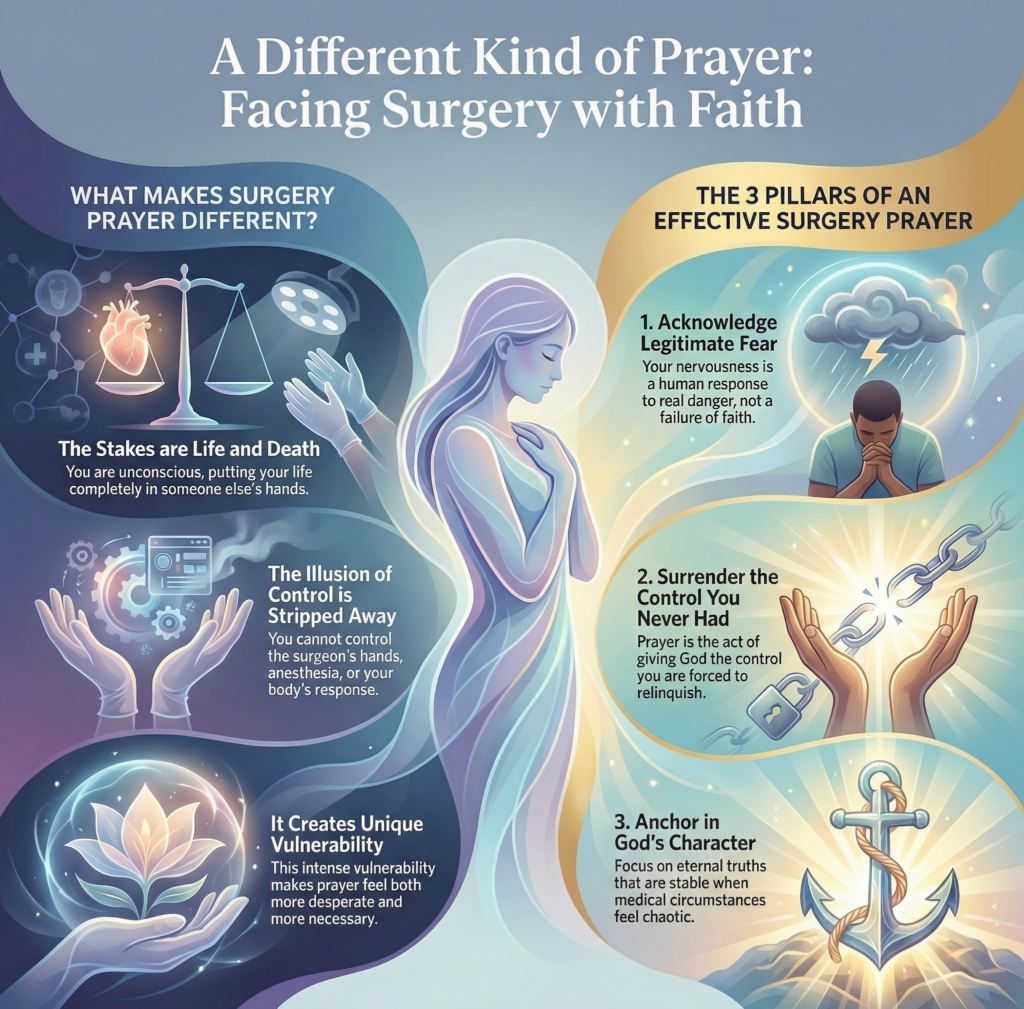
Surgery isn’t like praying for a job interview or a difficult conversation.
The stakes are fundamentally different.
You’re literally putting your life in someone else’s hands while unconscious.
You’re trusting your body to anesthesia that could fail, procedures that could go wrong, and recovery that might not happen.
I’ve counseled people through every kind of crisis imaginable.
Financial disasters, relationship breakdowns, career failures, you name it.
But there’s something uniquely vulnerable about surgery that makes prayer feel both more desperate and more necessary.
Here’s what I’ve learned about surgery prayer through both personal experience and pastoral ministry.
First, effective surgery prayer acknowledges legitimate fear without drowning in it.
Jesus Himself sweated drops of blood in Gethsemane, anticipating His suffering.
Your nervousness before surgery isn’t a failure of faith. It’s a human response to real danger.
Second, surgery prayer must surrender control you never actually had. We like feeling in charge of our lives, but surgery strips away that illusion.
You can’t control the surgeon’s hands, the anesthesia’s effects, or your body’s response. Prayer becomes the act of giving God control you’re being forced to relinquish anyway.
Third, surgery prayer grounds you in God’s character when circumstances feel chaotic.
Medical facts and statistics swirl in your head. Prayer refocuses you on eternal truths that don’t change regardless of surgical outcomes.
The prayer I prayed before my surgery contained all three elements.
It was honest about my fear, surrendered outcomes I couldn’t control, and anchored me to who God is, even when I didn’t know what would happen to me.
The Prayer That Changed Everything

Let me take you back to that pre-op room.
The anesthesiologist had just explained what would happen when they put me under.
My surgeon had marked the incision site.
Nurses were prepping equipment I didn’t want to look at too closely. And I was spiraling into panic.
That’s when I closed my eyes and prayed this:
God, I’m terrified right now, and I’m not going to pretend I’m not. In a few hours, I’ll be completely helpless on that operating table. I won’t be able to protect myself, advocate for myself, or even breathe on my own. Everything will depend on people I barely know and equipment I don’t understand. So I’m giving You what I can’t hold onto anyway. I’m releasing control of this surgery, my body, and the outcome. I trust that You love me more than I love myself. I trust that You’re more invested in my wellbeing than I am. I trust that whether I wake up healed, wake up with complications, or don’t wake up at all, You’ll be there and You’ll be good. I can’t do this in my own strength, so I’m leaning entirely on Yours. Guide the surgeon’s hands. Make the anesthesia work exactly as it should. Protect me from infection and complications. But most of all, stay with me. Don’t leave me alone in this. That’s what I need most. Not guaranteed outcomes, but Your guaranteed presence. I’m Yours. Do what You know is best. In Jesus’s Name, Amen.
I opened my eyes, and something had shifted.
The fear didn’t disappear completely. My heart was still racing.
But underneath the nervousness was a bedrock of peace I hadn’t felt moments earlier.
I’d released what I was trying desperately to control and found that God was already holding it.
When they wheeled me into the operating room twenty minutes later, I was still scared.
But I wasn’t alone in my fear. God was there, and that made all the difference.
Why This Prayer Works: The Biblical Foundation
That prayer wasn’t just an emotional catharsis.
It was theologically grounded in biblical truth about who God is and how He operates during crisis.
Let me show you the scriptural foundation supporting each element of that prayer.
Honesty About Fear: Psalm 56:3 says, “When I am afraid, I put my trust in you.” David didn’t say “if I’m afraid” as though fear was hypothetical. He said “when,” acknowledging that fear would come but describing what to do with it. My prayer started with honest fear because the Bible makes room for that.
Surrender of Control: Proverbs 3:5-6 instructs us to trust God with all our heart and not lean on our own understanding. Surgery forces that trust. You literally can’t understand everything happening. You can’t control it. Prayer becomes the vehicle for active surrender rather than anxious grasping.
Trust in God’s Character: Romans 8:28 promises that God works all things together for good for those who love Him. Notice it doesn’t say all things are good. Surgery, illness, and medical crises aren’t good. But God works them for good. My prayer claimed that promise even while acknowledging uncertain outcomes.
Request for God’s Presence: Psalm 23:4 declares, “Even though I walk through the valley of the shadow of death, I will fear no evil, for you are with me.” The comfort isn’t in avoiding danger. It’s in God’s presence during danger. That’s what I asked for most desperately, not protection from surgery but God’s presence through it.
Confidence in God’s Love: Romans 8:38-39 assures us that nothing can separate us from God’s love in Christ. Not death, not life, not anything. My surgery couldn’t separate me from God’s love, regardless of the outcome. That truth undergirded my entire prayer.
This biblical foundation transformed my desperate fear into grounded faith.
I wasn’t denying reality or manufacturing false confidence. I was standing on promises God has never broken.
How to Pray Your Own Surgery Prayer
Maybe you’re facing surgery soon, or someone you love is.
You need your own prayer, one that comes from your heart and addresses your specific fears.
Let me walk you through how to construct a surgery prayer that actually helps instead of just being religious words you feel obligated to say.
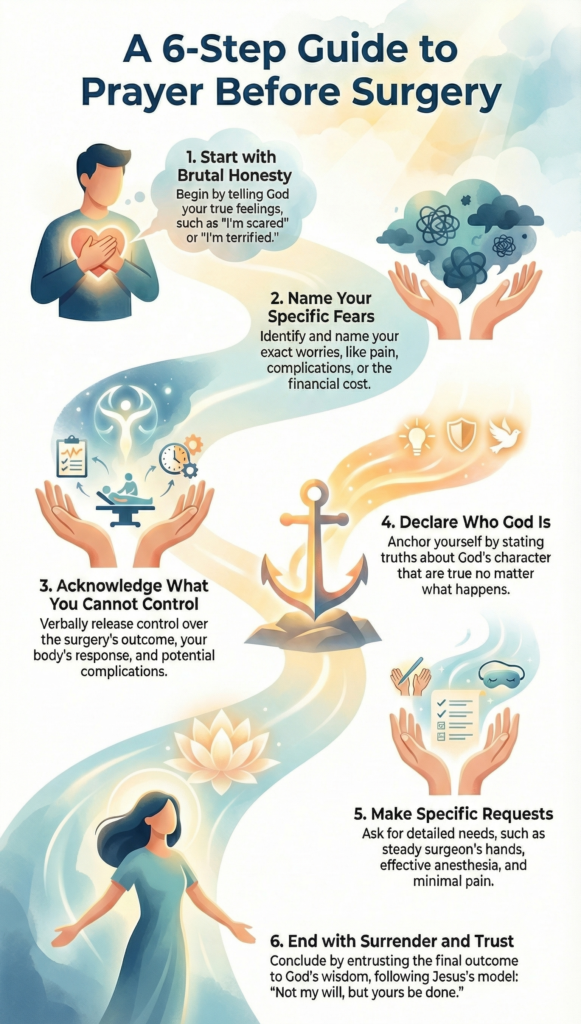
Step 1: Start With Brutal Honesty
Don’t begin with faith declarations you don’t feel.
Start with the truth. “God, I’m scared.” “Father, I don’t want to do this.” “Lord, I’m terrified of dying on that table.”
God already knows how you feel. Pretending in prayer doesn’t impress Him. It just creates distance between your real heart and your praying lips.
Psalm 62:8 invites us to pour out our hearts before God. Do that first.
Step 2: Name Your Specific Fears
What exactly are you afraid of? Pain? Not waking up? Complications? Being a burden to your family during recovery? Financial cost?
Bring those specific fears to God by name.
Generic prayers get generic comfort.
Specific prayers about specific fears invite God into the actual places where you’re struggling.
I was afraid of waking up paralyzed. I was afraid of my kids losing their mom. I was afraid of chronic pain.
I named each fear in prayer, and naming them somehow diminished their power over me.
Step 3: Acknowledge What You Cannot Control
This is the hardest part. Verbally releasing control of outcomes you desperately want to manage.
“God, I can’t control how this surgery goes.
I can’t control my body’s response. I can’t control whether complications develop. I’m releasing all of that to You.”
This isn’t passive resignation. It’s active surrender, recognizing that your white-knuckle grip on circumstances you can’t actually control only exhausts you.
Let go. God’s got it.
Step 4: Declare Who God Is Regardless of Outcomes
This is where faith enters.
Not faith that everything will turn out the way you want, but faith that God remains who He says He is, no matter what happens.
“You’re good even if this goes badly.
You’re faithful even if I face complications. You love me even if the outcome isn’t what I’m praying for.”
These declarations anchor you to eternal truth when temporary circumstances feel overwhelming.
They’re not denial. They’re perspective, seeing beyond the immediate crisis to the unchanging character of God.
Step 5: Make Specific Requests
Now ask for what you need. Be specific. Don’t just pray, “please let the surgery go well.” Get detailed.
Pray for the surgeon’s hands to be steady and skillful.
Pray for anesthesia to work perfectly without side effects.
Pray against infection, blood clots, and adverse reactions.
Pray for minimal pain and a quick recovery.
Pray for peace for your family in the waiting room.
God invites bold, specific requests. James 4:2 says we don’t have because we don’t ask. Ask. Be detailed. Trust that God hears every word.
Step 6: End With Surrender and Trust
Close your prayer by permitting God to do what He knows is best, even if it’s not what you’re asking for.
This isn’t undermining your requests. It’s acknowledging that God’s wisdom exceeds yours.
Jesus prayed in Gethsemane, “Not my will, but yours be done.” Follow that pattern.
“God, I’m asking for complete healing and smooth recovery. But if Your plan is different, I trust You. I’m Yours. Do what You know is best. I’m surrendering this to You.”
Prayers Others Have Prayed Before Surgery
Since I shared my surgery story publicly, dozens of people have sent me the prayers they prayed before their own procedures.
Each one is unique, but they all share similar elements. Let me share a few that particularly moved me.
Sarah’s Prayer Before Cancer Surgery:
Jesus, I don’t know if I’ll wake up from this surgery cancer-free or if I’m starting a long battle. I don’t know if they’ll get it all or if it’s already spread. But I know You walked this earth, suffered, and rose again. I know You understand pain I haven’t experienced yet. I’m asking You to heal me completely, to let this surgery remove every cancer cell. But even if that doesn’t happen, stay with me. Let me feel Your presence in the recovery room. Give my husband peace while he waits. Don’t let my kids be traumatized by this. And help me trust You with outcomes I can’t see yet. You’re my healer and my hope. In Your Name, Amen.
Marcus’s Prayer Before Heart Surgery:
Father, my heart is literally broken, and I need You to help them fix it. I’m sixty-two years old, and I’m not ready to die yet. I want to meet my grandchildren. I want to grow old with my wife. So I’m begging You to guide this surgeon’s hands, to make this repair successful, to give me more years. But I also know my times are in Your hands, and if today is my last day on earth, I trust You with that too. Just please don’t let me die alone or afraid. Be with me. That’s what I need most. Amen.
Jennifer’s Prayer Before Her Child’s Surgery:
God, this is my baby going into that operating room, and I can’t go with him. I can’t hold his hand or comfort him when he’s scared. I have to trust strangers to care for my son the way I would. It’s unbearable. So I’m asking You to be what I can’t be right now. Be his comfort. Be his protector. Guide the surgical team to fix what’s wrong without causing new problems. Bring my boy back to me healthy and whole. Please, God. Please. I know You love him even more than I do, so I’m trusting him to Your care. Just bring him through this. Amen.
Each of these prayers is raw, honest, and deeply trusting. That combination is what makes surgery prayer powerful.
What Happens When Surgery Doesn’t Go As Prayed
I need to address the painful reality that sometimes we pray these heartfelt prayers, and surgery still goes wrong.
Complications happen. Recovery is harder than expected. Worst of all, sometimes people don’t wake up. They die despite fervent prayers from faithful people.
Does that mean prayer failed?
Does it mean God didn’t hear or didn’t care?
No. It means we live in a broken world where bodies fail, and medicine has limits.
It means God’s purposes sometimes include suffering we can’t understand.
It means His ways are higher than ours in ways that frustrate and confuse us.
I’ve prayed with families before surgery and then conducted funerals afterward.
I’ve watched believers pray in absolute faith and still face devastating outcomes.
It’s the hardest part of pastoral ministry, and I don’t have neat answers that make it okay.
What I can tell you is this: God’s presence is real even when His intervention doesn’t come the way we pray for it.
His character remains good even when circumstances are terrible. And our prayers matter even when outcomes break our hearts.
Prayer changes spiritual realities we can’t see.
It invites God’s presence into unbearable situations.
It unites believers around suffering families. It prepares our hearts to receive whatever answer God gives.
Your surgery prayer is never wasted, even if healing doesn’t come the way you’re asking.
Keep praying. Keep trusting. Keep bringing your fear and faith to God.
He hears you. He loves you. And He’ll be with you regardless of what happens in that operating room.
Our Perspective After the Surgery
My surgery went well. Better than expected, actually.
I woke up with minimal pain, no complications, and a surgeon who seemed genuinely pleased with how everything went.
But here’s what struck me most in the recovery room.
The peace I felt before surgery didn’t come from knowing it would turn out fine.
It came from knowing God was with me regardless.
When I woke up, I was grateful for successful surgery but even more grateful that the peace had been real.
That prayer I prayed in pre-op didn’t manipulate God into giving me good outcomes.
It aligned my heart with His presence so I could face uncertain outcomes without being destroyed by fear.
That’s what I want for you.
Not a magic prayer formula that guarantees perfect surgery, but a genuine encounter with God that sustains you through whatever comes.
Surgery is scary. There’s no getting around that.
But God is present, and prayer is the vehicle through which you experience that presence most tangibly.
Pray honestly. Surrender completely. Trust deeply. And watch how God meets you in the most vulnerable moment of your life.
Your Surgery Prayer
Father, I lift up everyone reading this who’s facing surgery soon. They’re scared, and they have every right to be. Meet them in their fear. Give them peace that doesn’t make sense given their circumstances. Guide every surgeon who’ll operate on them. Make every anesthesiologist supernaturally skilled. Protect them from complications and infections. Bring them through surgery successfully and into smooth recovery. But most of all, be with them. Let them feel Your presence in the pre-op room, during surgery, and in recovery. Don’t let them face this alone. You’re the Great Physician, and we’re trusting You with these precious lives. In Jesus’s Name, Amen.
References
Keller, T. (2013). Walking with God through Pain and Suffering. Dutton.
Lewis, C. S. (2001). A Grief Observed. HarperOne.
Miller, P. E. (2009). A Praying Life: Connecting with God in a Distracting World. NavPress.
Peterson, E. H. (2005). The Message: The Bible in Contemporary Language. NavPress.
Piper, J. (2006). When I Don’t Desire God: How to Fight for Joy. Crossway.
Strong, J. (2010). Strong’s Exhaustive Concordance of the Bible. Hendrickson Publishers.
Tada, J. E. (2012). A Place of Healing: Wrestling with the Mysteries of Suffering, Pain, and God’s Sovereignty. David C. Cook.
Wiersbe, W. W. (2007). The Bible Exposition Commentary. David C. Cook.
Yancey, P. (1997). Where Is God When It Hurts? Zondervan.
Yancey, P. (2006). Prayer: Does It Make Any Difference? Zondervan.

