


My friend texted me at midnight: “They found something on the scan. I’m terrified.”
I wanted to text back the perfect prayer.
Something powerful and faith-filled that would fix everything.
But I sat staring at my phone, realizing I didn’t actually know how to pray for healing in a way that honored both God’s power and the terrifying reality she was facing.
That night forced me to study how people in Scripture actually prayed for healing.
Not the sanitized Sunday school versions.
The raw, honest, desperate prayers of people who needed God to intervene or they wouldn’t survive.
These seven prayers changed how I pray for healing.
Not because they’re magic formulas, but because they taught me to bring God both bold faith and honest fear, to ask for what I desperately want while surrendering to what He knows is best.
Disclaimer: These prayers are spiritual resources, not medical advice. If you or someone you love is facing serious illness, please seek qualified medical care alongside prayer. God often heals through doctors, medicine, and treatment. Faith and medicine work together, not against each other.
Why Biblical Healing Prayers Matter

You can find thousands of healing prayers online.
Most are beautiful, well-intentioned, and completely disconnected from how Scripture actually teaches us to pray.
Biblical healing prayers do three things generic prayers don’t:
First, they’re grounded in God’s character revealed through Scripture, not wishful thinking about what we want God to be.
Second, they balance bold faith with honest surrender, asking courageously while trusting God’s wisdom over our preferences.
Third, they prepare us for any answer God gives, including the answer we desperately don’t want.
These aren’t prayers designed to manipulate God into healing.
They’re prayers that align our hearts with God’s heart while we wait for His answer.
The 7 Biblical Healing Prayers
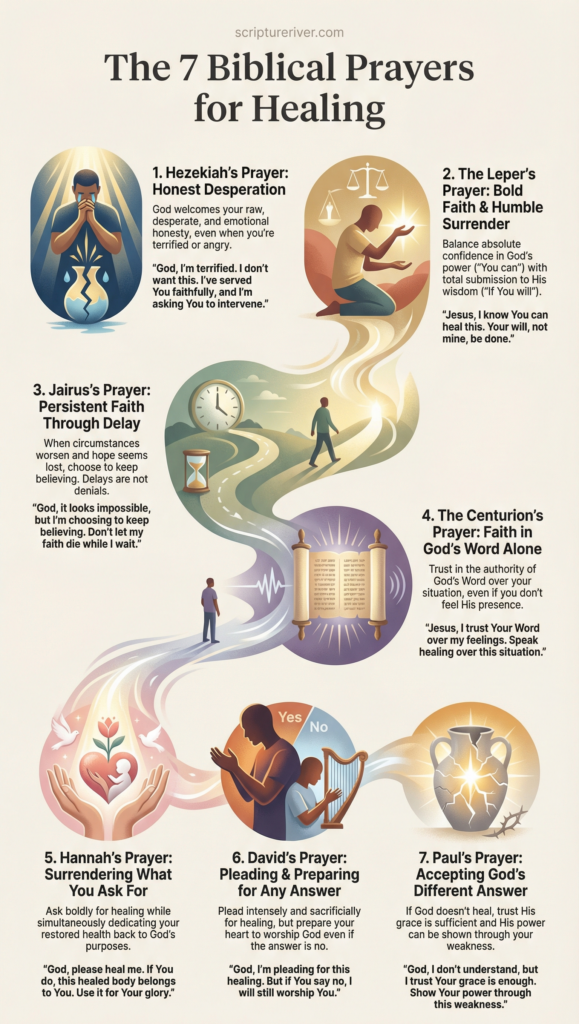
1. Hezekiah’s Prayer: Honest Desperation
King Hezekiah received a death sentence from the prophet Isaiah. God said through Isaiah: you will die, not recover. Put your affairs in order.
Hezekiah’s response teaches us that honest, desperate prayer is acceptable even when God’s already spoken.
2 Kings 20:2-3, New International Version (NIV)
“Hezekiah turned his face to the wall and prayed to the Lord, ‘Remember, Lord, how I have walked before you faithfully and with wholehearted devotion and have done what is good in your eyes.’ And Hezekiah wept bitterly.”
What This Prayer Teaches:
Hezekiah didn’t pretend to be fine with dying. He wept bitterly.
He reminded God of his faithfulness, not to earn healing but to appeal to their relationship.
He poured out honest emotion without apology.
God heard and added fifteen years to Hezekiah’s life.
Not because the prayer was eloquent but because it was honest.
How to Apply This:
When facing serious illness, don’t sanitize your prayers. Tell God exactly how terrified you are.
Remind Him of your relationship with Him. Weep if you need to. He’s not offended by your desperate honesty.
Pray: “God, I’m terrified. I don’t want to die. I don’t want this disease. I’ve served You faithfully and I’m asking You to heal me. Please. I need You to intervene because I can’t fix this.”
2. The Leper’s Prayer: Bold Faith With Humble Surrender
A man with leprosy approached Jesus with a prayer that balanced bold faith and humble surrender perfectly.
Matthew 8:2, English Standard Version (ESV)
“And behold, a leper came to him and knelt before him, saying, ‘Lord, if you will, you can make me clean.'”
What This Prayer Teaches:
The leper had absolute confidence in Jesus’s power: “You can.” But he submitted to Jesus’s will: “If you will.”
He didn’t doubt God’s ability. He surrendered to God’s decision.
Jesus healed him immediately. But the prayer’s power wasn’t in forcing Jesus’s hand. It was in trusting Jesus’s heart.
How to Apply This:
Pray with confident faith in God’s power while surrendering to His wisdom about whether healing serves His purposes best in your situation.
Pray: “Jesus, I know You can heal this. I’ve seen Your power. I believe You’re able. And I’m asking You to heal me. But if You have purposes I can’t see that require a different answer, I trust You. Your will, not mine.”
3. Jairus’s Prayer: Persistent Faith Through Delay
Jairus’s daughter was dying. He begged Jesus to come heal her. Jesus agreed but got delayed helping someone else.
While they were delayed, messengers arrived: “Your daughter is dead. Don’t bother the teacher anymore.”
Jesus told Jairus: “Don’t be afraid; just believe.”
Mark 5:36, Christian Standard Bible (CSB)
“But Jesus overheard what was said and told the synagogue leader, ‘Don’t be afraid. Only believe.'”
What This Prayer Teaches:
Jairus had to maintain faith through the delay that seemed to make healing impossible.
When hope appeared lost, Jesus commanded continued belief.
Jesus raised the girl from death, proving that delays don’t mean denial and apparent impossibility doesn’t limit God.
How to Apply This:
When healing doesn’t come immediately and circumstances worsen, keep believing anyway.
God’s delays aren’t always denials. Sometimes He’s setting up a bigger miracle than the one you asked for.
Pray: “God, this is getting worse, not better. I’m scared You’re not going to answer. But I’m choosing to keep believing You can heal even when it looks impossible. Don’t let my faith die while I’m waiting for Your answer.”
4. The Centurion’s Prayer: Faith in God’s Word Alone
The centurion’s servant was paralyzed and suffering terribly. When Jesus offered to come to his house, the centurion stopped Him.
Matthew 8:8, New King James Version (NKJV)
“The centurion answered and said, ‘Lord, I am not worthy that You should come under my roof. But only speak a word, and my servant will be healed.'”
What This Prayer Teaches:
The centurion believed Jesus’s word carried the same power as Jesus’s physical presence.
He didn’t need Jesus to touch his servant. Jesus’s spoken authority was enough.
Jesus called this “great faith” and healed the servant that very hour from a distance.
How to Apply This:
You don’t need to feel God’s presence to trust His power. His Word spoken over your situation carries authority whether you feel anything or not.
Pray: “Jesus, I don’t feel Your presence right now. I’m not experiencing anything supernatural. But I trust Your Word over my feelings. You said You’re the healer. I believe that even when I don’t feel it. Speak healing over this situation whether I sense You or not.”
5. Hannah’s Prayer: Surrendering What You’re Asking For
Hannah desperately wanted a child. She prayed so intensely at the temple that the priest thought she was drunk. But her prayer included radical surrender.
1 Samuel 1:11, New Living Translation (NLT)
“And she made this vow: ‘O Lord of Heaven’s Armies, if you will look upon my sorrow and answer my prayer and give me a son, then I will give him back to you. He will be yours for his entire lifetime.'”
What This Prayer Teaches:
Hannah asked boldly for what she wanted while simultaneously offering it back to God.
She wanted the son for herself but surrendered him to God’s purposes before he was even conceived.
God gave her Samuel, who became one of Israel’s greatest prophets.
How to Apply This:
Ask God for healing while surrendering the healed life back to His purposes.
This isn’t bargaining with God. It’s acknowledging that healing isn’t just about your comfort but about serving Him with restored health.
Pray: “God, I’m asking You to heal me. But if You do, this healed body belongs to You. I won’t waste restored health on my own comfort. Use it for Your purposes. Heal me for Your glory, not just my relief.”
6. David’s Prayer: Fasting and Pleading
When David’s infant son was dying, David fasted, lay on the ground all night, and pleaded with God for the child’s life.
2 Samuel 12:16, English Standard Version (ESV)
“David therefore sought God on behalf of the child. And David fasted and went in and lay all night on the ground.”
The child died anyway. David’s response reveals mature faith: he got up, washed, worshiped, and accepted God’s answer.
What This Prayer Teaches:
Intense, sacrificial prayer pleading for healing is appropriate. But so is worshiping God when He says no.
David prayed desperately while the child was alive and trusted God’s sovereignty when the child died.
How to Apply This:
Pray with everything you have while the outcome is uncertain.
Fast if you’re able. Plead with God. But prepare your heart to worship Him regardless of His answer.
Pray: “God, I’m fasting and pleading for this healing. I’m giving You everything I have to give. But if You say no, I’ll still worship You. You’re worthy whether You heal or not. I’m asking desperately while trusting completely.”
7. Paul’s Prayer: Accepting God’s Different Answer
Paul had a “thorn in the flesh” most scholars believe was a physical ailment. He prayed three times for God to remove it.
2 Corinthians 12:9, Christian Standard Bible (CSB)
“But he said to me, ‘My grace is sufficient for you, for my power is perfected in weakness.’ Therefore, I will most gladly boast all the more about my weaknesses, so that Christ’s power may reside in me.”
What This Prayer Teaches:
God sometimes says no to healing prayers because His power shows more clearly through sustained weakness than through miraculous healing.
Paul learned to boast in the weakness God wouldn’t remove because it made God’s strength more visible.
How to Apply This:
If God doesn’t heal despite faithful prayer, trust that His grace is sufficient and His purposes include demonstrating His power through your continued struggle.
Pray: “God, I’ve asked repeatedly for healing and You haven’t healed me. I don’t understand why. But I’m choosing to trust Your grace is enough. Show Your power through this weakness You won’t remove. Help me glorify You whether You heal me or sustain me through continued suffering.”
How to Pray These Prayers Over Your Situation
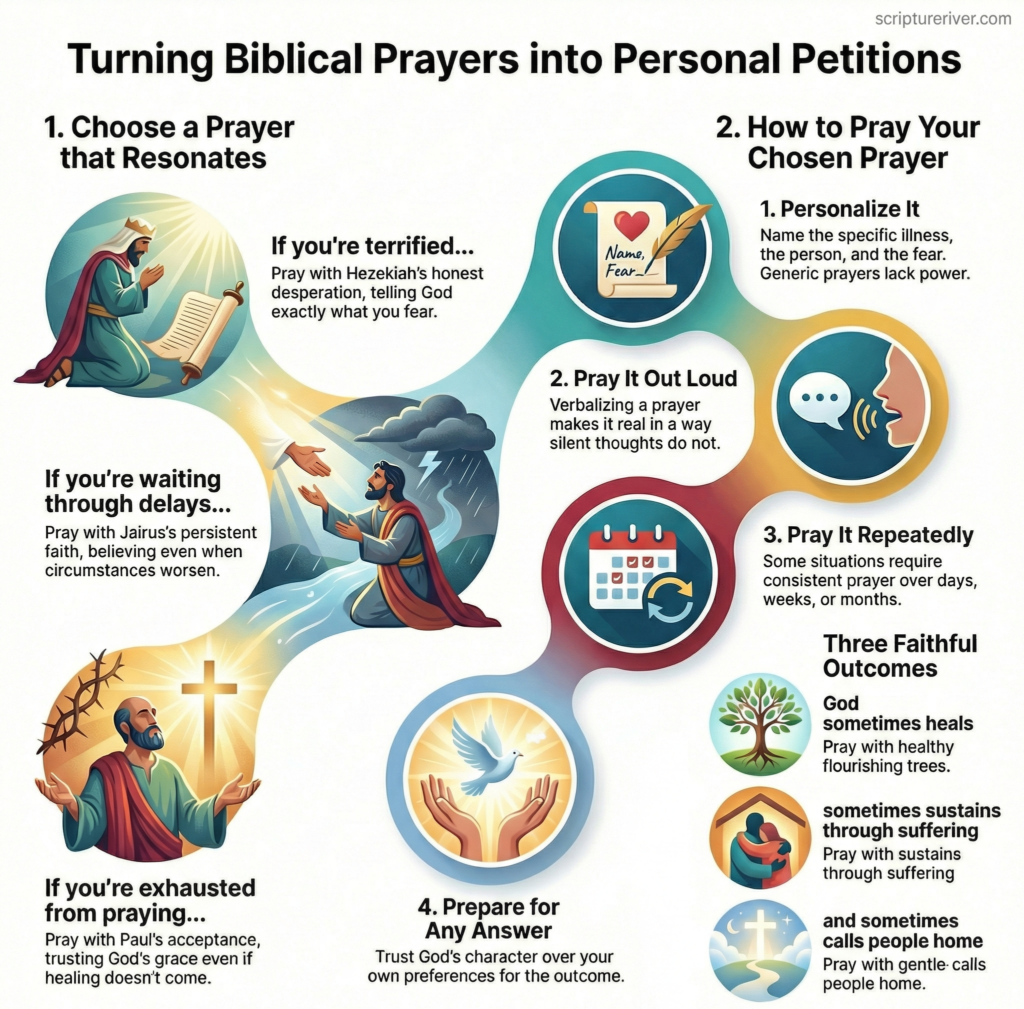
Don’t just read these prayers as information. Use them as templates for your actual situation.
Choose the prayer that resonates with where you are spiritually. If you’re terrified, pray Hezekiah’s honest desperation.
If you’re waiting through delays, pray Jairus’s persistent faith.
If you’re exhausted from praying without answer, pray Paul’s acceptance of God’s different plan.
Personalize it with your specific situation. Name the illness. Name the person. Name the fear. Generic prayers lack power. Specific prayers force you to bring real faith to real circumstances.
Pray it out loud. There’s something powerful about verbalizing prayer. It makes it real in a way silent thoughts don’t.
Pray it repeatedly. The centurion prayed once. Paul prayed three times. Hezekiah prayed constantly. Some situations require repeated prayer over days, weeks, or months.
Prepare for any answer. God heals sometimes. He sustains through suffering other times. He calls people home occasionally.
All three are acceptable outcomes for believers who trust God’s character over their preferences.
When Healing Doesn’t Come
I need to address what happens when you pray faithfully and healing doesn’t come.
My friend with the midnight text? She had surgery, did treatment, and recovered. Thank God.
But I’ve prayed these same prayers for others who didn’t recover. Who died despite desperate, faith-filled prayer.
Their deaths don’t prove these prayers don’t work.
They prove God’s answers include options we don’t want but that serve purposes we don’t see.
Hebrews 11 lists heroes of faith.
Some “conquered kingdoms, administered justice, and gained what was promised.”
Others “were tortured, refused release, faced jeers and flogging, were chained and put in prison.”
Both groups had faith. Both trusted God. God gave different answers to each.
If God doesn’t heal you or someone you love despite faithful prayer, it doesn’t mean you lacked faith.
It means God’s purposes include something different than the healing you asked for.
That’s hard. It’s supposed to be hard. But it’s still true.
Prayer for Those Seeking Healing
Father, I’m coming to You desperate for healing. For myself or for someone I love desperately. I’m scared. I’m exhausted from hoping. I don’t know what else to do besides ask You.
So I’m asking: please heal. You can. I believe You can. I’m asking You to do what only You can do. But I’m also surrendering to Your wisdom. If You have purposes I don’t see that require a different answer, I trust You.
Not because I want to. Because You’ve proven You’re trustworthy even when Your answers hurt. Give me faith to keep praying while preparing my heart for any answer You give.
Whether You heal miraculously, heal through medicine, sustain through suffering, or call home to complete healing in heaven, I trust You. Be glorified through whatever You decide.
In Jesus’s Name, Amen.
References
Alcorn, R. (2009). If God Is Good: Faith in the Midst of Suffering and Evil. Multnomah Books. [Book]
Keller, T. (2013). Walking with God Through Pain and Suffering. Dutton. [Book]
Lewis, C. S. (1940). The Problem of Pain. HarperCollins. [Book]
Peterson, E. H. (2005). The Message: The Bible in Contemporary Language. NavPress. [Bible Translation]
Piper, J. (2013). Don’t Waste Your Cancer. Crossway. [Book]
Strong, J. (2010). Strong’s Exhaustive Concordance of the Bible. Hendrickson Publishers. [Reference Book]
Tada, J. E. (2012). A Place of Healing: Wrestling with the Mysteries of Suffering, Pain, and God’s Sovereignty. David C. Cook. [Book]
Yancey, P. (1977). Where Is God When It Hurts? Zondervan. [Book]

