
My sister attended a wedding last month where the bride, standing at the altar in her white dress, recited Ruth 1:16-17 to her groom.
The words were beautiful, romantic, powerful. “Where you go, I will go, and where you stay, I will stay. Your people will be my people and your God my God.”
After the ceremony, my sister asked me, “Isn’t that verse about Ruth and Boaz? That’s such a perfect love story for a wedding.”
I had to tell her something that surprised her: “Actually, Ruth wasn’t speaking to her husband when she said those words. She was speaking to her mother-in-law.”
My sister’s jaw dropped. “Wait, what?”
That conversation reveals how misunderstood this passage truly is.
Ruth 1:16-17 has become one of the most quoted verses at weddings, yet most people don’t know the real context.
These aren’t words between romantic lovers.
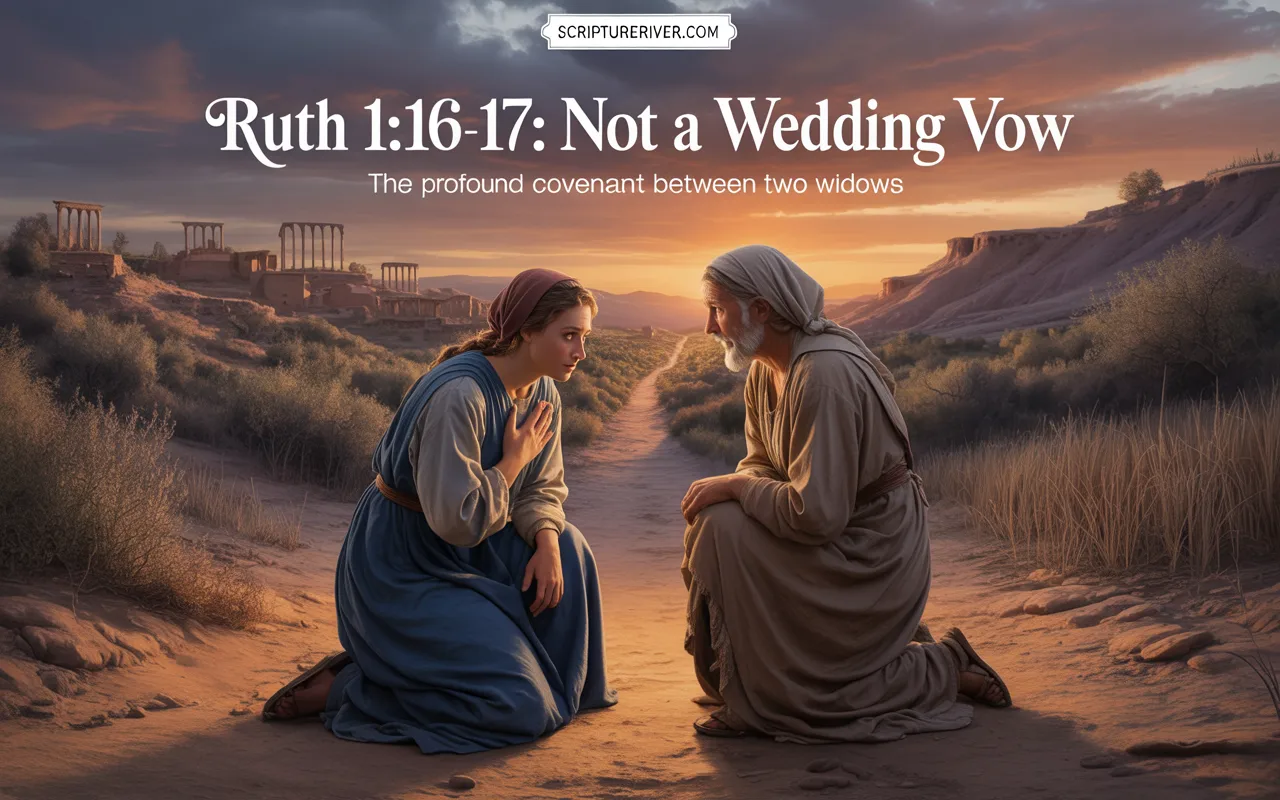
They’re words from a young widow to an older widow, spoken on a dusty road in Moab, at a moment when both women had lost everything.
Understanding the true context makes these words infinitely more powerful.
But Ruth replied, “Don’t urge me to leave you or to turn back from you. Where you go I will go, and where you stay I will stay. Your people will be my people and your God my God. Where you die I will die, and there I will be buried. May the LORD deal with me, be it ever so severely, if even death separates you and me.”
(Ruth 1:16-17, NIV)
The Context: Two Widows and One Choice
To understand Ruth’s declaration, we need to see what came before it.
Naomi, an Israelite woman, had fled to Moab with her husband and two sons during a famine in Bethlehem.
In Moab, her sons married Moabite women: Orpah and Ruth.
Then tragedy struck. Naomi’s husband died. Then both her sons died.
Three widows remained, with no male protection in a culture where women without men were utterly vulnerable.
When Naomi heard the famine had ended in Bethlehem, she decided to return home.
Her two daughters-in-law began the journey with her.
But on the road, Naomi stopped and urged them to return to their families in Moab. She had nothing to offer them. No more sons for them to marry. No security. No future.
Orpah, after much weeping, kissed Naomi goodbye and returned to Moab.
This was the reasonable choice. The sensible choice. The choice anyone would understand.
But Ruth made a different choice.
The Hebrew Behind the Commitment
Ruth’s words in verses 16-17 aren’t casual sentiment. They’re a covenant oath, binding and irrevocable.
Let’s examine what she actually said.
“Don’t Urge Me to Leave You”
The Hebrew phrase here is forceful. Ruth isn’t politely declining. She’s emphatically refusing.
The verb suggests meeting with hostility, encountering opposition. Ruth is saying, “Don’t even try to make me leave. Don’t stand in my way.”
“Where You Go I Will Go”
This is Hebrew parallelism at its finest. Ruth uses five parallel statements to emphasize her total commitment:
- “Where you go I will go”
- “Where you stay I will stay”
- “Your people will be my people”
- “Your God my God”
- “Where you die I will die”
Each phrase builds on the previous one, moving from temporary (“go”) to settled (“stay”) to identity (“people”) to faith (“God”) to finality (“die”).
The Theological Thunderclap
When Ruth says “Your God my God,” she uses a unique Hebrew construction called idem per idem (the same through the same).
There’s no verb stated explicitly. It’s not “Your God will be my God.” It’s “Your God, my God.” Present tense. Already done.
This is conversion language.
Ruth is renouncing the polytheism of Moab and embracing the monotheism of Israel.
She’s abandoning Chemosh, the chief deity of Moab, and committing to Yahweh, the covenant God of Israel.
The Oath: “May the LORD Deal With Me”
Ruth doesn’t just promise. She swears an oath, invoking the name Yahweh, the covenant name of God.
She’s saying, “May the LORD Himself punish me severely if anything but death separates us.”
This is binding covenant language, as serious as a marriage vow, as permanent as death itself.
Understanding Hesed: The Heart of the Story
The key to understanding Ruth 1:16-17 lies in one untranslatable Hebrew word: hesed (חֶסֶד).
Hesed appears three times in Ruth, at the beginning, middle, and end (Ruth 1:8, 2:20, 3:10). It’s the theological thread that ties the entire book together.
What Is Hesed?
Strong’s Concordance struggles to capture it: “steadfast love, mercy, kindness, loyalty.”
But hesed is bigger than any English word.
Bible scholar Darrell L. Bock explains that hesed wraps up “all the positive attributes of God: love, covenant faithfulness, mercy, grace, kindness, loyalty, in short, acts of devotion and loving-kindness that go beyond the requirements of duty.”
Hesed is covenant loyalty. It’s undeserved love freely given.
It’s someone bestowing favor they’re not obligated to give, to someone who has no right to demand it. It’s mercy that doesn’t ask what you deserve but what love requires.
Dr. Will Kynes notes, “Hesed is never merely an abstract feeling of goodwill, but always entails practical action on behalf of another.”
Ruth’s Hesed in Action
When Naomi urged Ruth to return to Moab, Ruth had every legal and cultural right to do so.
She owed Naomi nothing. Her husband was dead. Her obligation was fulfilled. Orpah’s choice was entirely reasonable.
But Ruth chose hesed.
She chose loyal love that goes beyond duty.
She chose to stay with an old woman who had nothing to offer her at that point.
She chose uncertainty over security, a foreign land over her homeland, and an unknown God over familiar gods.
This is what hesed looks like: sacrificial, costly, undeserved, freely given love.
Why This Matters Today
1. Loyalty Is Costly
Ruth teaches us that genuine loyalty often requires sacrifice. She left her country, her people, her gods, her culture, her language, her future prospects, everything she knew. Loyalty cost her dearly.
In our culture of convenience, we struggle with commitment that costs us. We want relationships that serve us, not relationships where we serve. Ruth challenges that. Real hesed love asks, “What will this cost me?” and answers, “I don’t care. I’m committed anyway.”
2. Covenant Commitment Transcends Biology
Ruth and Naomi weren’t related by blood. They were connected by marriage, and that marriage had ended in death. Yet Ruth’s commitment to Naomi rivals any blood relationship in Scripture.
This teaches us that covenant creates family. The Church is built on this truth. We’re adopted into God’s family not by biology but by covenant. Our commitment to fellow believers should reflect Ruth’s hesed love.
3. Conversion Changes Everything
Ruth’s declaration wasn’t just about geography or companionship. It was about God. “Your God my God” is the center of her commitment. Everything else flows from this conversion.
When we truly encounter the God of Israel through Jesus Christ, everything changes. Our people change. Our priorities change. Our path changes. True conversion, like Ruth’s, transforms every area of life.
4. God Honors Hesed
Ruth couldn’t have known how God would bless her faithfulness. She didn’t know she would marry Boaz. She didn’t know she would become the great-grandmother of King David. She didn’t know she would be listed in the genealogy of Jesus Himself (Matthew 1:5).
Ruth simply chose hesed, and God honored it beyond anything she could imagine. When we choose sacrificial, loyal love, we’re participating in God’s own character, and He delights to bless it.
Frequently Asked Questions
Why is Ruth 1:16-17 used at weddings if it’s not about marriage?
Ruth’s words embody covenant commitment: total loyalty, shared destiny, and binding promise until death. These are exactly what marriage vows express. While the original context was between two women, the covenantal nature makes it perfectly appropriate for marriage.
The Hebrew word dabaq (to cling) used in Ruth 1:14 is the same word used in Genesis 2:24 when a man “cleaves” to his wife. The language of binding attachment is identical.
The earliest known traditional wedding vows appear in the 1549 Book of Common Prayer, and scholars believe they were influenced by Ruth 1:16-17. The similarities are striking: “where you go I will go” parallels “for better, for worse,” and “where you die I will die” mirrors “till death do us part.”
Was Ruth romantically interested in Naomi?
No. This question projects contemporary categories onto ancient texts. Ruth’s commitment was hesed, covenant loyalty, which transcends romantic categories.
In ancient Near Eastern culture, a widow’s survival depended on male relatives. Ruth was choosing economic hardship and social vulnerability. Her commitment was profoundly sacrificial and relational, but not romantic.
Later, Ruth clearly pursues marriage with Boaz and bears his son. The narrative never suggests conflict between her commitment to Naomi and her relationship with Boaz. Both relationships demonstrate hesed love in appropriate contexts.
Why would Ruth choose a bitter, impoverished widow over returning to her own family?
This is the mystery at the heart of the story. Humanly speaking, it makes no sense. But Ruth’s conversion to faith in Yahweh explains everything. She says, “Your God my God.” Once Ruth encountered the true God through Naomi’s witness, she couldn’t return to Moab’s false gods.
The text also hints that Ruth had developed genuine love for Naomi beyond mere obligation. Ruth 1:14 says Ruth “clung” to Naomi with fierce attachment. Despite Naomi’s bitterness and repeated urging to leave, Ruth saw something in Naomi worth following.
Perhaps Ruth recognized authentic faith even in Naomi’s brokenness. Perhaps she’d observed how Naomi responded to tragedy with faith rather than abandoning God entirely. Whatever Ruth saw, it was compelling enough to leave everything behind.
What can we learn about God’s character from this story?
God quietly orchestrates events behind the scenes. What appears to be chance (Ruth “happening” to glean in Boaz’s field) is divine providence. God doesn’t always work through miracles. Sometimes He works through the faithful choices of people demonstrating hesed.
God welcomes outsiders. Ruth was a Moabite, from a nation that descended from Lot’s incest. Moabites worshipped false gods and were historical enemies of Israel. Yet God welcomed Ruth, blessed her, and included her in the Messianic line. This foreshadows the Gospel: God’s family isn’t limited by ethnicity but opened to all who come by faith.
God rewards hesed. Ruth demonstrated loyal love to Naomi, and God blessed her with Boaz, security, a son, and ultimately a place in Jesus’ genealogy. When we embody God’s character by showing hesed to others, God honors it.
How should this passage shape Christian relationships today?
Ruth 1:16-17 challenges us to examine our level of commitment in relationships. Do we practice convenience-based relationships that last only as long as they benefit us? Or do we practice hesed relationships that endure through hardship?
In Christian community, we’re called to covenant loyalty. That means sticking with struggling believers even when it’s inconvenient. It means choosing costly commitment over comfortable distance. It means treating spiritual family with the binding loyalty Ruth showed Naomi.
This passage also speaks to caring for the vulnerable. Naomi was a widow with no resources. Ruth was young with options. Yet Ruth chose to bind herself to the one who was vulnerable. Similarly, we should bind ourselves in hesed love to those who cannot repay us: the poor, the elderly, the marginalized, the broken.
Prayer for Covenant Faithfulness
Dear Father,
Thank You for the example of Ruth, who chose costly commitment over comfortable convenience. Thank You for her hesed love that reflects Your own character.
Forgive me for the times I’ve chosen self-preservation over sacrificial love. Forgive me for relationships I’ve abandoned when they became difficult, for commitments I’ve broken when they became costly, for people I’ve left behind when they had nothing left to offer me.
Give me Ruth’s courage to say “Your God my God” and mean it completely. Let that conversion transform every area of my life, my loyalties, my priorities, my people, my path.
Teach me hesed love. Not love based on what I receive but love rooted in covenant commitment. Not love that calculates cost and benefit but love that asks only “What does loyalty require?”
Help me see the Naomis in my life, the people who are bitter, broken, and have nothing to offer me, and choose to cling to them anyway. Let me demonstrate Your loyal love to those who feel abandoned.
Bind me to Your people with covenant commitment. Make my relationships reflect the depth of Ruth’s loyalty to Naomi. Let me be the kind of person others can depend on, even when it costs me everything.
Thank You that You demonstrated ultimate hesed through Jesus, who left heaven to cling to humanity, who chose the cross when He could have returned home, who bound Himself to us until death, and through death, forever.
Make me more like Ruth. Make me more like Jesus.
In His name, Amen.
Sources Consulted
Bible Stories Hub. (n.d.). Lessons from Ruth: Faithfulness and love that inspire. [Theological analysis of hesed and Ruth’s covenant commitment]
Knowing the Bible. (n.d.). Ruth. [Comprehensive study of hesed as steadfast loving-kindness and covenant loyalty]
The Nerdy Bible. (2023). The themes of Ruth: Hesed. [Cultural context and application of hesed in Ruth’s story]
GotQuestions.org. (2019). What is the meaning of the Hebrew word hesed? [Definition and theological significance of hesed]
FIRM Israel. (2024). The meaning of hesed: Hebrew word for love. [Practical application of hesed in Scripture]
BibleRef.com. (n.d.). What does Ruth 1:8 mean? [Contextual study of hesed in Ruth’s opening chapter]
Today in the Word. (n.d.). Naomi and Ruth: Uncommon kindness. [Devotional perspective on Ruth’s covenant commitment]
Bible.org. (n.d.). Ruth: Walking in loyal love. [Practical application of hesed to Christian relationships]
Reformed Witness Hour. (n.d.). Ruth’s vow. [Theological treatment of Ruth 1:16-17 as covenant oath]
The Gospel Coalition. (2024). Ruth commentary. [Academic treatment of covenant language and conversion in Ruth]

