


Last month, a woman in our congregation asked me to anoint her mother with oil before surgery.
The request caught me off guard, not because it was unusual, but because I realized how rarely we talk about anointing oil in modern evangelical circles.
Yet there it was in James 5:14, clear as day.
So why does the practice feel so foreign to many of us?
I’ve noticed this tension in the church for years.
Some believers swear by anointing oil for everything from healing prayers to blessing new homes.
Others dismiss it as outdated Old Testament ritual or even superstitious.
And honestly, both camps have valid reasons for their positions, which is exactly why we need to look carefully at what Scripture actually teaches.
This isn’t about picking a side in some denominational debate. It’s about understanding what God’s Word says and figuring out how that applies to us today.
Because here’s the thing: if anointing oil is biblical, we should use it. If it’s not, we shouldn’t pretend it has power it doesn’t possess.
Listen to This Article
Prefer to listen? Press play below to listen to the audio overview of this post. Perfect for your commute, workout, or while you’re doing dishes.
What Does the Bible Say About Anointing Oil?
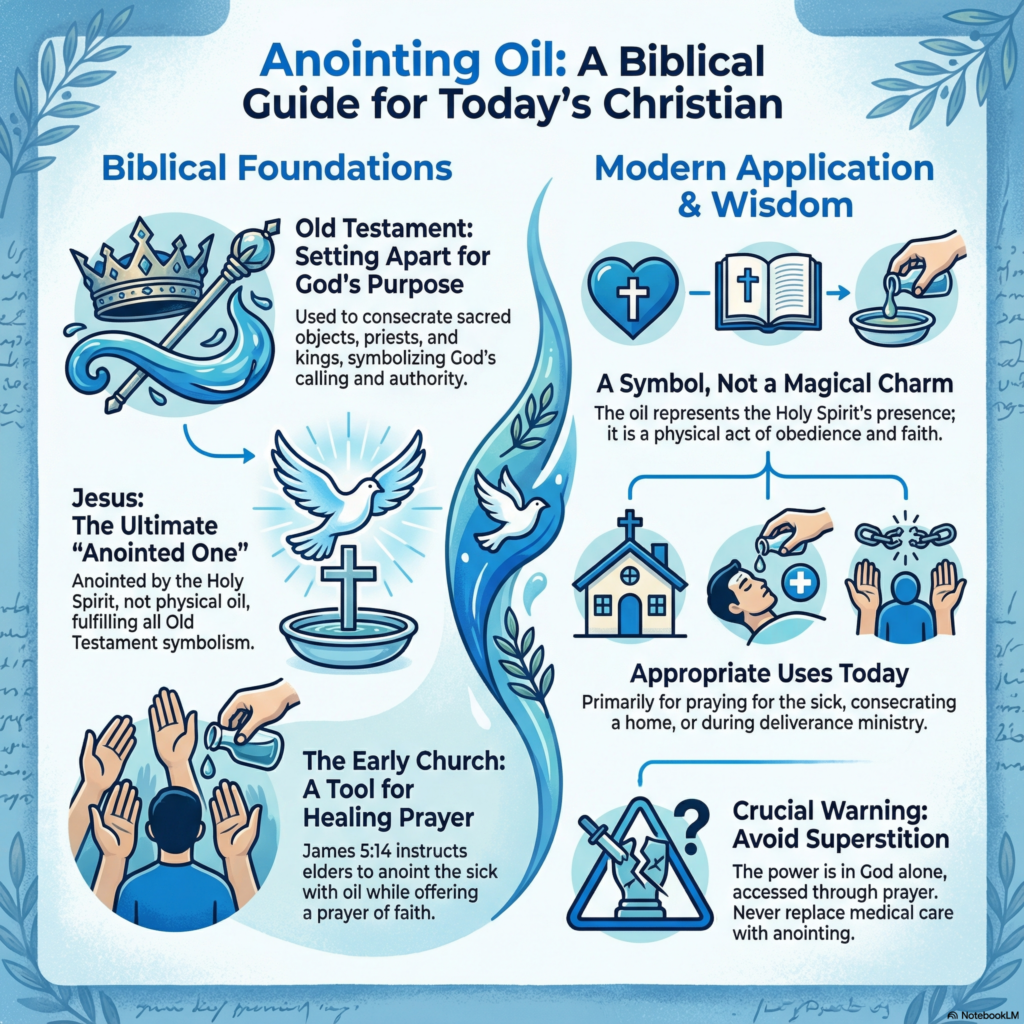
Let’s start where we always should: with Scripture itself. Anointing oil appears throughout the Bible, but not always in the same way or for the same purposes.
Old Testament Anointing
In the Old Testament, anointing oil had three primary uses, and they were all deeply significant.
1. Setting Apart Sacred Objects
When God gave Moses instructions for the tabernacle, He was specific about consecrating everything with anointing oil. The altar, the lampstand, the utensils, even the tent itself got anointed.
Here’s what God told Moses:
Then the Lord said to Moses, “Take the following fine spices: 500 shekels of liquid myrrh, half as much (that is, 250 shekels) of fragrant cinnamon, 250 shekels of fragrant calamus, 500 shekels of cassia, all according to the sanctuary shekel, and a hin of olive oil. Make these into a sacred anointing oil, a fragrant blend, the work of a perfumer. It will be the sacred anointing oil.”
Exodus 30:22-25 (NIV)
This wasn’t just any oil. God prescribed a specific recipe: myrrh, cinnamon, calamus, cassia, and olive oil. And He made it clear that this oil was holy, set apart for sacred purposes only.
In fact, He warned that anyone who made perfume like it for personal use or put it on an unauthorized person would be cut off from their people. That’s how seriously God took this.
2. Anointing Priests
Aaron and his sons were anointed to serve as priests. This wasn’t a casual ceremony. The oil symbolized God’s calling and the Holy Spirit’s empowerment for their sacred duties.
When Samuel anointed Aaron, it represented God setting him apart for holy service that no one else could perform.
3. Anointing Kings
Perhaps the most familiar Old Testament use of anointing oil was for kings. Samuel anointed both Saul and David. The Hebrew word “Messiah” literally means “anointed one.”
When a king was anointed, it signified God’s choice and blessing on that person’s leadership. The oil represented divine authority and the Spirit’s presence.
Here’s what happened when Samuel anointed David:
So Samuel took the horn of oil and anointed him in the presence of his brothers, and from that day on the Spirit of the Lord came powerfully upon David.
1 Samuel 16:13 (NIV)
Notice that connection: anointing with oil, and the Spirit of the Lord coming upon David. The oil was an outward sign of an inward spiritual reality.
New Testament Teaching
When we get to the New Testament, the context shifts. We’re no longer in a system of priests, kings, and tabernacles.
Jesus has come as our ultimate Prophet, Priest, and King.
So what happens to anointing oil?
1. Jesus and Anointing
Jesus Himself was anointed, though not in the way Old Testament kings were. Peter explains it this way:
God anointed Jesus of Nazareth with the Holy Spirit and power, and how he went around doing good and healing all who were under the power of the devil, because God was with him.
Acts 10:38 (NIV)
Jesus wasn’t anointed with physical oil for His ministry. He was anointed with the Holy Spirit at His baptism.
And this is crucial for understanding our question, because Jesus is the fulfillment of what all that Old Testament anointing pointed toward.
2. The Church’s Practice
But here’s where it gets interesting. Even though Jesus fulfills the symbolism, the early church still used anointing oil in at least one specific context.
James writes:
Is anyone among you sick? Let them call the elders of the church to pray over them and anoint them with oil in the name of the Lord. And the prayer offered in faith will make the sick person well; the Lord will raise them up. If they have sinned, they will be forgiven.
James 5:14-15 (NIV)
This is the clearest New Testament instruction we have about anointing oil, and it’s specifically tied to praying for the sick.
Notice a few things here: the sick person calls for the elders, the elders pray and anoint with oil, and healing comes through “the prayer offered in faith,” not the oil itself.
3. Other New Testament References
The disciples also used oil when Jesus sent them out:
They drove out many demons and anointed many sick people with oil and healed them.
Mark 6:13 (NIV)
Some scholars debate whether this was medicinal (olive oil was used medicinally in the ancient world) or symbolic. Probably both.
But either way, it was associated with healing ministry.
One more reference worth noting: when Jesus told the parable of the Good Samaritan, the Samaritan poured oil and wine on the wounded man’s injuries.
This was clearly medicinal, a common first-century medical practice.
Understanding Anointing in Christian Theology

So what do we make of all this? How do theologians and biblical scholars understand anointing oil’s place in Christian practice?
The Symbolic Nature of Oil
Throughout church history, most Christian traditions have understood anointing oil as symbolic rather than magical. The oil itself has no inherent power.
It’s not like a good luck charm or a spiritual weapon that automatically produces results.
Instead, the oil serves as a tangible symbol of several spiritual realities:
1. The Holy Spirit’s Presence
Just as oil was poured out on priests and kings, symbolizing the Spirit coming upon them, anointing oil in Christian practice can represent the Holy Spirit’s work.
When we anoint someone with oil, we’re acknowledging that any healing, blessing, or spiritual work comes from God’s Spirit, not from us or the oil.
2. Faith and Obedience
Using oil in response to James 5:14 is an act of obedience. It demonstrates that we take Scripture seriously and want to follow its instructions.
The oil becomes a physical expression of faith that God hears and answers prayer.
3. Consecration and Setting Apart
When we anoint someone or something with oil, we’re symbolically setting it apart for God’s purposes.
This is why some Christians anoint homes when they move in, asking God to make that space holy and protected.
Historical Christian Perspectives
The early church fathers wrote about anointing oil, and their perspective is helpful. They saw it as a practice for the church but were careful not to attribute magical properties to the oil itself.
In the Catholic and Orthodox Traditions
These churches developed more formal sacramental practices around anointing.
The Catholic Church has the Sacrament of Anointing of the Sick (formerly called Last Rites), where priests anoint seriously ill or dying persons.
The Eastern Orthodox Church anoints the sick and also includes oil in baptism and chrismation (similar to confirmation).
These traditions see the oil as a sacramental sign, a visible means through which God works.
But even in these traditions, the oil itself isn’t considered magical.
It’s God who heals through the faith of the church and the prayer of the righteous.
In Protestant Traditions
Protestant churches have been all over the map on this.
Some reformed traditions largely abandoned the practice, viewing it as too Catholic or potentially superstitious.
Pentecostal and charismatic churches embraced it enthusiastically, often anointing people during healing services or deliverance ministry.
Many evangelical churches fall somewhere in the middle.
They might keep a small vial of oil on hand for when someone specifically requests anointing for healing, but they don’t make it a regular part of their practice.
What the Reformers Said
Luther and Calvin both addressed anointing oil.
They acknowledged James 5:14 but questioned whether it was a permanent ordinance for the church or specific to the apostolic age when miraculous healing gifts were more common.
Calvin, in particular, argued that the passage referred to miraculous healing gifts that had ceased.
Other reformers took a more moderate view, seeing anointing as appropriate when done with faith and in obedience to Scripture, as long as people didn’t superstitious about the oil itself.
Different Christian Perspectives Today
Walk into ten different churches today and you’ll find ten different approaches to anointing oil. Let me break down the main camps:
Those Who Practice It Regularly
Pentecostal, charismatic, and some liturgical churches use anointing oil frequently.
They see it as a biblical practice that James commands, and they emphasize healing prayer, deliverance ministry, and consecration.
In these contexts, oil is readily available and used liberally.
Those Who Use It Occasionally
Many evangelical and mainline Protestant churches keep oil on hand but only use it when specifically requested or when praying for someone who’s seriously ill.
This approach says, “It’s in Scripture, so we’ll do it, but we’re not going to make it a focal point of our ministry.”
Those Who Don’t Practice It
Some reformed and dispensationalist churches rarely or never use anointing oil.
They might argue that the practice was for the early church period, that it’s too easily misunderstood as superstitious, or that the focus should be on prayer alone without physical symbols.
Here’s my take after years of ministry and study: I think there’s legitimate biblical warrant for using anointing oil, particularly when praying for the sick.
But I also think we need to be very careful about how we use it and what we communicate about it.
How to Apply This in Your Life

So what does this mean practically? Should you use anointing oil or not?
Let me give you some grounded, biblical guidance.
When Anointing Oil Is Appropriate
1. Praying for Physical Healing
This is the clearest biblical instruction we have.
James 5:14-15 gives us a model: when someone is sick, the elders of the church pray over them and anoint them with oil in Jesus’ name.
If you or someone you love is facing illness, it’s entirely appropriate to request this from your church leadership.
I’ve done this dozens of times in my ministry.
Sometimes I’ve seen remarkable healings. Other times the person wasn’t healed physically but experienced profound peace and spiritual strength.
The oil was never the magic ingredient. The prayer of faith was what mattered, and the oil was simply our obedient response to Scripture.
2. Consecrating a Home or Space
While there’s no explicit biblical command to anoint houses, many Christians find it meaningful to anoint a new home while praying for God’s protection and blessing.
I don’t see anything wrong with this as long as we understand it’s symbolic, not magical.
Think of it like dedicating a baby.
There’s no specific command to dedicate babies (as opposed to baptizing them), but many churches do it as a way of acknowledging God’s lordship over the child and the parents’ commitment to raise them in faith.
Anointing a home can work the same way.
3. During Deliverance or Spiritual Warfare
Some Christians anoint people during deliverance ministry or when praying against spiritual oppression.
Again, there’s no specific biblical command for this, but if done with faith and the understanding that the power is in Jesus’ name and the Holy Spirit’s work, not the oil, I think it can be appropriate.
The danger here is making the oil into a kind of spiritual weapon, like it has power to drive out demons on its own. It doesn’t.
The authority is in Christ and His name, period.
How to Use Anointing Oil Properly
If you decide to use anointing oil, here are some practical guidelines that honor Scripture and avoid superstition:
1. Use Simple Olive Oil
You don’t need special “holy anointing oil” from Israel or some expensive blend.
The Bible mentions olive oil because that’s what was available.
Any pure olive oil works fine.
The oil itself isn’t what makes it holy; it’s the purpose for which you’re using it and the prayer you’re offering.
Some people like to use oil with frankincense or myrrh added because it connects to biblical practice, and that’s fine. But don’t think you need a specific blend for it to “work.”
2. Focus on Prayer, Not the Oil
The healing, blessing, or spiritual work comes through prayer and faith, not the oil.
James says “the prayer offered in faith will make the sick person well,” not “the oil will make them well.”
The oil is a sign, a symbol, an act of obedience. It’s the accompaniment to prayer, not the main event.
When I anoint someone, I usually apply just a small amount of oil to their forehead while I’m praying. I’m not trying to use a lot of oil as if quantity matters.
The focus is on calling on God, declaring faith in His power, and asking for His will to be done.
3. Don’t Treat It as Magical
This is crucial. Oil doesn’t have power. It’s not a good luck charm. It won’t protect your house from demons just because you put it on your doorposts (that’s actually closer to superstition than biblical practice).
The power is in God alone, and He works through prayer, faith, and His sovereign will.
If you find yourself thinking, “I need to anoint this with oil so it will be protected,” stop.
That’s magical thinking. Instead, think, “I’m going to pray and ask God for His protection, and I’ll anoint this with oil as a symbol of my faith and obedience.”
4. Include Others When Possible
James says to call the elders of the church.
There’s something important about community here.
Anointing and prayer for healing aren’t meant to be secret, individualistic practices.
They’re meant to happen in the context of the believing community.
If you’re sick, call your pastor or church leaders. If you want to anoint your home, invite some mature believers to pray with you.
There’s strength and accountability in doing this together.
5. Respect Different Convictions
Not all Christians practice anointing with oil, and that’s okay. Don’t force it on others or judge those who don’t use it.
Similarly, if your church doesn’t practice it but you feel led to request it, have a respectful conversation with your leadership.
Most pastors will accommodate the request even if it’s not their regular practice.
When to Be Cautious
There are some situations where I’d pump the brakes on using anointing oil:
If It’s Becoming Superstitious
If you or someone you know starts attributing power to the oil itself, that’s a problem. If people start treating it like a rabbit’s foot or a spiritual force field, you need to step back and recalibrate.
If It Replaces Medical Care
Praying and anointing someone with oil doesn’t mean you skip the doctor.
James 5 doesn’t tell us to choose between prayer and medicine.
Luke was a physician, and Paul told Timothy to drink a little wine for his stomach (medical advice for that time).
Faith and medicine aren’t opposed to each other.
I’ve seen tragic situations where people refused medical treatment because they believed God would heal them through anointing and prayer alone.
That’s not faith; that’s presumption.
God can certainly heal miraculously without medicine, but He also works through doctors and medicine.
If Your Focus Is on the Ritual Instead of Relationship
If anointing with oil becomes about performing the right ritual rather than seeking God in faith, you’ve lost the plot.
Christianity is about relationship with God through Christ, not about following religious formulas that manipulate spiritual outcomes.
Addressing Common Questions
Let me tackle some questions I hear regularly about this topic.
“Isn’t Anointing Oil Just an Old Testament Thing?”
Not according to James 5:14-15. That’s New Testament instruction written to the early church.
Jesus also sent His disciples out with oil to heal the sick in Mark 6:13.
So no, it’s not just an Old Testament practice.
That said, the meaning and emphasis shift between the Old and New Testaments.
In the Old Testament, anointing oil was central to the entire religious system: priests, kings, tabernacle items, everything.
In the New Testament, Jesus is the ultimate anointed one (Christ means “anointed”), and we’re all anointed with the Holy Spirit when we believe.
So physical anointing with oil continues in the New Testament, but in a more limited, focused way, primarily connected to healing prayer.
“Does the Oil Need to Be Blessed or Consecrated?”
Some traditions bless or consecrate oil before using it for anointing. If that’s meaningful to you and your tradition, fine.
But there’s no biblical requirement for this. The oil James talks about doesn’t need special preparation beyond being olive oil.
What matters is that the person using the oil is a believer praying in faith, not that the oil has been through some consecration ceremony.
“Can I Anoint Myself, or Does It Need to Be an Elder?”
James specifically says to call the elders. There’s something significant about receiving ministry from church leadership, about the community of faith gathering around you.
That’s the ideal.
But let’s be practical. If you’re home sick and can’t get to church, and you want to pray and anoint yourself with oil as an act of faith, I don’t think God will fault you for that.
It’s not the ideal James describes, but it’s better than not praying at all.
Just don’t make it a habit to skip calling the church. There’s spiritual benefit in having others pray over you and minister to you.
“What If I Anoint Someone and They Don’t Get Healed?”
This is the hardest question, and it’s one I’ve wrestled with personally many times. I’ve anointed people who died shortly after.
Does that mean the anointing didn’t work? Does it mean we lacked faith?
Here’s what I’ve come to understand: James says “the prayer offered in faith will make the sick person well,” but that doesn’t mean immediate physical healing in every case.
Sometimes “well” means spiritual wholeness, peace, readiness for heaven.
Sometimes healing comes over time. Sometimes God says no for reasons we don’t understand.
God is sovereign. He heals according to His will, not according to our formulas.
Our job is to pray in faith, obey Scripture, and trust Him with the results.
The anointing and prayer aren’t guarantees of physical healing, but they are acts of faith that God honors, even when His answer isn’t what we hoped for.
“Is There a Difference Between Anointing and Smearing?”
Some people make a distinction, saying you should make a cross or specific mark rather than just putting oil on someone.
Others say you should pour oil generously, not just dab it.
Honestly, Scripture doesn’t specify the technique. It just says to anoint. In Old Testament times, they poured oil on people’s heads generously.
In my practice, I usually apply a small amount to the forehead while praying. I don’t think the method matters nearly as much as the heart behind it.
Don’t get caught up in trying to do it the “right” way ritually. Just pray with faith and apply the oil as a symbol of that faith.
Going Deeper: Recommended Resources
If you want to study this topic more thoroughly, here are some resources I’ve found helpful:
Books
Healing by Francis MacNutt gives a balanced, biblically grounded look at healing prayer, including the use of oil. MacNutt is Catholic but his insights are valuable for any tradition.
Power Healing by John Wimber explores healing ministry from a charismatic evangelical perspective and addresses practical questions about anointing.
Scripture for Further Study
Read through Exodus 30 for the original anointing oil recipe and instructions. Study 1 Samuel 16 for David’s anointing.
And work carefully through James 5:13-16 in context.
A Prayer for Wisdom in This Practice
Father, thank You for Your Word that guides us. Help us to honor You in all our practices, including the use of anointing oil. Give us wisdom to use it when appropriate, to avoid superstition, and to always focus on You as our healer and provider. When we anoint the sick, may our faith be in You, not in oil or ritual. When we pray for healing, help us trust Your sovereign will. And may everything we do bring glory to Your name. In Jesus’ name, amen.
The Bottom Line
So should Christians still use anointing oil today?
Based on Scripture, I believe the answer is yes, particularly when praying for physical healing.
James 5:14-15 gives us clear instruction, and there’s no reason to think that command expired with the early church.
But here’s what matters more than whether you use oil:
Are you praying in faith?
Are you seeking God for healing, blessing, and His presence?
Are you trusting Him with the outcomes?
The oil is a tool, a symbol, an act of obedience. It’s not the source of power. God is.
If using oil helps you pray with more faith and obedience to Scripture, use it. If it distracts you or tempts you toward superstition, skip it and just pray.
What we must never do is elevate the symbol above the reality it points to.
Jesus is our ultimate anointed one. The Holy Spirit is our guarantee and seal.
And prayer offered in faith, with or without oil, is what moves the heart of God.
If you’ve never experienced anointing for healing, consider asking your church leaders about it next time you or someone you love is sick.
If your tradition doesn’t practice it, that’s okay too.
What matters most is that you’re seeking God, trusting His goodness, and believing He cares about every detail of your life.
Because that’s what He does. He’s the God who heals, who comforts, who draws near to the brokenhearted.
And whether we use oil or not, He’s listening when we call.
References
Calvin, J. (1960). Institutes of the Christian religion (F. L. Battles, Trans.). Westminster John Knox Press. (Original work published 1536)
MacNutt, F. (1999). Healing. Ave Maria Press.
Moo, D. J. (2000). The letter of James. Pillar New Testament Commentary. Eerdmans.
Wimber, J. (1987). Power healing. HarperOne.
Wright, N. T. (2004). James (N. T. Wright for Everyone Bible Study Guides). Westminster John Knox Press.

