

The short answer is no, but the reason why matters more than the answer itself.
Christians should not use smudge sticks for smudging practices, and here’s what makes this clear: smudging isn’t what wellness influencers say it is.
It’s not “clearing negative energy” with aromatic herbs.
It’s not a secular self-care ritual.
It’s a sacred ceremonial practice from Indigenous North American spiritual traditions, designed specifically to interact with the spiritual realm through religious frameworks that don’t align with biblical Christianity.
When your favorite lifestyle blogger waves a smoking white sage bundle through her living room while talking about “good vibes” and “cleansing energy,” she’s participating in a religious ritual whether she realizes it or not.
And when that practice gets repackaged as wellness culture and sold at Target, it doesn’t become spiritually neutral.
It becomes spiritually deceptive.
The Bible gives clear instructions about adopting spiritual practices from other religions.
Not vague suggestions. Not gray areas requiring endless debate.
Clear commands that apply directly to smudging, even though Scripture was written thousands of years before smudge sticks appeared in the wellness aisle.
Understanding why this answer is biblically definitive requires examining what smudging actually is spiritually, where it comes from religiously, what Scripture says about practices from other spiritual traditions, and what Christians should do instead when they’re drawn to what smudging promises.
What Smudging Actually Is Spiritually
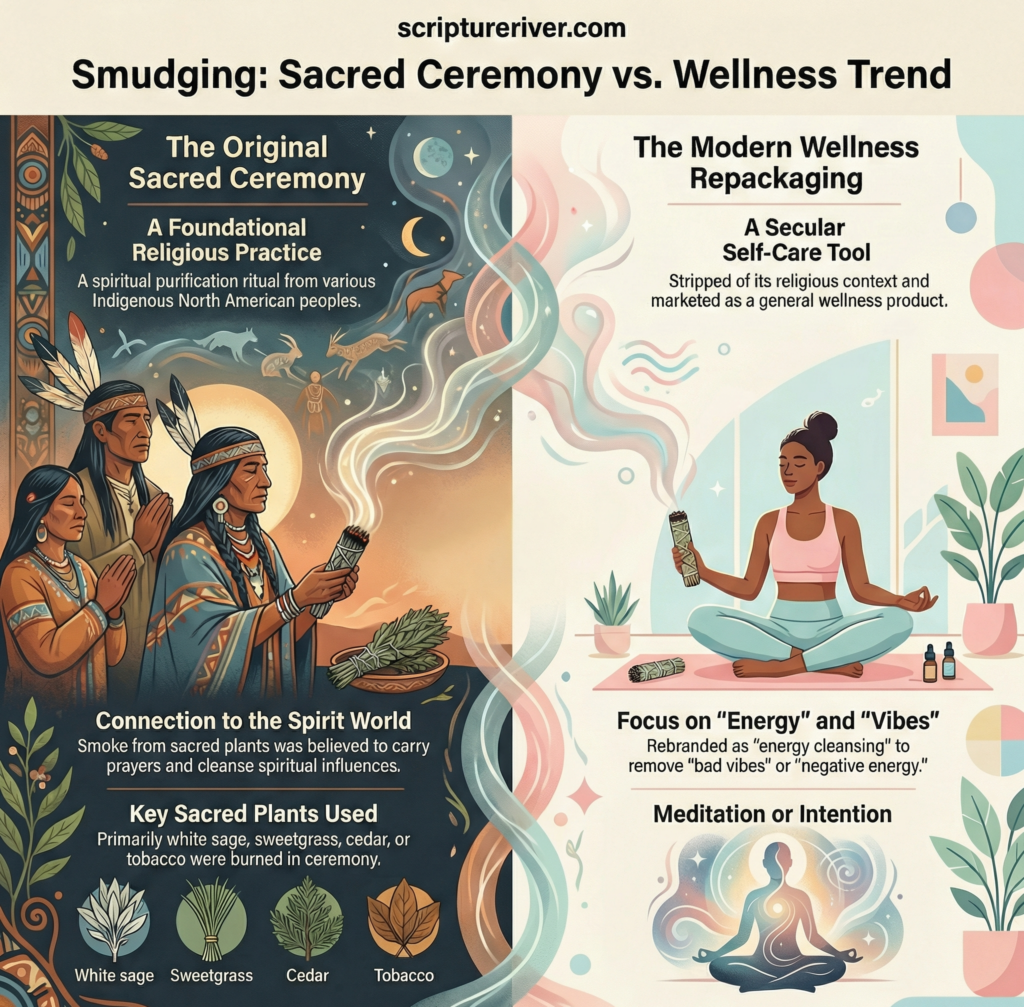
Smudging isn’t incense. It’s ceremony. Understanding this distinction is critical to understanding why Christians can’t simply baptize the practice with good intentions.
The Religious Origins of Smudging
Smudging is a ceremonial practice used by various Indigenous North American peoples, particularly among tribes in the Great Plains and Pacific Northwest regions.
According to anthropologist Joseph Epes Brown’s ethnographic research documented in The Sacred Pipe, smudging was traditionally performed as spiritual purification ritual before prayer, ceremonies, or sacred activities.
The smoke from burning sacred plants, primarily white sage, sweetgrass, cedar, or tobacco, was believed to carry prayers to the spirit world and cleanse spaces of negative spiritual influences.
This wasn’t folklore. This was foundational religious practice.
Scholar Raymond DeMallie’s extensive ethnographic work with Lakota spiritual leaders, published in The Sixth Grandfather, documents that smudging was integral to religious ceremonies involving specific prayers, intentions, and understandings about the spiritual properties of the plants being burned.
The ritual connected practitioners to spiritual forces within their Indigenous cosmology.
How Wellness Culture Has Repackaged It
Contemporary wellness industry has stripped smudging of its explicit religious context and rebranded it as:
Energy cleansing: Removing “negative energy” from spaces or people.
Spiritual purification: Clearing “bad vibes” or spiritual contamination.
Mood enhancement: Creating peaceful or positive atmosphere through smoke.
Manifestation tool: Preparing sacred space for intention-setting or meditation.
This secular rebranding obscures what smudging was designed to accomplish: interaction with the spiritual realm through specific Indigenous religious frameworks. Marketing it as neutral wellness practice doesn’t change its spiritual function. It just makes the spiritual dimension less obvious.
What the Bible Says About Practices from Other Religions

Scripture doesn’t mention smudge sticks by name. The Bible was completed nearly two thousand years before modern wellness culture existed.
But God’s Word provides crystal-clear principles for evaluating any spiritual practice that originates outside biblical faith.
God’s Direct Command Against Adopting Pagan Practices
Deuteronomy 18:9-12, English Standard Version (ESV)
“When you come into the land that the Lord your God is giving you, you shall not learn to follow the abominable practices of those nations. There shall not be found among you anyone who burns his son or his daughter as an offering, anyone who practices divination or tells fortunes or interprets omens, or a sorcerer or a charmer or a medium or a necromancer or one who inquires of the dead, for whoever does these things is an abomination to the Lord.”
This isn’t suggestion. It’s command.
God explicitly forbids His people from learning and adopting the spiritual practices of surrounding nations.
The issue wasn’t cultural difference or ethnic prejudice. It was spiritual allegiance and protection from false spiritual systems.
The practices listed, divination, sorcery, mediumship, and necromancy, were all methods of accessing spiritual power or information through means other than relationship with the one true God.
They connected practitioners to spiritual realities opposed to God’s authority.
Smudging for “spiritual cleansing” or “energy purification” operates on similar principle: accessing spiritual benefit through ritual practice rooted in non-biblical spiritual framework.
The Repeated Warning Against Syncretism
Syncretism is blending elements from different religions into hybrid practice. The Old Testament chronicles Israel’s repeated failures with this.
When Israel incorporated Canaanite religious practices while maintaining worship of Yahweh, God didn’t view it as cultural appreciation or open-mindedness.
He condemned it as spiritual adultery. They couldn’t worship the true God while adopting rituals designed for service to other deities.
According to missiologist Gailyn Van Rheenen’s published research on syncretism in Contextualization and Syncretism: Navigating Cultural Currents, mixing Christian faith with practices from other religious traditions creates theological confusion that progressively undermines biblical Christianity’s distinctiveness and authority.
Paul’s New Testament Warning
1 Corinthians 10:20-21, Christian Standard Bible (CSB)
“No, but I do say that what they sacrifice, they sacrifice to demons and not to God. I do not want you to be participants with demons. You cannot drink the cup of the Lord and the cup of demons. You cannot share in the Lord’s table and the table of demons.”
Paul addresses Christians in Corinth who were participating in pagan religious feasts.
His warning is stark: participating in religious rituals from pagan practices, even if you don’t personally believe in those gods, still connects you spiritually with demonic forces behind those practices.
The Corinthian believers argued the meat sacrificed to idols was just meat.
The idols weren’t real gods anyway. Why not participate in the community meals?
Paul’s response demolishes that reasoning.
The issue isn’t whether the idols are real. The issue is whether the worship directed toward them connects practitioners with actual spiritual forces opposed to God. It does.
The same principle applies to smudging.
The question isn’t whether you believe white sage has inherent spiritual power.
The question is whether participating in a ritual designed to access spiritual cleansing through non-biblical means connects you with spiritual realities you shouldn’t be engaging with.
Why “But I Don’t Believe in It” Doesn’t Matter
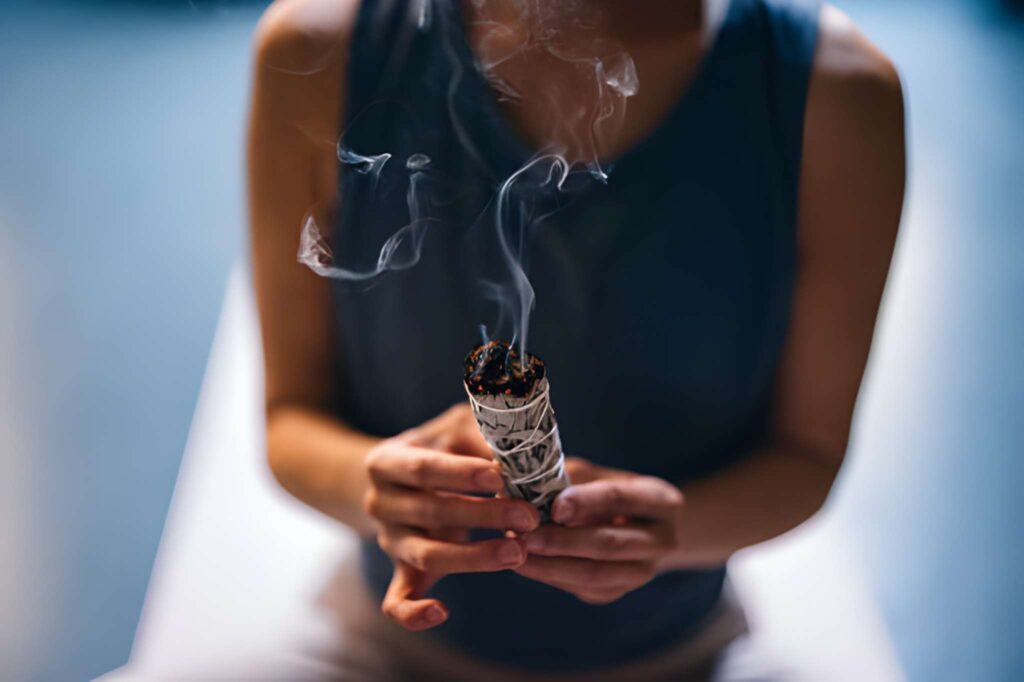
This is the most common objection Christians raise when confronted with problems in practices like smudging: “I don’t actually believe in the spiritual claims. I’m just burning herbs. My intentions are Christian.”
This reasoning has fatal flaws that Scripture directly addresses.
Practices Carry Spiritual Heritage Regardless of Your Beliefs
Theologian Clinton Arnold’s extensive research on spiritual warfare in the Ephesian context, published in Ephesians: Power and Magic, demonstrates that objects and practices used in pagan worship retained spiritual associations even when people claimed not to believe in the deities those practices served.
When Ephesian believers converted to Christianity, they didn’t keep their magic books and repurpose them for “positive Christian uses.” They burned them publicly despite their enormous financial value (Acts 19:19).
Why?
They recognized that objects and practices tied to occult spiritual systems couldn’t be Christianized through good intentions.
The spiritual associations remained regardless of what the new user believed about them.
You Can’t Strip Spiritual Rituals of Religious Meaning
Burning sage as culinary herb or simple incense for pleasant aroma is botanically and spiritually neutral.
Bundling white sage specifically for “cleansing negative energy,” “purifying space,” or “removing bad vibes” retains the exact spiritual framework the practice was designed to accomplish.
You’re not creating new practice.
You’re participating in existing religious ritual while claiming it means something different to you.
According to religious studies scholar Suzanne Owen’s published work on appropriation of Indigenous spiritual practices, attempting to divorce smudging from its religious context while maintaining its purported spiritual functions is both culturally disrespectful to Indigenous peoples and theologically problematic for Christians.
The Weaker Brother Principle Applies
Romans 14:13, 21, New International Version (NIV)
“Therefore let us stop passing judgment on one another. Instead, make up your mind not to put any stumbling block or obstacle in the way of a brother or sister… It is better not to eat meat or drink wine or to do anything else that will cause your brother or sister to fall.”
Even if you personally see no spiritual danger in smudge sticks, using them creates several problems:
It confuses other believers about what’s biblically acceptable.
It provides justification for Christians to explore other practices from non-Christian spiritual traditions.
It models syncretism that weaker believers might imitate in more spiritually dangerous ways.
Your freedom to do something doesn’t make it wise when it creates stumbling blocks for others.
Why The Incense Argument Doesn’t Hold
Some Christians defend smudging by pointing to biblical incense use. This comparison collapses under examination.
Biblical Incense Was Fundamentally Different
God specifically commanded incense in tabernacle and temple worship with precise formula that couldn’t be duplicated for common use (Exodus 30:34-38).
Unauthorized incense formulas were forbidden. Unauthorized use of proper incense resulted in death (Leviticus 10:1-2).
Biblical incense was offered directly to the God of Israel as worship.
It wasn’t used for “cleansing energy,” “removing negativity,” or interacting with spiritual forces. It was symbolic offering to God accompanying prayer and sacrifice.
The Bible never describes incense as having inherent spiritual power to purify spaces or people. Its purpose was worship directed toward God, not spiritual manipulation of environment.
Smudging Assumes Different Spiritual Framework
Smudging as practiced traditionally and as marketed currently assumes:
Spiritual energy exists independently of God that can be negative or positive and requires cleansing.
Plants have inherent spiritual properties that affect this energy.
Ritual smoke accesses spiritual realm to accomplish purification.
Spaces and objects can be spiritually contaminated in ways requiring non-biblical cleansing methods.
These assumptions don’t align with biblical cosmology. Christians believe God is sovereign over all spiritual reality. We access spiritual cleansing through Christ’s blood, confession of sin, and prayer in Jesus’s name. We don’t manipulate spiritual forces through rituals.
The Cultural Appropriation Dimension
Beyond biblical objections, Christians should consider the ethical problem of appropriating Indigenous sacred practices.
Why Indigenous Peoples Object to Commercial Smudging
Native American activists and spiritual leaders have consistently and vocally opposed commercial smudging and mass-market sale of white sage.
This isn’t about gatekeeping or excluding people. It’s about protecting sacred practices from exploitation and misuse.
Organizations including the Navajo Nation and various Lakota spiritual leaders have issued public statements, documented by Indigenous rights advocates, explaining that commercializing sacred practices disrespects their religious significance and reduces meaningful ceremonial ritual to consumer wellness product.
When non-Indigenous people, including Christians, purchase mass-produced smudge sticks and use them for purposes disconnected from their ceremonial context, we participate in cultural appropriation that harms marginalized communities.
Biblical Call to Honor All People
1 Peter 2:12, English Standard Version (ESV)
“Keep your conduct among the Gentiles honorable, so that when they speak against you as evildoers, they may see your good deeds and glorify God on the day of visitation.”
Christians are called to conduct themselves honorably toward all people. Appropriating sacred practices from communities that have experienced systematic oppression and marginalization doesn’t reflect Christ-like respect, humility, or love.
We can disagree with theological frameworks of other religions while still respecting those religions’ sacred practices enough not to commodify and appropriate them.
What Christians Should Do Instead
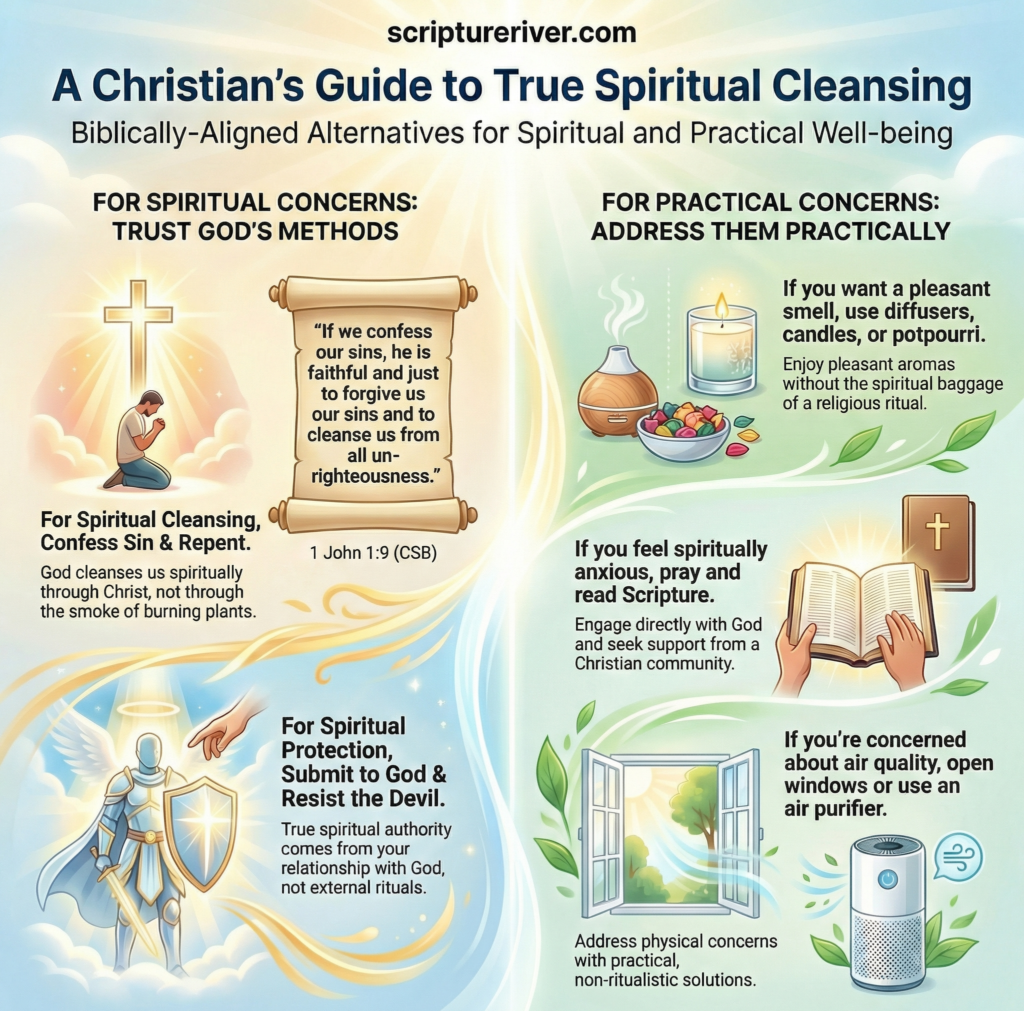
If you’re drawn to smudging for benefits it promises, here’s what aligns with biblical Christianity.
Trust God’s Actual Methods for Spiritual Cleansing
1 John 1:9, Christian Standard Bible (CSB)
“If we confess our sins, he is faithful and just to forgive us our sins and to cleanse us from all unrighteousness.”
God cleanses spiritually through Christ’s blood applied by faith, not through smoke from burning plants. If you sense spiritual oppression, contamination, or attack, the biblical response is confession of sin, repentance, and prayer in Jesus’s name.
James 4:7, New King James Version (NKJV)
“Therefore submit to God. Resist the devil and he will flee from you.”
Spiritual authority over demonic forces comes through submission to God and resistance in Jesus’s name. Not through rituals borrowed from other religions.
Address Practical Concerns Practically
If you want pleasant-smelling home, use candles, essential oil diffusers, or potpourri without the spiritual baggage of ritual designed for religious purposes.
If you’re concerned about indoor air quality, open windows, use air purifiers, and clean regularly.
If you’re feeling spiritually oppressed or anxious, pray. Read Scripture. Confess sin. Seek Christian community and accountability.
Recognize the Spiritual Authority Christians Already Have
Luke 10:19, English Standard Version (ESV)
“Behold, I have given you authority to tread on serpents and scorpions, and over all the power of the enemy, and nothing shall hurt you.”
Christians have authority over demonic forces through Christ. You don’t need rituals from other religions to protect or purify your space. Prayer in Jesus’s name, Scripture spoken aloud, and walking in obedience to God provide all the spiritual protection and cleansing you need.
Be Discerning About Wellness Culture
Not everything marketed as “wellness” is spiritually neutral.
Many contemporary wellness practices are rooted in Eastern religions (yoga, reiki, chakra work) or Indigenous spiritualities (smudging, crystal healing) that retain their spiritual frameworks even when repackaged with secular language.
Christians need discernment to recognize when practices presented as science-based self-care are actually spiritual practices from religious traditions incompatible with biblical faith.
Frequently Asked Questions
What if I already have smudge sticks in my home?
Dispose of them. Don’t keep them “just for the smell.” If you purchased them from Indigenous artisans, recognize you inadvertently participated in cultural appropriation of sacred practice. If bought from commercial retailers, recognize you engaged with practice rooted in spiritual tradition incompatible with Christianity. Get rid of them and use biblically appropriate means for whatever needs drove you to smudging.
Are all uses of sage wrong for Christians?
No. Using sage as culinary herb in cooking is fine. Burning sage or other herbs as simple incense for pleasant aroma without any spiritual intent or framework is acceptable. The problem is smudging as spiritual practice designed to cleanse energy or purify spaces through means other than biblical prayer and God’s authority.
What about other spiritual practices from non-Christian religions?
Evaluate each practice by asking: What was this designed to accomplish spiritually? What spiritual framework does it assume? What religious tradition does it come from? Can I participate without compromising biblical faith or appropriating another culture’s sacred practices? When answers reveal incompatibility with Christianity, abstain regardless of how popular or beneficial the practice claims to be.
Is this being overly strict or legalistic?
No. Avoiding spiritual practices from other religions isn’t adding human rules to Scripture. It’s applying Scripture’s actual commands against syncretism and adopting pagan practices. Legalism adds requirements God didn’t give. This obeys requirements God did give. There’s significant difference between the two.
What if my Christian friend uses smudge sticks and sees no problem?
Approach with grace, humility, and facts. Share what you’ve learned about smudging’s origins, spiritual purposes, and biblical concerns. Provide this information gently without creating division. Recognize believers have different levels of knowledge and maturity. Don’t judge their relationship with God based on this issue, but don’t compromise your own biblical convictions to maintain false peace.
Can I participate when someone else smudges their home?
No. Just as Daniel refused food sacrificed to idols even when it offended his hosts (Daniel 1:8), Christians should politely decline participating in spiritual practices from other religions even when it creates social awkwardness. You can respectfully explain your beliefs without condemning theirs.
Prayer for Discernment and Wisdom
Father, thank You for Your Word that provides wisdom for navigating spiritual questions. Give me discernment to recognize when practices marketed as neutral wellness are actually rooted in spiritual traditions opposed to You. Forgive me for times I’ve adopted practices without examining their origins or spiritual implications. Help me trust that Your methods for spiritual cleansing, protection, and blessing are sufficient. I don’t need rituals from other religions when I have relationship with You through Christ. Protect me from deception that comes through attractive packaging of spiritually dangerous practices. Give me courage to reject what’s popular when it conflicts with what’s biblical. Help me treat all people, including those whose sacred practices I cannot adopt, with genuine respect and Christ-like love. Guard my heart from both spiritual compromise and religious pride. Make me wise, discerning, and humble. In Jesus’s Name, Amen.
Research Sources
Arnold, C. E. (1989). Ephesians: Power and Magic. Cambridge University Press. [Theological Study]
Brown, J. E. (1989). The Sacred Pipe: Black Elk’s Account of the Seven Rites of the Oglala Sioux. University of Oklahoma Press. [Anthropological Study]
DeMallie, R. J. (Ed.). (1984). The Sixth Grandfather: Black Elk’s Teachings Given to John G. Neihardt. University of Nebraska Press. [Ethnographic Study]
Peterson, E. H. (2005). The Message: The Bible in Contemporary Language. NavPress. [Bible Translation]
Strong, J. (2010). Strong’s Exhaustive Concordance of the Bible. Hendrickson Publishers. [Reference Book]
Van Rheenen, G. (2006). “Syncretism and Contextualization: The Church on a Journey Defining Itself.” In Contextualization and Syncretism: Navigating Cultural Currents (pp. 1-30). Evangelical Missiological Society. [Theological Article]

