

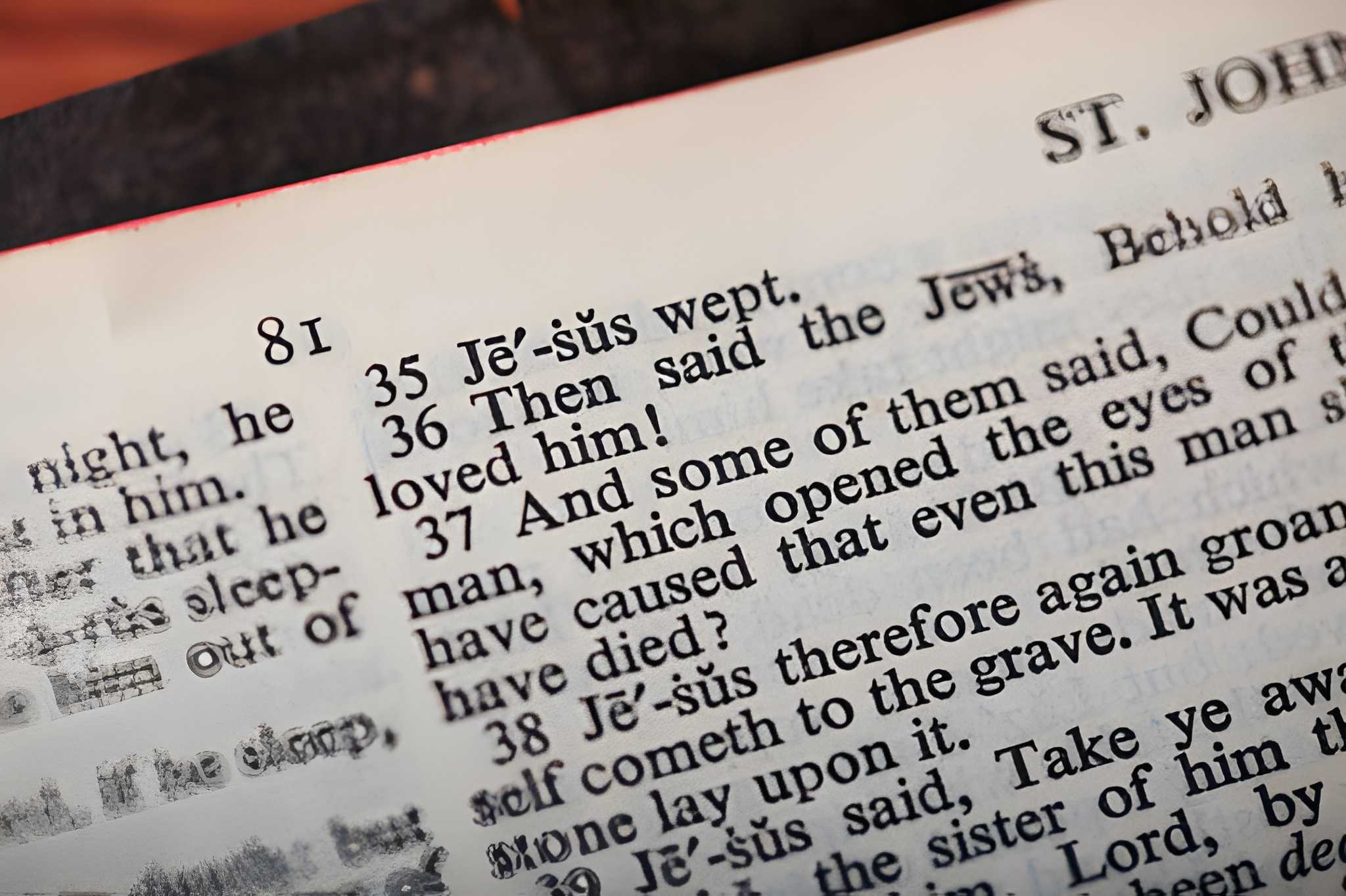
John 11:35, the precise bible verse with two words that shatter every theological assumption you’ve made about God’s emotional life.
John 11:35, English Standard Version (ESV)
“Jesus wept.”
The shortest verse in Scripture carries weight that entire chapters struggle to match.
God incarnate, standing at the tomb of His friend Lazarus, cried.
Not a single tear slides down His cheek in a cinematic slow motion. The Greek word suggests loud, convulsive sobbing that shook His body.
This matters more than you realize.
Your theology of suffering hinges on whether God feels or merely observes human pain.
Your prayers during grief depend on whether you believe God understands from experience or just comprehends intellectually.
Your trust in God’s compassion rests on whether His comfort comes from someone who’s wept or someone who’s only watched others weep.
The context surrounding these two words reveals why Jesus wept, what His tears teach about God’s character, and how His weeping changes everything about how you approach Him in your own grief.
The Scene Before the Tears
1. Lazarus Dies While Jesus Delays
“Now a man was sick, Lazarus, from Bethany, the village of Mary and her sister Martha. Mary was the one who anointed the Lord with perfume and wiped his feet with her hair, and it was her brother Lazarus who was sick. So the sisters sent a message to him: ‘Lord, the one you love is sick.’ When Jesus heard it, he said, ‘This sickness will not end in death but is for the glory of God, so that the Son of God may be glorified through it.’ Now Jesus loved Martha, her sister, and Lazarus. So when he heard that he was sick, he stayed two more days in the place where he was.”
John 11:1-6, Christian Standard Bible (CSB)
Jesus loved Lazarus. Scripture explicitly states this.
Yet when He received word that His friend was dying, He stayed where He was for two more days. Deliberately. Intentionally. Knowing Lazarus would die before He arrived.
This delay was calculated (You’ll see why at the Frequently Asked Questions section of this post).
Jesus knew what He planned to do. But His friends didn’t know. They watched Lazarus die, thinking Jesus didn’t come in time.
2. Martha’s Accusation and Faith
“‘Lord,’ Martha said to Jesus, ‘if you had been here, my brother would not have died. But I know that even now God will give you whatever you ask.’ Jesus said to her, ‘Your brother will rise again.’ Martha answered, ‘I know he will rise again in the resurrection at the last day.’ Jesus said to her, ‘I am the resurrection and the life. The one who believes in me will live, even though they die; and whoever lives by believing in me will never die. Do you believe this?’ ‘Yes, Lord,’ she replied, ‘I believe that you are the Messiah, the Son of God, who is to come into the world.'”
John 11:21-27, New International Version (NIV)
Martha’s first words to Jesus carry both accusation and faith. “If you had been here” implies His absence caused Lazarus’s death.
Yet she immediately adds “even now God will give you whatever you ask,” suggesting hope beyond death.
3. Mary’s Grief and the Mourners
“Then the Jews who were with her in the house, and comforting her, when they saw that Mary rose up quickly and went out, followed her, saying, ‘She is going to the tomb to weep there.’ Then, when Mary came where Jesus was, and saw Him, she fell down at His feet, saying to Him, ‘Lord, if You had been here, my brother would not have died.’ Therefore, when Jesus saw her weeping, and the Jews who came with her weeping, He groaned in the spirit and was troubled.”
John 11:31-33, New King James Version (NKJV)
Mary collapses at Jesus’s feet with the same words Martha spoke.
The mourners weep loudly around her. The scene is raw grief, uncontained emotion, devastating loss.
Jesus’s response? He “groaned in the spirit and was troubled.”
The Greek word for “groaned” (embrimaomai) suggests intense emotion, possibly including anger or deep disturbance. Something about this scene profoundly moved Him.
The Moment Jesus Wept
“And he said, ‘Where have you laid him?’ They said to him, ‘Lord, come and see.’ Jesus wept.”
John 11:34-35, English Standard Version (ESV)
Between asking where they’d laid Lazarus and actually weeping, Scripture records no explanation. It simply states the fact: Jesus wept.
The Greek word (dakryo) means to shed tears, to weep.
Unlike the loud wailing of the mourners (klaio), Jesus’s tears seem more controlled but no less genuine. He wasn’t performing grief. He experienced it.
What Observers Thought
“So the Jews said, ‘See how he loved him!’ But some of them said, ‘Couldn’t he who opened the blind man’s eyes also have kept this man from dying?'”
John 11:36-37, Christian Standard Bible (CSB)
The crowd interpreted Jesus’s tears two ways. Some saw love. Some saw failure. “If He loved Lazarus and had power to heal, why didn’t He prevent this death?”
Their question reveals misunderstanding of both Jesus’s power and His purposes.
They assumed His tears meant He couldn’t save Lazarus. They didn’t know He was about to raise him.
Why Jesus Wept: Five Possible Reasons
1. Compassion for His Friends’ Pain
Jesus wept with those who wept.
Even knowing He would raise Lazarus minutes later, He entered fully into His friends’ grief. Their pain moved Him to tears.
This reveals God’s compassionate response to human suffering.
He doesn’t stand distant from your pain. He enters it. He feels it. He weeps with you even when He knows the ending you don’t.
2. Grief Over Death’s Devastation
Though Jesus would reverse this particular death, death itself remained humanity’s enemy.
Perhaps Jesus wept at death’s cruel destruction of relationships, its violation of God’s original design, its temporary victory over bodies meant for eternity.
Death wasn’t supposed to exist. It entered through sin as intruder into God’s good creation.
Every death, even one Jesus planned to reverse, demonstrated sin’s devastating consequences.
3. Anger at Sin and Death
Some interpret the “groaning” and “troubled” language as indicating anger.
Jesus might have wept with holy rage at what sin and death had done to people He loved. His tears could have contained both sorrow and fury at the enemy He came to defeat.
4. Empathetic Human Experience
Jesus was fully God and fully human. As human, He experienced genuine human emotion.
He wasn’t acting divine while pretending to be human. He actually felt what humans feel when loved ones die.
This validates human grief as appropriate response to death.
If Jesus wept, you’re not weak for weeping. If Jesus felt deep emotion at loss, you’re not unspiritual for feeling devastated.
5. Knowledge of His Own Coming Death
Some scholars suggest Jesus wept knowing this wasn’t the only tomb He’d visit. His own burial awaited.
Perhaps Lazarus’s tomb foreshadowed His own grave, and grief for His friend mingled with anticipation of His own suffering.
What Jesus’s Tears Teach About God
God Experiences Genuine Emotion
The incarnation wasn’t just God wearing human body like costume. Jesus’s human experience was authentic. His tears prove God genuinely feels, not just observes, human suffering.
God Isn’t Emotionally Distant
You don’t pray to God who’s indifferent to your pain. You pray to God who’s wept. Who’s experienced grief, loss, betrayal, physical pain, and death itself. He understands not theoretically but experientially.
Grief Doesn’t Contradict Faith
Jesus knew Lazarus would rise minutes later. He still wept. Knowing God’s plan doesn’t eliminate appropriate grief over present pain. You can trust God’s purposes while honestly feeling loss.
God Enters Your Suffering
Jesus could have remained emotionally detached, knowing the happy ending. He didn’t. He entered the grief fully. When you suffer, God doesn’t watch from distance. He enters your suffering with you.
Tears Don’t Indicate Weakness
If Jesus, the perfectly strong Son of God, wept publicly, tears aren’t weakness. They’re appropriate human response to loss that honors relationships and acknowledges pain honestly.
How This Changes Your Relationship With God
You Can Bring Honest Grief to God
Don’t sanitize your prayers. Don’t pretend you’re fine when you’re devastated. God who wept understands tears. He welcomes yours.
You Don’t Have to Explain Your Emotions
Jesus didn’t justify His tears or apologize for them. He wept. You can too without feeling you need to defend or explain your emotional responses to loss.
God’s Silence Doesn’t Mean Indifference
Jesus delayed coming to Lazarus deliberately. His delay looked like indifference. It wasn’t. When God seems absent during your crisis, His purposes are still good even when His timing is confusing.
Resurrection Hope Doesn’t Eliminate Present Grief
Christians grieve with hope, not without grief. Jesus demonstrated this. You can believe in resurrection while honestly mourning death. Hope and grief coexist.
God’s Plan Includes Your Pain
Jesus’s plan included Lazarus dying and His friends grieving. God’s good purposes sometimes include painful processes. Your suffering isn’t outside His plan or evidence His plan has failed.
Frequently Asked Questions
Why did Jesus wait four days before coming to Lazarus?
Jesus waited deliberately so that Lazarus would be unmistakably dead, beyond any possibility of natural recovery or resuscitation.
By the time Jesus arrived, Lazarus had been in the tomb four days. Jewish belief held that the soul lingered near the body for three days, hoping to return, but by the fourth day, decomposition made death irreversible.
Martha even protested, “There will be a stench” (John 11:39). Jesus waited until the situation was humanly hopeless so the resurrection would be undeniably miraculous, not explainable as a medical recovery. This demonstrated His power over death itself, not just illness.
The miracle’s purpose, stated in John 11:4, was “for the glory of God, so that the Son of God may be glorified through it.” The four-day delay also foreshadowed Jesus’s own resurrection: just as Lazarus was raised after days in the tomb, Jesus would rise on the third day.
The delay wasn’t cruelty or indifference but a strategic demonstration of resurrection power that would strengthen His disciples’ faith for His own approaching death.
Why did Jesus weep if He knew He’d raise Lazarus?
His foreknowledge didn’t eliminate the reality of death’s pain or His friends’ grief. He entered their suffering genuinely despite knowing its temporary nature. This teaches that legitimate grief doesn’t require uncertainty about outcomes.
Does this mean Jesus cried often?
Scripture records few instances of Jesus weeping. This one is explicit. Luke 19:41 mentions Him weeping over Jerusalem. Hebrews 5:7 references prayers “with loud cries and tears” in Gethsemane. But these recorded instances don’t constitute complete record of His emotional life.
Was Jesus angry or just sad?
Possibly both. The “groaning” and “troubled” language suggests complex emotion that might have included righteous anger at sin and death alongside grief for His friends. Multiple emotions can coexist.
How does this relate to Jesus in heaven now?
Jesus remains fully God and fully human eternally. His glorified body retains human nature. Whether He experiences emotion identically now is debated, but His incarnation permanently united divine and human natures in His person.
Should Christians avoid crying since we have resurrection hope?
No. Jesus demonstrated that hope doesn’t eliminate appropriate grief. Paul commands believers to “weep with those who weep” (Romans 12:15). Resurrection hope transforms grief, but doesn’t eliminate it.
What about when the Bible says God doesn’t change?
God’s character, promises, and purposes don’t change. This doesn’t mean God lacks emotions or emotional responses. His faithfulness is unchanging. His capacity for emotion, demonstrated in Christ, is real.
Say This Prayer
Jesus, You wept at Your friend’s tomb. You entered human grief fully. You experienced loss deeply. Thank You that my tears don’t confuse You or disappoint You. When I’m grieving, help me remember You’ve wept too. When I feel weak for crying, remind me You cried. When suffering seems to separate me from You, show me You’re closer in pain than in comfort. Give me permission to grieve honestly while trusting Your purposes. Help me weep with hope, knowing You understand from experience and promise resurrection beyond every grave. In Your Name, Amen.
Resources
Brown, R. E. (1966). The Gospel According to John I-XII. Doubleday. [Biblical Commentary]
Carson, D. A. (1991). The Gospel According to John. Eerdmans Publishing Company. [Biblical Commentary]
Köstenberger, A. J. (2004). John. Baker Academic. [Biblical Commentary]
Peterson, E. H. (2005). The Message: The Bible in Contemporary Language. NavPress. [Bible Translation]
Strong, J. (2010). Strong’s Exhaustive Concordance of the Bible. Hendrickson Publishers. [Reference Book]

