


I’ll never forget the moment I first saw the Serenity Prayer hanging on a coffee shop wall, beautifully framed with rustic lettering.
It felt deeply spiritual, profoundly Christian, and unmistakably biblical.
Except it wasn’t in the Bible at all.
That discovery sent me down a research path that completely changed how I understood the relationship between Christian wisdom and biblical authority.
As someone who’s spent long years teaching believers to build their faith on Scripture, I needed to know:
Is the Serenity Prayer biblical?
Should Christians pray it?
And what does it actually mean?
Today, we’re going to explore the fascinating history of this prayer, examine its theology verse by verse against Scripture, and answer the question every Christian asks:
Can I pray this in good conscience?
Whether you’ve been praying it for years or you’re hearing about it for the first time, you’ll walk away with a clear understanding of where this prayer came from, what it really says, and whether it aligns with biblical Christianity.
Prefer To Listen??
If you prefer to listen, I’ve provided an audio overview of this post.
Press play below to hear a summary of the key insights we addressed about the Serenity Prayer’s origins, meaning, and biblical alignment.
You can listen while on your morning walk, or whenever sitting down to read feels impossible.
The full written content with detailed analysis and Scripture comparisons follows below.
What Exactly Is the Serenity Prayer?

Before we can determine if it’s biblical, we need to know what it actually says.
Most people only know the short version of the Serenity Prayer, which goes like this:
“God, grant me the serenity to accept the things I cannot change, courage to change the things I can, and wisdom to know the difference.”
That’s the version you’ll see on greeting cards, recovery meeting walls, and social media graphics.
It’s beautiful, concise, and deeply resonating. But that’s only the beginning.
The full Serenity Prayer is significantly longer and more theologically robust:
“God, grant me the serenity to accept the things I cannot change, courage to change the things I can, and wisdom to know the difference. Living one day at a time, enjoying one moment at a time, accepting hardship as a pathway to peace, taking, as Jesus did, this sinful world as it is, not as I would have it, trusting that You will make all things right if I surrender to Your will, so that I may be reasonably happy in this life and supremely happy with You forever in the next. Amen.”
I’ve counseled believers for over a decade, and I can tell you that fewer than five percent know this complete version exists.
Most are genuinely shocked when they hear it for the first time.
The full prayer is explicitly Christian, references Jesus directly, speaks of surrender to God’s will, and looks forward to eternal happiness with God.
The abbreviated version that became famous is spiritually generic enough to be embraced by virtually any religion or even secular self-help movements.
That difference matters tremendously when we’re evaluating whether it’s biblical.
The Surprising History Behind the Serenity Prayer
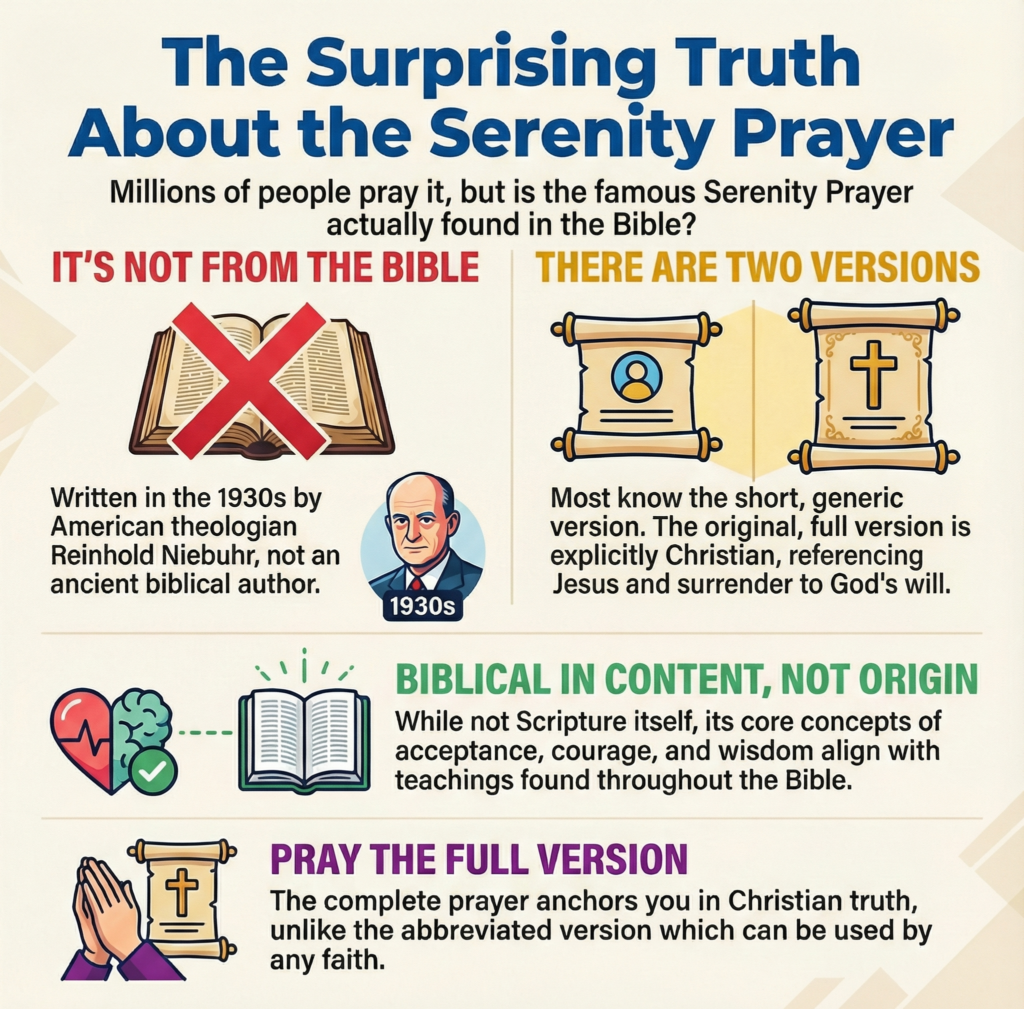
Here’s where things get interesting.
The Serenity Prayer wasn’t written by an ancient church father, a medieval mystic, or even a Reformation leader.
It was written in the early 1930s or 1940s by an American theologian named Reinhold Niebuhr.
Niebuhr was a Protestant theologian, pastor, and professor at Union Theological Seminary in New York.
He was deeply engaged with both Christian orthodoxy and the social issues of his time, including war, poverty, and human limitation.
The prayer first appeared in a 1943 sermon Niebuhr preached, though he later said he may have used it earlier.
After his death, his daughter confirmed he composed it, likely around 1932 to 1933, though the exact date remains somewhat disputed.
Now here’s what captured my attention when I first researched this: Niebuhr himself never claimed the prayer came from Scripture.
He wrote it as a pastoral prayer expressing Christian wisdom about navigating life’s challenges.
It was his original composition, influenced by his theological training and biblical understanding, but not a direct quotation or paraphrase of Scripture.
So how did it become so widespread?
In 1942, a friend of Niebuhr’s shared the prayer with a military chaplain, who distributed it to soldiers during World War II.
Those soldiers brought it home.
Then Alcoholics Anonymous adopted it in 1941 as a centering prayer for their recovery meetings.
From there, it exploded into mainstream American culture.
By the 1950s and 1960s, the Serenity Prayer had become so ubiquitous that many Christians genuinely believed it was from the Bible.
I’ve had older believers argue with me that it’s in Proverbs or the Psalms. It’s not.
Understanding this history is crucial because it shapes how we evaluate the prayer’s authority and use.
Breaking Down the Serenity Prayer Theologically
Let’s examine each phrase of the full prayer and compare it to biblical teaching.
This is where we move beyond history to theology, beyond origin to orthodoxy.
“God, grant me the serenity to accept the things I cannot change”
This opening line addresses one of humanity’s most fundamental struggles: the inability to control circumstances.
The concept of accepting what we cannot change has deep biblical roots.
Ecclesiastes 3:1 says there is “a time for everything, and a season for every activity under the heavens.”
Solomon recognized that certain things operate beyond human control, according to God’s sovereign timing.
Jesus taught this principle explicitly in Matthew 6:27: “Can any one of you by worrying add a single hour to your life?”
He was addressing the futility of trying to control what only God controls.
The word “serenity” isn’t explicitly biblical, but the concept maps onto biblical peace, which is “eirene” in Greek.
This isn’t just the absence of conflict but the presence of wholeness, even amid chaos.
Philippians 4:6-7 instructs believers not to be anxious about anything but to bring everything to God in prayer, promising that His peace will guard hearts and minds.
That’s serenity, the inner tranquility that comes from trusting God with what you cannot control.
From pastoral experience, I’ve watched countless believers torture themselves trying to change family members, fix broken systems, or reverse irreversible losses.
This first line of the prayer addresses that torment directly and biblically.
“Courage to change the things I can”
This phrase balances the first. It’s not passive resignation to everything but active engagement where God has given you agency.
The Bible is filled with calls to courageous action.
Joshua 1:9 commands, “Be strong and courageous. Do not be afraid; do not be discouraged, for the Lord your God will be with you wherever you go.”
Paul tells Timothy in 2 Timothy 1:7, “For God has not given us a spirit of fear, but of power and of love and of a sound mind.” Courage to act according to God’s will is a biblical virtue.
James 2:17 goes further: “Faith by itself, if it is not accompanied by action, is dead.” Biblical faith isn’t fatalism. It’s trust in God that produces obedient action in areas where God has called you to move.
I’ve counseled believers on both extremes.
Some try to control everything and burn out from the effort.
Others surrender to helplessness and abdicate responsibility God actually gave them.
This second line addresses the latter, calling believers to courage where courage is needed.
“And wisdom to know the difference”
This might be the most crucial line in the entire prayer because it acknowledges that discerning between what you can and cannot change requires divine wisdom.
James 1:5 promises, “If any of you lacks wisdom, you should ask God, who gives generously to all without finding fault, and it will be given to you.”
This is precisely what the Serenity Prayer is doing, asking God for wisdom to discern.
Proverbs 3:5-6 instructs believers to trust in the Lord with all their heart and not lean on their own understanding, promising that God will make paths straight.
Human judgment about what’s changeable versus unchangeable is often wrong. We need divine perspective.
I’ve made terrible decisions when I didn’t pray for wisdom first.
I’ve tried changing things God never asked me to change while neglecting things He was specifically calling me to address.
This line keeps me dependent on God’s discernment, not my assumptions.
“Living one day at a time”
Jesus taught this explicitly in Matthew 6:34: “Therefore do not worry about tomorrow, for tomorrow will worry about itself. Each day has enough trouble of its own.”
The principle of daily dependence on God runs throughout Scripture. The Israelites received manna daily in the wilderness, unable to hoard for tomorrow. God was teaching them to trust Him one day at a time.
Lamentations 3:22-23 declares that God’s mercies are “new every morning.” Not monthly or annually, but daily. God’s provision is designed to keep us returning to Him continually.
This phrase counters our culture’s obsession with five-year plans and total control of the future. Biblical faith operates in the present tense, trusting God moment by moment.
“Enjoying one moment at a time”
This line might seem less obviously biblical, but it reflects Ecclesiastes’ repeated instruction to enjoy life as God’s gift.
Ecclesiastes 5:18 says, “This is what I have observed to be good: that it is appropriate for a person to eat, to drink and to find satisfaction in their toilsome labor under the sun during the few days of life God has given them, for this is their lot.”
Paul instructs in 1 Thessalonians 5:16 to “rejoice always.”
Not rejoice when everything’s perfect, but rejoice always, in every moment, because of who God is regardless of circumstances.
Jesus promised abundant life in John 10:10. Not just future eternal life but present abundant life.
Enjoying moments doesn’t mean denying hardship. It means recognizing God’s goodness even within difficulty.
“Accepting hardship as a pathway to peace”
This is profoundly biblical and reflects New Testament teaching that suffering produces spiritual growth.
James 1:2-4 instructs believers to “consider it pure joy” when facing trials because testing produces perseverance, which leads to maturity and completeness.
Hardship isn’t random punishment but purposeful refinement.
Romans 5:3-5 says suffering produces perseverance, perseverance produces character, and character produces hope. Paul saw hardship as a pathway, not a dead end.
Peter writes in 1 Peter 5:10 that after suffering “a little while,” God will Himself restore, confirm, strengthen, and establish believers. The pathway through hardship leads to greater peace and stability.
I learned this truth the hard way during a season of ministry crisis.
The hardship I desperately wanted God to remove became the exact pathway through which He brought me deeper peace than I’d ever known.
This line of the prayer captures that paradox beautifully.
“Taking, as Jesus did, this sinful world as it is, not as I would have it”
This phrase references Jesus’s incarnation and earthly ministry.
He entered a fallen, broken, sinful world and engaged it without demanding it be sanitized first.
Jesus ate with tax collectors and sinners, touching lepers and speaking with Samaritans.
He didn’t wait for the world to become righteous before engaging it. He met people where they were.
Philippians 2:5-8 describes Jesus’s mindset, how He humbled Himself and took on human nature, even to the point of death.
He accepted reality as it was, not as ideal theology would have it.
Yet Jesus also worked to transform that reality through His teaching, healing, and ultimately His death and resurrection.
This line balances acceptance of reality with active engagement to bring God’s kingdom into broken spaces.
“Trusting that You will make all things right if I surrender to Your will”
This speaks to both God’s sovereignty and human surrender.
Romans 8:28 promises that God works all things together for good for those who love Him and are called according to His purpose. Even things that are currently wrong will ultimately serve God’s redemptive plan.
Revelation 21:5 declares that God is “making everything new.” Not leaving everything broken but actively working toward complete restoration.
The condition “if I surrender to Your will” reflects Jesus’s prayer in Gethsemane: “Not my will, but yours be done” (Luke 22:42). Surrender to God’s will isn’t passive resignation but active trust.
I’ve wrestled with this line personally because surrender feels like losing control. But I’ve discovered that surrendering to God’s will is the only way to access His power to actually make things right.
“So that I may be reasonably happy in this life and supremely happy with You forever in the next”
This closing frames Christian hope with both present and future dimensions.
Jesus promised in John 16:33, “In this world you will have trouble. But take heart! I have overcome the world.” He was honest about earthly difficulty while promising ultimate victory.
“Reasonably happy” is refreshingly honest. It’s not prosperity gospel promising perfect earthly life. It’s biblical realism acknowledging that joy coexists with hardship in this age.
The phrase “supremely happy with You forever” reflects 1 Corinthians 2:9: “What no eye has seen, what no ear has heard, and what no mind has conceived, the things God has prepared for those who love him.”
Revelation 21:4 promises God will wipe away every tear, and there will be no more death, mourning, crying, or pain. That’s supreme happiness, joy without limitation or end.
Is the Serenity Prayer Biblical? The Verdict
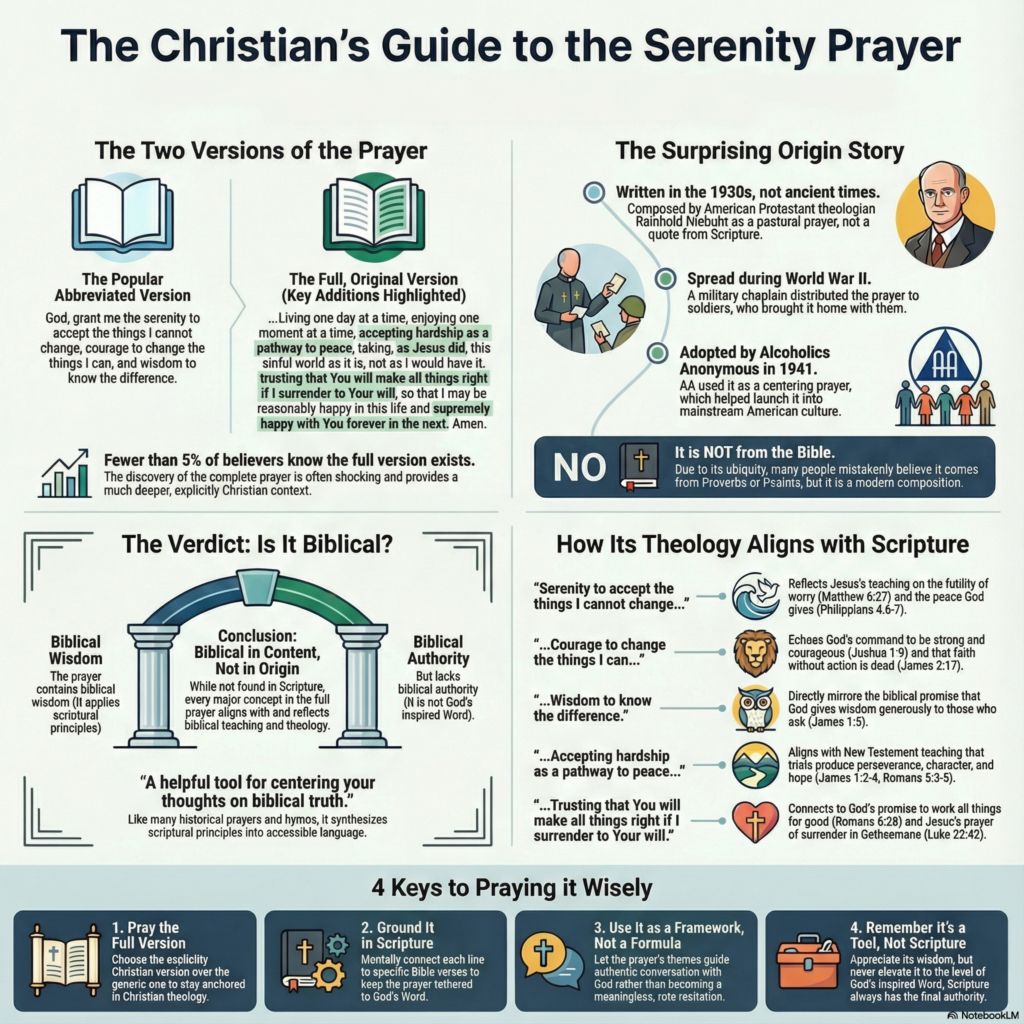
After examining every phrase against Scripture, here’s my conclusion as both a theologian and pastor: The Serenity Prayer is not biblical in origin, but it is biblical in content.
Let me explain the distinction because it matters for how Christians should approach this prayer.
The prayer doesn’t appear in Scripture.
Reinhold Niebuhr wrote it in the 20th century, not Moses, David, Paul, or any biblical author.
It’s not inspired Scripture and doesn’t carry biblical authority.
However, every major concept in the prayer aligns with biblical teaching. It reflects biblical wisdom, biblical theology, and biblical spirituality.
Niebuhr wasn’t inventing new doctrine. He was synthesizing scriptural principles into a pastoral prayer.
That makes it similar to many prayers throughout church history.
Augustine’s prayers aren’t in the Bible, but they’re profoundly biblical. The same is true for prayers by Luther, Wesley, Tozer, and countless others.
So should Christians pray the Serenity Prayer?
I believe yes, with appropriate understanding. It’s not Scripture itself, but it expresses Scripture’s wisdom in accessible language.
It can be a helpful tool for centering your thoughts on biblical truth, especially regarding acceptance, courage, and discernment.
However, it should never replace Scripture or function as if it carries biblical authority.
It’s a human prayer informed by Scripture, useful for expressing biblical concepts but not equivalent to God’s Word itself.
How to Pray the Serenity Prayer as a Biblical Christian

If you choose to pray the Serenity Prayer, here’s how to do so in a way that honors both its wisdom and Scripture’s supremacy.
1. Pray the Full Version, Not Just the Abbreviated One
The short version that became popular is spiritually generic. It can be prayed by anyone of any faith or no faith.
The full version is explicitly Christian, referencing Jesus, God’s will, and eternal life with God. If you’re a believer, pray the full prayer that reflects Christian theology, not the watered-down version.
I made this shift in my own prayer life several years ago, and the difference is profound.
The complete prayer keeps me anchored in Christian truth, not vague spirituality.
2. Ground It in Specific Scripture
When I pray the Serenity Prayer, I intentionally connect each line to specific Bible verses I’ve memorized.
For example, when I pray “grant me serenity to accept what I cannot change,” I’m mentally referencing Matthew 6:27 about the futility of worry and Philippians 4:6-7 about God’s peace.
This keeps the prayer tethered to biblical authority. I’m not just reciting words. I’m praying Scripture-saturated truth.
3. Use It as a Framework, Not a Formula
The danger with any repeated prayer is that it becomes rote, words without meaning.
I’ve counseled believers who pray the Lord’s Prayer so mechanically they’re not actually praying, just reciting. The same can happen with the Serenity Prayer.
Use it as a framework for authentic conversation with God.
Let it guide your thoughts but don’t let it replace genuine communication.
Some days I pray the words exactly. Other days I use the structure to pour out my specific struggles.
4. Examine Your Heart Regularly
Am I praying this to avoid responsibility God is calling me to take? Am I using “accepting what I cannot change” as an excuse for passivity?
Or am I trying to control things God never asked me to control? Am I wearing myself out trying to change people or circumstances that only God can change?
The Serenity Prayer should drive you toward biblical balance, not enable either extreme of passivity or control.
5. Remember It’s a Tool, Not Scripture
This is crucial. The Serenity Prayer is helpful precisely because it synthesizes biblical wisdom. But it remains a human tool, not divine revelation.
If it conflicts with Scripture anywhere, Scripture wins. Always.
If it helps you live out scriptural principles, use it gratefully. But never elevate it to the status of God’s Word itself.
What I’ve Learned About Biblical Wisdom vs. Biblical Authority
Many years of ministry has taught me to distinguish between these two categories, and the Serenity Prayer is a perfect case study.
Biblical wisdom is understanding and applying Scripture’s principles to life situations.
It’s taking God’s revealed truth and living it out practically.
Many prayers, books, sermons, and songs contain biblical wisdom without being Scripture themselves.
Biblical authority is the unique status of Scripture as God’s inspired, inerrant Word.
Only the Bible carries this authority. Everything else, no matter how wise or helpful, remains subordinate to Scripture.
The Serenity Prayer contains biblical wisdom. It helps believers apply scriptural principles about trust, surrender, courage, and discernment. That makes it valuable.
But it doesn’t carry biblical authority. It wasn’t inspired by the Holy Spirit in the same way Scripture was. It can be wrong in ways Scripture cannot.
That requires we hold it appropriately.
I’ve watched believers make two opposite errors. Some reject anything not explicitly in Scripture, even when it faithfully represents Scripture’s teaching.
That’s unnecessarily restrictive.
Others treat favored prayers, songs, or teachings as if they’re Scripture itself, giving them authority God never intended.
That’s dangerously idolatrous.
The Serenity Prayer deserves neither rejection nor elevation. It deserves appreciation as a helpful tool that expresses biblical truth in memorable language.
Our Thoughts on the Serenity Prayer’s Place in Christian Life
I’m grateful for the Serenity Prayer.
It’s helped millions of Christians articulate biblical truth in accessible language.
It’s guided people toward scriptural principles about acceptance, courage, and discernment.
But I’m also cautious about any prayer that becomes so culturally embedded that people assume it’s Scripture when it’s not.
The prayer’s value lies in how faithfully it represents biblical teaching, not in its origin or popularity.
Niebuhr wrote something genuinely helpful that synthesizes scriptural wisdom beautifully. That’s worth celebrating.
At the same time, we need to be people of the Word first and foremost.
Let Scripture shape your prayers more than any human composition, no matter how beautiful or helpful.
If the Serenity Prayer helps you walk in biblical truth, pray it regularly.
Let it remind you of God’s sovereignty, your limitations, and your need for divine wisdom.
Use it as a tool for centering your heart on scriptural realities.
Just remember what it is: a helpful prayer informed by Scripture, not Scripture itself. A useful tool for applying biblical truth, not the source of that truth.
And if you’ve never read the full version before today, take time this week to pray it completely.
You might discover that the parts most people don’t know are the parts most explicitly Christian and most deeply helpful.
Prayer for Biblical Discernment
Father, thank You for Your Word that guides, corrects, and sustains us. Thank You that Scripture is sufficient for life and godliness, that it equips us for every good work.
Thank You also for wise teachers throughout church history who’ve helped us understand and apply Your Word. Thank You for prayers, books, and songs that point us back to Scripture’s truth.
Give me discernment to distinguish between biblical authority and biblical wisdom. Help me treasure Scripture above all human teaching, no matter how helpful. Keep me grounded in Your Word as my ultimate foundation.
When I pray the Serenity Prayer or any other prayer, let it be an expression of biblical truth, not a replacement for it. Teach me to accept what I cannot change, to courageously change what I can, and to seek Your wisdom for knowing the difference.
Help me live one day at a time, trusting You with what I cannot control and faithfully stewarding what You’ve placed in my hands. Give me grace to accept hardship as a pathway to deeper peace and greater intimacy with You.
Most of all, help me surrender to Your will, trusting that You’re making all things right in Your perfect timing. May I know reasonable happiness in this life and supreme happiness with You forever.
In Jesus’s Name, Amen.
References
Brown, R. E. (1997). An Introduction to the New Testament. Doubleday.
Fee, G. D. (2014). Paul, the Spirit, and the People of God. Baker Academic.
Fox, E. S. (2014). The Serenity Prayer: Faith and Politics in Times of Peace and War. Penguin Press.
Köstenberger, A. J. (2013). A Theology of John’s Gospel and Letters. Zondervan Academic.
Niebuhr, R. (1943). The Serenity Prayer [Sermon]. Union Theological Seminary.
Niebuhr, R. (1952). The Irony of American History. Charles Scribner’s Sons.
Packer, J. I. (1993). Concise Theology: A Guide to Historic Christian Beliefs. Tyndale House Publishers.
Sittser, J. (2004). Water from a Deep Well: Christian Spirituality from Early Martyrs to Modern Missionaries. InterVarsity Press.
Strong, J. (2010). Strong’s Exhaustive Concordance of the Bible. Hendrickson Publishers.
Walton, J. H., Matthews, V. H., & Chavalas, M. W. (2000). The IVP Bible Background Commentary: Old Testament. InterVarsity Press.
Wiersbe, W. W. (2007). The Bible Exposition Commentary. David C. Cook.
Wright, N. T. (2006). Simply Christian: Why Christianity Makes Sense. HarperOne.

