
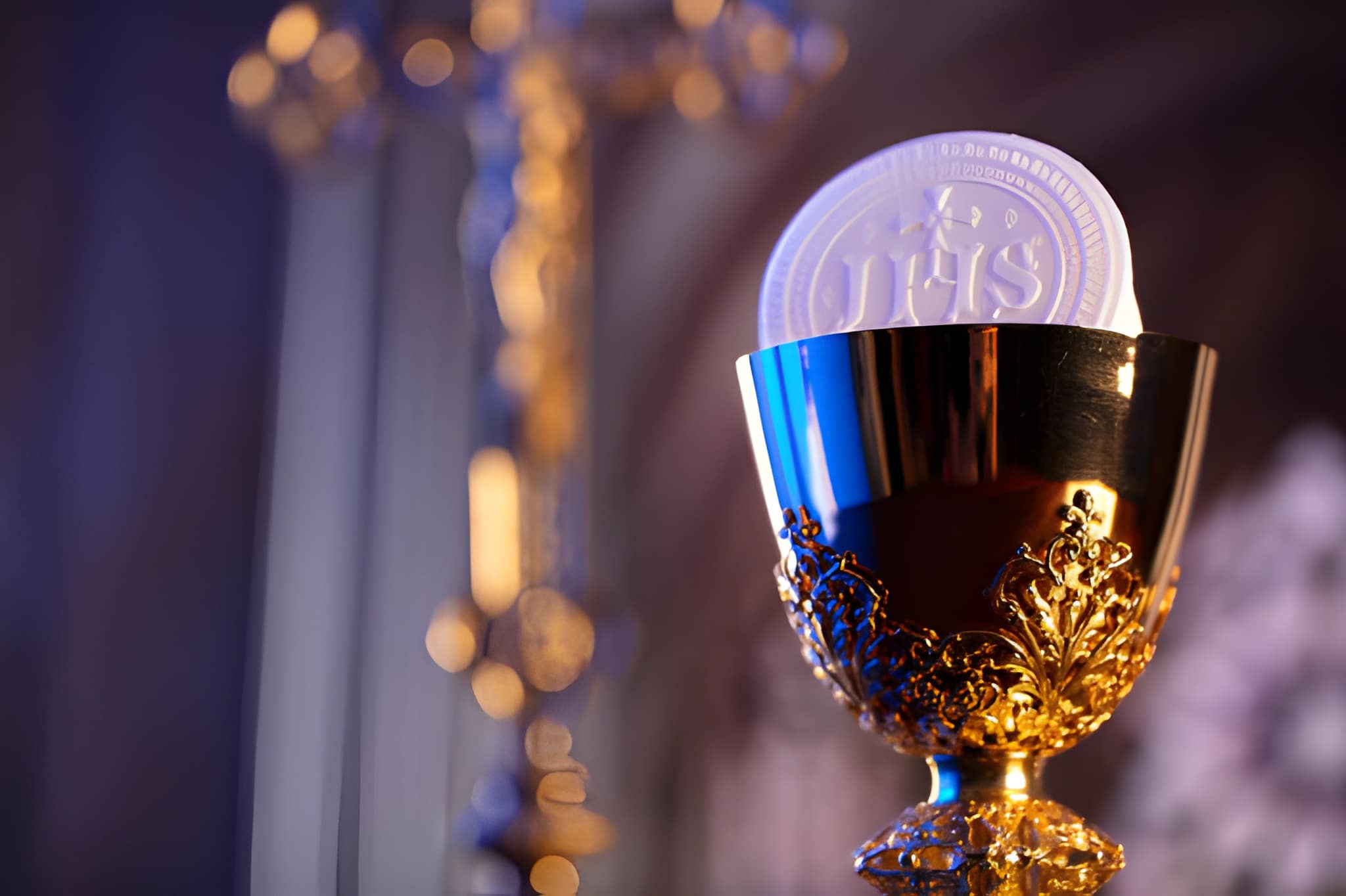
I attended three different communion services in one month.
Catholic Mass on Sunday morning.
Protestant service Wednesday evening.
Orthodox Divine Liturgy on Saturday.
Same sacred meal. Completely different prayers.
The Catholic priest consecrated the elements with ancient liturgical words I’d never heard.
The Protestant pastor prayed spontaneously, inviting us to remember Jesus’s sacrifice.
The Orthodox priest chanted prayers in a language I couldn’t understand while incense filled the space.
All three claimed biblical authority.
All three believed they were obeying Jesus’s command to “do this in remembrance of me.”
Yet the prayers, the theology, and the practices looked nothing alike.
That month forced me to study what Christians actually believe about communion prayer.
Not to judge who’s right, but to understand why we pray so differently over the same bread and wine Jesus gave us.
What Jesus Actually Said About Communion
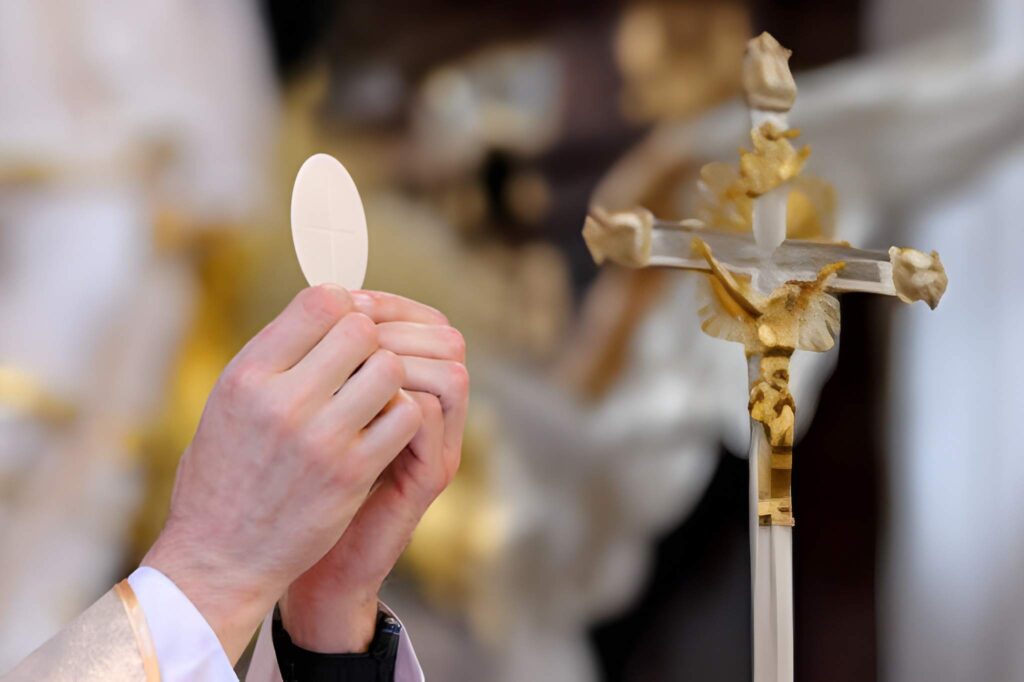
Before exploring how different traditions pray during communion, we need to establish what Jesus actually commanded.
All three major Christian traditions base their communion theology on the same biblical passages, yet interpret them differently.
1 Corinthians 11:23-26, English Standard Version (ESV)
“For I received from the Lord what I also delivered to you, that the Lord Jesus on the night when he was betrayed took bread, and when he had given thanks, he broke it, and said, ‘This is my body, which is for you. Do this in remembrance of me.’ In the same way also he took the cup, after supper, saying, ‘This cup is the new covenant in my blood. Do this, as often as you drink it, in remembrance of me.’ For as often as you eat this bread and drink the cup, you proclaim the Lord’s death until he comes.”
Jesus gave clear commands: take bread, give thanks, break it, distribute it.
Take the cup, give thanks, distribute it. Do this in remembrance.
What He didn’t specify: exact words to pray, frequency of observance, who can preside, or precise theological explanation of what happens to the elements.
That silence is why Christians developed different traditions.
We’re all trying to faithfully obey the same command with different theological frameworks.
Catholic Communion Prayer: The Eucharistic Prayer
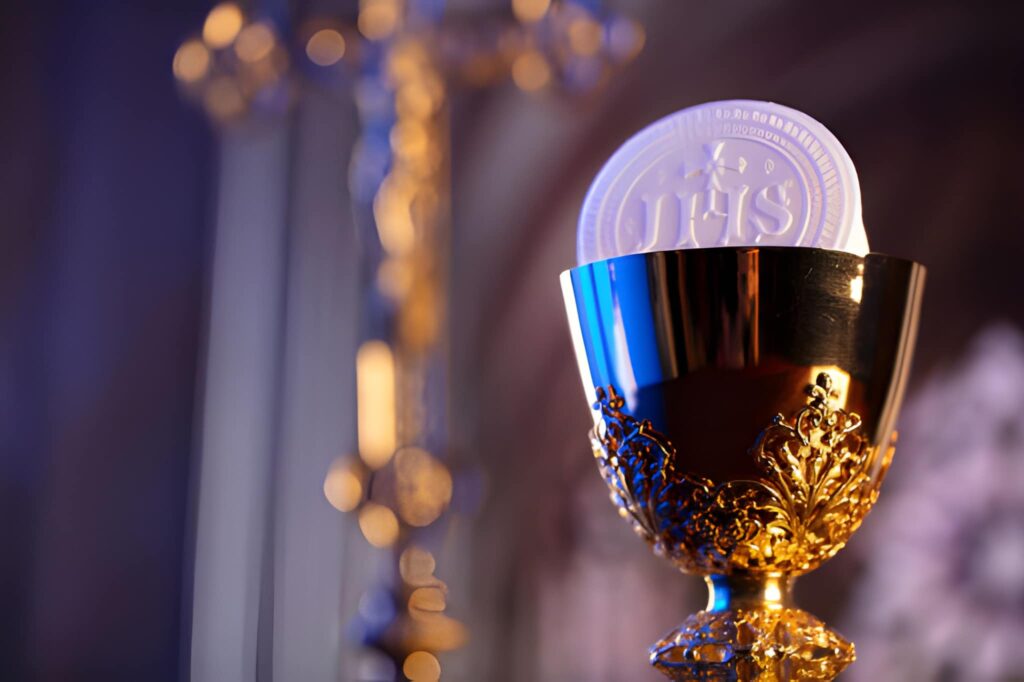
The Catholic Church calls communion the Eucharist, from the Greek word “eucharistia” meaning thanksgiving.
Catholic theology teaches transubstantiation: the bread and wine literally become Christ’s body and blood.
Not symbolically. Actually.
The substance changes even though the appearance remains bread and wine.
This belief profoundly shapes Catholic communion prayers.
The Consecration Prayer
The priest prays the Eucharistic Prayer, which includes the consecration.
This is when Catholics believe the bread and wine transform into Christ’s actual body and blood.
The Words of Institution form the heart of this prayer:
“Take this, all of you, and eat of it, for this is my Body, which will be given up for you. Take this, all of you, and drink from it, for this is the chalice of my Blood, the Blood of the new and eternal covenant, which will be poured out for you and for many for the forgiveness of sins. Do this in memory of me.”
Only ordained priests can pray this consecration because Catholic theology teaches priests act in persona Christi, in the person of Christ.
The priest’s ordination gives him authority to call down the Holy Spirit to transform the elements.
Prayer Before Receiving
Catholics pray before receiving the Eucharist, acknowledging their unworthiness and Jesus’s power to heal:
“Lord, I am not worthy that you should enter under my roof, but only say the word and my soul shall be healed.”
This prayer comes from the centurion’s words in Matthew 8:8.
It acknowledges the tremendous privilege and responsibility of receiving what Catholics believe is Christ’s actual body.
Key theological emphasis: The prayer’s focus is receiving Christ Himself, not just remembering Him.
Catholics don’t just commemorate the Last Supper.
They believe they’re participating in Christ’s ongoing sacrifice made present through the Eucharist.
Protestant Communion Prayer: The Lord’s Supper
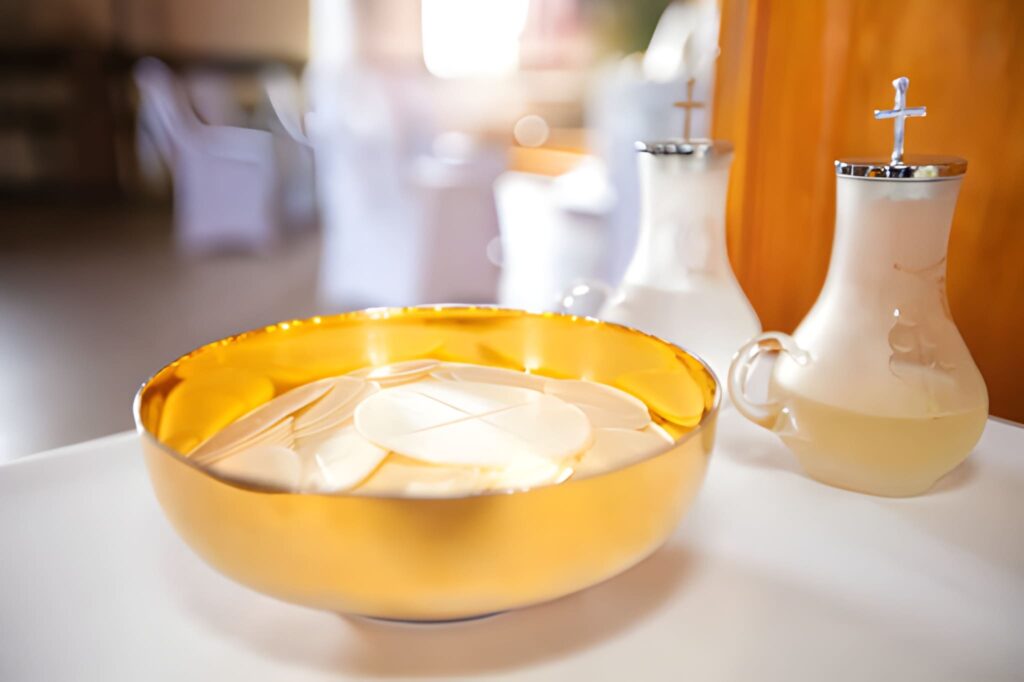
Protestant traditions developed during the Reformation when reformers challenged Catholic transubstantiation theology.
Most Protestant churches teach either symbolic memorial (Zwinglian view) or spiritual presence (Calvinist view).
The bread and wine remain bread and wine but serve as sacred signs pointing to Christ’s sacrifice.
This theological difference dramatically affects how Protestants pray during communion.
The Words of Institution
Protestant ministers typically read the Words of Institution from Scripture as recitation, not consecration.
They’re reminding the congregation what Jesus said and did, not performing a transformation.
The prayer might sound like:
“On the night He was betrayed, our Lord Jesus took bread, gave thanks, broke it, and gave it to His disciples, saying, ‘Take and eat; this is my body given for you. Do this in remembrance of me.’ In the same way, after supper, He took the cup, gave thanks, and offered it to them, saying, ‘Drink from it, all of you. This is my blood of the covenant, which is poured out for many for the forgiveness of sins.'”
Notice the difference: Protestant prayers often say “He said” or “He took,” referring to what Jesus did historically.
Catholic prayers say “This is my body,” with the priest speaking as Christ.
Prayer of Thanksgiving
Many Protestant traditions include a prayer of thanksgiving before or after communion.
These prayers are often spontaneous rather than liturgical, thanking God for Christ’s sacrifice and asking the Holy Spirit to use the elements to strengthen faith.
A typical Protestant communion prayer might be:
“Heavenly Father, we thank You for the gift of Your Son, Jesus Christ, who gave His body and blood for our salvation. As we partake of this bread and cup, help us remember His sacrifice. Strengthen our faith through these symbols of His broken body and shed blood. Make us more like Christ through this sacred meal. In Jesus’s Name, Amen.”
Key theological emphasis: Protestant prayers focus on remembering Christ’s finished work and receiving spiritual nourishment through faith, not literal transformation of elements.
Orthodox Communion Prayer: The Divine Liturgy
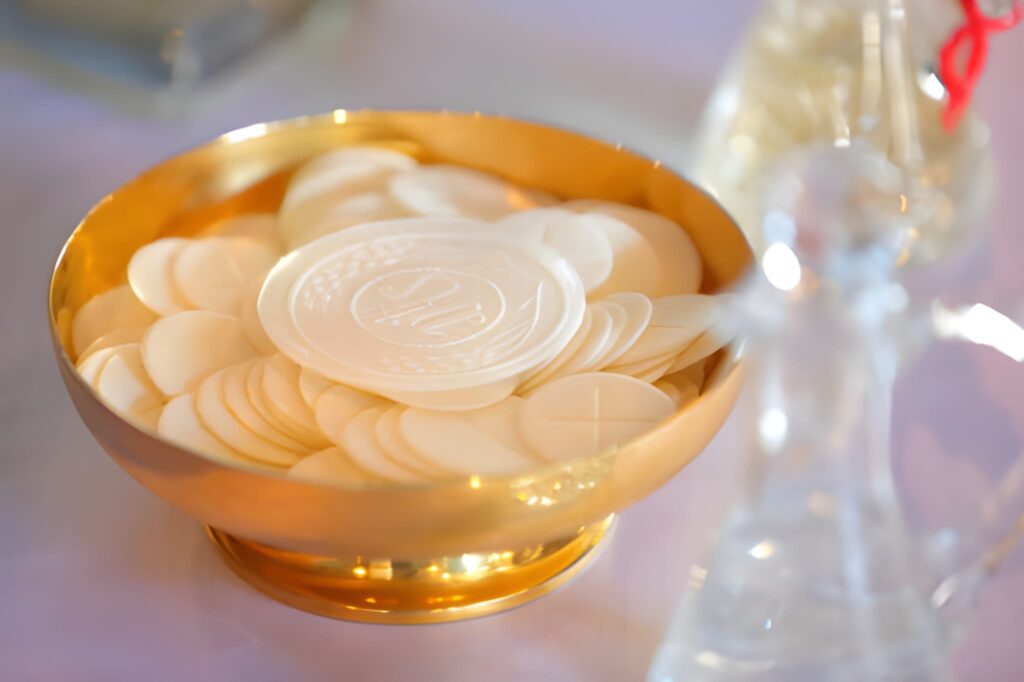
Eastern Orthodox Churches maintain the ancient liturgical tradition that developed in the first centuries of Christianity.
Orthodox theology teaches the bread and wine become Christ’s body and blood through the epiclesis, the prayer calling down the Holy Spirit.
However, Orthodox Christians don’t use the term transubstantiation and resist Western theological precision about exactly when or how the change occurs.
The mystery itself is what matters, not explaining it scientifically.
The Anaphora
The Orthodox Eucharistic prayer, called the Anaphora, is chanted rather than spoken.
The most common is the Liturgy of St. John Chrysostom.
The epiclesis prayer directly invokes the Holy Spirit:
“Send down Thy Holy Spirit upon us and upon these Gifts here presented. And make this bread the precious Body of Thy Christ. And that which is in this cup the precious Blood of Thy Christ. Changing them by Thy Holy Spirit.”
This prayer explicitly asks God to transform the elements.
Unlike Catholic theology that ties transformation to the Words of Institution, Orthodox theology emphasizes the Holy Spirit’s role.
Preparation Prayers
Orthodox Christians pray extensive preparation prayers before receiving communion, often including confession, fasting, and prayers of repentance the night before.
One traditional Orthodox prayer before communion says:
“I believe, O Lord, and I confess that Thou art truly the Christ, the Son of the living God, who came into the world to save sinners, of whom I am first. I believe also that this is truly Thine own pure Body, and that this is truly Thine own precious Blood.”
Key theological emphasis: Orthodox prayers emphasize mystery, the Holy Spirit’s work, and extensive personal preparation recognizing the sacred privilege of receiving Christ’s body and blood.
The Biblical Foundation All Traditions Share
Despite different prayers and theologies, all Christian traditions ground communion in the same Scriptures.
Luke 22:19-20 records Jesus’s institution of communion at the Last Supper.
John 6:51-58 contains Jesus’s teaching about eating His flesh and drinking His blood, which all traditions interpret through their theological lenses.
1 Corinthians 11:27-29 warns about taking communion unworthily, which every tradition takes seriously though they define “unworthily” differently.
All Christians agree communion is sacred.
All agree it involves Christ’s body and blood somehow.
All agree unworthy participation is spiritually dangerous.
All agree Jesus commanded us to do this.
The disagreement is in the “how,” not the “what” or “why.”
What This Means for Your Communion Practice
Understanding these different traditions helps you approach communion more thoughtfully, regardless of which tradition you belong to.
If you’re Catholic: Recognize Protestant and Orthodox brothers and sisters aren’t being disrespectful when they pray differently. They’re being faithful to their theological convictions based on Scripture.
If you’re Protestant: Understand Catholics and Orthodox aren’t being superstitious when they treat the elements with such reverence. They genuinely believe they’re handling Christ’s body and blood.
If you’re Orthodox: Appreciate that Western Christians, whether Catholic or Protestant, are trying to faithfully obey Christ’s command even though their theological frameworks differ from yours.
If you’re exploring Christianity: Don’t let denominational differences about communion discourage you. All Christians are trying to obey the same Jesus who said “do this in remembrance of me.”
Praying Your Own Communion Prayer
Regardless of your tradition, communion prayer should include these biblical elements that transcend denominational boundaries.
Thanksgiving: Jesus gave thanks before breaking the bread. Your communion prayer should thank God for Christ’s sacrifice.
Remembrance: Jesus commanded us to remember Him. Your prayer should focus your mind on what He did on the cross.
Self-examination: Paul warned against taking communion unworthily. Your prayer should include honest confession and repentance.
Unity: Paul rebuked the Corinthians for divisions during communion. Your prayer should remember you’re part of Christ’s body, the church.
Proclamation: Communion proclaims Christ’s death until He returns. Your prayer should acknowledge both His finished work and His promised return.
Here’s a simple communion prayer incorporating these biblical elements:
“Father, thank You for Jesus who gave His body and blood to save me. As I receive this bread and cup, help me remember His sacrifice. Forgive my sins. Cleanse my heart. Unite me with all believers who share this meal. And remind me that Christ died, Christ rose, and Christ will come again. In Jesus’s Name, Amen.”
That prayer honors what all Christians believe about communion without requiring you to resolve centuries of theological debate.
A Personal Reflection
After attending those three different communion services, I realized something profound.
We all approached the same table. We all received bread and wine. We all left changed, even though we understood what happened differently.
Catholic, Protestant, Orthodox. Different prayers. Different theologies. Same Jesus who said “do this in remembrance of me.”
Maybe that’s enough.
References
Allison, G. R. (2011). Historical Theology: An Introduction to Christian Doctrine. Zondervan. [Book]
Bradshaw, P. F., & Johnson, M. E. (2012). The Eucharistic Liturgies: Their Evolution and Interpretation. Liturgical Press. [Book]
Calvin, J. (1559/1960). Institutes of the Christian Religion (F. L. Battles, Trans.). Westminster John Knox Press. [Book]
Catechism of the Catholic Church (2nd ed.). (2000). Libreria Editrice Vaticana. [Official Church Document]
Meyendorff, J. (1979). Byzantine Theology: Historical Trends and Doctrinal Themes. Fordham University Press. [Book]
Peterson, E. H. (2005). The Message: The Bible in Contemporary Language. NavPress. [Bible Translation]
Schmemann, A. (1988). The Eucharist: Sacrament of the Kingdom. St. Vladimir’s Seminary Press. [Book]
Strong, J. (2010). Strong’s Exhaustive Concordance of the Bible. Hendrickson Publishers. [Reference Book]
Zwingli, U. (1525/1984). Commentary on True and False Religion. Labyrinth Press. [Book]

