

“The wages of sin is death” sounds like religious language designed to scare people into behaving.
Most Christians can quote Romans 6:23 without understanding what it actually means.
We throw it around in evangelism like a threat, using it to convince sinners they need Jesus.
But few believers can explain what “death” means in this context or why sin earns that specific wage.
I spent years preaching this verse before I truly understood it.
I thought I knew what it meant because I could define the words.
Sin equals bad behavior.
Death equals physical dying.
Wages equal consequences.
Simple theology for simple minds.
Then I encountered people whose lives were being destroyed by sin’s effects in ways that had nothing to do with physical death.
The verse suddenly became more complex and more devastating than I’d realized.
Death isn’t just what happens when your heart stops. It’s what’s happening right now to everyone enslaved by sin.
Understanding what Scripture actually means by “the wages of sin is death” changes everything about how you view sin, salvation, and spiritual life.
The Full Verse in Context
Here’s the complete verse that gets shortened to a slogan:
Romans 6:23, New International Version (NIV)
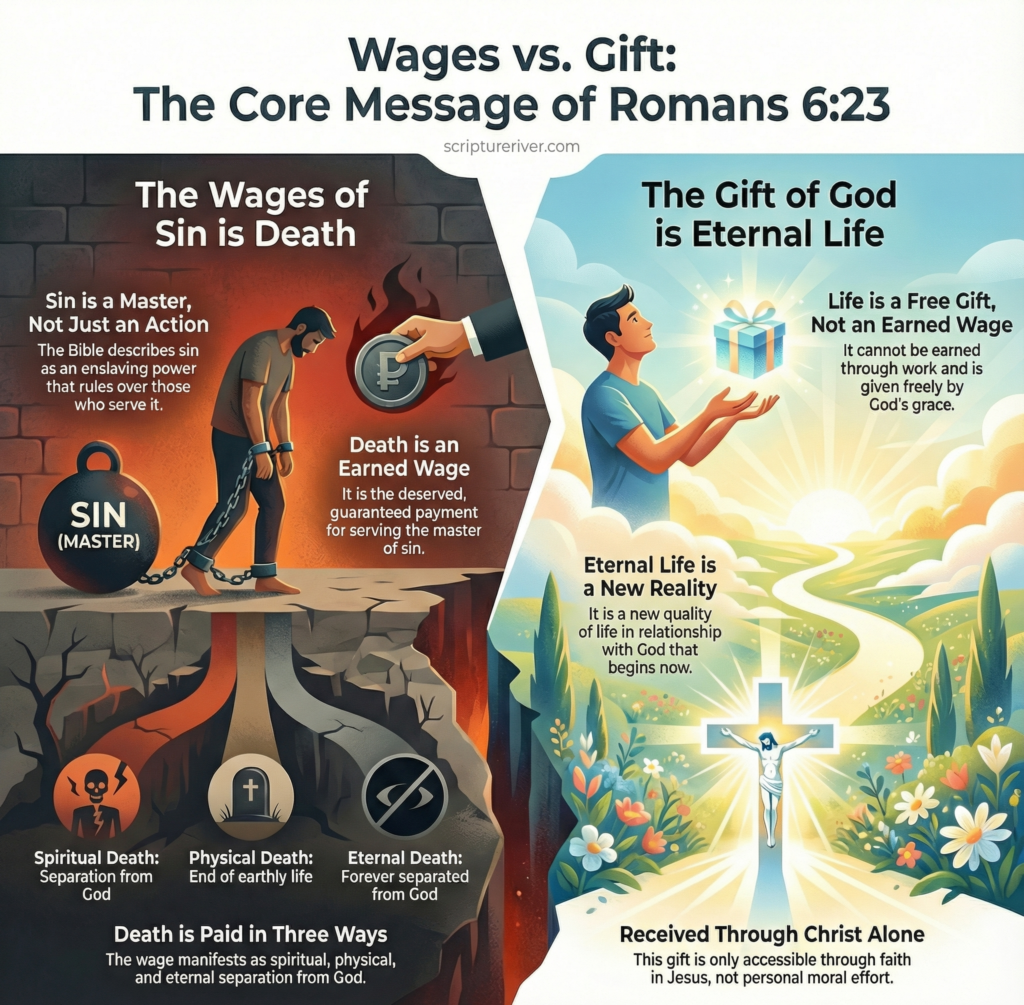
“For the wages of sin is death, but the gift of God is eternal life in Christ Jesus our Lord.”
Paul wrote this to believers in Rome, explaining the radical difference between life under sin’s dominion and life under grace.
The contrast matters tremendously.
Wages versus gift. Sin versus God. Death versus eternal life.
Paul isn’t just making one point. He’s drawing a sharp line between two completely different systems of operation.
Sin pays wages. You work for sin, sin pays you. The transaction is transactional, earned, deserved.
God gives gifts. You don’t work for gifts. You receive them freely because the giver is generous.
What sin pays is death. What God gives is eternal life through Jesus.
To understand the verse properly, you need to know what Paul means by sin, what he means by death, why he calls it wages, and how this contrasts with God’s gift.
Let’s break it down piece by piece until the full weight of this statement becomes clear.
What “Sin” Actually Means in Romans 6

Paul isn’t talking about individual sinful actions in Romans 6.
He’s talking about Sin with a capital S as a power, a force, a slave master that controls people who aren’t in Christ.
Look at how Paul describes sin throughout Romans 6:
Romans 6:6 says we were “slaves to sin.” Sin isn’t just something you do. It’s something that owns you.
Romans 6:12 warns, “Do not let sin reign in your mortal body.” Sin wants to rule you like a king rules subjects.
Romans 6:14 declares, “Sin shall no longer be your master.” Sin functions as a master over slaves.
Paul personifies sin as an enslaving power that pays wages to those who serve it.
This completely reframes how we think about sin. Most Christians view sin as breaking God’s rules. That’s true but incomplete.
Sin is an active force that enslaves humanity.
It’s not just wrong actions. It’s a power that produces wrong actions because it controls the person committing them.
When Paul says “the wages of sin is death,” he means that serving this enslaving power results in death.
The more you serve sin, the more death you experience.
The wage is proportional to the work. Serve sin consistently, receive death consistently.
Three Dimensions of Death That Sin Produces
Death in Scripture isn’t one-dimensional.
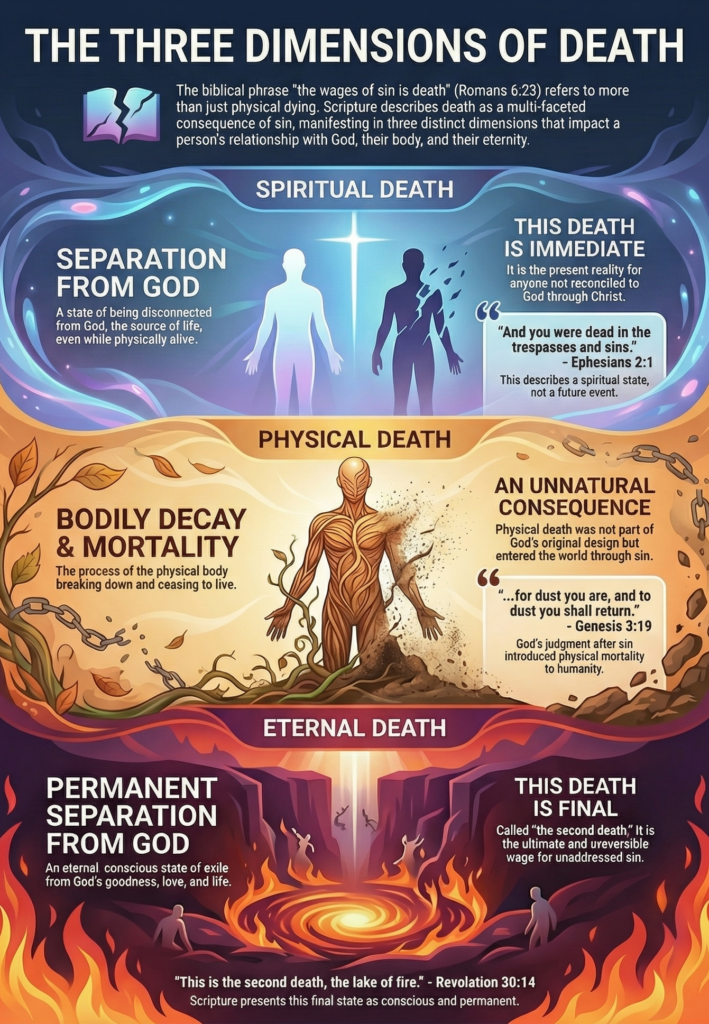
The Bible describes three types of death, and sin produces all three.
Understanding these distinctions unlocks what Romans 6:23 actually means.
Spiritual Death: Separation From God
This is the most immediate wage sin pays.
Ephesians 2:1, English Standard Version (ESV) says:
“And you were dead in the trespasses and sins.”
Dead. Present tense. Not “you will be dead someday.” You were dead while physically alive.
Spiritual death means separation from God, the source of all life.
Sin creates a barrier between humans and God that results in spiritual deadness even while physically alive.
I’ve counseled people who described feeling spiritually empty, disconnected from God, unable to sense His presence or hear His voice.
That’s spiritual death. Sin produces it by cutting off the relationship with the life-giver.
This death is immediate.
The moment sin entered humanity through Adam, spiritual death spread to everyone. Romans 5:12 explains that death came to all people because all sinned.
You don’t wait until physical death to experience death’s wage.
Spiritual death is operative right now in everyone not reconciled to God through Christ.
Physical Death: Bodily Decay and Mortality
Sin introduced physical death into creation.
Before sin, Adam and Eve had access to the tree of life. They were created to live forever physically. Sin changed that.
Genesis 3:19, New King James Version (NKJV) records God’s judgment after sin:
“In the sweat of your face you shall eat bread till you return to the ground, for out of it you were taken; for dust you are, and to dust you shall return.”
Physical death wasn’t part of God’s original design. It entered as sin’s consequence.
Every funeral, every hospital, every cemetery exists because sin pays wages. Death wasn’t natural or inevitable. It’s sin’s payment.
Romans 5:12 explicitly connects physical death to sin: “sin entered the world through one man, and death through sin, and in this way death came to all people.”
Physical death is universal because sin is universal. Everyone dies physically because everyone sins.
The wage is consistently paid.
Eternal Death: Permanent Separation From God
This is the ultimate wage sin pays if left unaddressed.
Revelation 20:14, Christian Standard Bible (CSB) calls it “the second death”:
“Death and Hades were thrown into the lake of fire. This is the second death, the lake of fire.”
The second death is eternal, conscious separation from God’s presence.
Not annihilation. Not unconsciousness. Permanent exile from the source of all goodness, love, joy, and life.
Jesus described it repeatedly using terms like outer darkness, weeping and gnashing of teeth, eternal fire prepared for the devil and his angels.
This death is final.
There’s no recovery, no reprieve, no second chance. Sin’s ultimate wage for those who die spiritually dead is eternal death.
This reality makes the gospel urgently necessary.
Sin doesn’t just make life difficult. It leads to eternal catastrophe if not dealt with through Christ.
Why Scripture Calls Death a “Wage”
Paul’s choice of the word “wage” is deliberate and revealing.
In Greek, “wage” is “opsōnion,” which originally referred to a soldier’s pay or rations.
It’s what you earn through service. Payment for work performed.
This destroys several popular misconceptions about sin and death.
Death Isn’t an Arbitrary Punishment
God isn’t randomly deciding to punish sin with death like a parent grounding a child for misbehavior.
Death is the natural wage sin pays.
It’s intrinsic to sin’s nature. Serving sin produces death the way working a job produces a paycheck.
You earn death by serving sin. It’s payment for services rendered.
Death Is Deserved, Not Unjust
When you work and receive wages, you’ve earned that payment. You deserve it because you worked for it.
Death is sin’s deserved wage.
Not because God is mean, but because serving the master of death produces death as a natural consequence.
Nobody can claim death is unfair when they’ve actively served sin. You worked for sin. Sin paid you what you earned.
The Wage Is Guaranteed
Wages aren’t optional. When you work, you get paid. It’s not a maybe or a possibility. It’s certain.
Sin always pays death. Not sometimes. Not depending on severity. Always.
Every person who serves sin receives death as guaranteed payment. The wage comes due without exception.
This certainty is both terrifying and clarifying. You can’t serve sin and avoid death any more than you can work a job and avoid receiving payment.
How Death Manifests in Daily Life Before Physical Death
Most Christians think “the wages of sin is death” only applies to eternal destiny.
That misses how death operates in the present through sin’s ongoing effects.
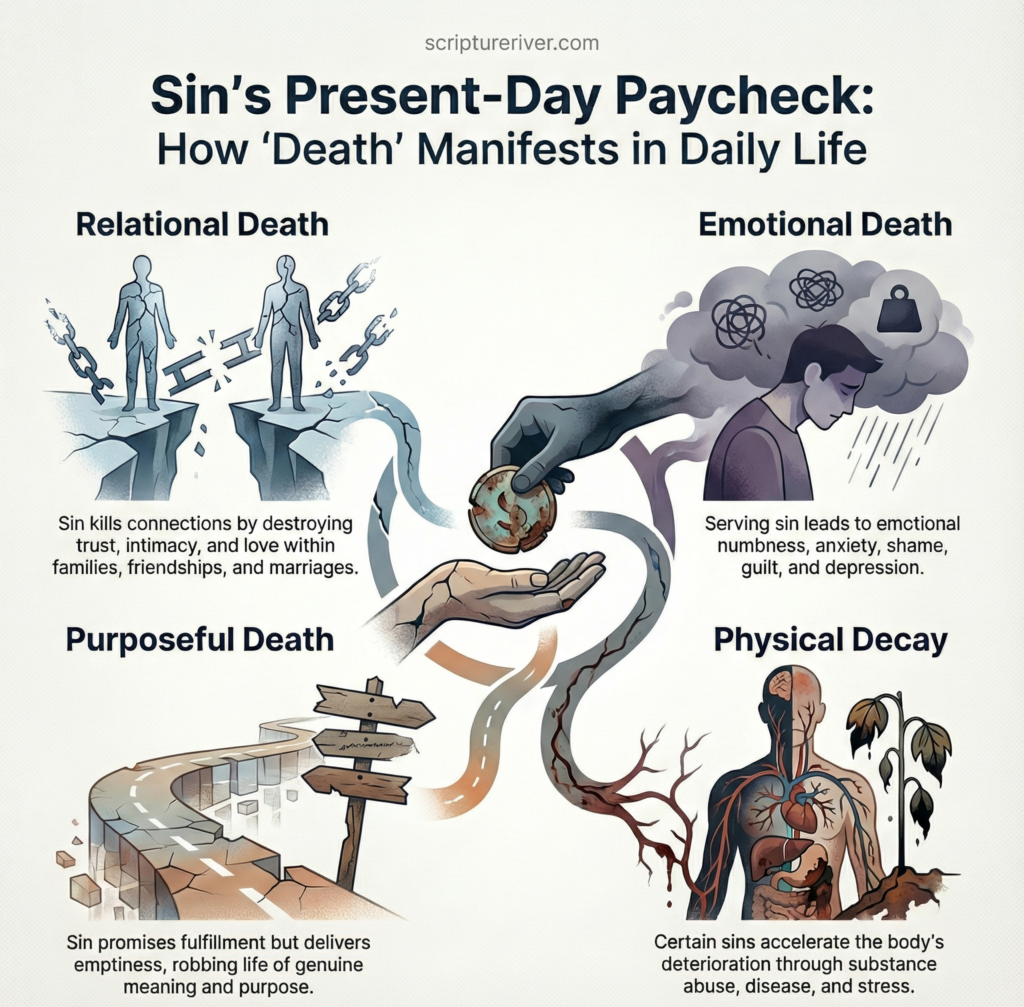
Sin produces death in your life right now in measurable ways.
Relational Death
Sin kills relationships. Lying destroys trust. Adultery murders marriages. Gossip assassinates friendships. Selfishness suffocates intimacy.
I’ve watched sin produce relational death repeatedly. Families torn apart. Friendships ended. Marriages dissolved. Communities fractured.
That’s death operative through sin. Not physical death, but death of connection, trust, and love.
Emotional Death
Sin produces depression, anxiety, shame, guilt, and emotional numbness. The more you serve sin, the more emotionally dead you become.
Addiction numbs you. Sexual sin fills you with shame. Bitterness eats you from the inside. Anger isolates you. Greed empties you.
People describe feeling dead inside after years of sin. That’s not a metaphor. That’s sin paying wages.
Purposeful Death
Sin robs life of meaning and purpose. It promises fulfillment but delivers emptiness.
The person chasing success discovers it’s hollow. The person pursuing pleasure finds it unsatisfying. The person seeking approval realizes it’s never enough.
Sin kills the soul’s capacity to find genuine purpose because it directs you toward dead ends rather than the source of life.
Physical Decay Before Death
Sin accelerates physical deterioration through its effects. Substance abuse destroys bodies.
Sexual sin spreads disease. Gluttony creates health problems. Stress from guilt produces physical symptoms.
You can see sin’s death-wages playing out in people’s physical appearance and health long before they actually die.
The Contrast: God’s Gift of Eternal Life
Paul doesn’t leave us with only bad news.
Romans 6:23 has two parts. The second part completely reverses the first.
“But the gift of God is eternal life in Christ Jesus our Lord.”
Gift, Not Wage
God doesn’t pay wages for good behavior. He gives gifts freely to undeserving recipients.
You can’t earn eternal life. It’s not payment for spiritual work. It’s a gift given by grace through faith.
Eternal Life, Not Death
Eternal life isn’t just duration. It’s quality. Relationship with God, the source of all life, forever.
It begins now, not after physical death. Spiritual death reverses the moment you’re united to Christ.
Through Christ, Not Personal Effort
Eternal life comes exclusively through Jesus. Not through religion, morality, sincerity, or effort.
Christ took death’s wage on the cross so believers could receive life as a gift. He earned death by bearing our sin. We receive life by trusting Him.
This creates the most dramatic contrast imaginable.
Serve sin, earn death. Trust Christ, receive life.
Work for one master, get paid with death. Trust the other Master, receive a gift you could never earn.
Why This Truth Matters for Believers Today
Understanding “the wages of sin is death” isn’t just theological knowledge.
It has immediate practical implications for how you live.
It Explains Why Sin Is Deadly Serious
Our culture trivializes sin. Small lies, minor gossip, little bitterness, occasional lust. No big deal, right?
Wrong. Sin pays death. Always. Every time. The wage might pay out gradually, but it always pays.
When you understand that serving sin produces death in your relationships, emotions, purpose, and ultimately eternity, you stop treating it casually.
It Clarifies Why Jesus’s Death Was Necessary
If sin’s wage could be negotiated or ignored, Jesus didn’t need to die.
But wages must be paid. Someone had to receive death. Either us earning it through sin, or Jesus receiving it as our substitute.
The cross makes sense only when you understand that death’s wage was non-negotiable and had to be paid.
It Motivates Daily Resistance to Sin
Every time you’re tempted to sin, remember what you’re working for. That sin is offering to pay you with death.
Would you work for an employer who paid you with poison? Then why serve sin that pays death?
This truth creates urgency about holiness. You’re not just trying to be good. You’re refusing employment from a master whose paycheck is death.
It Increases Gratitude for Grace
When you grasp that you deserved death and received life instead, gratitude explodes.
God didn’t give you what you earned. He gave you what His Son earned on your behalf.
That’s not an obligation. That’s not a transaction. That’s a pure gift, and it should produce overwhelming thanksgiving.
Common Questions About This Verse Answered
“Doesn’t everyone sin? Why doesn’t everyone immediately die?”
Everyone does sin, and everyone does experience spiritual death apart from Christ. Physical death is delayed by God’s patience, giving time for repentance (2 Peter 3:9). Eternal death is held back by grace until final judgment.
“Are some sins worse than others in terms of death’s wage?”
All sin produces death, but some sins accelerate death’s effects more visibly than others. Murder produces immediate death. Bitterness produces slower relational death. Both earn death, but the manifestation differs.
“Can believers still experience death as sin’s wage?”
Believers are freed from sin’s dominion (Romans 6:14), so we don’t earn death eternally. But when believers choose to serve sin temporarily, we experience death’s effects in relationships, emotions, and purpose. The eternal wage is paid by Christ, but temporal consequences remain.
“What about people who seem to prosper despite sinning?”
Prosperity isn’t life. Someone can have wealth, success, and comfort while being spiritually dead. Death’s wage manifests primarily spiritually and eternally, not always materially.
The Choice Every Person Faces
Romans 6:23 presents two employment options.
Serve sin, earn death. Trust Christ, receive life.
You’re working for one of these masters right now. Sin or God. Death or life. Wage or gift.
The transaction is happening whether you acknowledge it or not.
Every sinful choice serves a master who pays death. Every act of faith-filled obedience is received from a Master who gives life.
You can’t serve both. Matthew 6:24 is clear: no one can serve two masters.
The question is simple: who are you working for today?
Are you serving sin, accumulating death as your wage? Or are you trusting Christ, receiving life as God’s gift?
The masters are hiring. The wages are opposite. The choice is yours.
Choose life.
Prayer for Understanding and Freedom
Father, I confess I’ve served sin and earned death. I’ve worked for a master whose payment is destruction, death, and separation from You.
Forgive me for treating sin casually when it produces death seriously. Thank You that through Jesus, You’ve offered me a gift I could never earn: eternal life. I receive that gift by faith right now. Free me from sin’s mastery.
Break its power over my choices, relationships, emotions, and purpose. Help me serve You instead of sin, receiving life instead of earning death.
Give me clarity to see sin for what it is: a deadly master offering poisonous wages. Give me faith to trust Christ for what He offers: eternal life as a free gift.
Transform me from death to life, from slavery to freedom, from wages earned to gifts received.
In Jesus’s Name, Amen.
References
Carson, D. A., & Moo, D. J. (2005). An Introduction to the New Testament (2nd ed.). Zondervan.
Fee, G. D. (2014). Paul, the Spirit, and the People of God. Baker Academic.
Köstenberger, A. J., Kellum, L. S., & Quarles, C. L. (2009). The Cradle, the Cross, and the Crown: An Introduction to the New Testament. B&H Academic.
Moo, D. J. (1996). The Epistle to the Romans. Eerdmans Publishing Company.
Morris, L. (1988). The Epistle to the Romans. Eerdmans Publishing Company.
Peterson, E. H. (2005). The Message: The Bible in Contemporary Language. NavPress.
Schreiner, T. R. (1998). Romans. Baker Academic.
Stott, J. R. W. (1994). The Message of Romans: God’s Good News for the World. InterVarsity Press.
Strong, J. (2010). Strong’s Exhaustive Concordance of the Bible. Hendrickson Publishers.
Wiersbe, W. W. (2007). The Bible Exposition Commentary: New Testament (Vol. 1). David C. Cook.
Wright, N. T. (2002). Romans. In L. E. Keck (Ed.), The New Interpreter’s Bible (Vol. 10). Abingdon Press.

