

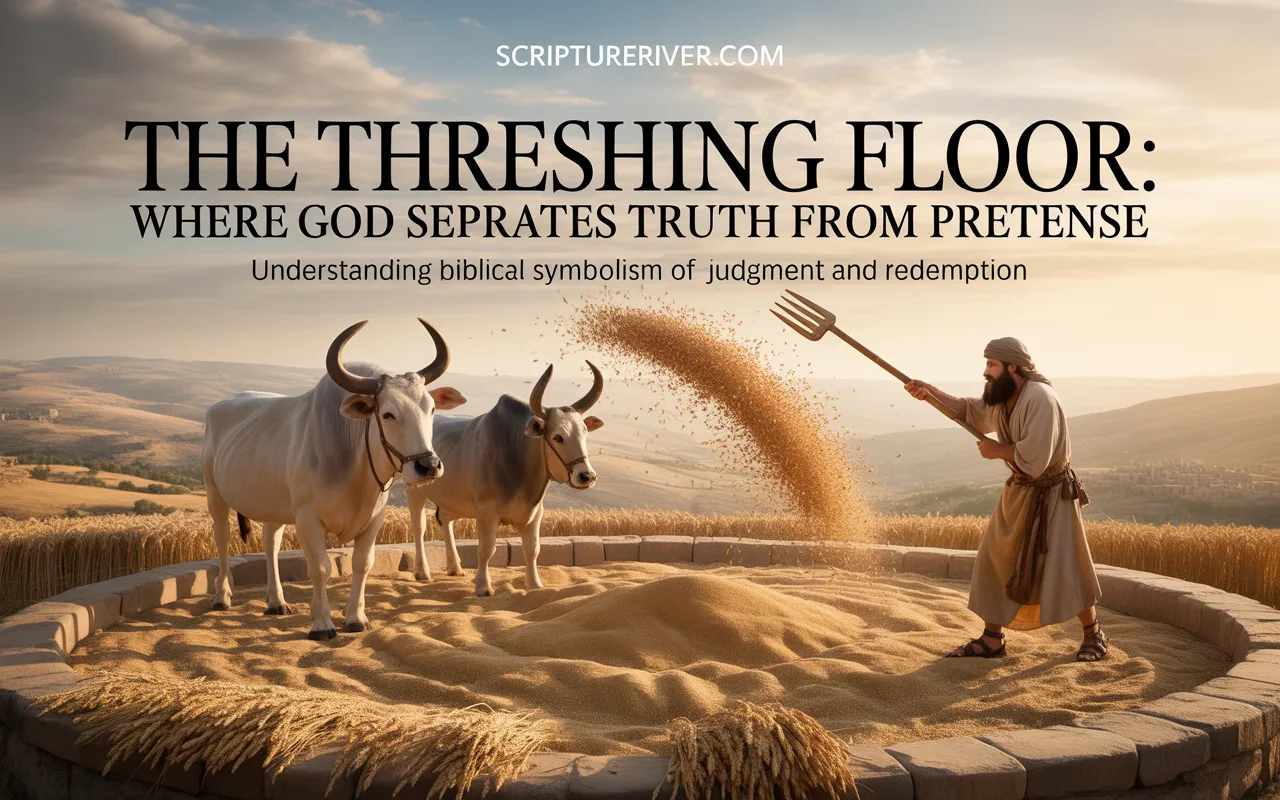
Ancient threshing floors were where wheat became bread and barley became beer, but in Scripture, they’re where God separated true worshipers from pretenders.
Most modern readers skip right past threshing floor references in the Bible without realizing they’re missing some of the most loaded symbolism in Scripture.
When Ruth met Boaz at the threshing floor, when David bought Araunah’s threshing floor, when Gideon threshed wheat in a winepress, and when John the Baptist declared Jesus would thoroughly purge His threshing floor, these weren’t random agricultural details.
They were theologically saturated moments where physical locations became stages for spiritual truth.
Understanding what a threshing floor actually was, how it functioned in ancient Near Eastern agriculture, why biblical authors used it as symbol, and how it reveals Christ’s work transforms dozens of passages from confusing to crystal clear.
The Physical Reality: What a Threshing Floor Actually Was
Location and Construction
A threshing floor (Hebrew: goren) was circular flat area, typically 25-40 feet in diameter, constructed on elevated ground to catch prevailing winds.
Ancient Israelites built them from packed earth or flat rock, often on hilltops or elevated plateaus.
The elevation served practical purpose: consistent wind was essential for winnowing.
Without wind, separating grain from chaff was nearly impossible.
Archaeological evidence from ancient Israel shows these floors were communal spaces.
Villages often shared threshing floors located just outside town gates, where multiple families could process their harvests.
The Threshing Process
After harvest, farmers spread cut grain stalks across the threshing floor.
Then they employed several methods to break grain kernels free from surrounding chaff:
Animals treading: Oxen or cattle walked repeatedly over the grain, their hooves breaking kernels loose. Deuteronomy 25:4 commands “You shall not muzzle an ox when it is treading out the grain,” allowing the animal to eat while working.
Threshing sledges: Wooden platforms studded with sharp stones or metal teeth were dragged across grain by animals, cutting through stalks and separating kernels.
Beating: For smaller quantities, farmers used flails or rods to manually beat grain.
The Winnowing Process
After threshing broke kernels loose, winnowing separated valuable grain from worthless chaff and straw.
Farmers tossed threshed material into the air with winnowing forks or shovels during afternoon when winds were strongest.
Heavier grain fell back to the floor. Lighter chaff and straw blew away.
This process was repeated until only clean grain remained.
A missionary friend who worked in rural Africa told me about watching villagers thresh and winnow grain using methods virtually identical to biblical times.
She said the winnowing created a cloud of chaff that choked anyone standing downwind.
The separation was total: grain in one pile, chaff scattered completely.
That image helped her understand Jesus’s winnowing metaphor in ways reading about it never had.
Biblical Stories Featuring Threshing Floors
1. Ruth and Boaz at the Threshing Floor
“Now is not Boaz our relative, with whose young women you were? See, he is winnowing barley tonight at the threshing floor. Wash therefore and anoint yourself, and put on your cloak and go down to the threshing floor, but do not make yourself known to the man until he has finished eating and drinking. But when he lies down, observe the place where he lies. Then go and uncover his feet and lie down, and he will tell you what to do.”
Ruth 3:2-7, English Standard Version (ESV)
Ruth approached Boaz at the threshing floor after he’d finished winnowing and eating.
The threshing floor setting is significant: it was public space where business transactions occurred, making it appropriate location for Ruth to make her appeal for redemption.
2. Gideon Threshing Wheat in a Winepress
“The angel of the Lord came, and he sat under the oak that was in Ophrah, which belonged to Joash, the Abiezrite. His son Gideon was threshing wheat in the winepress in order to hide it from the Midianites.”
Judges 6:11, Christian Standard Bible (CSB)
Gideon threshed in a winepress instead of a proper threshing floor.
This was abnormal and inefficient. Winepresses were low, enclosed spaces with no wind for winnowing.
Gideon worked there to hide from Midianite raiders who regularly stole Israelite crops.
This detail reveals Israel’s desperation under oppression. They couldn’t use proper threshing floors because enemies would steal their harvest.
3. David Purchases Araunah’s Threshing Floor
“On that day Gad went to David and said to him, ‘Go up and build an altar to the Lord on the threshing floor of Araunah the Jebusite.’ … Araunah said to David, ‘Let my lord the king take whatever he wishes and offer it up. Here are oxen for the burnt offering, and here are threshing sledges and ox yokes for the wood.’ … But the king replied to Araunah, ‘No, I insist on paying you for it. I will not sacrifice to the Lord my God burnt offerings that cost me nothing.’ So David bought the threshing floor and the oxen and paid fifty shekels of silver for them. David built an altar to the Lord there and sacrificed burnt offerings and fellowship offerings.”
2 Samuel 24:18-25, New International Version (NIV)
This threshing floor became the site of Solomon’s temple (2 Chronicles 3:1). The location where grain was separated from chaff became the location where God’s presence dwelt among His people.
4. Hosea’s Metaphor of Judgment
“Therefore they shall be like the morning cloud and like the early dew that passes away, like chaff blown off from a threshing floor and like smoke from a chimney.”
Hosea 13:3, New King James Version (NKJV)
God warns that unfaithful Israel will be blown away like chaff from a threshing floor. They’ll be separated and discarded as worthless.
The Symbolic Meaning: Separation and Judgment
Threshing Floors as Places of Separation
The primary symbolic use of threshing floors in Scripture is separation of valuable from worthless. This appears consistently:
“The wicked are not so, but are like chaff that the wind drives away.”
Psalm 1:4, English Standard Version (ESV)
“I scattered them with a winnowing fork at the city gates of the land. I made them childless; I destroyed my people. They would not turn from their ways.”
Jeremiah 15:7, Christian Standard Bible (CSB)
God uses threshing floor imagery to describe judgment that separates righteous from wicked. The righteous remain valuable. The wicked are blown away as worthless chaff.
John the Baptist’s Prophecy About Jesus
“I baptize you with water for repentance. But after me comes one who is more powerful than I, whose sandals I am not worthy to carry. He will baptize you with the Holy Spirit and fire. His winnowing fork is in his hand, and he will clear his threshing floor, gathering his wheat into the barn and burning up the chaff with unquenchable fire.”
Matthew 3:11-12, New International Version (NIV)
John prophesies that Jesus will thoroughly purge His threshing floor. He’ll gather wheat (genuine believers) into the barn (eternal safety). He’ll burn chaff (false professors) with unquenchable fire (eternal judgment).
This is strongest threshing floor metaphor in Scripture. Jesus is winnower who completely separates true disciples from pretenders.
Why Threshing Floor Imagery Works Theologically
The threshing process perfectly illustrates judgment and salvation:
Violent process: Threshing involves beating, crushing, and brutal treatment. God’s judgment is severe.
Complete separation: Winnowing leaves no mixture. Grain and chaff don’t coexist in final pile. Heaven and hell don’t mix.
Based on nature, not preference: Grain and chaff separate according to their inherent nature. Heavy grain falls. Light chaff blows away. Similarly, judgment reveals people’s true nature.
Valuable kept, worthless discarded: Farmers keep grain and discard chaff. God saves believers and judges unbelievers.
Wind does the separating: Wind, often symbolic of the Holy Spirit, does the work. God’s Spirit reveals who truly belongs to Him.
Threshing Floors and Spiritual Disciplines
Testing Reveals True Nature
“In this you rejoice, though now for a little while, if necessary, you have been grieved by various trials, so that the tested genuineness of your faith—more precious than gold that perishes though it is tested by fire—may be found to result in praise and glory and honor at the revelation of Jesus Christ.”
1 Peter 1:6-7, English Standard Version (ESV)
Trials function like threshing. They separate genuine faith from superficial profession. What remains after testing reveals what was real all along.
Refining Precedes Use
Grain must be threshed before it’s useful for bread. Similarly, believers undergo refining before God uses them significantly. The process is difficult but necessary.
Confession Clears the Floor
When you confess sin and turn from it, you’re allowing God to winnow your life. What doesn’t belong to Him blows away. What’s genuinely His remains.
How This Applies to Christians Today
God Still Separates
Jesus’s winnowing work continues. The church includes wheat and chaff presently. Final judgment will completely separate them. This should motivate holy living and self-examination.
Trials Reveal Authenticity
When you face difficulty, view it through threshing floor lens. God is revealing what’s real in your faith and what’s superficial. What survives the trial is genuine.
Final Separation Is Coming
Matthew 13:24-30, Christian Standard Bible (CSB) contains the parable of wheat and tares growing together until harvest. At harvest, they’re separated completely. Similarly, professing Christians and genuine Christians coexist now. At judgment, complete separation occurs.
Examine Yourself
“Examine yourselves to see whether you are in the faith; test yourselves. Do you not realize that Christ Jesus is in you—unless, of course, you fail the test?”
2 Corinthians 13:5, New International Version (NIV)
Don’t assume you’re wheat just because you’re on the threshing floor. Genuine faith has substance. Chaff looks like grain until winnowing reveals the truth.
Frequently Asked Questions
Were threshing floors used for pagan worship?
Yes. Archaeological evidence shows Canaanites used threshing floors for Baal worship, believing the fertility god blessed harvests. Israel was commanded to avoid such practices, making threshing floors spiritually contested spaces where loyalty to Yahweh versus Baal was demonstrated.
Why did David buy the threshing floor instead of accepting it free?
David insisted on paying because he refused to offer God sacrifices that cost him nothing (2 Samuel 24:24). Worship that costs nothing is worthless. Buying the threshing floor demonstrated his genuine devotion.
What’s the difference between threshing and winnowing?
Threshing breaks grain kernels free from stalks through beating or crushing. Winnowing separates grain from chaff after threshing by tossing it into the wind. Both are necessary. Both appear as judgment metaphors in Scripture.
Is there New Testament threshing floor symbolism besides John the Baptist’s prophecy?
Yes. Luke 22:31-32 records Jesus telling Peter, “Simon, Simon, behold, Satan demanded to have you, that he might sift you like wheat, but I have prayed for you that your faith may not fail.” Sifting is winnowing imagery. Satan wanted to prove Peter was chaff. Jesus’s intercession ensured Peter remained wheat.
How does understanding threshing floors help interpret Ruth 3?
Knowing threshing floors were public business spaces explains why Naomi sent Ruth there. It wasn’t inappropriate sexual advance but legitimate legal appeal made in proper location for redemption transactions. The winnowing had spiritual significance: Boaz was separating grain from chaff literally while becoming Ruth’s redeemer spiritually.
Does the threshing floor metaphor mean Christians will never face judgment?
Christians won’t face judgment for salvation (that’s settled through Christ) but will face judgment for rewards (1 Corinthians 3:12-15). Our works will be tested.
What’s built with quality materials survives. What’s built with worthless materials burns. This is different winnowing: not to determine who’s saved but to determine reward.
Bibliography
Borowski, O. (2003). Daily Life in Biblical Times. Society of Biblical Literature. [Ancient Near Eastern Life]
Brueggemann, W. (1997). Theology of the Old Testament: Testimony, Dispute, Advocacy. Fortress Press. [Old Testament Theology]
King, P. J., & Stager, L. E. (2001). Life in Biblical Israel. Westminster John Knox Press. [Biblical Archaeology]
Matthews, V. H. (1991). Manners and Customs in the Bible (Rev. ed.). Hendrickson Publishers. [Biblical Culture]
Peterson, E. H. (2005). The Message: The Bible in Contemporary Language. NavPress. [Bible Translation]
Strong, J. (2010). Strong’s Exhaustive Concordance of the Bible. Hendrickson Publishers. [Reference Book]

