
On the coat of arms of Edinburgh, Scotland, three Latin words have been engraved for centuries: Nisi Dominus Frustra.
Without the Lord, nothing.
A city chose a quotation from Psalm 127:1 as its official motto.
That is the weight this verse has carried.
Not a devotional thought. Not a warm morning reflection.
A governing conviction: without God’s involvement, everything a person, a family, or a city builds amounts to one word: vain.
This post explains what Psalm 127:1 means, who wrote it, what the Hebrew reveals, and what it demands of anyone who takes it seriously.
The Verse in Full: Psalm 127:1-2
Before examining verse 1 alone, it must be read alongside verse 2, because Solomon wrote them as a single thought:
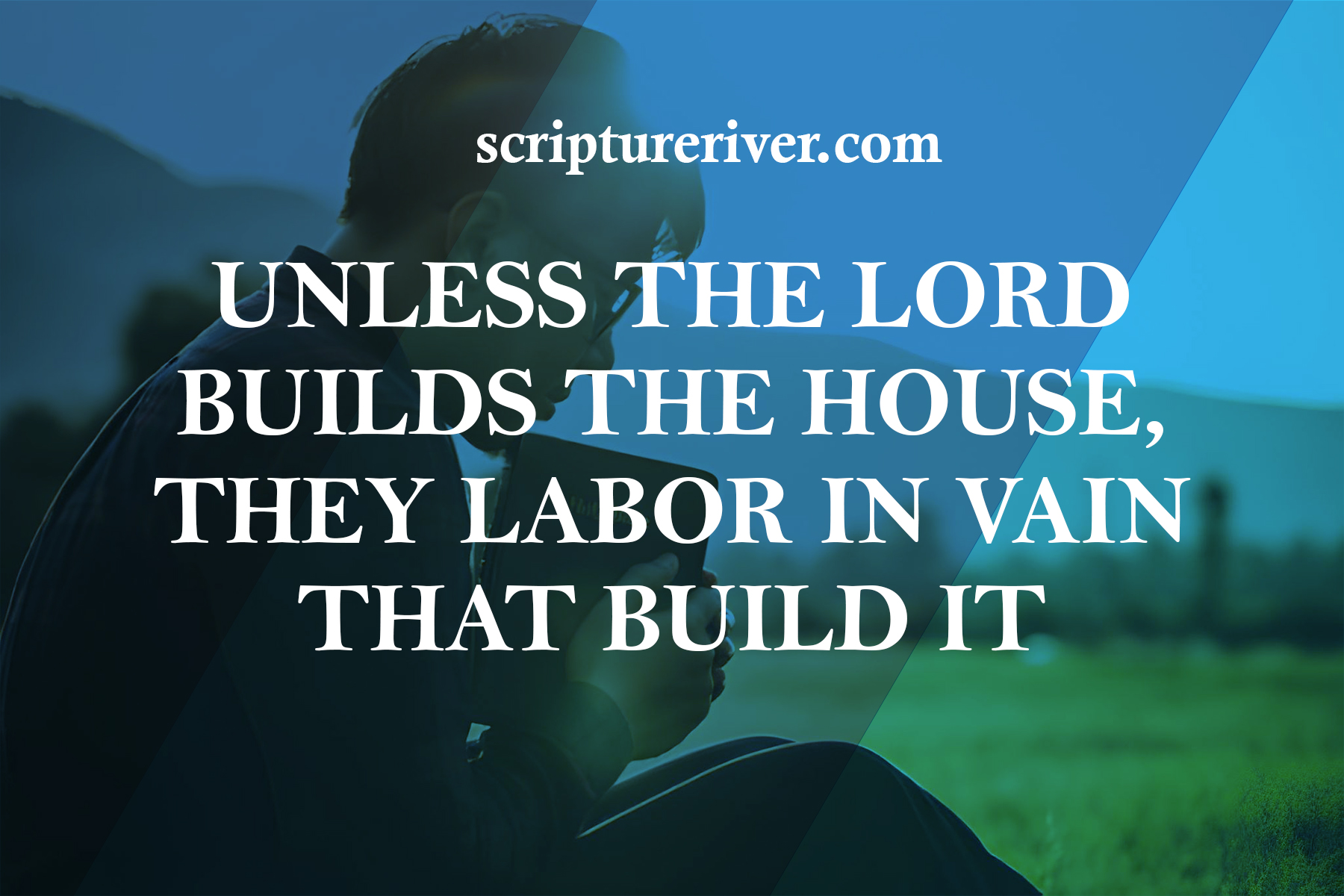
“Unless the LORD builds the house, those who build it labor in vain. Unless the LORD watches over the city, the watchman stays awake in vain. It is in vain that you rise up early and go late to rest, eating the bread of anxious toil; for he gives to his beloved sleep.”
— Psalm 127:1-2 (ESV)
Three times in two verses, Solomon reaches for the same word: vain.
The Hebrew word is shav, meaning emptiness, futility, nothingness. And the word he places before it, deliberately, three times, is the name of God.
Who Wrote It and Why It Matters
Psalm 127 is titled A Song of Ascents. Of Solomon. It is the only Song of Ascents attributed to him.
The Songs of Ascents are Psalms 120 through 134, a collection sung by pilgrims walking up to Jerusalem for the annual festivals.
The songs marked the journey inward: toward the city, toward the temple, toward God. Psalm 127, uniquely, is Solomon’s voice in that procession.
The Solomonic authorship is not incidental. Solomon was the builder.
He constructed the Jerusalem temple, the most significant structure in Israel’s history.
He also built his own royal palace, which took thirteen years.
He knew what it was to gather materials, employ thousands of laborers, draft plans, and see something rise from nothing.
And yet he wrote: unless the Lord builds, the builders labor in vain.
Commentators point to the deep irony.
Solomon accomplished more in construction than any Israelite before him and also wrote “vanity of vanities, all is vanity” (Ecclesiastes 1:2).
The psalm is not abstract theology from someone who had never tried to build anything.
It is the testimony of a builder who learned what makes building mean something.
What the Hebrew Reveals
One detail in the Hebrew text deserves attention.
Standard Hebrew word order is verb-subject-object. But in Psalm 127:1, Solomon rearranges it. The name of God, YHWH, appears first in each line:
YHWH, unless He builds the house… YHWH, unless He watches the city…
This is not a grammatical accident. Solomon places God at the front of every sentence as a deliberate statement: God must come first, or what follows is futile.
The Hebrew word for “build” here is banah, which is also the root of the word for son (ben) and house (bayit).
A family, in Hebrew thinking, and a physical house share the same word because they share the same concept: a built thing.
When Solomon writes about God building the house, commentators like Adam Clarke note that he is speaking not only of structures but of households, legacies, and family lines. “Sons and daughters build up a household as much and as really as stones and timber constitute a building.”
This connects verse 1 directly to verses 3 through 5, where Solomon shifts to children as a heritage from God.
The psalm is unified: the house God builds is not primarily a building. It is a family, a people, a lasting work.
The Bread of Anxious Toil
Verse 2 extends verse 1 from construction to daily labor.
“It is in vain that you rise up early and go late to rest, eating the bread of anxious toil.”
The phrase “bread of anxious toil” is striking.
The Hebrew word translated as “anxious” or “sorrows” is itstsabown, the same word used in Genesis 3:16-17 for the pain of childbirth and the toil of working cursed ground after the fall.
Solomon is reaching back to the consequences of Eden.
Work severed from God’s blessing carries the same painful, grinding quality as post-fall labor: you pour yourself out and cannot fill yourself back up.
This is not a prohibition against hard work. Scripture consistently commends diligence. Proverbs 6:6-8 sends the sluggard to learn from the ant. The Proverbs 31 woman rises before dawn.
What verse 2 is targeting is the workaholic spirit, the person whose identity, security, and significance are entirely wrapped in what they produce.
As Ecclesiastes 5:12 frames it: the sleep of the worker is sweet, but the abundance of the rich permits no sleep.
The contrast at the end of verse 2 is pointed: the beloved of God receives sleep.
Not because he worked less, but because he is not carrying the weight of outcomes that belong to God. Sleep, in this psalm, is not laziness. It is the fruit of trust.
What “Unless the Lord Builds” Does Not Mean
This verse has been misread in two opposite directions.
The first misreading treats it as an excuse for passivity.
If God must build it, why labor at all? But Solomon does not remove the builders from verse 1.
The watchman is still awake in verse 1, still at his post. The builders are still building.
The psalm does not say, “Sit down and let God work.” It says the work means nothing if it is not grounded in God’s direction and blessing.
The second misreading treats it as a formula: pray over your plans, ask for God’s blessing, and then the outcome is guaranteed.
But the psalm is not about attaching God’s name to projects He has not authored.
GotQuestions observes that the verse is both a warning and a promise: if you want ultimate success, align your plans with God’s plan.
When that alignment exists, ultimate failure becomes impossible. When it doesn’t, ultimate success is impossible, regardless of skill or effort.
Kidner asks the sharper question: “The house and the city may survive, but were they worth building?”
A person can construct a career, a marriage, or a ministry that stands for decades and discover at the end that it was built for the wrong reasons.
The house survived. It was still vain.
What It Means to Build with God
Jesus uses the same metaphor in Matthew 7:24-27. He distinguishes between two builders: one who hears His words and acts on them, building on rock, and one who hears and does not act, building on sand. Both build. The difference is the foundation.
Paul applies identical logic to ministry in 1 Corinthians 3:11-15. Every worker builds, but what is built will be tested by fire. Only what is grounded in Christ survives the test.
The practical question Psalm 127:1 raises is not whether to work, but how: with submitted plans and a posture that asks God to direct what is built from the beginning, not merely to bless what has already been decided.
Nisi Dominus Frustra. Without the Lord, nothing lasts.
A Prayer Over the Work of Your Hands
Lord, I confess that I have often asked You to bless what I had already decided to build. Teach me to begin with You instead of bringing You in at the end. Let the work of my hands be work You have directed, not simply work I have dedicated. I do not want to rise early and stay up late eating the bread of anxious toil. I want to be Your beloved, doing the work You have given me and trusting the outcome to You. In Jesus’ name, Amen.
Frequently Asked Questions About Psalm 127:1
What does “the house” mean in Psalm 127:1?
In Hebrew, the word bayit (house) carries a broader meaning than a physical structure. It can refer to a family, a dynasty, or a lasting legacy. Commentators, including Adam Clarke, note that “build” (banah), “son” (ben), and “house” (bayit) all share the same Hebrew root, linking family-building and structure-building under one concept. In context, Solomon likely means both: literal construction and the household or life a person is working to establish.
Does Psalm 127:1 mean Christians should not work hard?
No. The psalm addresses the spirit behind work, not the act of working. Solomon himself was one of Israel’s most prolific builders. Proverbs 6:6-8 explicitly commends diligent labor. What “bread of anxious toil” targets is the person whose identity and security rest entirely on their own output, rising early and staying late not out of faithful diligence but out of fear. The psalm calls for work done in trust, not an end to work.
Who wrote Psalm 127, and what is a Song of Ascents?
Psalm 127 is attributed to Solomon, the only Song of Ascents credited to him. The Songs of Ascents (Psalms 120-134) were sung by Jewish pilgrims traveling to Jerusalem for the annual festivals. The word “ascents” reflects both the physical journey uphill to the city and the spiritual movement toward God. Solomon’s authorship carries particular weight: as Israel’s greatest builder, his declaration that building without God is vain carries testimony quality alongside its theology.
What is the connection between Psalm 127:1 and Ecclesiastes?
Both texts come from Solomon and circle the same theological center. Ecclesiastes opens with “vanity of vanities, all is vanity” and proceeds to catalog everything Solomon built, acquired, and achieved without God as its foundation. Psalm 127:1’s word shav (vain) echoes Ecclesiastes’ hebel (breath, vapor, emptiness). The two books are companion documents: Ecclesiastes shows what a life of self-directed building looks like from the inside; Psalm 127 identifies the cause and points to the correction.
What does “he gives to his beloved sleep” mean in verse 2?
The contrast is between the anxious toiler, whose security depends entirely on his own effort, and the beloved, who receives sleep as a gift. Sleep here signals trust: the person who believes God is building the house does not exhaust himself maintaining control over outcomes. The word “beloved” is yedid, a term of warm affection. Solomon’s birth name, Jedidiah, means “beloved of the Lord” (2 Samuel 12:25), giving the verse a quietly personal dimension.
Building What Lasts
The psalmist does not tell anyone to stop building.
He tells everyone to examine what they are building and where their security actually lives. The builders are still on site. The watchman is still at the gate. None of that stops.
What changes is the center of gravity.
The person who has taken this verse seriously works with open hands, submits plans before finalizing them, and carries outcomes as a steward rather than an owner. They do not eat the bread of anxious toil because they are not ultimately responsible for the harvest.
YHWH builds the house. That is the fact on which everything else rests.
“Unless the LORD builds the house, those who build it labor in vain.”
— Psalm 127:1 (ESV)
References
Clarke, A. (1831). Clarke’s commentary on the Bible (Vol. 3). T. Mason and G. Lane.
Guzik, D. (2020). Psalm 127. Enduring Word Bible Commentary. Enduring Word Media.
Kidner, D. (1975). Psalms 73–150: An introduction and commentary (Tyndale Old Testament Commentaries). InterVarsity Press.
Longman, T. (1988). How to read the Psalms. InterVarsity Press.
Luther, M. (1519). Commentary on the Psalms. Translated in Luther’s Works, Vol. 11. Concordia Publishing House.
Stafford, M. (2023, March). Psalm 127 commentary. Psalms in Life.
Swartz, K. (2016, January). Psalm 127: Unless the Lord builds the house. The Reformed Presbyterian Witness. Crown and Covenant Publications.
VanGemeren, W. A. (1991). Psalms (The Expositor’s Bible Commentary, Vol. 5). Zondervan.

