

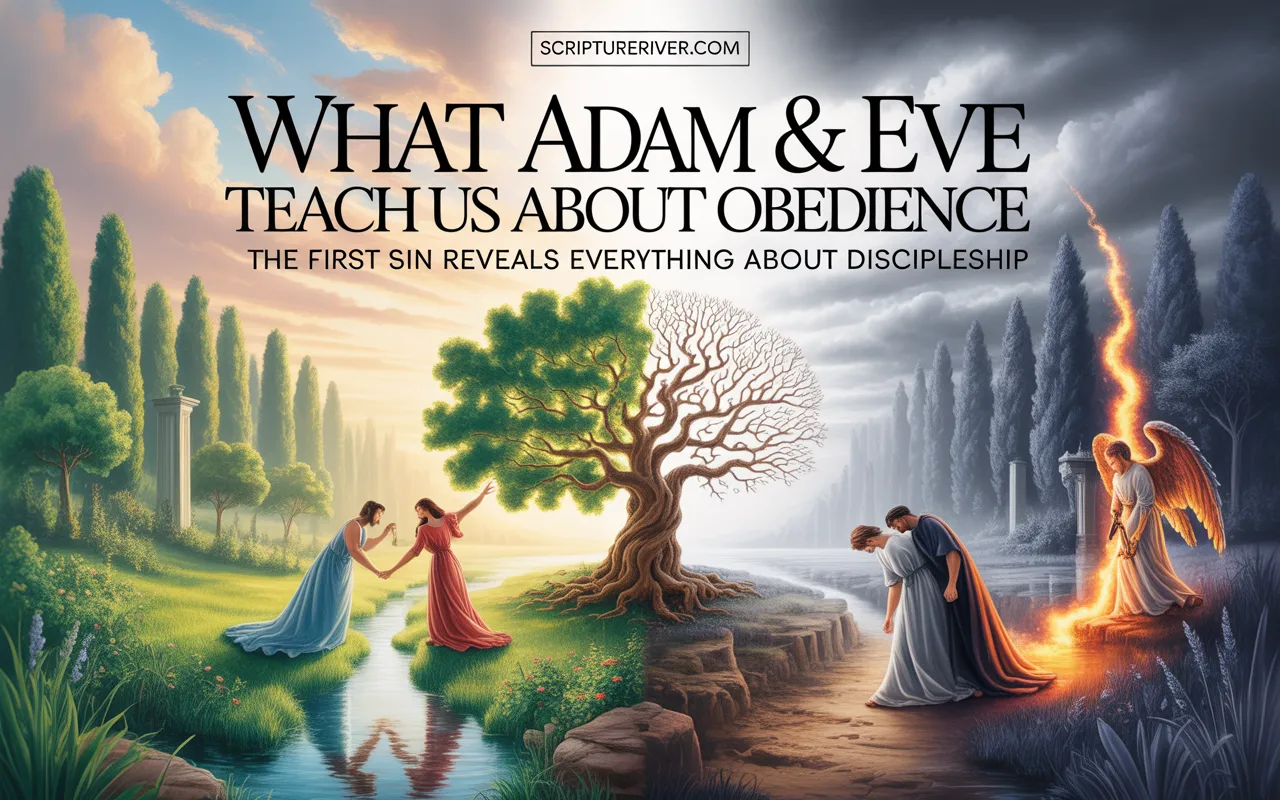
The first command God ever gave humans was the easiest one to obey, and they failed.
Not a complicated theological directive. Not a demanding moral requirement that pushed the limits of human capability.
A simple boundary: don’t eat from one specific tree in a garden full of other trees they could freely enjoy.
Genesis 2:16-17, English Standard Version (ESV)
“And the Lord God commanded the man, saying, ‘You may surely eat of every tree of the garden, but of the tree of the knowledge of good and evil you shall not eat, for in the day that you eat of it you shall surely die.'”
God gave Adam and Eve everything they needed, one boundary they couldn’t cross, and complete freedom within that boundary.
They had unbroken fellowship with God, a perfect environment, meaningful work, companionship with each other, and access to the tree of life that would have sustained them eternally.
Then they chose the one thing God said no to.
That decision in Eden reveals everything we need to understand about obedience, discipleship, and why following God is simultaneously simple and impossibly difficult.
Adam and Eve’s story isn’t ancient history with no modern application.
It’s the template that explains every spiritual struggle you face and every lesson you need to learn about what it means to follow God.
What Happened in the Garden
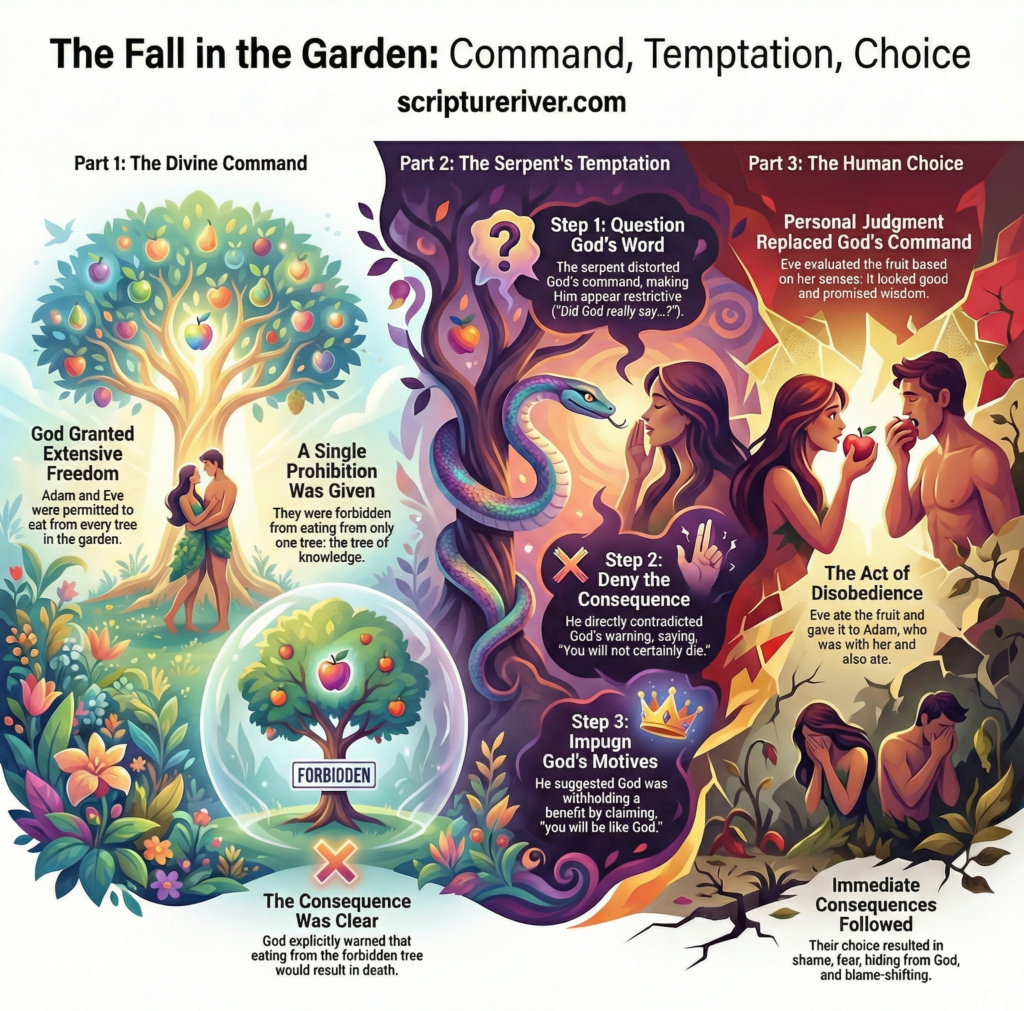
Understanding the Fall requires examining what God commanded, what Satan tempted, and what Adam and Eve chose.
The Command and the Freedom
God placed Adam in Eden “to work it and keep it” (Genesis 2:15). Work existed before sin. Labor wasn’t a curse but a calling. Adam had a meaningful purpose caring for creation.
God gave extensive freedom: “You may surely eat of every tree of the garden” (Genesis 2:16). Emphasis on permission, not restriction. Everything except one tree was available.
Then came the single prohibition: “but of the tree of the knowledge of good and evil you shall not eat” (Genesis 2:17). One boundary. One test of trust and obedience.
According to Old Testament scholar Gordon Wenham’s commentary on Genesis, the tree’s name suggests it represents God’s prerogative to determine what’s good and evil.
Eating from it meant claiming moral autonomy independent from God.
The Temptation’s Strategy
Genesis 3:1, Christian Standard Bible (CSB)
“Now the serpent was the most cunning of all the wild animals that the Lord God had made. He said to the woman, ‘Did God really say, “You can’t eat from any tree in the garden”?'”
Satan’s first move was questioning whether God actually said what He said.
“Did God really say?” plants doubt about whether we heard correctly or whether God meant what He said.
The question also distorted God’s command.
God said they could eat from every tree except one. Satan reframed it as “you can’t eat from any tree,” making God seem restrictive rather than generous.
Genesis 3:4-5, New International Version (NIV)
“‘You will not certainly die,’ the serpent said to the woman. ‘For God knows that when you eat from it your eyes will be opened, and you will be like God, knowing good and evil.'”
Satan’s second move was denying God’s consequence. “You will not certainly die” directly contradicted God’s explicit warning.
His third move was suggesting God was withholding something good from them. “You will be like God” implied their current state was deficient and God was selfishly keeping them from improvement.
The Choice and Its Consequences
Genesis 3:6, English Standard Version (ESV)
“So when the woman saw that the tree was good for food, and that it was a delight to the eyes, and that the tree was to be desired to make one wise, she took of its fruit and ate, and she also gave some to her husband who was with her, and he ate.”
Eve evaluated the forbidden fruit by her own assessment rather than God’s command.
It looked good. It appeared desirable. It promised wisdom. Her feelings and reasoning replaced God’s explicit instruction.
Adam, who was present during the temptation, said nothing to stop her and joined her in disobedience.
The immediate consequences were shame, fear, hiding from God, blame-shifting, and expulsion from Eden.
The long-term consequences affected all humanity: death, pain, difficulty in work, relational conflict, and separation from God.
4 Lessons About Obedience
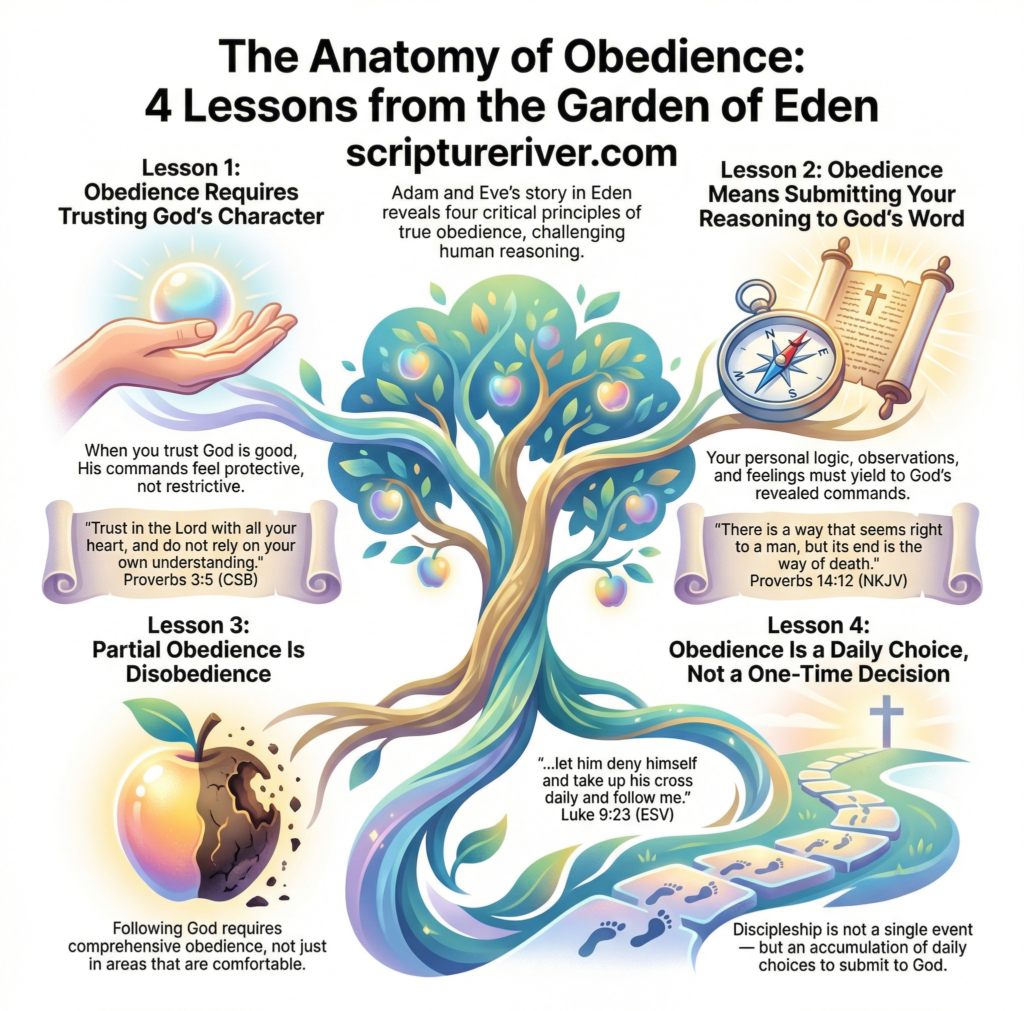
Adam and Eve’s failure teaches critical truths about what obedience requires and why it’s difficult.
Lesson 1: Obedience Requires Trusting God’s Character
Eve’s disobedience began with doubting whether God was truly good and truthful. If she’d trusted that God’s command protected her and His prohibition served her best interests, she wouldn’t have been vulnerable to Satan’s lies.
Proverbs 3:5-6, Christian Standard Bible (CSB)
“Trust in the Lord with all your heart, and do not rely on your own understanding; in all your ways know him, and he will make your paths straight.”
Obedience flows from trust. When you don’t trust God’s goodness, His commands feel restrictive. When you trust He wants what’s best for you, His boundaries feel protective.
Lesson 2: Obedience Means Submitting Your Reasoning to God’s Word
Eve reasoned that the fruit was good for food, pleasant to eyes, and desirable for wisdom. Her reasoning was logical given what she observed. But her reasoning contradicted God’s explicit command.
Christian obedience requires submitting our logic, feelings, and assessments to God’s revealed truth in Scripture. What seems right to us isn’t the standard. What God says is right becomes the standard.
Proverbs 14:12, New King James Version (NKJV)
“There is a way that seems right to a man, but its end is the way of death.”
Lesson 3: Partial Obedience Is Disobedience
Adam and Eve obeyed God in countless ways. They cultivated the garden. They named animals. They enjoyed creation. But disobedience in one area negated all the obedience in other areas.
You can’t selectively obey God only in comfortable areas while ignoring commands that cost you something. Biblical discipleship requires comprehensive obedience to all of Scripture, not just favorite parts.
Lesson 4: Obedience Is Daily Choice, Not One-Time Decision
Adam and Eve started in perfect obedience. They didn’t begin rebellious. At some point, they chose disobedience despite having chosen obedience previously.
Following God requires continual choosing. You can’t coast on yesterday’s obedience. Every day presents new opportunities to trust God or trust yourself, to obey or rebel.
Luke 9:23, English Standard Version (ESV)
“And he said to all, ‘If anyone would come after me, let him deny himself and take up his cross daily and follow me.'”
Jesus commands daily cross-bearing. Discipleship isn’t one dramatic decision but accumulated daily choices to submit to God’s authority.
5 Lessons About Discipleship
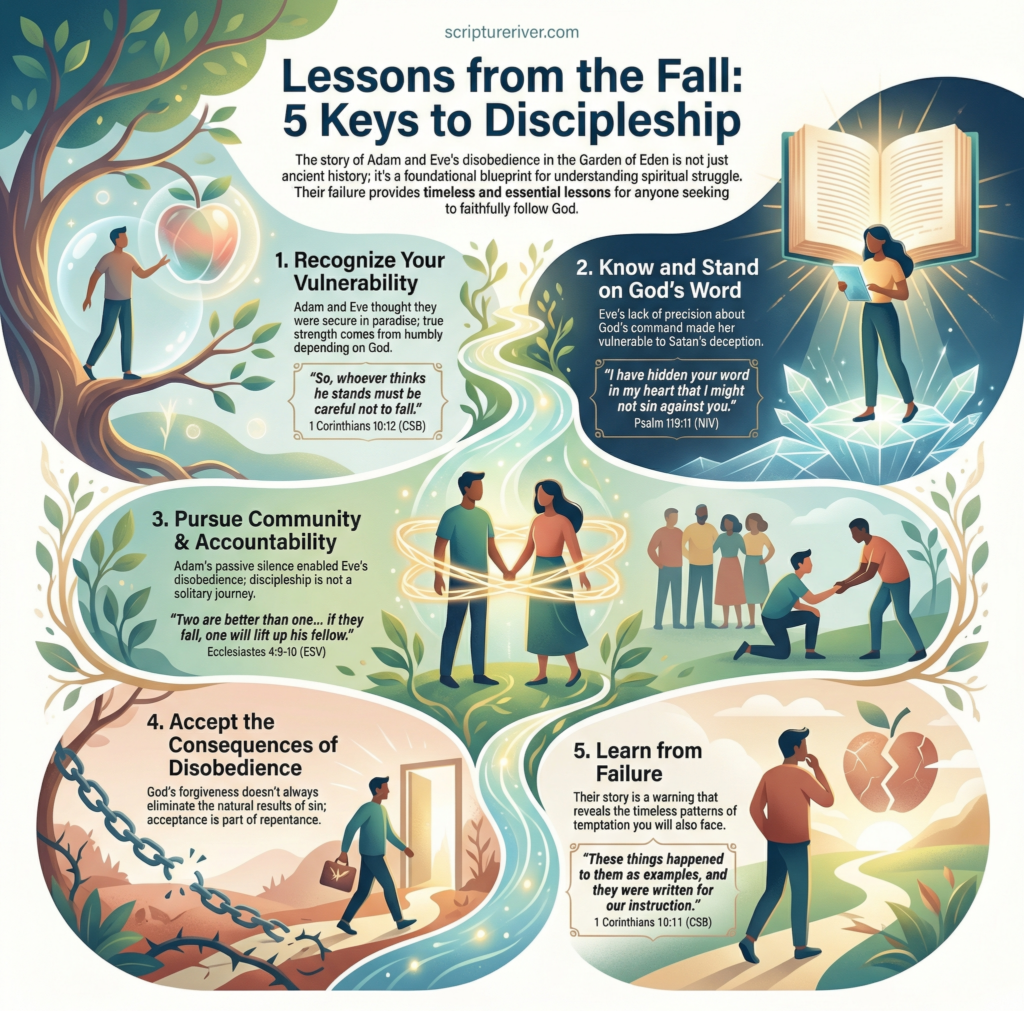
Discipleship is learning to follow Jesus as Adam and Eve failed to follow God. Their story provides essential instruction for anyone attempting to walk with God.
Lesson 1: Discipleship Requires Recognizing Your Vulnerability
Adam and Eve didn’t think they were vulnerable to temptation. They lived in paradise with God. What could go wrong?
Everything, as it turned out. The moment they thought they were beyond temptation was the moment they fell to it.
1 Corinthians 10:12, Christian Standard Bible (CSB)
“So, whoever thinks he stands must be careful not to fall.”
Disciples who assume they’re beyond certain temptations set themselves up for spectacular failure. Humility about your vulnerability keeps you dependent on God’s strength.
Lesson 2: Discipleship Requires Knowing and Standing on God’s Word
Eve’s lack of precision about God’s command made her vulnerable. When Satan questioned what God said, she couldn’t respond with confidence because she hadn’t internalized God’s exact words.
Psalm 119:11, New International Version (NIV)
“I have hidden your word in my heart that I might not sin against you.”
Disciples need Scripture memorized, understood, and ready for deployment when temptation comes. You can’t stand on truth you don’t know.
Lesson 3: Discipleship Requires Community and Accountability
Adam stood silently while Eve was deceived. He failed to protect, correct, or intervene. His presence without engagement enabled her disobedience.
According to family systems researcher John Gottman’s work on relationships, passive presence without active engagement in critical moments damages relationships as severely as direct conflict.
Christian discipleship isn’t solitary. We need people who will speak truth when we’re deceived, challenge us when we’re rationalizing sin, and stand with us against temptation.
Ecclesiastes 4:9-10, English Standard Version (ESV)
“Two are better than one, because they have a good reward for their toil. For if they fall, one will lift up his fellow. But woe to him who is alone when he falls and has not another to lift him up!”
Lesson 4: Discipleship Requires Accepting Consequences of Disobedience
Adam and Eve faced real consequences for their sin. Expulsion from Eden. Pain. Death. Broken relationship with God.
God didn’t remove those consequences. He provided redemption through promised offspring who would crush the serpent (Genesis 3:15), but He didn’t eliminate earthly results of their choice.
Disciples must accept that disobedience carries consequences. Forgiveness doesn’t automatically eliminate natural results of sin. Accepting those consequences with humility is part of repentance.
Lesson 5: Discipleship Means Learning from Failure
Adam and Eve’s failure teaches what not to do. Their story provides warning, not just history. Every temptation you face follows similar pattern: questioning God’s word, denying consequences, suggesting God is withholding good things.
1 Corinthians 10:11-12, Christian Standard Bible (CSB)
“These things happened to them as examples, and they were written for our instruction, on whom the ends of the ages have come. So, whoever thinks he stands must be careful not to fall.”
The Redemption That Adam and Eve Needed
Adam and Eve’s disobedience created problem they couldn’t solve. They needed outside intervention, which God provided through Christ.
The Second Adam
Romans 5:19, English Standard Version (ESV)
“For as by the one man’s disobedience the many were made sinners, so by the one man’s obedience the many will be made righteous.”
Paul contrasts Adam’s disobedience with Christ’s obedience. Where Adam failed the test of obedience in paradise, Jesus succeeded in the wilderness, in Gethsemane, and on the cross.
Jesus is the Second Adam who obeyed perfectly where the first Adam failed catastrophically. His obedience provides righteousness that covers our disobedience when we trust Him.
The Gospel That Makes Discipleship Possible
Adam and Eve show us we can’t obey perfectly. Our track record demonstrates that given freedom and one boundary, we’ll cross it.
That’s why discipleship depends on gospel, not willpower. You’re not trying to earn right standing with God through obedience. You’re obeying out of gratitude for right standing already secured through Christ’s obedience.
Titus 2:11-12, Christian Standard Bible (CSB)
“For the grace of God has appeared, bringing salvation for all people, instructing us to deny godlessness and worldly lusts and to live in a sensible, righteous, and godly way in the present age.”
Grace doesn’t eliminate obedience. It makes obedience possible by providing both forgiveness for failures and power to grow.
Frequently Asked Questions
Were Adam and Eve the only humans according to the Bible?
Yes, according to biblical text. Genesis 1:27-28 describes God creating humanity as male and female, then Genesis 2:7, 21-22 details Adam’s creation from dust and Eve’s creation from Adam’s rib. Genesis 3:20 states “Adam named his wife Eve, because she would become the mother of all the living.” This indicates all humanity descended from them. When Cain feared others would kill him (Genesis 4:14), these were likely his siblings or their descendants, as Adam and Eve had many children (Genesis 5:4). The biblical genealogies trace all people back to Adam and Eve.
Why did God put the forbidden tree in the garden if He knew they’d fail?
God created humans with genuine free will to choose obedience or rebellion. Without real choice, obedience would be programming, not love. The tree’s presence allowed authentic relationship based on chosen trust rather than forced compliance. God knew they’d fail, but He also planned redemption through Christ before creation (Ephesians 1:4).
Was it unfair that everyone suffers because of Adam’s sin?
Paul addresses this in Romans 5:12-21. Adam represented humanity as our head, so his disobedience affected all his descendants. This seems unfair until you recognize Christ also represented believers as our head, so His obedience benefits all who trust Him. If we object to inheriting Adam’s guilt, we must also reject receiving Christ’s righteousness, which we didn’t earn.
Why did God make the test so simple if the consequences were so severe?
The simplicity made the test about pure trust and obedience, not ability or understanding. Complex commands could be failed through ignorance or inability. The simple command revealed heart issues. Would they trust God’s goodness enough to obey when His prohibition didn’t make complete sense to them?
Did Eve sin more than Adam since she ate first?
No. Romans 5:12-19 attributes the fall to Adam repeatedly. While Eve was deceived, Adam sinned with full knowledge. As head of humanity and Eve’s husband, Adam bore primary responsibility for their joint rebellion. Both sinned, both faced consequences, but Scripture places theological weight on Adam’s choice.
How does the Adam and Eve story apply to Christians today?
Their story reveals universal human tendency to doubt God’s goodness, trust our own reasoning over His Word, and choose autonomy over obedience. Every sin you commit follows their pattern. Every temptation uses Satan’s same strategies. Their failure shows why you need Christ’s righteousness, and their consequences warn what disobedience costs.
Prayer for Obedient Discipleship
Father, Adam and Eve’s story exposes my own heart. I doubt Your goodness when Your commands conflict with my desires. I trust my reasoning over Your Word. I want autonomy more than I want obedience. Forgive me for following their pattern of rebellion. Thank You that where Adam failed, Christ succeeded. Thank You that His obedience covers my disobedience when I trust Him. Help me learn from Adam and Eve’s failure. Give me humility to recognize my vulnerability to temptation. Help me know Your Word so thoroughly that I recognize lies when they come. Surround me with people who will challenge me when I’m deceived. Give me grace to accept consequences when I disobey while clinging to Your forgiveness. Make me an obedient disciple who trusts Your character enough to submit to Your commands even when I don’t fully understand them. In Jesus’s Name, Amen.
Referenced Works
Gottman, J. M., & Silver, N. (1999). The Seven Principles for Making Marriage Work. Crown Publishers. [Research-Based Study]
Peterson, E. H. (2005). The Message: The Bible in Contemporary Language. NavPress. [Bible Translation]
Strong, J. (2010). Strong’s Exhaustive Concordance of the Bible. Hendrickson Publishers. [Reference Book]
Wenham, G. J. (1987). Genesis 1-15. Thomas Nelson Publishers. [Biblical Commentary]

