
Three words changed everything.
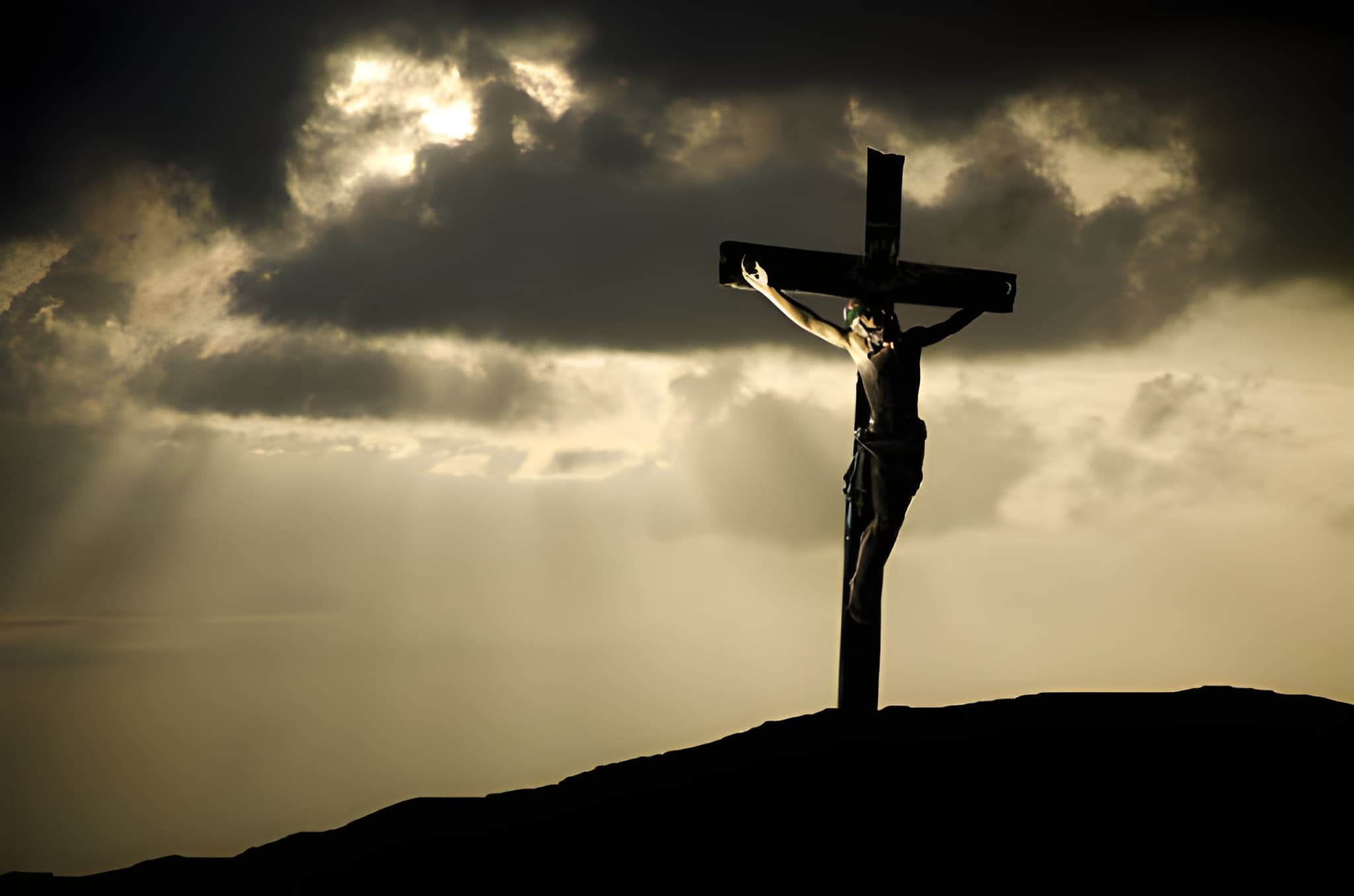
Jesus hung on a Roman cross for six excruciating hours.
His body was broken. His strength was gone. He’d been whipped, beaten, mocked, and nailed to wood.
In His final conscious moment before death, He spoke one sentence that has echoed through two thousand years of Christian history.
John 19:30, English Standard Version (ESV)
“When Jesus had received the sour wine, he said, ‘It is finished,’ and he bowed his head and gave up his spirit.”
In English, “it is finished” sounds like resignation. Like someone giving up. Like defeat.
But the Greek word Jesus spoke carries profoundly different meaning. That single word “tetelestai” declared something so theologically massive that understanding it correctly determines whether you grasp the gospel at all.
What did Jesus mean when He said “it is finished”?
Was He announcing His death?
Declaring victory?
Confirming a transaction?
The answer matters more than almost any other interpretive question in Scripture.
The Greek Word That Changes Everything
Jesus spoke Aramaic daily, but the Gospel of John was written in Greek.
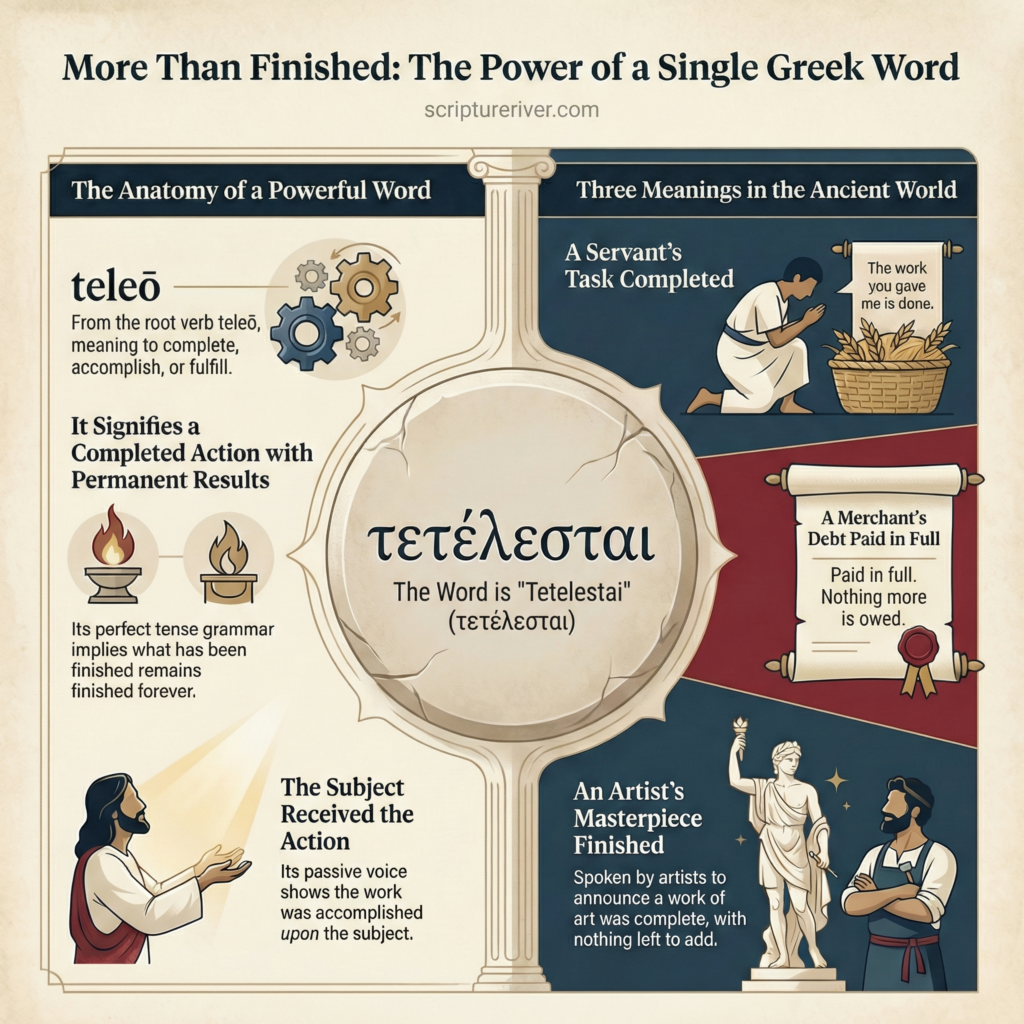
The word John recorded is “tetelestai” (τετέλεσται), the perfect passive indicative form of the verb “teleō.”
What Tetelestai Means Grammatically
According to Greek lexicographer William Mounce’s analysis, “teleō” means to bring to an end, to complete, to accomplish, to fulfill.
The perfect tense indicates a completed action with ongoing results.
The passive voice indicates the subject received the action rather than performing it.
So “tetelestai” literally means “it has been finished” or “it stands completed,” with the implication that what’s been finished remains finished permanently.
How Tetelestai Was Used in First-Century Greek
New Testament scholar Leon Morris documents three primary ways ancient Greeks used “tetelestai” that illuminate what Jesus meant:
Servants would say it when completing assigned tasks. “The work you gave me is tetelestai.” Task completed. Duty fulfilled.
Merchants would write it on receipts when debts were fully paid. “Tetelestai” stamped on a bill meant “paid in full.” Nothing more owed.
Artists would say it when finishing a masterpiece. The painting, sculpture, or work was complete. Nothing left to add.
All three uses share a common theme: something required has been fully accomplished. The task is done. The debt is paid. The work is complete.
What Jesus Declared Finished
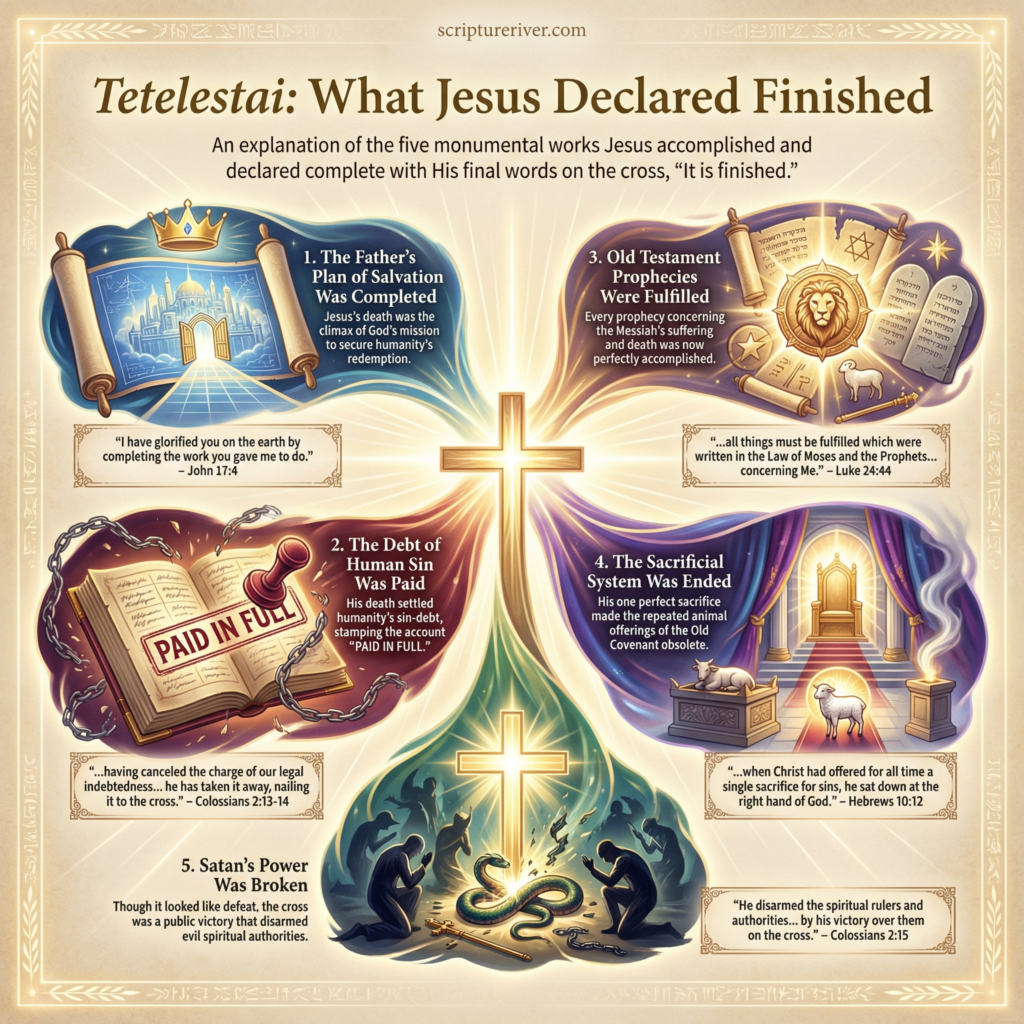
When Jesus said “tetelestai,” He wasn’t just acknowledging His life was ending. He was declaring specific things were now accomplished.
1. The Father’s Plan of Salvation Was Completed
John 17:4, Christian Standard Bible (CSB)
“I have glorified you on the earth by completing the work you gave me to do.”
Jesus came to earth with a mission: accomplish humanity’s redemption.
Every step of His life moved toward the cross. His crucifixion wasn’t a tragic accident or defeat. It was the climax of God’s predetermined plan.
When Jesus said “tetelestai,” He declared that the work the Father sent Him to do was fully accomplished. The mission was complete. Salvation was secured.
2. The Debt of Human Sin Was Paid
Colossians 2:13-14, New International Version (NIV)
“When you were dead in your sins and in the uncircumcision of your flesh, God made you alive with Christ. He forgave us all our sins, having canceled the charge of our legal indebtedness, which stood against us and condemned us; he has taken it away, nailing it to the cross.”
Humanity’s sin created a debt we couldn’t pay. The wages of sin is death, according to Romans 6:23. Someone had to die to satisfy justice.
Jesus’s death paid that debt in full. “Tetelestai” was God’s receipt stamped “PAID IN FULL” across humanity’s sin debt.
Nothing more needs paying. The account is settled.
3. Old Testament Prophecies Were Fulfilled
Luke 24:44, New King James Version (NKJV)
“Then He said to them, ‘These are the words which I spoke to you while I was still with you, that all things must be fulfilled which were written in the Law of Moses and the Prophets and the Psalms concerning Me.'”
Hundreds of Old Testament prophecies pointed toward the Messiah. His birth, life, suffering, death, and resurrection were predicted centuries before they happened.
Jesus’s “tetelestai” declared that every prophecy requiring fulfillment through His death was now complete.
Isaiah 53’s suffering servant. Psalm 22’s pierced hands and feet. Zechariah 12:10’s pierced one. All fulfilled.
4. The Old Covenant Sacrificial System Was Ended
Hebrews 10:10-12, English Standard Version (ESV)
“And by that will we have been sanctified through the offering of the body of Jesus Christ once for all. And every priest stands daily at his service, offering repeatedly the same sacrifices, which can never take away sins. But when Christ had offered for all time a single sacrifice for sins, he sat down at the right hand of God.”
For 1,500 years, Jewish priests offered animal sacrifices daily. Bulls, goats, and lambs were slaughtered to cover sin temporarily.
The sacrifices never actually removed sin. They pointed forward to a better sacrifice coming.
Jesus was that better sacrifice.
His one death accomplished what millions of animal sacrifices couldn’t. “Tetelestai” ended the sacrificial system.
No more offerings needed. The perfect sacrifice was complete.
5. Satan’s Power Was Broken
Colossians 2:15, New Living Translation (NLT)
“In this way, he disarmed the spiritual rulers and authorities. He shamed them publicly by his victory over them on the cross.”
Satan’s power over humanity came through sin and death.
He held people captive through fear of judgment. Jesus’s death and resurrection broke that power.
“Tetelestai” was Jesus’s declaration of victory. Though it looked like defeat to observers, the cross was where Jesus decisively defeated evil, disarmed spiritual enemies, and secured ultimate triumph.
What “It Is Finished” Means for Salvation
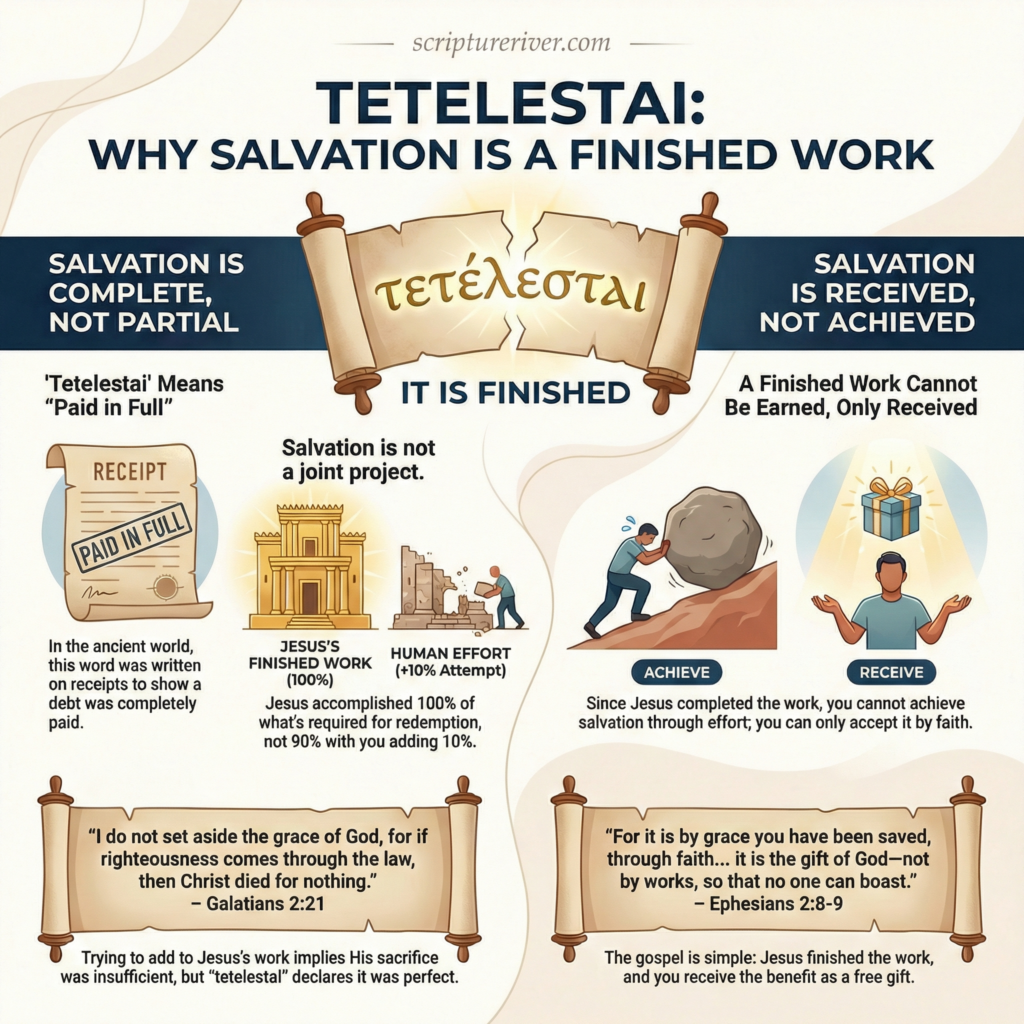
Understanding “tetelestai” is essential for understanding how salvation works.
Salvation Is Complete, Not Partial
Jesus didn’t say “it is mostly finished” or “I’ve done my part, now you do yours.” He said “it is finished.” Completely. Totally. Fully.
This means salvation isn’t a joint project where Jesus does 90% and you do 10%. Jesus accomplished 100% of what’s required for your redemption.
Nothing Can Be Added to Jesus’s Work
Galatians 2:21, Christian Standard Bible (CSB)
“I do not set aside the grace of God, for if righteousness comes through the law, then Christ died for nothing.”
If anything could be added to Jesus’s finished work to make salvation more complete, then His death was insufficient.
But “tetelestai” declares His work was fully sufficient.
Your good works don’t add to salvation. Your religious performance doesn’t complete what Jesus started. Your efforts don’t pay remaining debt. It’s finished. Completely finished.
Salvation Is Received, Not Achieved
Since salvation is finished work, you can’t achieve it through effort. You can only receive it through faith.
Ephesians 2:8-9, New International Version (NIV)
“For it is by grace you have been saved, through faith—and this is not from yourselves, it is the gift of God—not by works, so that no one can boast.”
Jesus finished the work. You receive the benefit. That’s the gospel.
What “It Is Finished” Doesn’t Mean
Misunderstanding “tetelestai” creates theological confusion. Here’s what Jesus wasn’t saying.
It Doesn’t Mean Everything About God’s Plan Is Complete
Some aspects of God’s plan remain future. Jesus’s second coming hasn’t happened. Final judgment hasn’t occurred. The new heaven and new earth haven’t been established.
“Tetelestai” specifically refers to the work Jesus came to accomplish through His death. That work is complete. Other aspects of God’s plan continue unfolding.
It Doesn’t Mean Christians Don’t Need to Obey
“It is finished” means your salvation is complete in Christ. It doesn’t mean Christian obedience is optional or unnecessary.
James 2:17, English Standard Version (ESV)
“So also faith by itself, if it does not have works, is dead.”
You’re not saved by works. But saving faith produces obedience.
Jesus finished the work of salvation. Christians respond to that finished work through obedient lives.
It Doesn’t Mean There’s No Ongoing Work in Believers
Philippians 2:12-13, Christian Standard Bible (CSB)
“Therefore, my dear friends, just as you have always obeyed, so now, not only in my presence but even more in my absence, work out your own salvation with fear and trembling. For it is God who is working in you both to will and to work according to his good purpose.”
The work of justification (being declared righteous) is finished. The work of sanctification (becoming holy) is ongoing.
Jesus completed what was needed for your right standing with God. The Holy Spirit continues working to transform you into Christ’s likeness.
The Practical Impact of “It Is Finished”
Understanding what Jesus meant by “tetelestai” should radically affect how you live as a Christian.
It Eliminates Religious Performance
You don’t need to earn God’s acceptance through spiritual performance. Jesus already accomplished everything required. Your identity is secure in His finished work.
This frees you from the exhausting treadmill of trying to be good enough. You already are accepted based on Christ’s finished work, not your ongoing efforts.
It Creates Confident Assurance
When salvation depends on Jesus’s completed work rather than your incomplete work, assurance becomes possible.
1 John 5:13, New King James Version (NKJV)
“These things I have written to you who believe in the name of the Son of God, that you may know that you have eternal life.”
You can know you’re saved because salvation rests on Jesus’s finished work, not your unfinished efforts.
It Motivates Obedience From Gratitude
When you understand Jesus’s finished work saved you completely, obedience flows from gratitude rather than obligation.
You don’t obey to earn salvation. You obey because you’re overwhelmed by what Jesus already accomplished for you.
It Ends Self-Righteousness
Self-righteousness depends on comparing your goodness to others’ badness. When salvation comes through Jesus’s finished work alone, everyone stands on equal ground at the cross.
You’re not better than anyone else. You’re just forgiven by the same Savior who forgives everyone who trusts Him.
Frequently Asked Questions About “It Is Finished”
Did Jesus say “it is finished” in Aramaic or Greek?
Jesus likely spoke Aramaic on the cross, but the Gospel of John, written in Greek, records the phrase as “tetelestai.” We don’t know the exact Aramaic word Jesus used, but John’s Greek translation accurately captures the theological meaning.
Why did Jesus say “it is finished” instead of “I am finished”?
The Greek construction focuses on the work being finished, not merely Jesus’s life ending. “It” refers to the mission, the task, the work the Father sent Him to do. This was a declaration of accomplishment, not just death.
Does “it is finished” prove Jesus died physically?
Yes. John explicitly states Jesus “gave up his spirit” immediately after saying “tetelestai.” Combined with the Roman soldiers’ confirmation of His death and the spear thrust that produced blood and water (John 19:33-34), the text confirms Jesus died physically on the cross.
How does “it is finished” relate to Jesus’s resurrection?
“Tetelestai” declared the work of atonement was complete. The resurrection three days later proved God accepted Jesus’s sacrifice and confirmed Jesus’s victory over death. Both are essential to salvation. The finished work on the cross is validated by the empty tomb.
Can salvation be lost if it’s finished?
This is a theological debate between Christians. Those who believe salvation can be lost argue believers can reject Christ after being saved. Those who believe in eternal security argue Jesus’s finished work secures believers permanently. Both sides agree Jesus accomplished salvation fully on the cross. They disagree about whether believers can walk away from what Jesus finished.
What should I do with the truth that “it is finished”?
Trust it. Rest in it. Let it free you from religious performance. Thank Jesus for accomplishing what you never could. Live in grateful response to His finished work. Share this good news with others who don’t yet know salvation is complete in Christ.
Prayer of Gratitude for Finished Work
Jesus, thank You for declaring “it is finished” from the cross. Thank You that salvation doesn’t depend on my incomplete efforts but on Your completed work. Thank You for paying my sin debt in full. Thank You for fulfilling every prophecy. Thank You for ending the sacrificial system with Your perfect sacrifice. Thank You for defeating Satan’s power. Help me rest in Your finished work instead of trying to add to it. Free me from religious performance and self-righteousness. Give me confidence that my salvation is secure in what You accomplished. And fill me with gratitude that motivates joyful obedience. It truly is finished. Amen.
Sources Consulted
Carson, D. A. (1991). The Gospel According to John. Eerdmans Publishing Company. [Book]
Köstenberger, A. J. (2004). John. Baker Academic. [Book]
Morris, L. (1995). The Gospel According to John. Eerdmans Publishing Company. [Book]
Mounce, W. D. (2006). Mounce’s Complete Expository Dictionary of Old and New Testament Words. Zondervan. [Reference Book]
Peterson, E. H. (2005). The Message: The Bible in Contemporary Language. NavPress. [Bible Translation]
Strong, J. (2010). Strong’s Exhaustive Concordance of the Bible. Hendrickson Publishers. [Reference Book]
Wiersbe, W. W. (2007). The Bible Exposition Commentary: New Testament (Vol. 1). David C. Cook. [Book]

